
Choosing a new smartphone in 2024 isn’t just about brand loyalty—it’s about real-world performance, longevity, and whether the price tag matches the payoff. The iPhone 15 and Motorola’s latest flagship, likely the Edge 40 Pro or Moto X40 depending on region, represent two very different philosophies. Apple delivers refinement, ecosystem integration, and long-term software support. Motorola offers aggressive pricing, near-stock Android, and hardware that punches above its weight. But which one deserves your upgrade?
Design and Build: Premium vs Practical
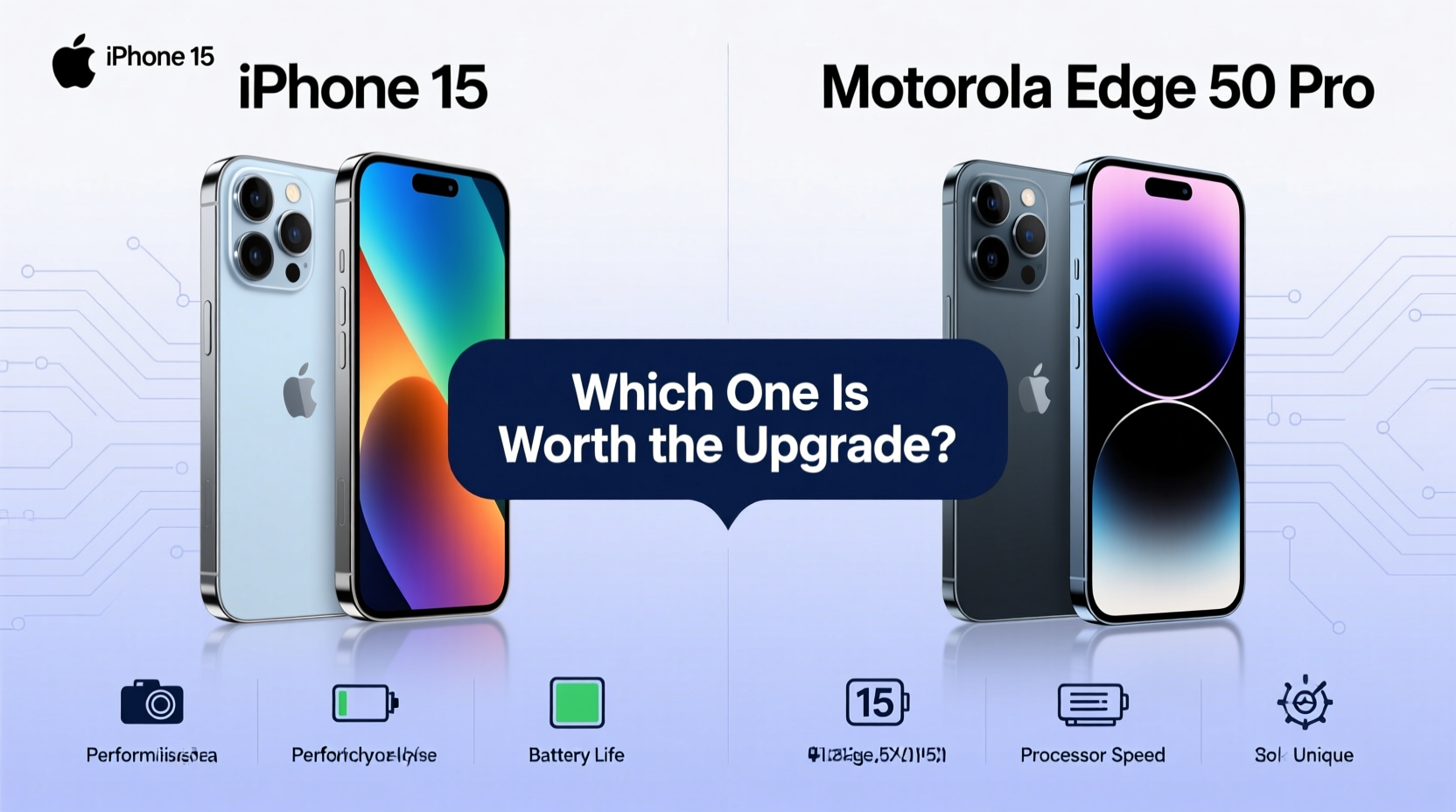
The iPhone 15 continues Apple’s tradition of minimalist elegance. With an aerospace-grade aluminum frame, Ceramic Shield front glass, and an IP68 rating, it feels solid in hand. The Dynamic Island—Apple’s pill-shaped interactive notch—is now standard across all models, offering glanceable notifications and app integrations. It’s sleek, familiar, and built to last.
Motorola’s approach is more functional. The Edge 40 Pro features a curved pOLED display, vegan leather or glass back options, and an IP68 rating as well. While not as polished as Apple’s fit-and-finish, it stands out with bold colors and ergonomic curves. Motorola has also retained the iconic power button fingerprint sensor, which many users find faster than Face ID in certain situations—like when wearing masks or lying in bed.
Performance: iOS Optimization vs Raw Power
The iPhone 15 runs on the A16 Bionic chip—a holdover from the iPhone 14 Pro, but still faster than any Android chip in real-world tasks. Paired with iOS 17, it delivers buttery-smooth animations, instant app launches, and exceptional thermal management. Games like Resident Evil Village run at console-like settings thanks to Apple’s tight hardware-software integration.
Motorola’s top-tier models use the Qualcomm Snapdragon 8 Gen 2 (or newer), which is powerful on paper. In benchmarks, it may even surpass the A16 in multi-core scores. But Android fragmentation and heavier skins can dull the experience. Motorola uses a near-stock version of Android, which helps, but background processes and inconsistent updates can lead to slowdowns over time.
“Apple’s silicon advantage isn’t just speed—it’s sustained performance and efficiency. That matters for long-term ownership.” — David Kim, Mobile Hardware Analyst at TechPulse Insights
Camera Comparison: Consistency vs Versatility
The iPhone 15 features a 48MP main sensor with pixel binning, delivering sharp, true-to-life photos in most conditions. Its computational photography excels in dynamic range and color accuracy. The new 2x telephoto option (via sensor cropping) is useful for portraits, though not a true optical zoom. Night mode is fast and reliable.
Motorola counters with triple-lens setups—typically a 50MP main, 50MP ultrawide, and 12MP telephoto. On paper, this looks superior. In practice, photos can appear oversharpened or overly saturated. Low-light performance is decent but inconsistent. However, Motorola supports lossless zoom up to 3x and includes unique features like Ready For desktop mode, which turns your phone into a PC interface when connected to a monitor.
| Feature | iPhone 15 | Motorola (Edge 40 Pro) |
|---|---|---|
| Main Sensor | 48MP (f/1.6) | 50MP (f/1.8) |
| Ultrawide | 12MP (f/2.4) | 50MP (f/2.0) |
| Telephoto | Digital 2x | 12MP (2.6x optical) |
| Video Recording | 4K@60fps, Dolby Vision | 4K@60fps, no native Dolby |
| Low-Light Performance | Excellent | Good |
Battery Life and Charging: Real-World Endurance
The iPhone 15 lasts a full day with moderate use—around 10–12 hours of screen time. It supports 20W wired charging (0–50% in 30 minutes) and MagSafe wireless. No USB-C fast charging beyond that, and no charger in the box.
Motorola typically packs larger batteries—5100mAh vs. iPhone’s 3349mAh. This translates to 1.5 days of light use. More importantly, Motorola supports 125W Hyper-Charging in select regions (0–100% in under 20 minutes). Even in global versions, 68W charging is standard. Wireless charging is included, but slower than MagSafe.
Software and Updates: The Long Game
This is where Apple dominates. The iPhone 15 will receive iOS updates for at least five years—possibly six or seven. Security patches arrive monthly. Apps stay compatible longer. Resale value remains high.
Motorola promises three OS upgrades and four years of security patches—solid by Android standards, but not industry-leading. Google Pixel and Samsung Galaxy devices offer seven years. Some users report delayed updates, especially in carrier-locked markets. Near-stock Android means fewer bloatware issues, but less post-purchase innovation compared to Apple’s annual iOS leaps.
Mini Case Study: Sarah’s Upgrade Dilemma
Sarah, a freelance photographer in Chicago, used a four-year-old iPhone XR. She considered both the iPhone 15 and Motorola Edge 40 Pro. She needed strong video capabilities, long battery life, and fast file transfers. She ultimately chose the iPhone 15 because her entire workflow—editing on iPad, syncing with MacBook, using iCloud—relies on Apple’s ecosystem. “The Motorola had better specs,” she said, “but I’d lose too much seamless integration.”
In contrast, Raj, a student in Singapore, upgraded from a budget Android phone. He wanted a large screen, fast charging, and good cameras without breaking the bank. He picked the Motorola for its 125W charging and vibrant display. “I don’t own other Apple devices, so the ecosystem doesn’t matter to me. For $300 less, I get similar performance.”
Price and Value: What You’re Really Paying For
The iPhone 15 starts at $799. There are no meaningful discounts. Accessories like cases and chargers add $50–$100. Over five years, that’s a significant investment.
Motorola flagships start around $549–$699, often dropping to $499 during sales. You get comparable processing power, better charging, and more storage options. For users outside the Apple ecosystem, this represents far better value.
- Choose iPhone 15 if: You own other Apple devices, value long-term software support, prioritize photo consistency, and prefer a refined user experience.
- Choose Motorola if: You want faster charging, lower upfront cost, stock Android, and don’t rely on iCloud, AirDrop, or Continuity.
Checklist: Is This Upgrade Right for You?
- Are you upgrading from a phone older than 3 years? → Both are improvements.
- Do you use multiple Apple devices daily? → iPhone 15 enhances synergy.
- Is fast charging a priority? → Motorola wins decisively.
- Do you keep phones for 4+ years? → iPhone’s update policy is safer.
- Is your budget under $600? → Motorola offers better specs per dollar.
- Do you record a lot of video? → iPhone’s Dolby Vision and stabilization are unmatched.
Frequently Asked Questions
Can Motorola phones match iPhone build quality?
Motorola’s flagship builds are solid and IP68-rated, but materials and precision lag behind Apple. The iPhone feels more premium in daily handling and long-term durability.
Is the iPhone 15 camera better than Motorola’s?
Yes, in real-world use. While Motorola has higher megapixel counts, Apple’s image processing produces more natural colors, better dynamic range, and superior low-light results. Video quality is also significantly better on the iPhone.
Will Motorola get iOS-level software updates?
No. Three OS updates are standard, compared to Apple’s five or more. Security patches may also arrive later. If long-term reliability matters, iPhone is the safer bet.
Final Verdict: Who Should Upgrade—and Why
If you're already in the Apple ecosystem, the iPhone 15 is a logical, future-proof upgrade. It’s not revolutionary, but it refines what works: excellent cameras, long support, and seamless integration. You’re paying for peace of mind as much as hardware.
If you’re on Android—or willing to switch—the Motorola flagship offers remarkable value. For hundreds less, you get flagship performance, class-leading charging speeds, and a clean software experience. It’s ideal for users who prioritize function over brand prestige.
Ultimately, the “worth” of an upgrade depends on your needs. Don’t follow trends. Ask: Does this device solve my current frustrations? Will it last three years without slowing down? Does it fit into my digital life?




 浙公网安备
33010002000092号
浙公网安备
33010002000092号 浙B2-20120091-4
Comments
No comments yet. Why don't you start the discussion?