
When it comes to modern shonen anime, few series have captured global attention like My Hero Academia and Jujutsu Kaisen. Both are products of the post-*Attack on Titan* era—dark, emotionally charged, and unafraid to challenge the traditional hero narrative. While action sequences and world-building play major roles in their popularity, it’s the evolution of their characters that often resonates most deeply with audiences. The real question isn’t just about who fights better or has cooler powers—it’s about who grows more meaningfully. So, when comparing My Hero Academia and Jujutsu Kaisen, which series crafts the more compelling, transformative character arcs?
The answer isn’t straightforward. Each series approaches character development differently—one through gradual, school-based progression; the other through intense psychological trials and existential dread. To truly assess which has “better” arcs, we need to examine depth, realism, emotional payoff, and narrative consistency.
Defining Character Arcs in Shonen Anime
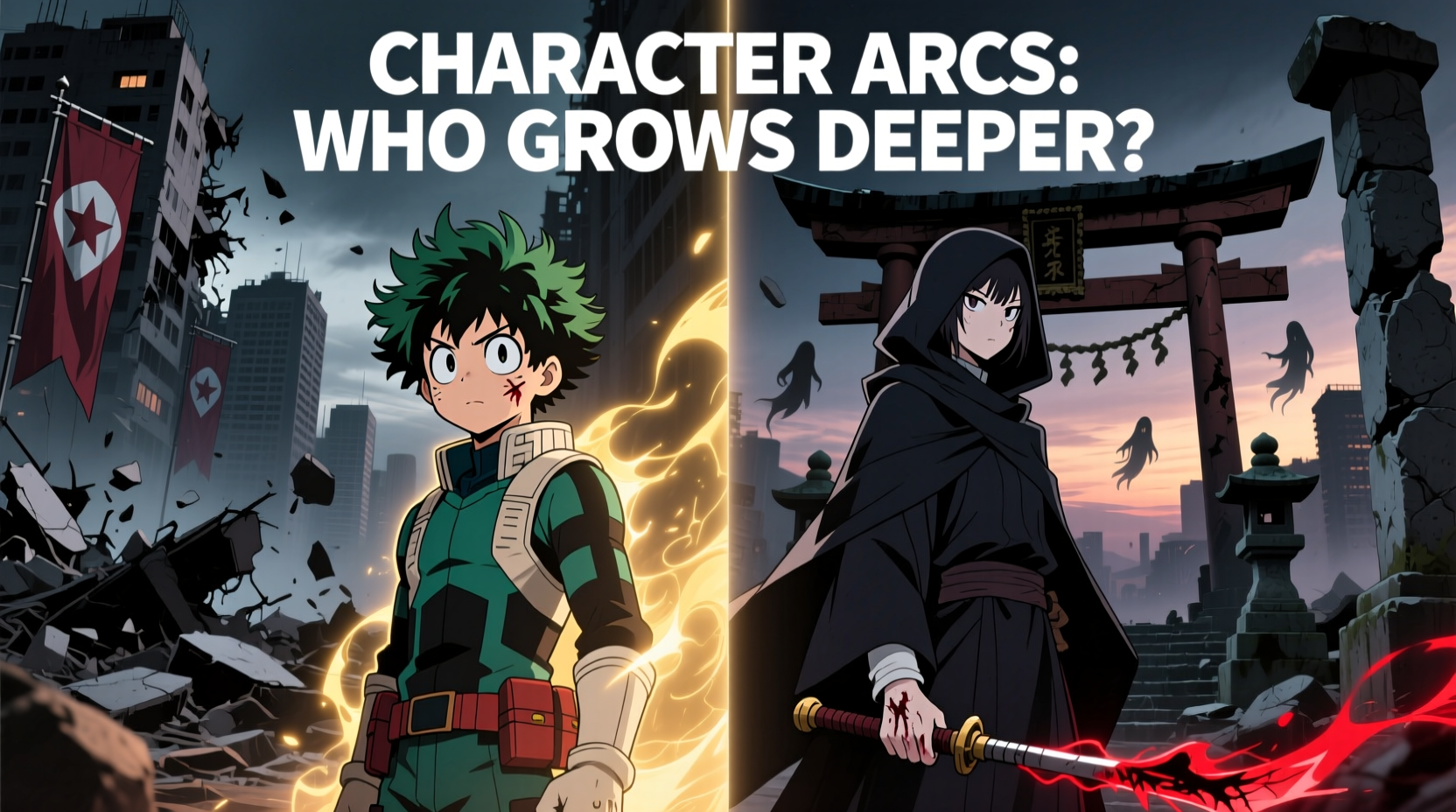
A strong character arc doesn’t just mean a protagonist getting stronger. It means change driven by internal conflict, trauma, moral dilemmas, and self-discovery. In shonen, where power escalation is expected, the best stories balance external battles with internal transformation.
My Hero Academia (MHA), created by Kohei Horikoshi, follows Izuku Midoriya from a powerless fanboy to a legitimate hero-in-training. His journey is aspirational, rooted in perseverance and idealism. On the other hand, Jujutsu Kaisen (JJK), written by Gege Akutami, centers on Yuji Itadori, a boy who inherits a cursed object and must navigate a brutal world where survival often requires sacrificing one’s humanity.
While both protagonists start with noble intentions, their paths diverge sharply in tone and consequence. MHA emphasizes hope and legacy; JJK questions whether heroism can exist in a world built on suffering.
Protagonist Development: Idealism vs. Nihilism
Izuku Midoriya begins as an outcast—bullied for being Quirkless in a society that idolizes superpowers. His arc is defined by resilience. From his first battle against Muscular to facing Shigaraki Tomura and All For One, each fight chips away at his naivety. He learns that saving everyone isn’t always possible, and that heroism demands sacrifice—not just physically, but ethically.
Yet, despite these lessons, Izuku never fully abandons his core belief: that anyone can be a hero with enough effort. This unwavering optimism is both his strength and limitation. Critics argue that his growth is linear—he gets stronger, wiser, and more responsible, but rarely undergoes true ideological crisis. Even after losing limbs and enduring immense pain, his worldview remains intact.
Yuji Itadori, in contrast, experiences a far steeper descent into moral ambiguity. After swallowing Sukuna’s finger to save his friends, Yuji becomes a vessel for evil. His arc forces him to confront what it means to be human while hosting a monster. Unlike Izuku, Yuji’s kindness is constantly tested—not just by enemies, but by allies who see him as a time bomb.
“Yuji’s tragedy isn’t that he might die—it’s that he might lose himself before then.” — Rei Takahashi, Anime Narrative Analyst
His journey is less about becoming a hero and more about retaining his soul. When he kills Hanami during the Shibuya Incident, it’s not a victory—it’s a breaking point. He cries not from triumph, but from the realization that he enjoyed it. That moment marks a turning point: Yuji no longer believes in simple good and evil. He understands that power corrupts, and that compassion may not be enough.
Supporting Cast: Depth and Tragedy
One area where Jujutsu Kaisen consistently outshines My Hero Academia is in the emotional weight given to secondary characters. Take Megumi Fushiguro: raised by a neglectful father, burdened by family shame, and driven by a desire to protect others without recognition. His arc explores identity, duty, and the cost of silence. When he sacrifices himself to trap Sukuna, it’s not just a plot twist—it’s the culmination of a lifetime of feeling invisible.
Similarly, Nobara Kugisaki defies the \"female sidekick\" trope. She enters the story confident, brash, and unapologetically herself. Her death—brutal, sudden, and politically motivated—is a narrative gut punch. But it also serves her arc: she dies asserting her worth, refusing to let a villain define her value. Her final words—\"I’m so happy I was born\"—elevate her from comic relief to tragic heroine.
MHA’s supporting cast, while beloved, often receives less nuanced development. Characters like Ochaco Uraraka and Tenya Iida serve thematic purposes—love interest, moral compass—but rarely face personal crises that reshape them. Bakugo’s redemption arc is compelling, especially in the later seasons, where his arrogance gives way to reluctant respect and vulnerability. However, his growth is tied closely to Izuku, making it reactive rather than organic.
Compare this to JJK’s Gojo Satoru. Charismatic and nearly invincible, Gojo spends much of the series mentoring students and cracking jokes. But his philosophy—that talent should rule, and weak people must accept their fate—is challenged by the unfolding conspiracy. His eventual sealing isn’t just a loss for the team; it’s a failure of ideology. The man who believed he could change the system from within becomes a prisoner of it.
Character Arc Comparison Table
| Character | Series | Type of Growth | Emotional Impact | Narrative Payoff |
|---|---|---|---|---|
| Izuku Midoriya | MHA | Linear progression, idealism refined | High (for fans of underdog stories) | Ongoing, unresolved |
| Yuji Itadori | JJK | Psychological unraveling, moral compromise | Very High | Potentially tragic |
| Bakugo Katsuki | MHA | Redemption through humility | Moderate to High | Partially resolved |
| Megumi Fushiguro | JJK | Identity crisis, self-sacrifice | Very High | Tragic completion |
| Nobara Kugisaki | JJK | Assertion of self-worth | Extremely High | Final and definitive |
| Ochaco Uraraka | MHA | Limited personal struggle | Low to Moderate | Underdeveloped |
Narrative Structure and Pacing of Arcs
The pacing of character development plays a crucial role in how impactful an arc feels. My Hero Academia spans over 300 chapters, allowing slow-burn growth. Izuku’s evolution is methodical: each school term introduces new challenges, mentors, and failures. This structure mirrors real-life learning—incremental, sometimes frustrating, but ultimately rewarding.
However, this extended timeline also leads to stagnation. Some characters remain static for dozens of chapters. Momo Yaoyorozu, for instance, struggles with self-confidence early on but sees little resolution until late arcs. By the time characters mature, audience investment may have waned.
Jujutsu Kaisen, in contrast, operates on compressed timelines. The entire Kyoto Goodwill Event, a pivotal moment for multiple characters, unfolds over just a few chapters. This intensity amplifies emotional stakes. When Panda questions his humanity or Toge Inumaki risks his life using cursed speech, there’s no filler to dilute the impact.
Gege Akutami employs a “trial by fire” approach. Characters aren’t given time to reflect—they’re thrown into life-or-death situations that force immediate decisions. This creates sharper, more dramatic arcs. But it also means less room for subtlety. Nuanced changes happen between the lines, requiring readers to infer internal shifts from minimal dialogue.
Step-by-Step: How to Evaluate a Strong Character Arc
- Identify the character’s starting belief – What do they assume about themselves or the world?
- Map key traumatic or transformative events – Which moments challenge their worldview?
- Analyze their choices post-trauma – Do they adapt, regress, or break?
- Assess consistency – Does their behavior align with their growth?
- Evaluate emotional resonance – Does the arc feel earned, not forced?
Thematic Depth: What Do These Arcs Say About Heroism?
This is where the two series diverge most profoundly. My Hero Academia upholds the classic shonen ideal: hard work beats talent, and heroes inspire society. Even All Might’s decline is framed as a passing of the torch—a generational shift toward a brighter future.
But Jujutsu Kaisen dismantles that myth. It presents a world where curses are born from human negativity, meaning the very existence of evil stems from societal flaws. Heroes don’t fix problems—they manage symptoms. Yuji’s journey isn’t about building a better world; it’s about surviving long enough to ask if one is possible.
In this context, character arcs become philosophical statements. Megumi’s summoning of the Eight-Tailed Buddha isn’t just a power-up—it’s a rejection of his father’s nihilism. Nobara’s defiance in death critiques a system that discards the weak. Even Sukuna, though monstrous, represents unchecked freedom—an anti-hero whose clarity contrasts with the heroes’ confusion.
MHA’s themes are uplifting but increasingly strained. As the series delves into systemic corruption and wartime ethics, Izuku’s unwavering morality starts to feel less like virtue and more like denial. Can a hero truly succeed if he refuses to acknowledge the darkness within?
Mini Case Study: The Death of a Side Character
Consider the death of Fat Gum during the Paranormal Liberation War in MHA. A respected pro hero, he dies protecting civilians from mind-controlled villains. It’s a heroic end, but narratively, it serves mostly as a catalyst for others’ anger. We don’t see his fears, his final thoughts, or how he reconciles with his past. His arc ends abruptly, without closure.
Now consider Kento Nanami. Once a disillusioned salaryman, he returns to jujutsu work seeking purpose. In his final battle, he fights not for glory, but because “it’s his job.” Surrounded and bleeding, he calmly states, “I’ve got things to do tomorrow,” before being decapitated. That line—simple, human, heartbreaking—captures his entire arc. He found meaning not in grand ideals, but in responsibility.
Nanami’s death resonates because his journey was relatable: burnout, return to duty, quiet courage. His arc wasn’t about becoming the strongest—it was about being dependable. And in dying, he embodies the very principle he lived by.
FAQ: Common Questions About Character Arcs in Both Series
Is Bakugo’s character arc complete?
No, but it’s one of the most developed in MHA. From childhood bully to reluctant ally, Bakugo learns to value teamwork and recognize Izuku’s strength. However, his pride remains a flaw, and his ultimate test—accepting equality rather than superiority—has yet to be fully resolved.
Why is Yuji’s arc considered darker than Izuku’s?
Because Yuji is forced to compromise his morals early and often. He kills, enjoys violence, and risks becoming the monster he fights. Unlike Izuku, who is celebrated for his heroics, Yuji is feared and distrusted. His arc questions whether goodness can survive in a cruel world.
Which series gives more agency to its female characters?
Jujutsu Kaisen edges ahead here. Nobara is bold, independent, and central to her own story. Maki Zenin overcomes abuse and familial betrayal to forge her own path. In MHA, female characters like Ochaco and Tsuyu are well-liked but often sidelined in major plot developments, serving more as emotional support than leaders.
Conclusion: Which Has Better Character Arcs?
If measured by emotional depth, thematic complexity, and narrative risk, Jujutsu Kaisen holds the edge. Its characters are shaped by trauma, forced into impossible choices, and often pay the ultimate price. Their arcs feel urgent, fragile, and authentic. The series doesn’t promise happy endings—it promises consequences.
My Hero Academia offers a different kind of strength. Its arcs are inspirational, emphasizing perseverance and the power of will. Izuku’s journey reminds viewers that empathy and effort matter. But as the story grows darker, its reluctance to let go of idealism undermines the gravity of its conflicts.
In the end, “better” depends on what you value in storytelling. If you seek catharsis through tragedy and psychological realism, Jujutsu Kaisen delivers more consistently. If you prefer hopeful transformation and the celebration of human spirit, My Hero Academia remains powerful.
Both series prove that modern shonen can offer more than flashy fights—it can explore what it means to grow, suffer, and still choose to move forward.




 浙公网安备
33010002000092号
浙公网安备
33010002000092号 浙B2-20120091-4
Comments
No comments yet. Why don't you start the discussion?