
For many, the nativity scene is not merely seasonal decoration—it’s a quiet anchor of meaning amid the visual noise of the holidays. Yet in homes defined by clean lines, neutral palettes, and purposeful emptiness, traditional crèches can feel visually dissonant: too ornate, too busy, or awkwardly scaled. The challenge isn’t about removing tradition—it’s about translating reverence into spatial language that respects both faith and aesthetic integrity. Modern minimalism, when practiced thoughtfully, doesn’t reject symbolism; it refines it. This article presents actionable, design-aware strategies for placing a nativity scene that feels at home—not as an afterthought, but as an intentional, serene focal point within a restrained interior.
Why Placement Matters More Than Ever in Minimalist Spaces
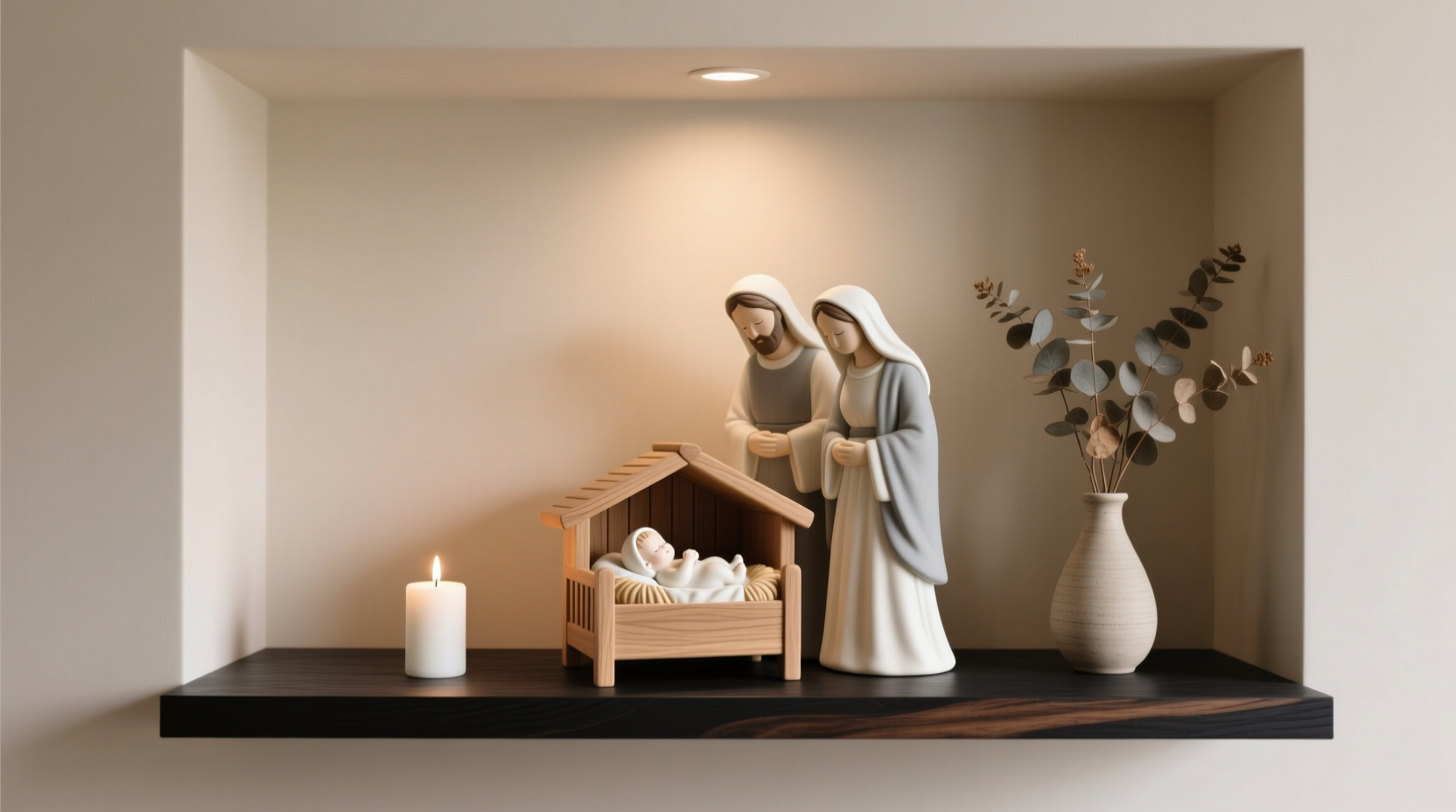
In minimalist environments, every object carries heightened visual weight. A single ceramic vase, a framed line drawing, or even a folded linen napkin communicates intention. Introducing a nativity scene without careful spatial consideration risks undermining the very values the space embodies: clarity, calm, and conscious curation. Unlike maximalist settings where layers absorb visual tension, minimalist rooms amplify contrast—so a mismatched figurine set or haphazard shelf arrangement draws attention not to the story it represents, but to its stylistic intrusion. Interior designer Lena Voss observes: “Minimalism isn’t austerity—it’s precision. When a spiritual object enters that field, its placement must reflect the same level of deliberation as a built-in shelving unit or a custom window treatment.” That precision begins with understanding scale, material harmony, and sightline hierarchy—not just aesthetics, but emotional resonance.
7 Intentional Placement Ideas (with Rationale & Practical Execution)
1. The Floating Shelf Sanctuary
Mount a single, narrow floating shelf—3–4 inches deep, 36–48 inches long—at eye level (approx. 58–62 inches from floor). Use matte black, warm oak, or raw concrete-finish wood. Place only the Holy Family trio (Mary, Joseph, infant Jesus) centered on the shelf. Omit shepherds, animals, and angels. Keep bases flush and unadorned. Add one small, unglazed ceramic bowl containing dried white pampas grass or bleached birch twigs beside the figures—no color, no texture competition, only subtle organic warmth.
2. The Negative Space Niche
Identify a recessed wall niche, architectural alcove, or even a shallow built-in bookshelf bay. Clear all contents except for the nativity. Position the manger low in the niche—centered horizontally, placed 6–8 inches above the sill or base. Let the surrounding emptiness act as a visual frame. Use only monochrome figures: matte white porcelain, stone-gray stoneware, or unbleached linen-wrapped forms. No gold accents, no painted details—only form and silhouette.
3. The Threshold Altar
Position the nativity directly on the floor—on a smooth, untextured surface such as polished concrete, wide-plank white oak, or honed limestone tile. Center it beneath a doorway arch, between two rooms, or at the foot of a staircase landing. Elevate the manger on a single 2-inch-thick slab of travertine or honed basalt (30 × 18 inches), its edges precisely squared. Surround with a 12-inch radius of bare floor—no rug, no runner, no border. This placement treats the threshold not as passage, but as pause: a literal and symbolic crossing point where meaning enters daily life.
4. The Monochrome Mantel Edit
If using a fireplace mantel, remove all other objects. Leave only the nativity—and one additional element: a single pillar candle in a matte black or brushed brass cylinder, placed 12 inches to the right or left of the manger. Choose figures cast in one consistent material: matte black terracotta, raw plaster, or frosted glass. Ensure all bases are identical in height (ideally 1.5 inches) and aligned along a single front plane. No staggered depths. No overlapping silhouettes. The mantel becomes a stage—not for display, but for contemplation.
5. The Wall-Mounted Relief Panel
Commission or source a low-relief nativity carved into a single slab of reclaimed fir, white oak, or brushed steel (18 × 24 inches). Mount it flush to the wall at seated eye level (approx. 48 inches from floor). No frame. No shadow box. The carving should be shallow—no more than 3/8 inch deep—with soft, rounded contours. Finish in natural oil or clear matte sealant only. This transforms narrative into architecture: the story becomes part of the wall itself, legible up close, quietly textural from across the room.
6. The Under-Window Still Life
Place the nativity on a narrow console table positioned directly beneath a large, unadorned window—preferably one with clean, unbroken glass and simple metal or wood framing. Align the manger’s center with the window’s vertical midpoint. Allow natural light to fall evenly across the figures during morning or late afternoon hours. Choose figures in matte white or dove gray with subtle tonal variation (e.g., Mary’s robe slightly cooler, Joseph’s tunic warmer)—no sharp contrasts, no reflective surfaces. Let the changing light become part of the ritual.
7. The Grounded Corner Cluster
In a sparsely furnished corner (e.g., where two white walls meet), place a low, square plinth (16 × 16 × 4 inches) of honed marble or textured plaster. On it, arrange only three elements: the manger, a small unglazed ceramic vessel holding a single sprig of rosemary (symbolizing remembrance), and a smooth river stone wrapped in undyed linen thread. No figures stand upright—instead, use a recumbent Christ child in swaddling cloth, flanked by simplified, seated forms of Mary and Joseph rendered in smoothed clay or cast concrete. Height remains under 6 inches. This cluster reads as a grounded, tactile meditation—not a tableau, but a gathering.
Material & Color Harmony Checklist
Successful integration depends less on where you place the nativity—and more on how its physical presence converses with your existing palette and textures. Use this checklist before purchasing or arranging:
- ✅ All figures share the same finish: matte (never glossy), unvarnished, and non-reflective
- ✅ Base materials match dominant interior textures: e.g., oak figures in an oak-dominant room; stone in a concrete-and-linen space
- ✅ Color palette limited to three tones max: e.g., warm white + charcoal gray + raw linen beige
- ✅ No metallic accents unless they’re brushed brass or unlacquered copper—and used only once, intentionally
- ✅ Figure scale respects room volume: in a 12-foot ceiling space, avoid figures taller than 8 inches
What Not to Do: A Minimalist Nativity Don’ts Table
| Action | Why It Breaks Minimalism | Better Alternative |
|---|---|---|
| Placing the nativity on a crowded bookshelf | Introduces visual competition and hierarchical confusion | Use a dedicated floating shelf or wall-mounted panel |
| Using red/gold fabric backdrops or garlands | Adds chromatic intensity that overwhelms neutral fields | Substitute undyed wool felt or raw silk in heather gray or oatmeal |
| Mixing figure styles (e.g., painted wood + ceramic + resin) | Creates material dissonance and perceived clutter | Select one material family and stick to it—even if sourcing across brands |
| Grouping with other holiday items (stockings, wreaths, lights) | Dilutes focus and introduces competing narratives | Keep nativity separate; let it occupy its own temporal and spatial rhythm |
| Adding artificial snow, glitter, or faux moss | Introduces unnecessary texture and visual noise | Use one natural element only—e.g., a single fallen magnolia leaf or a shard of mica |
Mini Case Study: The Brooklyn Loft Transformation
When architect Maya Chen renovated her 900-square-foot industrial loft—exposed ductwork, poured concrete floors, floor-to-ceiling windows—she struggled to integrate her inherited 1950s Italian olive wood nativity. Its rich grain and hand-carved detail felt jarring against the space’s cool neutrality. Her solution? She commissioned a local woodworker to create a custom wall-mounted oak panel (24 × 36 inches) with recessed channels matching the exact footprint of each figure. She then mounted the original figures *into* the panel—flush, secure, and shadow-free. She painted the panel matte white, leaving only the wood grain visible where the figures sat. For two weeks each December, the nativity was “revealed” not as decoration, but as embedded architecture. Neighbors commented not on the figures—but on the quiet gravity the wall now held. As Maya notes: “It stopped being something I *put on display*, and became something the room *holds*.”
Expert Insight: The Design-Theology Intersection
“The most powerful minimalist nativity isn’t the smallest or the plainest—it’s the one that asks the least of your attention, and gives the most back in stillness. When form is stripped to essence, what remains isn’t absence—it’s invitation.” — Rev. Dr. Samuel Lin, Liturgical Designer & Author of Sacred Space, Simple Form
Step-by-Step: Preparing Your Space for Intentional Placement
- Clear & Assess: Remove all non-essential objects from potential zones (mantel, shelf, corner). Photograph each zone empty. Note sightlines, light paths, and traffic flow.
- Measure Twice: Record exact dimensions of your nativity’s footprint (including base) and height. Compare to candidate surfaces—ensure at least 2x clearance on all sides.
- Test Material Match: Place a sample of your flooring or wall finish next to a figurine. View under both daylight and evening lighting. Adjust material or finish if contrast feels jarring.
- Mock Up Silhouette: Cut cardboard to your nativity’s outline. Tape it to the wall or surface at proposed height. Live with it for 24 hours. Does it feel anchored—or adrift?
- Finalize Context Elements: Select one supporting object (candle, stone, plant) that echoes a material already present in the room—nothing new introduced solely for the nativity.
FAQ
Can I use a digital nativity projection in a minimalist space?
Projection risks undermining the tactile, grounded nature central to nativity symbolism. Light-based solutions often compete with ambient lighting and lack physical presence. If exploring technology, opt instead for a single-frame, high-resolution print on archival paper—mounted flush, unframed, and lit with a focused, warm LED spotlight. Even then, physical objects carry greater resonance in spaces designed for human scale and touch.
What if my nativity set has colorful painted details?
Respect the craftsmanship—but consider reinterpretation. A skilled conservator or ceramicist can carefully matte-seal painted surfaces to reduce reflectivity, or gently tone down saturated hues using diluted, archival-grade mineral pigments. Alternatively, photograph the set in grayscale, then commission a monochrome ceramic replica based on those proportions. The story remains intact—the vessel evolves.
Is it appropriate to rotate placements throughout Advent?
Yes—if done with discipline. Limit rotations to two locations maximum (e.g., mantel Week 1–2, floor niche Week 3–4). Each move must follow the same material and scale rules. Avoid midweek shifts or decorative “re-staging.” Rotation should deepen contemplation—not become logistical theater.
Conclusion
A nativity scene in a minimalist home does not need to whisper to be heard. It needs only to occupy space with unwavering intention—to be placed not where it fits, but where it belongs. These ideas are not about compromise; they’re about distillation. They ask us to consider: What part of this story needs to be seen, felt, remembered—right here, right now? Not the spectacle, but the stillness. Not the abundance, but the arrival. Not the ornament, but the offering. Your space already holds clarity. Your tradition already holds depth. Where those two truths meet—there is where your nativity finds its truest home.




 浙公网安备
33010002000092号
浙公网安备
33010002000092号 浙B2-20120091-4
Comments
No comments yet. Why don't you start the discussion?