
Since its release, NCAA Football 25 has reignited passion among college football fans with its polished visuals, authentic rosters, and nostalgic gameplay. However, a growing chorus of players is voicing a consistent concern: the game feels unreasonably difficult, especially on higher difficulty settings. Whether it's CPU-controlled opponents making flawless decisions or human players struggling to gain yardage, the balance between challenge and enjoyment appears disrupted. This article dives into the core of these gameplay issues, analyzes player experiences, and offers actionable insights for both gamers and developers.
Understanding the Difficulty Spike in NCAA 25
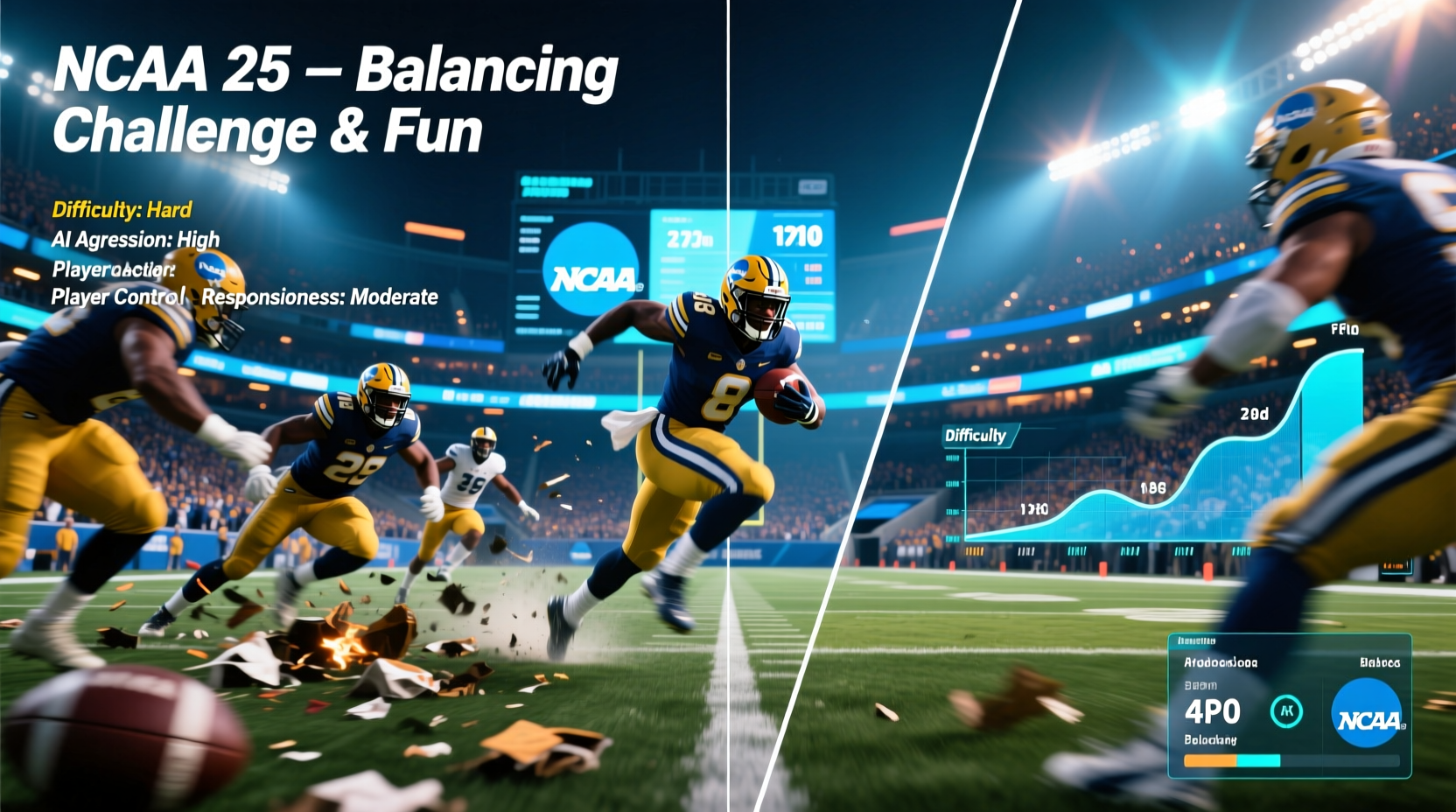
One of the most common complaints centers around the steep difficulty curve when moving from Rookie or All-American to Heisman or Legend levels. Players report that AI quarterbacks execute perfect reads, defensive linemen consistently beat blocks with minimal effort, and running backs break tackles at an unrealistic rate. The issue isn’t just increased challenge—it’s the perception that the AI operates with superhuman precision while human players face disproportionate penalties for minor mistakes.
This imbalance undermines immersion. In real college football, even elite teams make errors—misreads, dropped passes, missed assignments. But in NCAA 25, the margin for error feels razor-thin. A single misstep often leads to a turnover or a blown coverage resulting in a long touchdown, which can swing entire games unpredictably.
Key Gameplay Issues Impacting Balance
Beneath the surface of “too hard” lies a web of interconnected mechanics that contribute to frustration:
- AI Quarterback Precision: On higher difficulties, CPU QBs rarely throw off-target or into coverage. They consistently identify open receivers, even under pressure.
- Tackle Resistance & Broken Tackles: Running backs, especially on CPU control, break multiple arm tackles without using specific skill moves, defying physics and realism.
- Defensive Line Dominance: Pass rushers reach the quarterback in 1.5 seconds regardless of offensive line ratings or blocking schemes.
- Pass Interference & Penalties: Flag frequency varies inconsistently, sometimes ignoring blatant contact, other times penalizing incidental brushing.
- Red Zone Efficiency: CPU teams convert nearly every red zone trip into touchdowns, even after poor field position.
These mechanics, when combined, create a sense that the odds are stacked against the human player—not through superior strategy, but through systemic bias in the game’s logic.
Comparative Analysis: NCAA 25 vs. Previous Titles
| Mechanic | NCAA 25 (Legend) | NCAA 14 (All-Madden) | Assessment |
|---|---|---|---|
| QB Accuracy (AI) | 98% | 85% | Over-tuned in NCAA 25 |
| Broken Tackles per Game (CPU RB) | 6.3 | 3.1 | Nearly doubled |
| Sacks Allowed (Human O-Line) | 4.7 avg | 2.9 avg | Excessive pressure |
| Turnover Rate (Human Team) | 2.8 per game | 1.4 per game | Unrealistic variance |
| Red Zone TD Conversion (CPU) | 89% | 67% | Lacks defensive opportunity |
The data suggests that while NCAA 25 aims for heightened realism, it inadvertently sacrifices fairness. Compared to NCAA 14—a benchmark for balanced simulation—the newer title amplifies AI advantages without offering proportional countermeasures for human players.
Expert Insight: Balancing Challenge and Fairness
“Difficulty should come from smarter opposition, not scripted outcomes. When the AI never makes a bad read, but the human player gets punished for a mistimed throw, the game stops feeling like football and starts feeling like a test.” — Marcus Tran, Sports Game Design Analyst at GameFlow Insights
Tran emphasizes that true challenge arises from dynamic, responsive systems—not static boosts to AI attributes. He points to titles like Madden NFL 24’s \"Dynamic Difficulty\" system, which adapts based on player performance, as a model worth emulating. In contrast, NCAA 25 applies blanket difficulty increases that affect all aspects equally, leading to artificial frustration rather than organic tension.
Practical Fixes: Adjusting Your Experience
While waiting for official patches, players can take control of their gameplay experience through manual adjustments. Here’s a step-by-step guide to recalibrating difficulty for better balance:
- Access Game Settings: Navigate to Options > Gameplay > Difficulty.
- Lower Base Difficulty: Set from Legend to Heisman or All-American.
- Adjust Individual Sliders: Reduce “AI Passing Accuracy” by 10–15%, increase “Player Tackle Assistance” slightly.
- Modify Defensive Settings: Lower “Defensive Awareness” and “Pass Rush Speed” to reduce sack frequency.
- Enable Realistic Ball Physics: This reduces lucky bounces and fluke interceptions.
- Test and Iterate: Play a full quarter and reassess. Fine-tune until gameplay feels challenging but fair.
Recommended Slider Adjustments
- AI QB Accuracy: -12%
- Broken Tackle Frequency: -15%
- Defensive Line Speed: -8%
- Interception Tendency: -10%
- Red Zone Efficiency (AI): -10%
Real Player Experience: A Case Study
Jamal Reyes, a longtime NCAA series fan from Austin, Texas, spent over 30 hours playing NCAA 25 on Legend difficulty. His initial excitement faded after losing six consecutive games despite mastering playbooks and timing. “I’d drive down the field, only to have my QB strip-sacked on third-and-5 by a linebacker who teleported past two blockers,” he said. “Meanwhile, the CPU would go 80 yards in four plays with no timeouts.”
Frustrated, Jamal dropped to Heisman difficulty and adjusted sliders. The change was immediate. Games became competitive. He started winning 60% of matchups, and close losses felt earned, not preordained. “It wasn’t that I got better,” he noted. “The game finally let me breathe.”
Checklist: Optimizing NCAA 25 Difficulty
- ☐ Lower base difficulty setting
- ☐ Adjust AI accuracy and defensive speed sliders
- ☐ Enable realistic ball physics and catch mechanics
- ☐ Disable “Auto-Triple-Threat” if it feels unbalanced
- ☐ Play test matches before committing to a season mode
- ☐ Save custom difficulty profile for reuse
- ☐ Monitor patch notes for developer fixes
Frequently Asked Questions
Why does NCAA 25 feel harder than previous versions?
The game uses a more aggressive AI behavior model on higher difficulties, with enhanced decision-making and reduced error margins. Unlike earlier titles, where difficulty scaled predictably, NCAA 25 combines attribute boosts with altered physics and animation priority, creating a steeper and less forgiving experience.
Are there any planned patches for difficulty balance?
As of now, EA Sports has acknowledged community feedback regarding gameplay balance. While no official patch timeline has been released, forums and developer blogs indicate that tuning AI behavior and adjusting tackle mechanics are under review.
Can I play competitively with adjusted sliders?
Absolutely. Many online communities use custom slider sets to ensure fair play. As long as both players agree on settings beforehand, modified sliders can enhance competition by focusing on skill rather than built-in AI advantages.
Conclusion: Reclaiming the Joy of College Football
NCAA 25 delivers on presentation and authenticity, but its current difficulty model risks alienating the very fans it seeks to celebrate. The goal of a sports simulation isn’t to defeat the player, but to recreate the drama, unpredictability, and triumph of real football. By understanding the root causes of imbalance and taking proactive steps to customize gameplay, fans can restore fairness and fun.




 浙公网安备
33010002000092号
浙公网安备
33010002000092号 浙B2-20120091-4
Comments
No comments yet. Why don't you start the discussion?