
For collectors and fans alike, the decision between a Nendoroid and a Funko Pop often comes down to more than just aesthetics—it’s about value, functionality, and long-term enjoyment. At first glance, the price difference can be staggering: a typical Nendoroid retails for $50–$80, while a standard Funko Pop rarely exceeds $20. The most obvious justification for this gap is articulation—Nendoroids are fully poseable with multiple joints, swappable faces, and accessories, whereas Funko Pops are static figures with minimal movement. But is that extra range of motion truly worth doubling or even tripling your investment?
This question isn’t just financial; it speaks to how you engage with your collection. Are you looking for display pieces that capture a character’s essence in a single iconic pose? Or do you want interactive figures you can reposition, photograph, and customize over time? To answer this, we need to look beyond surface-level differences and examine materials, craftsmanship, brand philosophy, and real-world usability.
The Anatomy of Design: What Sets Them Apart
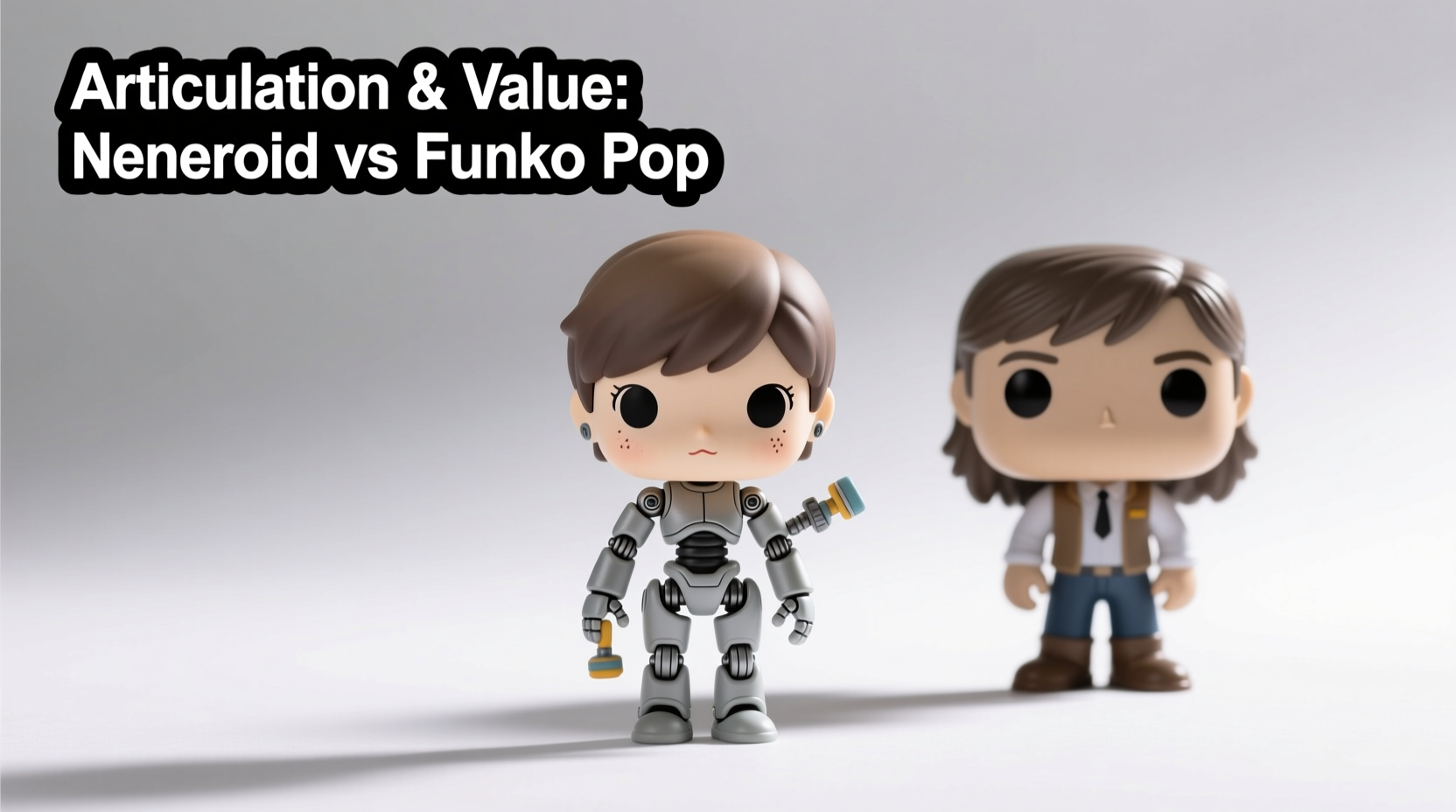
Nendoroids, produced by Good Smile Company (GSC), are part of the \"chibi\" or super-deformed style—large heads, small bodies, exaggerated expressions. Despite their cute proportions, they’re engineered with precision. Most Nendoroids feature ball-jointed limbs, rotating wrists and ankles, swivel waists, and sometimes even spring joints for stability. They come with interchangeable facial expressions (often three to five options), optional hands, props like weapons or drinks, and a stand for dynamic posing. This modularity allows for storytelling through arrangement—a Nendoroid Goku can switch from smiling to furious, arms raised mid-Kamehameha or casually sipping tea.
Funko Pops, on the other hand, follow a consistent stylized formula: oversized heads, dot eyes, minimalist features, and a rigid vinyl construction. While instantly recognizable, they offer no articulation beyond slight head tilt (on some variants) and cannot be reconfigured. Their strength lies in uniformity—they create a cohesive visual language across franchises—and accessibility. With thousands of characters released across movies, games, anime, and sports, Funko has built a pop culture empire on breadth rather than depth.
Material Quality and Build Longevity
Both lines use PVC/vinyl as their primary material, but the execution differs significantly. Nendoroids are made with higher-grade plastics, tighter seams, and superior paint applications. Fine details like eyelashes, hair strands, and costume textures are consistently crisp. Because each figure is designed for handling, joints are stress-tested during production to prevent breakage under normal use.
Funko Pops, while durable for display, are more prone to manufacturing flaws. Common issues include misaligned heads, uneven paint, and “glue globs” at mold lines. Over time, exposure to sunlight can cause yellowing, especially in white or light-colored figures. While newer Pop variants (like Glow-in-the-Dark or metallic finishes) show improved quality control, inconsistency remains a known issue among collectors.
The durability factor becomes relevant when considering usage. A Nendoroid handled weekly for photo shoots will likely outlast a Pop kept behind glass—not because of inherent fragility, but because GSC designs with interaction in mind. Funko’s model assumes passive admiration, not manipulation.
Price-to-Value Analysis: Breaking Down the Cost
Let’s compare two similar characters: the *Demon Slayer* Nendoroid Tanjiro Kamado ($75) and the Funko Pop Tanjiro ($18). On paper, the Nendoroid costs over four times as much. But when you account for included components, the equation shifts.
| Feature | Nendoroid Tanjiro | Funko Pop Tanjiro |
|---|---|---|
| Base Price | $75 | $18 |
| Articulation | Full (15+ points) | None (fixed pose) |
| Interchangeable Faces | Yes (4 options) | No |
| Optional Hands/Props | Sword, breathing effect, alternate hands | None |
| Display Stand | Included | None |
| Packaging Collectibility | Window box with artwork | Standard window box |
| Replay Value | High (poseable, customizable) | Low (static) |
When viewed through this lens, the Nendoroid isn’t just a figure—it’s a modular system. You’re paying for versatility. For photographers, content creators, or fans who enjoy curating evolving displays, that replay value adds tangible utility. In contrast, the Pop offers instant gratification and franchise representation at low cost, ideal for building large collections quickly.
“With Nendoroids, you’re not buying a statue—you’re buying an experience. The joy comes from rearranging, reimagining, and interacting.” — Kenji Saito, Product Designer at Good Smile Company (interview, Hobby Japan, 2021)
Collector Psychology: Display vs. Interaction
The choice between these brands often reflects deeper collecting motivations. Some fans treat their shelves like museums—curated, dust-free zones where every piece is preserved in pristine condition. For them, Funko Pops make sense. They’re affordable, visually uniform, and easy to organize by theme or series. A full row of anime Pops creates a bold wall of pop culture nostalgia.
Others see collecting as participatory. They want to engage with their figures—posing them in battle stances, recreating scenes, or even using them in stop-motion videos. These collectors value agency over aesthetics. A $75 Nendoroid used daily may bring more satisfaction than ten untouched Pops sitting idle.
A mini case study illustrates this well: Sarah, a digital artist and longtime anime fan, started with Funko Pops. She amassed over 60 figures in two years, focusing on Studio Ghibli and *My Hero Academia*. But she found herself taking photos of only three—the ones with unique variants. After switching to Nendoroids, she bought fewer pieces (just eight in the same timeframe), but spent hours arranging dioramas, swapping faces, and sharing setups online. Her engagement increased dramatically, despite the smaller collection size.
Her realization? “I wasn’t collecting characters—I was collecting moments. And Nendoroids let me create new ones anytime.”
Practical Considerations: Storage, Maintenance, and Scalability
Cost doesn’t end at purchase. Ongoing maintenance and storage play a role in total ownership experience.
- Storage: Nendoroids require more space due to stands and accessory trays. Organizing parts safely prevents loss. Pops stack neatly and fit into standard acrylic cases.
- Maintenance: Frequent handling of Nendoroids means cleaning joints and checking for loose parts. Pops mainly need dusting.
- Scalability: With Pops, you can expand rapidly across franchises. Nendoroids demand selective investment—most collectors focus on favorites.
If budget and shelf space are limited, Pops offer faster gratification. But if you prioritize depth over quantity, Nendoroids reward patience and curation.
Checklist: Choosing the Right Figure for Your Collection
- Define your purpose: Display-only or interactive use?
- Assess your budget: Can you afford $60–$80 per figure, or do you prefer $15–$25 entries?
- Consider frequency of use: Will you pose, photograph, or leave it static?
- Evaluate available space: Do you have room for stands and extra parts?
- Think long-term: Do you want a growing collection or a few premium pieces?
- Research availability: Some Nendoroids go pre-order only and sell out fast; Pops are widely available.
Are Nendoroid Prices Justified?
The short answer: yes, but conditionally. The premium isn’t just for articulation—it covers research and development, licensing, sculpting detail, and accessory engineering. Each Nendoroid undergoes extensive prototyping to ensure joint durability and aesthetic consistency. GSC also limits production runs, increasing perceived exclusivity.
Funko operates at scale. Their business model relies on mass production, broad licensing deals, and retail partnerships (Target, Walmart, GameStop). This allows lower prices but sacrifices individual craftsmanship. It’s the difference between a bespoke suit and off-the-rack fashion—one fits perfectly and lasts longer; the other gets the job done affordably.
That said, not every Nendoroid justifies its price. Re-releases of older sculpts with minimal updates can feel overpriced. Conversely, some exclusive Pops (metallic, chase variants) exceed $50 on the secondary market—proving demand can inflate value regardless of functionality.
FAQ
Can I add articulation to a Funko Pop?
Technically, yes—some hobbyists retrofit Pops with ball joints or convert them into action figures. However, this requires advanced modeling skills, voids collectible value, and risks damaging the figure. It’s generally not recommended for display-focused collectors.
Do Nendoroids hold their value better than Funko Pops?
Generally, yes. Limited-run or sold-out Nendoroids often appreciate on resale markets like Mandarake or Yahoo Japan Auctions. While rare Pops can spike in value, most remain near retail due to high availability. Nendoroids’ combination of scarcity, quality, and fan loyalty supports stronger long-term valuation.
Are there poseable alternatives under $50?
Yes. Lines like SH Figuarts (Tamashii Nations), Ani Statue, or even certain Kotobukiya Bishoujo models offer articulation at lower price points. However, they lack the chibi charm and face-swap system that define Nendoroids. Entry-level options exist, but none replicate the full Nendoroid experience below $50.
Final Verdict: Articulation vs. Accessibility
The articulation in Nendoroids is absolutely worth the price difference—if interaction matters to you. For creators, photographers, or fans who love customizing their displays, the ability to change expressions, poses, and accessories transforms a static object into a dynamic tool. The build quality, attention to detail, and emotional engagement justify the investment.
But if your goal is to represent a wide array of characters affordably, or if you prefer clean, uniform shelves, Funko Pops deliver unmatched accessibility. They democratize collecting, letting fans own pieces of their favorite stories without breaking the bank.
In the end, it’s not about which brand is “better.” It’s about alignment with your personal collecting philosophy. Some treasure the ritual of rearranging a scene; others find joy in completing a lineup. Both are valid. The best approach might be balance: use Pops for breadth, Nendoroids for depth.




 浙公网安备
33010002000092号
浙公网安备
33010002000092号 浙B2-20120091-4
Comments
No comments yet. Why don't you start the discussion?