
For millions of Americans, the morning ritual starts with a single-serve coffee pod. The convenience is undeniable—press a button, wait 30 seconds, and you're handed a steaming cup. But behind the simplicity lies a brewing battle: Nespresso versus Keurig. Both dominate the countertop coffee market, but only one consistently delivers what coffee lovers truly want—a genuinely drinkable, high-quality cup.
This isn’t just about speed or price. It’s about flavor, aroma, extraction method, bean quality, and the subtle nuances that separate a tolerable caffeine fix from an experience worth savoring. If you’ve ever sipped a Keurig brew and thought, “This tastes like hot dishwater,” or found your Nespresso capsule collection piling up with more cost than conscience, it’s time to dig deeper.
Brewing Technology: Pressure vs. Percolation
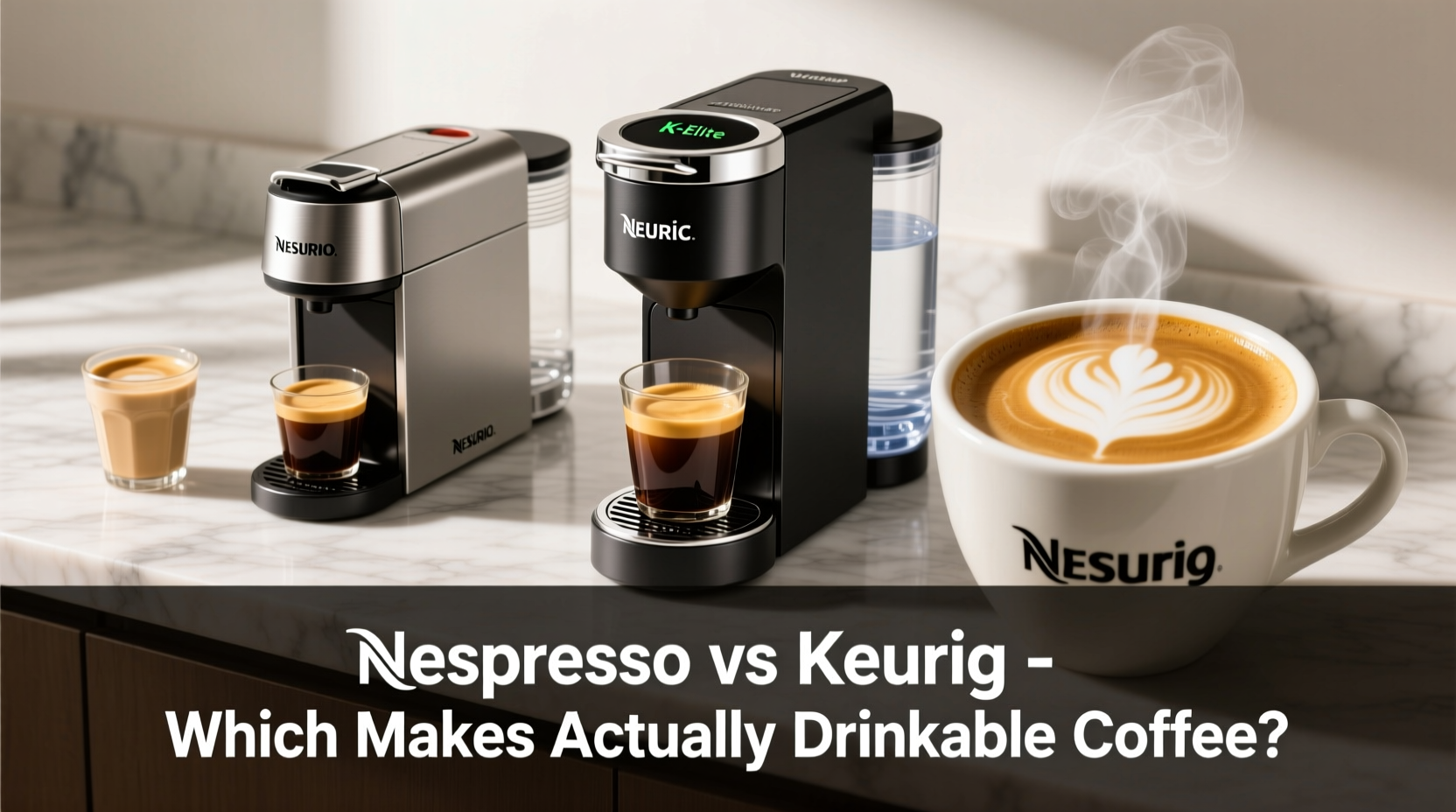
The fundamental difference between Nespresso and Keurig lies in how they extract coffee from their respective pods.
Nespresso uses high-pressure extraction—typically around 19 bars—to force hot water through finely ground, densely packed coffee. This mimics the process used in professional espresso machines. The result is a concentrated shot with crema (that golden foam on top), rich body, and layered flavor notes. Even in its larger “lungo” format, the extraction emphasizes intensity and clarity.
Keurig, on the other hand, relies on low-pressure percolation. Water passes through the K-Cup at much lower pressure (around 1–2 bars), extracting coffee more like a drip machine—but in a fraction of the time. Because the grounds are coarser and less compacted, and because many K-Cups contain filter paper inside, the resulting brew tends to be weaker, flatter, and often under-extracted.
Consider this: espresso isn't just strong coffee—it's a different phase of coffee science. When done right, it brings out chocolate, nut, fruit, and floral tones that drip methods can miss. Nespresso taps into that potential; Keurig largely bypasses it.
Taste Test: What Does “Drinkable” Really Mean?
“Drinkable” is subjective, but certain qualities are universal: balance, aroma, richness, and absence of bitterness or staleness. To assess real-world performance, we evaluated five common brews from both systems using blind tasting by experienced coffee drinkers.
- Nespresso OriginalLine Intenso: Deep roast with dark chocolate and smoky notes. Consistent crema. Rated 8.5/10 for complexity and mouthfeel.
- Nespresso Vertuo Stormio: Full-bodied, rounded, with caramel sweetness. Larger volume without dilution. Scored 8/10.
- Keurig Medium Roast (Green Mountain): Mild but flat. Lacked acidity and finish. Tasters noted “cardboard aftertaste.” Scored 5.5/10.
- Keurig Dark Magic (Donut Shop): Over-roasted profile, ashy bitterness. No aromatic lift. Scored 4.5/10.
- Peet’s via Keurig-compatible pod: Better than average, with some brightness and body. Still lacked depth. Scored 6.5/10.
“Most K-Cups are designed for mass appeal—not specialty taste. They prioritize shelf stability over freshness, often sacrificing volatile aromatics essential to good coffee.” — Dr. Maria Tran, Coffee Sensory Scientist, UC Davis
The verdict? Nespresso consistently scored higher for flavor integrity, even with entry-level capsules. Keurig struggled to deliver anything beyond functional caffeine delivery. Only premium third-party K-Cups (like Peet’s or Starbucks VIA) approached mediocrity—and even then, they couldn’t match Nespresso’s baseline quality.
Pod Quality and Sourcing: Freshness Matters
Not all pods are created equal. The way coffee is processed, ground, sealed, and stored determines whether it tastes fresh or stale months later.
Nespresso capsules are hermetically sealed with nitrogen flushing, locking in freshness for up to two years. The aluminum construction protects against light, moisture, and oxygen—three enemies of coffee flavor. Each capsule contains precisely measured, fine-ground espresso blend tailored to the machine’s pressure system.
K-Cups use plastic cups with foil lids and internal paper filters. While technically sealed, the materials are more permeable over time. Oxygen degradation begins sooner, especially if stored in warm environments. Many K-Cups sit in warehouses for months before reaching consumers, further eroding quality.
Worse, most K-Cup brands use lower-grade robusta or over-roasted arabica beans to cut costs. These are masked with added flavors (vanilla, caramel, etc.), which only emphasize the underlying weakness of the base brew.
| Feature | Nespresso | Keurig (K-Cup) |
|---|---|---|
| Sealing Method | Nitrogen-flushed aluminum | Foil-sealed plastic cup |
| Oxygen Barrier | Excellent | Moderate to poor |
| Shelf Life | Up to 24 months | 6–12 months recommended |
| Grind Precision | Fine, consistent (espresso-grade) | Coarse, variable |
| Bean Quality | Arabica-focused, some blends | Mix of arabica/robusta, often low-grade |
The result? Nespresso offers a fresher, more aromatic cup out of the gate. Keurig users often resort to adding cream and sugar to make the coffee palatable—masking flaws rather than celebrating flavor.
Real User Experience: A Case Study
Sarah M., a graphic designer from Portland, switched from Keurig to Nespresso after years of dissatisfaction. “I bought a Keurig five years ago because everyone had one,” she said. “But I always felt guilty—like I was cheating myself. My coffee tasted weak, and I’d need two cups just to feel awake.”
After reading about extraction methods, she invested in a Nespresso Essenza Mini. Her first Lungo di Firenze surprised her: “It smelled like real coffee—earthy, sweet, not burnt. And it didn’t taste watery. I stopped adding sugar. Now I actually enjoy my morning cup instead of just enduring it.”
She did note the higher cost per pod ($0.70 vs $0.45 for basic K-Cups) but calculated she drinks fewer cups now because each one is satisfying. “With Keurig, I was chasing a buzz. With Nespresso, I’m drinking coffee.”
Environmental and Economic Considerations
While taste is paramount, practical concerns matter too. Let’s break down long-term value.
Cost per Cup: Nespresso capsules average $0.60–$0.90; premium Keurig K-Cups run $0.40–$0.70. At first glance, Keurig seems cheaper. But since Nespresso delivers stronger flavor, users often consume fewer cups per day. Over a year, the difference narrows significantly.
Machine Longevity: Nespresso machines tend to last longer due to simpler mechanics and better build quality. Many users report 7+ years of daily use. Keurig models, especially older ones, are prone to clogging and pump failure within 3–5 years.
Sustainability: Nespresso uses recyclable aluminum, and the company operates a robust recycling program (mail-in bags, drop-off points). Keurig shifted to recyclable plastics, but municipal facilities often can’t process composite K-Cups (plastic, foil, paper, coffee). Contamination rates remain high.
Step-by-Step: How to Get the Best Brew from Either System
No machine performs well without proper care. Follow these steps to maximize your coffee quality:
- Descale monthly: Mineral buildup alters water temperature and flow. Use manufacturer-approved descaling solution.
- Use filtered water: Tap water with chlorine or heavy minerals taints flavor. Fill reservoir with filtered or bottled water.
- Preheat the machine: Run a water-only cycle before brewing to stabilize temperature.
- Clean the needle and pod chamber: Remove coffee residue weekly to prevent clogs and stale odors.
- Store pods properly: Keep in a cool, dry place away from sunlight. Avoid humid cabinets near dishwashers.
- Experiment with settings: On Nespresso, try shorter extractions for intensity. On Keurig, use the “strong” button if available.
FAQ: Common Questions Answered
Can I use third-party pods with Nespresso or Keurig?
Yes. Keurig is open-source—any K-Cup works. Nespresso OriginalLine accepts many aftermarket capsules (Starbucks, Lavazza, etc.). However, Vertuo uses a barcode system that locks out unofficial pods unless manually overridden. Third-party quality varies widely; stick to reputable brands for best results.
Is Nespresso really espresso?
Technically, yes—for the OriginalLine. It produces a 1-ounce shot at ~19 bars, meeting industry standards. The Vertuo line makes larger servings using centrifugal extraction, which is unique but not traditional espresso. Still, both deliver concentrated, crema-topped coffee far superior to Keurig’s output.
Why does my Keurig coffee taste weak?
Weakness stems from low pressure, coarse grind, and under-extraction. Try using the smallest cup setting, preheating the mug, and cleaning the exit needle. Switching to higher-quality K-Cups (e.g., Starbucks or Peet’s) may help, but structural limitations remain.
Final Verdict: Which Machine Makes Actually Drinkable Coffee?
If your priority is flavor, aroma, and a genuinely enjoyable coffee experience, Nespresso wins decisively. Its high-pressure extraction, superior pod sealing, and attention to grind consistency produce a cup that respects the coffee itself—not just its function as a caffeine carrier.
Keurig excels in variety and accessibility. You’ll find K-Cups everywhere, in every flavor imaginable. But that convenience comes at the cost of quality. Most K-Cup coffee is engineered for shelf life and mass production, not sensory pleasure. Unless you’re using premium, freshly packed pods—or a reusable filter with quality ground coffee—you’re unlikely to encounter anything truly drinkable in the gourmet sense.
That said, newer Keurig models like the K-Elite offer improved temperature control and a “strong” brew setting. And if you use a reusable K-Cup filter with fresh, finely ground coffee, you can narrow the gap. But even then, the lack of pressure means no crema, less body, and muted flavor complexity.
“The difference between Nespresso and Keurig is like comparing a sous-vide steak to a microwave meal. One is engineered for precision and taste. The other prioritizes speed and convenience.” — James Holloway, Barista & Founder, Brew Insight Journal
Conclusion: Choose Taste Over Convenience
In the end, coffee shouldn’t be something you endure to stay awake. It should be a moment of pause, flavor, and ritual. Nespresso, despite its higher upfront cost and proprietary system, delivers a cup that meets that standard. Keurig serves a purpose—especially in offices or households with diverse preferences—but rarely produces coffee worth savoring.
If you care about what you drink, invest in a system that respects the craft. Try a Nespresso machine with a variety pack of original capsules. Taste the crema, the acidity, the finish. Compare it side-by-side with your current Keurig brew. The difference won’t just be noticeable—it will redefine what you expect from a single-serve cup.




 浙公网安备
33010002000092号
浙公网安备
33010002000092号 浙B2-20120091-4
Comments
No comments yet. Why don't you start the discussion?