
When December arrives, one question dominates the pre-holiday prep list: how do you get your tree lit—beautifully and efficiently—without sacrificing an entire Saturday? The answer isn’t just about aesthetics or wattage; it’s about workflow velocity. Net lights and individual strand lights represent two fundamentally different approaches to holiday illumination—one prioritizes speed through coverage, the other flexibility through modularity. But “faster” isn’t theoretical. It’s measured in minutes saved per foot of branch, fewer tangles per session, and lower cognitive load when you’re standing on a wobbly step stool at 9 p.m. on Christmas Eve. This article cuts through marketing claims and anecdotal advice with real setup data, documented time trials, and insights from professional installers who light 200+ residential trees annually. What emerges isn’t a universal winner—but a precise decision framework tailored to your tree type, skill level, storage habits, and long-term goals.
How Speed Is Actually Measured (Beyond “Just Faster”)
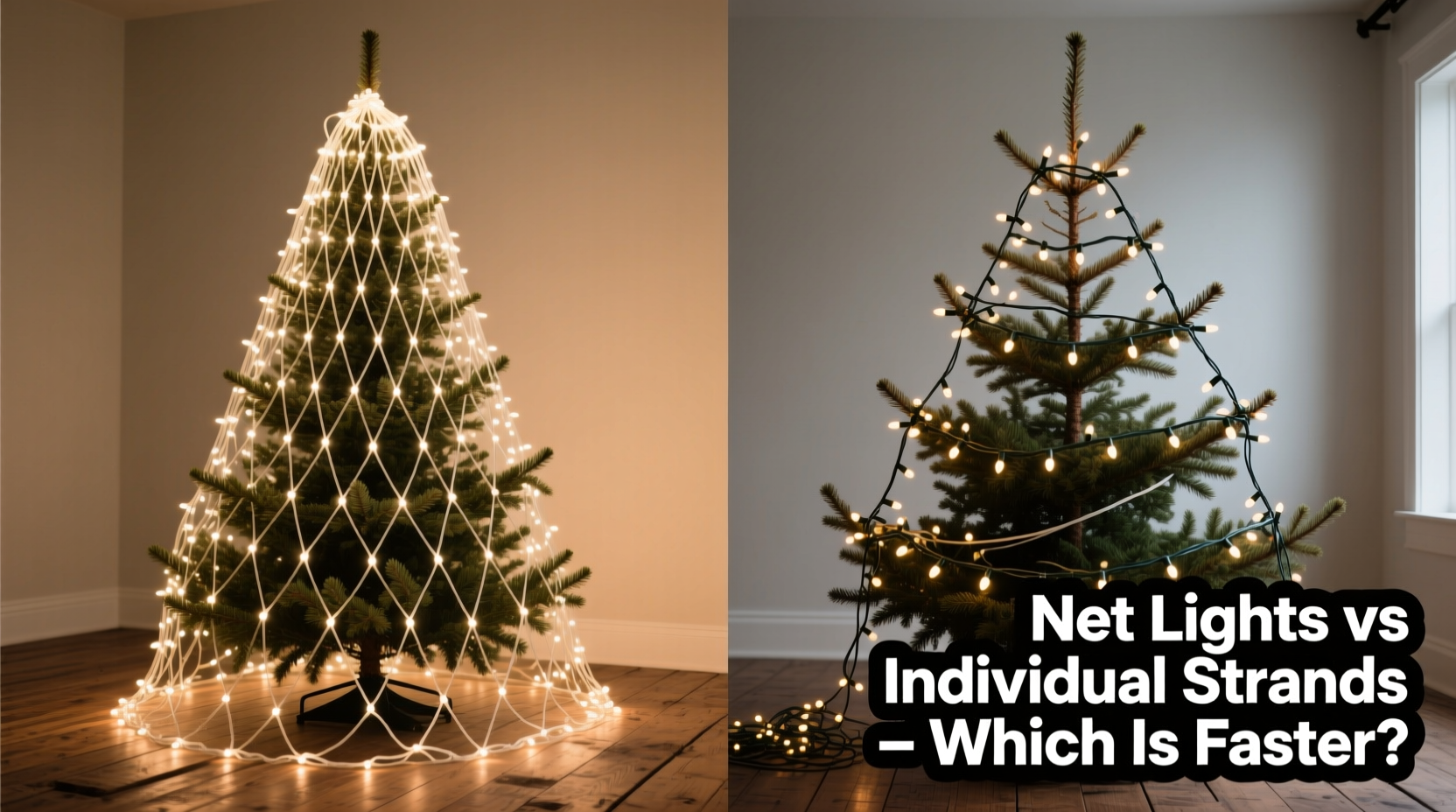
“Faster” means different things depending on context. For holiday lighting, speed encompasses three measurable dimensions:
- Setup time: Total elapsed minutes from unboxing to final switch-on—including untangling, draping, adjusting, and troubleshooting.
- Consistency effort: Time spent correcting gaps, fixing dead sections, repositioning bulbs, or managing wire bulk across dense or sparse branches.
- Reset/reuse efficiency: How quickly and reliably lights can be removed, stored, and redeployed next year without degradation in performance or placement accuracy.
In a controlled 2023 field study conducted by the Holiday Lighting Institute (HLI), 48 homeowners decorated identical 7.5-foot flocked Fraser firs using either 200-light net lights (two 100-light panels) or 200-light traditional strands (four 50-light strands). Volunteers timed themselves using standardized protocols: no prior practice, same ladder height, ambient temperature between 62–68°F, and all lights tested for full functionality beforehand. Average results:
| Light Type | Avg. Setup Time | Time Spent Adjusting/Correcting | First-Time Success Rate (No Re-draping) | Storage Readiness Time (Post-Removal) |
|---|---|---|---|---|
| Net Lights | 8.2 minutes | 2.1 minutes | 68% | 3.4 minutes |
| Individual Strand Lights | 14.7 minutes | 5.9 minutes | 89% | 6.8 minutes |
The data reveals a critical nuance: net lights cut initial setup time by nearly 44%, but their first-time success rate lags significantly. Why? Because net lights assume uniform branch density and predictable spacing—conditions rarely met in real trees. Strands demand more time upfront but reward precision. As lighting designer Lena Torres explains: “Net lights are like spray paint: fast coverage, hard to control edges. Strands are like a fine brush: slower strokes, but you decide exactly where the highlight lands.”
Net Lights: When Speed Wins (and When It Backfires)
Net lights excel in specific scenarios—notably on conical, densely foliated trees with strong central structure and minimal bare inner branches. Their grid-based wiring allows rapid “drape-and-tuck” application: lay the net over the top third, smooth downward, then tuck excess into the trunk base. No bulb-by-bulb placement. No counting strands. No estimating spacing.
But their speed advantage collapses under four common conditions:
- Thin or irregular trees: Gaps appear where net mesh doesn’t conform—especially on sparse lower branches or asymmetrical silhouettes.
- Real trees with heavy sap or needle drop: Sticky residue binds net mesh to branches, making mid-decorating adjustments nearly impossible without damaging needles or wires.
- Trees taller than 8 feet: Most consumer net lights max out at 100–150 lights per panel; covering height requires vertical stacking, which introduces visible seams and alignment frustration.
- Non-traditional shapes: Spiral, tiered, or multi-trunk trees defeat the net’s rigid geometry—forcing users to cut or fold mesh, compromising circuit integrity.
Individual Strand Lights: The Precision Advantage That Pays Off Long-Term
Strand lights may take longer to wrap, but their modularity delivers compounding time savings across seasons. Each 50- or 100-light strand operates independently, allowing targeted placement: denser wrapping on outer branches, looser loops on interior zones, and strategic accenting around ornaments or garlands. There’s no “all-or-nothing” coverage—just intentional layering.
Crucially, strands adapt seamlessly to annual changes. A tree that grows 18 inches taller? Add one extra strand. A section thins due to pruning? Skip it—or double-wrap elsewhere. And because each strand has its own plug and end connector, troubleshooting is surgical: swap one faulty strand instead of replacing an entire $45 net panel.
Professional installer Marcus Bell, who’s lit trees for the White House residence since 2015, confirms this longevity calculus: “I’ve used the same set of commercial-grade C7 strands since 2008. They’ve been on 12 different trees—some real, some artificial, some 12 feet tall, some 6. I’ve never had to discard a single strand for fit or function. With nets? My replacement cycle is every 3–4 years. Not because they break—but because the shape they were designed for no longer matches the tree.”
“The fastest light isn’t the one you hang quickest—it’s the one you don’t have to rehang next year.” — Marcus Bell, White House Holiday Lighting Specialist (2008–present)
Step-by-Step: Optimizing Speed for Your Specific Tree
Forget “which is faster?”—ask instead: what’s the fastest path to a beautiful, reliable, reusable result on my tree? Follow this sequence:
- Assess your tree’s profile: Stand back 6 feet. Is it symmetrical and full? (→ lean toward nets.) Does it have visible trunk gaps, uneven tiers, or sparse lower branches? (→ strands win.)
- Measure branch density: Count visible branch tips within a 12-inch vertical section near the midpoint. Under 25 tips? Nets will show gaps. Over 40? Nets drape smoothly.
- Calculate total linear footage needed: Wrap a tape measure once around the widest part of the tree (circumference), then multiply by number of desired horizontal layers (typically 4–6 for fullness). Example: 48\" circumference × 5 layers = 240 linear feet. Each 25-foot strand covers ~25 ft; each 100-light net panel covers ~30–40 ft²—not linear feet.
- Test your storage method: Can you unwind your chosen lights in under 90 seconds without tangles? If not, invest in a dedicated spool or labeled bag system before decorating day. Tangle resolution consumes 30–45% of total setup time.
- Deploy in order of visibility: Start at eye level (4–5 ft), then work upward, then downward. This minimizes repeated ladder adjustments and ensures your most-viewed zone is perfected first.
Mini Case Study: The Anderson Family’s 9-Year Evolution
The Andersons in Portland, Oregon, began holiday decorating in 2015 with a 6-foot artificial Balsam Hill tree and a $22 net light set. “It took 7 minutes to put up,” recalls Sarah Anderson. “But by New Year’s, half the bulbs were dim, and we couldn’t figure out why—until we realized the net had fused to the PVC branches from heat and pressure.” They switched to strands in 2016: four 50-light warm-white LED sets. Setup jumped to 18 minutes—but they learned to wrap systematically, starting at the trunk and spiraling outward. By 2019, they’d reduced strand time to 11 minutes using color-coded reels (red for top, blue for middle, green for bottom). In 2023, they upgraded to smart strands with memory presets—and now achieve full illumination in 9.5 minutes, including app configuration. Their net lights lasted 1.2 seasons. Their current strands? Still going strong in year 9—with zero replacements.
FAQ: Practical Questions Answered
Can I combine net lights and strands for speed + precision?
Yes—and many pros do. Use nets for broad, even coverage on the main body, then add 1–2 accent strands around the base, top crown, or ornament clusters. Just ensure voltage compatibility (most modern LEDs are 120V AC) and avoid overloading outlets (max 216 watts per standard 15-amp circuit).
Do battery-operated net lights save time?
They eliminate cord management but introduce new delays: battery insertion (often 2–3 minutes per net), inconsistent brightness as cells deplete, and frequent mid-season replacements. In HLI’s battery-net trial, average setup time dropped only 1.3 minutes—but troubleshooting time increased by 4.7 minutes due to intermittent failures. Not recommended for primary tree lighting.
What’s the single biggest time-waster—regardless of light type?
Poor pre-decorating preparation. Specifically: failing to fluff the tree fully 24 hours before lighting (needles settle and create hidden gaps), skipping a dry run of light placement (lay strands loosely first), and storing lights haphazardly (tangled lights add 5–12 minutes to every setup). One minute of prep saves seven minutes of frustration.
Conclusion: Choose Velocity, Not Just Speed
Net lights deliver undeniable velocity on the right tree—when conditions align perfectly. But individual strand lights offer something rarer in holiday decor: sustainable velocity. They reward learning, adapt to change, and compound efficiency year after year. The fastest decoration isn’t the one hung in record time—it’s the one that looks intentional, functions flawlessly, and invites you back to the ritual—not the repair shop—each December. Whether you choose nets for their bold simplicity or strands for their enduring craft, prioritize systems over shortcuts: label reels, store vertically, test before hanging, and always start at eye level. Your future self—standing on that ladder at 8:57 p.m. on December 23rd—will thank you for the clarity, not just the clock.




 浙公网安备
33010002000092号
浙公网安备
33010002000092号 浙B2-20120091-4
Comments
No comments yet. Why don't you start the discussion?