
When it comes to decorating homes for the holidays, few elements create as much warmth and visual impact as outdoor string lights. But achieving that lush, professional-grade glow isn’t just about how many bulbs you hang—it’s about how you place them. One of the most common dilemmas homeowners face is choosing between net lights and individually placed strands. Both have their merits, but when the goal is full, even coverage across bushes, trees, or eaves, the decision becomes critical. This guide dives deep into both methods, comparing their effectiveness, ease of use, and aesthetic outcomes to help you decide which option truly delivers the fullest possible illumination.
Understanding the Two Approaches
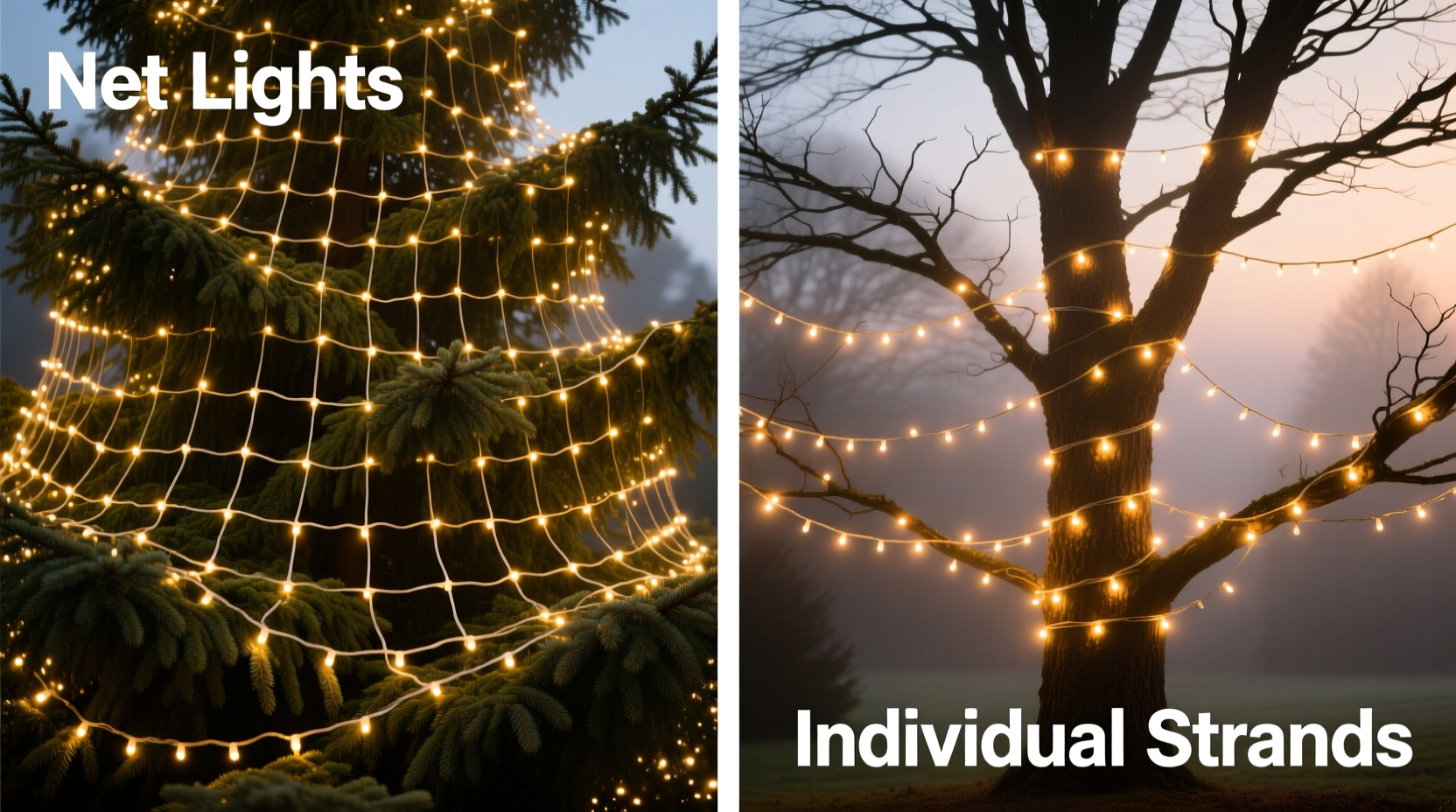
Before comparing performance, it’s essential to define what each method entails.
Net lights are pre-assembled grids of light strings, typically arranged in a rectangular or square mesh pattern. Each intersection holds a bulb, and the entire unit drapes over shrubs, hedges, or flat surfaces like fences or house fronts. They’re popular for quick installation and uniform spacing.
Individual strand placement, on the other hand, involves manually arranging separate strands of lights—either mini lights, C7s, or C9s—by wrapping, weaving, or clipping them into desired locations. This method allows total control over density, direction, and layering.
The fundamental difference lies in structure versus flexibility. Net lights offer consistency; individual strands offer customization. But which one fills space more completely?
Visual Density and Light Distribution
Coverage isn’t just about how much area is lit—it’s about how evenly and densely the light appears. A sparse arrangement can leave dark gaps, undermining the festive effect.
Net lights provide predictable spacing. Most standard 4x6-foot nets contain 100 to 200 bulbs, spaced 6 to 12 inches apart. While this creates a consistent grid, it also means every inch between bulbs remains unlit. On flat surfaces like hedges or railings, this works well. But on three-dimensional shapes like rounded shrubs, the rigid geometry causes uneven contact. Parts of the net float away from the plant, creating floating \"patches\" of light rather than seamless integration.
In contrast, individual strands allow decorators to wrap lights concentrically around branches, work inward from the outer edges, and double up in thinner areas. This layered technique builds depth and eliminates shadows. By adjusting spacing—tightening coils where needed or adding extra strands—you can achieve near-total saturation.
Comparison Table: Net Lights vs Individual Strand Placement
| Feature | Net Lights | Individual Strands |
|---|---|---|
| Installation Time | Fast (5–10 min per net) | Slow (30–60 min per shrub) |
| Coverage Uniformity | Even but rigid | Highly customizable, fuller potential |
| 3D Adaptability | Low (gaps on rounded forms) | High (wraps any shape) |
| Bulb Density Control | Fixed by design | Adjustable (add layers) |
| Reusability & Storage | Easy to fold and store | Requires careful coiling |
| Best For | Hedges, fences, flat surfaces | Trees, rounded shrubs, complex shapes |
Real-World Example: The Suburban Front Yard Makeover
Consider a homeowner in Denver preparing for the December Nights festival. Their front yard features six rounded boxwood shrubs, a curved walkway, and a two-story pine tree. Last year, they used net lights on the shrubs. While fast to install, the results were underwhelming—lights pooled on the outer edges, leaving the centers dim and the overall look patchy. Neighbors commented that it looked “like Christmas threw up a grid.”
This year, they switched tactics. Using 50-foot strands of warm white mini lights, they began at the trunk of each shrub and worked outward in tight spirals. On the pine tree, they started at the bottom and wound lights upward in vertical runs, then added horizontal wraps every two feet. The transformation was dramatic. Even from across the street, the yard glowed with depth and dimension. No single bulb stood out; instead, the collective effect was a soft, radiant halo around each plant.
A local landscaper who specializes in holiday lighting noted: “The difference wasn’t more lights—it was better placement. They achieved fuller coverage not by quantity, but by strategy.”
“The secret to professional lighting isn’t more bulbs—it’s intelligent distribution. Wrap inward, layer densely, and let the form guide the flow.” — Marcus Reed, Holiday Lighting Designer, Everlume Designs
Step-by-Step Guide to Achieving Fuller Coverage with Individual Strands
If you're aiming for maximum visual impact, follow this proven sequence:
- Assess the shape: Determine whether the target (shrub, tree, railing) is flat, rounded, or irregular. Rounded forms benefit most from individual strands.
- Choose the right strand length: Use longer strands (50+ feet) to minimize plug-ins and breaks in continuity.
- Start from the interior: Begin near the base or trunk, not the outer edge. This ensures inner branches receive light, reducing shadowing.
- Spiral outward: Move in a clockwise or counterclockwise motion, overlapping each loop slightly (about 2–3 inches) to avoid gaps.
- Add vertical layers: On taller plants, run strands vertically from top to bottom before wrapping horizontally to build depth.
- Double up in thin spots: If an area appears sparse, weave a second strand through without duplicating the entire process.
- Test before finalizing: Plug in the lights during dusk to evaluate brightness and evenness. Adjust as needed.
When Net Lights Are the Better Choice
Despite their limitations in coverage, net lights excel in specific scenarios:
- Flat surfaces: Fences, railings, or foundation plantings benefit from the uniform grid pattern.
- Time-constrained projects: For renters or busy families, net lights offer a “good enough” solution with minimal effort.
- Larger areas: Covering a 20-foot hedge with individual strands could take hours; the same area takes minutes with nets.
- Budget-friendly setups: Pre-lit nets often cost less per bulb than buying multiple long strands.
However, even when using net lights, you can improve coverage. Overlap adjacent nets by 6–12 inches to reduce visible seams. For shrubs, consider combining a net on the front with a single wrapped strand around the sides and back to add depth.
Checklist: Choosing the Right Method for Full Coverage
Use this checklist to determine the best approach for your project:
- ☐ Is the surface flat or gently curved? → Net lights may suffice.
- ☐ Is the plant rounded, tall, or irregularly shaped? → Individual strands recommended.
- ☐ Do you have more than 30 minutes per shrub? → You can achieve fuller results with manual wrapping.
- ☐ Are you aiming for a professional, magazine-worthy look? → Individual placement wins.
- ☐ Will you reuse these lights next year? → Consider storage needs—nets are easier to manage.
- ☐ Can you combine both methods? → Use nets for front coverage, strands for depth.
Frequently Asked Questions
Can I mix net lights and individual strands on the same bush?
Yes—and it’s often the smartest compromise. Use a net on the front-facing side for speed and consistency, then wrap individual strands around the sides and top to fill in gaps and enhance dimension. This hybrid approach balances efficiency with visual richness.
Do individual strands use more bulbs than nets?
Not necessarily. A standard 4x6-foot net has about 100–200 bulbs. Wrapping a medium shrub might require one 50-light strand (for the core) plus a 100-light strand (for outer layers), totaling a similar count. The difference is in distribution: individual strands allow denser clustering where it matters most.
Which option lasts longer?
Durability depends more on build quality than format. However, net lights can degrade faster if stretched over sharp branches or exposed to wind flapping. Individual strands, when properly secured, experience less strain. Either type can last 5–7 seasons with careful storage and handling.
Final Verdict: Which Delivers Fuller Coverage?
While net lights offer convenience and speed, **individual strand placement consistently provides fuller, more natural-looking coverage**, especially on three-dimensional subjects like shrubs, trees, and architectural curves. The ability to control density, adapt to contours, and layer light ensures no corner stays dark. Net lights serve well for flat, repetitive applications, but they lack the depth-building potential of hand-wrapped designs.
Full coverage isn’t just about covering ground—it’s about filling space. Light behaves volumetrically, and the most compelling displays treat plants as sculptures, not flat screens. Only individual strands allow decorators to work in the round, building luminosity from within outward.
“People don’t remember how many lights you used. They remember how the light made the landscape feel.” — Lena Tran, Landscape Lighting Consultant
Take Action This Season
This holiday season, challenge yourself to move beyond the net. Whether you’re illuminating a single bush or redesigning your entire façade, try wrapping one plant by hand. Start small, apply the spiral technique, and observe the difference in glow. You’ll likely find that the extra time yields exponentially better results. Share your before-and-after insights online, inspire neighbors, and elevate the art of outdoor lighting—one thoughtful strand at a time.




 浙公网安备
33010002000092号
浙公网安备
33010002000092号 浙B2-20120091-4
Comments
No comments yet. Why don't you start the discussion?