
When it comes to decorating outdoor trees for the holidays or special events, one of the most debated choices isn’t about color or brightness—it’s about installation efficiency. Homeowners, event planners, and landscapers alike face a recurring question: should they use net lights or traditional individual string lights when wrapping trees? The answer impacts not just how long the job takes, but also the final look, durability, and ease of storage. While both options have loyal followings, understanding their real-world performance in setup speed can save hours—especially during busy seasons.
Tree lighting isn’t just about aesthetics; it’s often a race against time, weather, and limited daylight. Whether you're prepping for a neighborhood display, a wedding backdrop, or seasonal curb appeal, reducing labor without sacrificing quality is key. This article breaks down the core differences between net lights and individual string lights, focusing specifically on installation speed, while also evaluating factors like coverage, adaptability, and long-term usability.
Understanding Net Lights and String Lights
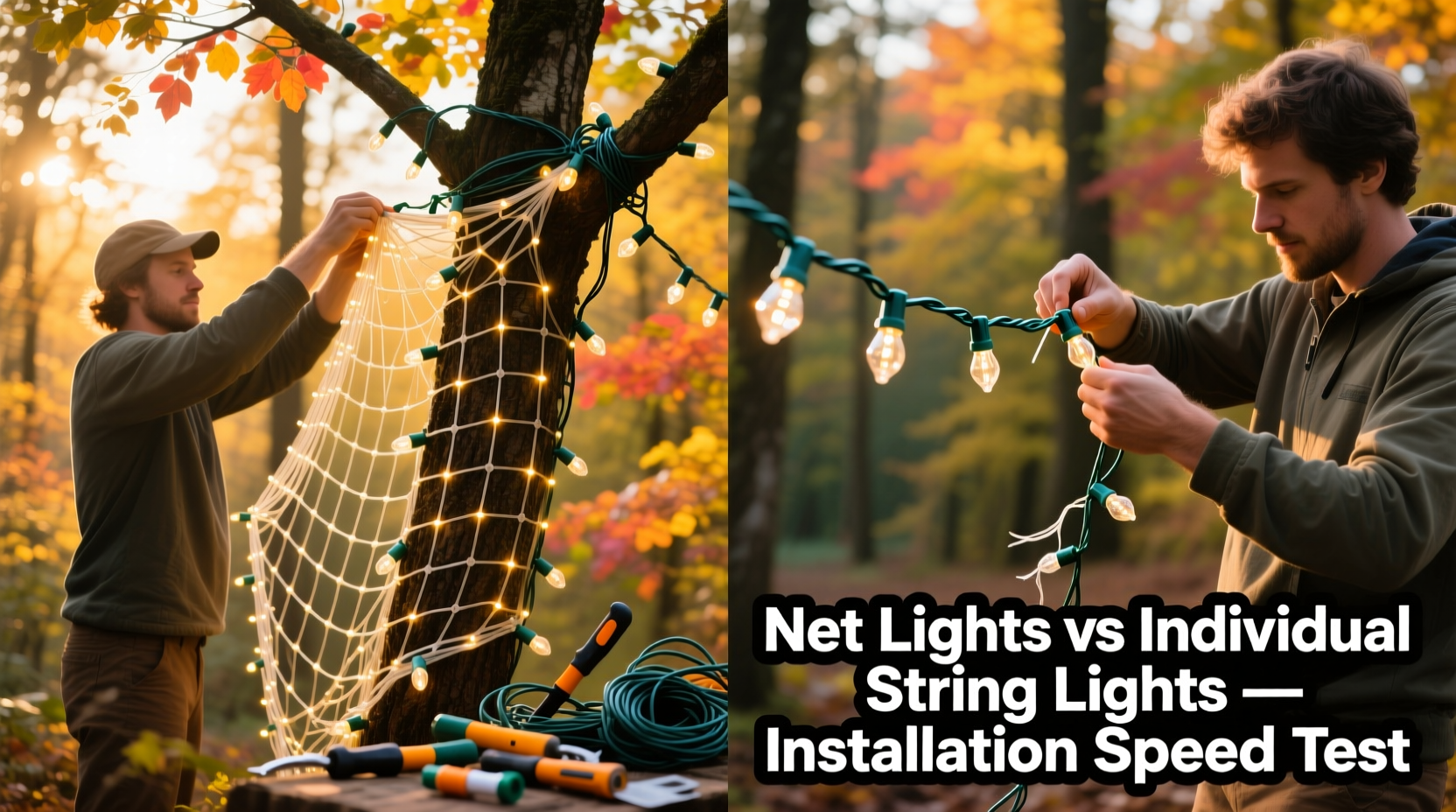
Before comparing installation times, it's important to understand what each type of lighting entails.
Net lights are pre-wired grids of LED bulbs arranged in a mesh pattern, typically in rectangular or square layouts. They resemble fishing nets with evenly spaced lights and are designed for quick draping over bushes, hedges, and small to medium-sized trees. Common sizes range from 4x6 feet to 8x12 feet, and they often come with built-in clips or hooks for fast attachment.
Individual string lights, on the other hand, consist of a single strand of bulbs (usually 25 to 100 per string) connected by a flexible wire. These are the classic holiday lights used for everything from tree wrapping to railing decoration. Multiple strings can be linked together, allowing for customization based on height, girth, and desired density.
The fundamental difference lies in structure: net lights offer a fixed layout, while string lights provide flexibility. But when time is critical, that structural distinction becomes a major factor in decision-making.
Installation Speed: Head-to-Head Comparison
To determine which option installs faster, consider the typical workflow for each method when applied to a medium-sized evergreen tree (approximately 8–10 feet tall).
Net Lights: The “Drape and Done” Approach
Net lights are engineered for speed. Their grid design allows for near-instant coverage. For a tree that fits within the dimensions of a standard net (e.g., 6x8 feet), installation often takes under 10 minutes. The process usually involves:
- Unfolding the net light panel.
- Positioning it over the outer layer of the tree.
- Securing corners with included clips or zip ties.
- Plugging in and testing.
No winding, no spacing calculations—just placement. If multiple nets are needed for full coverage, the total time scales linearly but remains significantly faster than manual wrapping.
String Lights: Precision at a Cost
Installing individual string lights on a tree is more involved. Achieving even coverage requires careful planning to avoid dark spots or clumping. The typical process includes:
- Starting at the base of the trunk and working upward.
- Wrapping the string around the tree in a spiral pattern, spacing rows 6–12 inches apart.
- Using twist ties or insulated clips to secure the wire to branches.
- Connecting multiple strings end-to-end if needed.
- Testing the entire run for continuity.
For an 8-foot tree, this process typically takes 30 to 45 minutes for one person, depending on experience and tree density. More complex shapes or thicker foliage increase time further. While the result can be more tailored, the labor investment is substantially higher.
Comparative Analysis: Setup Time vs. Other Factors
Speed isn’t the only consideration, but it often drives the decision—especially for commercial setups or large-scale displays. The table below compares net lights and string lights across several key criteria.
| Factor | Net Lights | String Lights |
|---|---|---|
| Average Install Time (per tree) | 5–15 minutes | 30–60 minutes |
| Coverage Uniformity | High (consistent grid) | Variable (depends on skill) |
| Adaptability to Tree Shape | Low to moderate | High |
| Reusability & Storage | Moderate (bulky, tangling risk) | High (flexible coiling) |
| Cost per Unit Area | Higher | Lower |
| Best For | Fast, repetitive jobs; uniform shrubs/trees | Custom designs; irregular or large trees |
While net lights win decisively in speed, they fall short in adaptability. Trees with irregular shapes, sparse lower branches, or excessive tapering may leave gaps when covered with rigid nets. In contrast, string lights can conform precisely to any silhouette, making them ideal for specimen trees where appearance matters more than speed.
“Time is the hidden cost of holiday lighting. For property managers or event crews, cutting installation time by 70% with net lights translates directly into labor savings and faster project turnover.” — Daniel Reeves, Commercial Lighting Consultant
Real-World Example: Municipal Park Holiday Display
In 2023, the city of Ashland, Oregon, undertook a holiday beautification project involving 40 ornamental evergreens along a central boulevard. With a tight two-week deadline and only three staff members assigned, the parks department faced a logistical challenge.
They tested both methods on identical trees: half were wrapped with string lights (averaging 40 minutes each), while the other half used 6x8-foot net lights (averaging 12 minutes each). The net-light trees achieved a consistent, festive appearance with minimal variation. Though some required minor tucking at the base, the overall time savings allowed the team to complete the project three days ahead of schedule.
According to lead technician Maria Tran, “We didn’t expect such a dramatic difference. The net lights weren’t perfect for every tree—two had odd shapes and needed supplemental strings—but for the majority, it was plug-and-play. We’ll definitely use them again for high-volume jobs.”
This case illustrates a broader truth: when dealing with multiple similar trees, net lights are not just faster—they’re scalable. The consistency of application reduces training needs and quality control issues.
Step-by-Step Guide: Choosing the Right Option for Your Project
Follow this decision framework to determine whether net lights or string lights are better suited for your tree lighting needs—especially when speed is a priority.
- Assess tree size and shape. Measure height and spread. Are the trees uniform? Do they have dense, symmetrical canopies?
- Determine the number of trees. Fewer than five? Flexibility may matter more. Ten or more? Speed becomes critical.
- Evaluate access and equipment. Are trees in hard-to-reach areas? Ladders or lifts may limit time per tree, favoring faster methods.
- Check power source locations. Net lights often require fewer connections due to integrated design. String lights may need more extension cords and junction points.
- Decide on reuse potential. Will these lights be used annually? Consider storage space—nets take up more room but reduce setup time each year.
- Test one of each. Install a net light and a string-wrapped section on similar trees. Compare results side by side.
This structured approach prevents costly overinvestment in the wrong product and ensures alignment with both aesthetic and operational goals.
Common Pitfalls and How to Avoid Them
Even with the right choice, mistakes can slow down installation or compromise results.
- Choosing nets that are too small. Gaps at the top or sides defeat the purpose of fast coverage. Opt for slightly larger nets and fold excess neatly.
- Overlapping strings too densely. When using individual lights, wrapping too tightly creates hotspots and increases energy use. Stick to 6–12 inch vertical spacing.
- Ignoring voltage drop. Long runs of string lights (beyond 200–300 watts combined) can dim at the far end. Use shorter runs or commercial-grade low-voltage systems.
- Poor securing methods. Relying on gravity or weak clips leads to sagging. Use UV-resistant zip ties or insulated branch clips for lasting hold.
- Not checking for damage beforehand. Test all lights before installation. Replacing a faulty bulb mid-process wastes time.
Frequently Asked Questions
Can I combine net lights and string lights on the same tree?
Yes, and many professionals do. Use net lights for the main body of the tree to save time, then add individual string lights to highlight the trunk, inner layers, or canopy top for depth and dimension.
Are net lights suitable for very large trees?
Generally, no. Most net lights max out at around 8x12 feet, making them impractical for trees over 15 feet. For larger specimens, individual string lights remain the only viable option for full coverage.
Do net lights use more electricity?
Not inherently. Power consumption depends on the number and type of bulbs. However, because net lights often have higher bulb density, they may draw more wattage per square foot than sparsely wrapped string lights. Always check the manufacturer’s specs and consider LED efficiency.
Final Recommendation: Match the Tool to the Task
So, which is faster? Unequivocally, net lights install faster than individual string lights on trees—often by a factor of three or more. For uniform, medium-sized trees installed in volume, net lights are the superior choice when time is limited.
However, speed isn’t everything. For unique landscapes, heritage trees, or high-design environments, the precision and adaptability of string lights justify the extra labor. The smartest approach is hybrid: use net lights where they fit well, and reserve string lights for detail work or challenging forms.
As LED technology improves and modular net systems become more customizable, the gap in flexibility may narrow. But for now, the fastest path to a lit tree starts with assessing your priorities: raw speed or tailored elegance.




 浙公网安备
33010002000092号
浙公网安备
33010002000092号 浙B2-20120091-4
Comments
No comments yet. Why don't you start the discussion?