
When it comes to decorating for the holidays or enhancing outdoor spaces with festive lighting, one of the most overlooked factors is setup time. Many homeowners and event planners assume all string lights are created equal, but the reality is that the choice between net lights and individual string lights can dramatically affect how long—and how easily—you get your space illuminated. While both options deliver visual impact, they differ significantly in installation efficiency, flexibility, and maintenance. Understanding these differences helps you make a smarter, faster decorating decision—especially when time is limited.
The Setup Challenge: Why Speed Matters
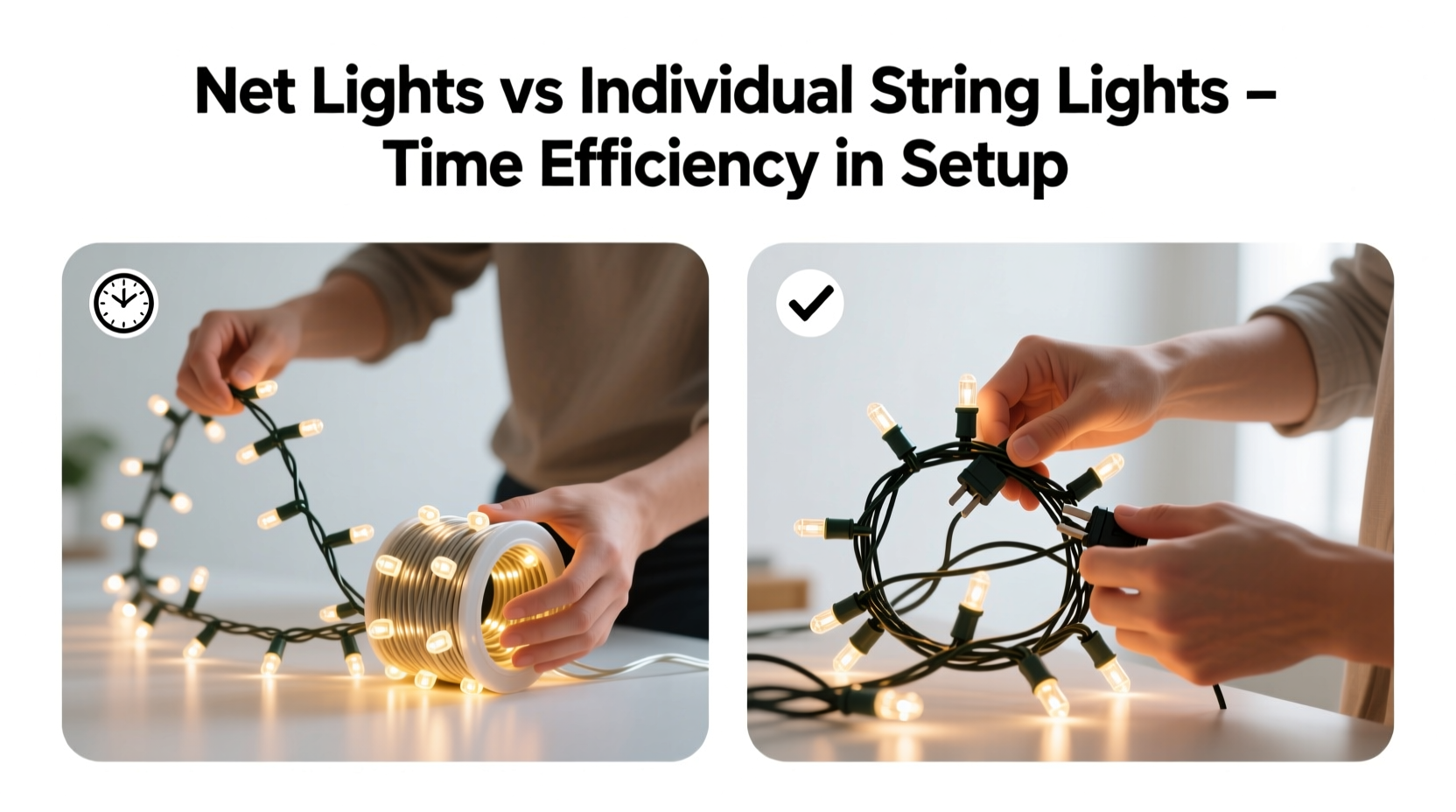
Holiday decorating often competes with packed schedules, family obligations, and winter weather. The average homeowner spends 6–10 hours setting up exterior lights alone, according to a 2023 survey by the National Retail Federation. For those using traditional string lights, much of that time is spent untangling wires, aligning spacing, and securing each strand individually. This repetitive process becomes even more cumbersome on large surfaces like hedges, fences, or rooftops.
Speed isn’t just about convenience—it’s also about safety. Working at night or in cold conditions increases risks, especially when ladders and electrical connections are involved. A solution that reduces exposure time while delivering consistent results is not only efficient but practical.
Understanding Net Lights: Design and Application
Net lights consist of strings of bulbs pre-wired into a grid pattern, resembling a fishing net. They come in various sizes—commonly 4x6 feet or 6x6 feet—and are designed to drape directly over bushes, shrubs, railings, or flat wall surfaces. Most models use incandescent or LED bulbs spaced evenly (typically 6 inches apart), creating a dense, uniform glow.
Because the lights are already fixed in position, installation requires minimal adjustment. You simply lay the net over the target area and secure it with clips, zip ties, or tacks. No measuring, no spacing calculations, and no need to connect multiple strands for full coverage.
This design makes net lights ideal for landscaping features with predictable shapes. Shrubs, evergreen trees, and porch railings benefit from the blanket-style coverage net lights provide. Some models even include corner connectors to link multiple panels seamlessly.
Advantages of Net Lights for Fast Setup
- Predictable layout: Bulbs are already spaced, eliminating guesswork.
- Fewer connections: One or two plug-in points per panel reduce outlet congestion.
- Quick draping: Can be tossed over bushes and adjusted in minutes.
- Less ladder work: Often installed from ground level when used on lower foliage.
“Net lights cut our setup time by nearly 70% compared to individual strings. For commercial clients with tight deadlines, they’re a game-changer.” — Daniel Reyes, Professional Holiday Lighting Installer, BrightEdge Decorations
Individual String Lights: Flexibility vs. Time Investment
Individual string lights—the kind sold in spools of 25, 50, or 100 feet—are the traditional go-to for holiday lighting. They offer unmatched versatility. You can wrap them around columns, weave them through tree branches, outline rooflines, or create custom patterns. However, this flexibility comes at a cost: time.
Installing individual strings involves several labor-intensive steps:
- Unspooling and untangling each strand.
- Measuring distances to ensure even spacing.
- Securing each section with clips or staples.
- Connecting multiple strands end-to-end (often requiring multiple circuits).
- Adjusting sagging or uneven sections after initial placement.
On complex structures like multi-gabled roofs or sprawling trees, this process can take hours. A single large oak might require 10–15 separate strands to achieve full coverage, each needing its own attachment point and power connection.
While some modern string lights feature built-in clips or improved durability, the fundamental workflow remains manual and time-consuming. Even with experience, decorators report spending 30–50% more time on string light installations than on equivalent net light projects.
When Individual Strings Are Worth the Extra Effort
- Irregular architectural features (e.g., bay windows, dormers).
- Trees with sparse or asymmetrical branching.
- Custom light designs (e.g., snowflakes, stars).
- Indoor applications where precise routing matters (mantels, staircases).
Direct Comparison: Net Lights vs. String Lights
| Feature | Net Lights | Individual String Lights |
|---|---|---|
| Setup Time (per 100 sq ft) | 15–25 minutes | 60–90 minutes |
| Spacing Accuracy | Pre-set, uniform | Manual, variable |
| Ladder Use Required? | Rarely (for low foliage) | Frequently |
| Number of Electrical Connections | 1–2 per panel | Multiple (1 per 2–3 strands) |
| Storage Size | Bulkier (flat panels) | Compact (can be coiled) |
| Reusability on Different Surfaces | Low (shape-specific) | High (adaptable) |
| Best For | Hedges, bushes, flat walls | Rooftops, trees, custom layouts |
The data shows a clear advantage for net lights in terms of speed and simplicity. However, their rigid structure limits reusability. A net sized for a front-yard boxwood may not fit a side-yard juniper, leading some users to purchase multiple sizes—a potential cost consideration.
Real-World Example: Residential Installation Showdown
In December 2023, two neighboring homes in Portland, Oregon, undertook identical holiday lighting upgrades—one using net lights, the other individual strings. Both properties featured similar landscaping: two large arborvitae hedges (each ~8 ft tall x 4 ft wide) and a front porch with wooden railings.
Home A (Net Lights): Used two 4x6 ft LED net light panels for the hedges and one 6x6 ft panel for the porch railing. Total setup time: 38 minutes. One person completed the job without a ladder. Lights were draped and secured with plastic clips in under 10 minutes per panel.
Home B (Individual String Lights): Used 100-foot LED strands (three per hedge, two for railing). Each strand required careful wrapping, clipping every 12 inches, and managing overlapping ends. Total setup time: 3 hours and 12 minutes. Required two people and frequent ladder repositioning.
Both displays looked professionally finished, but the time difference was stark. Home A’s owner reported feeling “relieved” to finish quickly; Home B’s owner admitted, “I almost gave up halfway through.”
Step-by-Step Guide: How to Choose Based on Your Needs
Follow this timeline to determine which lighting type will save you the most time:
- Week 1: Survey Your Space (30 mins)
Walk around your property. Identify key areas: bushes, fences, eaves, trees. Note dimensions and accessibility. - Week 2: Categorize by Surface Type (20 mins)
- Flat or rounded surfaces (shrubs, low walls): Ideal for net lights.
- Linear or irregular features (rooflines, bare trees): Better suited for string lights.
- Week 3: Measure and Plan Coverage (45 mins)
Calculate square footage. For net lights, choose panels that match or slightly exceed the area. For strings, estimate 25–50 feet per vertical/horizontal element. - Week 4: Purchase and Pre-Test (1 hour)
Buy lights and test them indoors. Check for dead bulbs and verify plug compatibility. - Installation Day: Execute Efficiently
Start with net lights if using both types—they go up fastest and allow focus on detailed string work afterward.
Maximizing Efficiency: Hybrid Approach
Many experienced decorators use a hybrid method: net lights for broad, repetitive areas (like hedges), and individual strings for architectural highlights (gutters, columns). This strategy balances speed with customization.
For example:
- Use green-net LED lights on all front-yard shrubs (setup: 45 minutes).
- Use copper-wire string lights to outline the roofline and wrap porch pillars (setup: 2 hours).
Total time: ~2.75 hours—still less than using strings alone, while achieving greater visual depth. This approach is increasingly popular among professional installers serving high-volume clients.
FAQ: Common Questions About Setup Efficiency
Can I use net lights on trees?
Only if the tree has dense, bushy foliage like an arborvitae or spruce. For deciduous or sparsely branched trees, individual strings are better because they can be woven through limbs for a 3D effect. Net lights tend to slip or look flat on open structures.
Are net lights more expensive?
Initially, yes—net lights typically cost 20–30% more per bulb than bulk string lights. However, when factoring in labor savings and reduced risk of damage during setup, the long-term value often evens out, especially for annual reuse.
Do net lights use more electricity?
No. Power consumption depends on bulb type (LED vs. incandescent) and total number of bulbs, not the wiring format. A 200-bulb net uses the same energy as a 200-bulb string. Most modern net lights now use energy-efficient LEDs, drawing as little as 10 watts per panel.
Checklist: Quick-Start Guide for Time-Saving Light Setup
- ✅ Audit your outdoor surfaces and categorize by shape.
- ✅ Prioritize net lights for shrubs, bushes, and flat facades.
- ✅ Reserve string lights for rooflines, trees, and custom accents.
- ✅ Pre-test all lights before installation day.
- ✅ Use durable, weather-rated clips or zip ties (avoid staples on net lights).
- ✅ Install net panels first, then add string lights for detail.
- ✅ Label storage containers by location (e.g., “Front Hedge – 4x6 Net”).
Conclusion: Make Every Minute Count
The question isn’t whether net lights or individual string lights look better—it’s which helps you achieve a beautiful display without sacrificing hours of your time. For大面积 coverage on predictable surfaces, net lights are the undisputed winner in setup speed, ease, and consistency. They transform what used to be a weekend project into a single afternoon task.
That said, individual string lights remain essential for precision and creativity. The smartest approach blends both: leverage the speed of nets where possible, and reserve strings for where artistry matters most. By planning strategically and choosing the right tool for each job, you’ll spend less time climbing ladders and more time enjoying the glow.




 浙公网安备
33010002000092号
浙公网安备
33010002000092号 浙B2-20120091-4
Comments
No comments yet. Why don't you start the discussion?