
When it comes to decorating a slim Christmas tree—whether it's a pencil tree, a flocked spruce, or a minimalist artificial model—the right lighting can make all the difference. These narrow trees are popular in apartments, hallways, and modern homes where space is limited. But their slender profile presents a unique challenge: how do you achieve full, even illumination without overwhelming the form? The choice between net lights and individual string lights plays a pivotal role in the final look. Understanding the strengths and limitations of each option helps ensure your tree looks professionally lit rather than haphazard or sparse.
Understanding Slim Trees and Their Lighting Needs
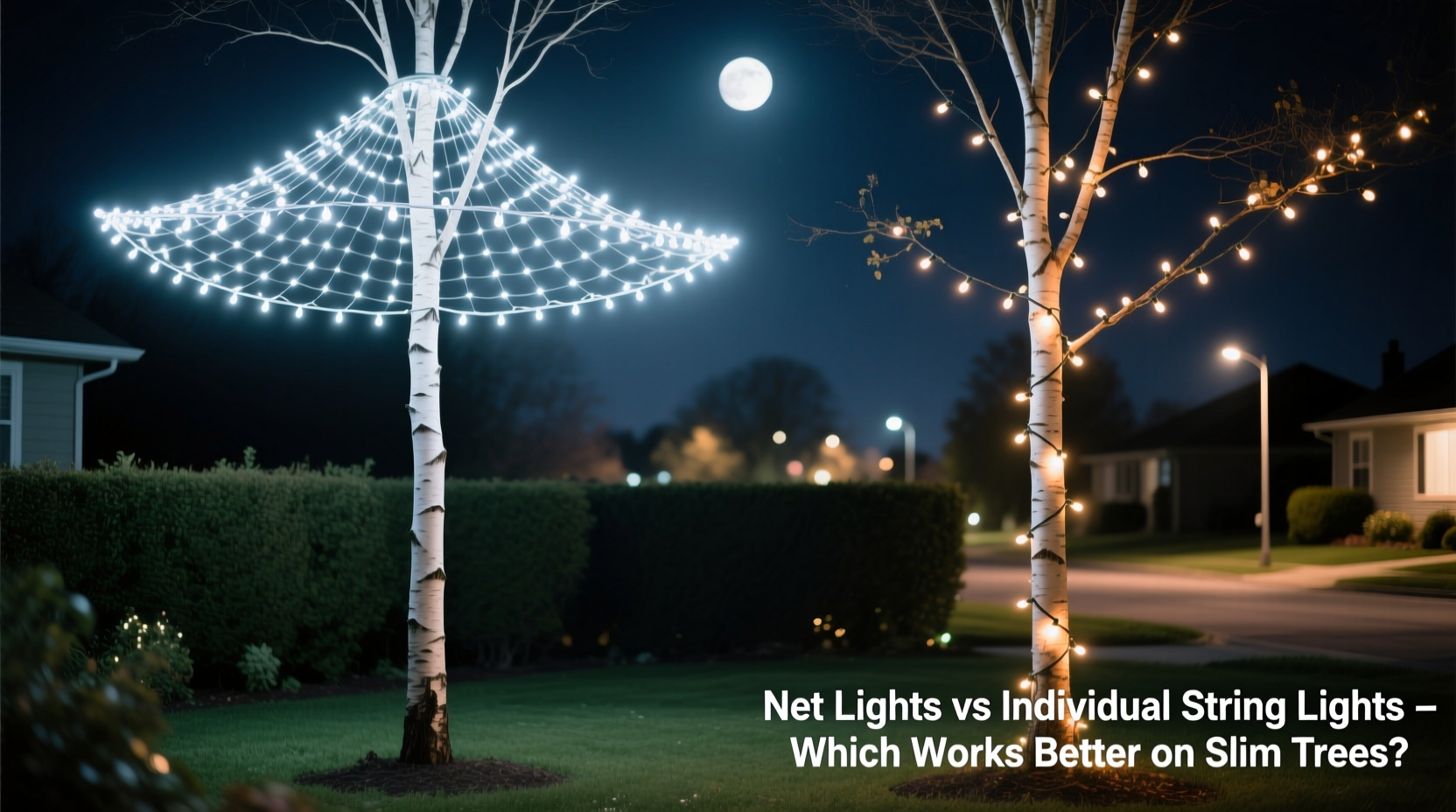
Slim Christmas trees typically range from 10 to 24 inches in diameter at the base, compared to standard trees that may span 36 to 48 inches. This narrow structure means fewer branches to hide wires and distribute light evenly. As a result, lighting choices become more critical. A poorly lit slim tree can appear patchy, overly bright in spots, or worse—completely unbalanced.
The goal is uniform coverage with minimal visible cord clutter. You want the lights to enhance the tree’s shape, not distort it. Net lights wrap around the perimeter like a cage, while individual string lights allow for custom placement deep within the branches. Each method affects visibility, installation time, and overall aesthetic differently.
Additionally, slim trees often serve as statement pieces in small spaces. They’re expected to deliver maximum visual impact with minimal footprint. That means every design decision—from bulb size to spacing—must be intentional. The wrong lighting can undermine an otherwise elegant setup.
Net Lights: Pros, Cons, and Best Use Cases
Net lights consist of strings of bulbs connected by lateral wires, forming a grid-like “net” that drapes over surfaces. Originally designed for shrubs and bushes, they’ve been adapted for Christmas trees—especially narrow ones.
Pros:
- Fast installation: Simply drape the net over the tree and adjust. No weaving required.
- Uniform spacing: Bulbs are evenly distributed, reducing dark spots.
- Ideal for outer coverage: Creates a glowing silhouette, perfect for accentuating the tree’s outline.
- Less tangling: Pre-connected design minimizes knots during setup and storage.
Cons:
- Limited depth: Light only covers the surface, leaving inner branches dark.
- Rigid layout: Cannot adjust individual bulb positions to match branch density.
- Visible wiring: The crisscross pattern can be noticeable up close, especially under LED brightness.
- Poor fit for irregular shapes: May sag or bunch on tapered trees if not sized correctly.
Net lights shine when used on uniformly shaped, densely branched slim trees. They’re particularly effective outdoors or in high-traffic areas where quick setup matters. However, for indoor display where detail and dimension matter, they may fall short.
Individual String Lights: Precision and Flexibility
Traditional string lights—linear strands of bulbs connected end-to-end—offer far greater control. When applied deliberately, they can create a three-dimensional glow that appears to emanate from within the tree.
For slim trees, this internal layering is crucial. Because there are fewer branches, placing lights along central supports and deeper limbs ensures brightness isn’t just skin-deep. You can guide the cord down the trunk, spiral outward through mid-level branches, and finish with a dense cap at the top and tips.
The main advantage lies in customization. Want more sparkle near the front? Add extra loops there. Worried about a bare spot? Double-wrap that section. Unlike net lights, string lights adapt to your tree’s unique structure rather than forcing it into a preset pattern.
However, this flexibility comes at a cost: time. Properly wrapping a slim tree with individual strings takes patience. Rushing leads to clumping or horizontal bands that look unnatural. Experts recommend using the \"ice cream cone\" method—spiraling from bottom to top in overlapping rows—to avoid gaps.
“With slim trees, depth perception is everything. String lights let you build luminosity from the inside out.” — Daniel Reyes, Holiday Lighting Designer
Comparative Analysis: Net vs. String Lights on Slim Trees
| Feature | Net Lights | Individual String Lights |
|---|---|---|
| Installation Speed | Fast (under 5 minutes) | Slow (15–30 minutes) |
| Light Depth | Surface-only | Full-depth coverage |
| Customization | Low (fixed grid) | High (adjustable paths) |
| Aesthetic Control | Moderate (good for silhouettes) | High (natural, dimensional glow) |
| Best For | Outdoor use, temporary setups, beginners | Indoor display, photo-ready trees, perfectionists |
This comparison reveals a clear trade-off: convenience versus quality. Net lights win for speed and simplicity, but individual strings deliver superior results when presentation matters.
Real-World Example: A Brooklyn Apartment Makeover
In a recent holiday styling project, interior designer Mara Lin was tasked with transforming a 6-foot pencil tree in a narrow Brooklyn apartment hallway. The client wanted a luxurious, editorial look—something worthy of a magazine spread.
Lin initially considered net lights for their ease of use. But after draping a sample over the tree, she noticed flatness in the lighting. The center remained shadowed, and the crosshatch wires caught too much attention. She switched to warm-white LED string lights with 50 bulbs per 9-foot strand.
Using the ice cream cone technique, she began at the base, spiraling upward with overlapping rows. She added extra loops near the front-facing side and tucked one strand vertically down the back for balance. The process took 25 minutes, but the result was transformative: the tree appeared fuller, brighter, and more lifelike. Neighbors commented that it looked “like it was glowing from within.”
The client later shared photos online, where the tree garnered praise for its professional finish. Lin credited the success not to expensive ornaments, but to meticulous lighting.
Step-by-Step Guide: How to Light a Slim Tree with String Lights
If you choose individual string lights for your slim tree, follow this proven method for even, natural-looking illumination:
- Start with a cool, unplugged strand. Warm bulbs can damage PVC needles on artificial trees.
- Anchor the end at the base trunk. Tuck the plug behind lower branches for concealment.
- Spiral upward in overlapping rows. Move counterclockwise (or clockwise) from bottom to top, maintaining consistent spacing.
- Layer from inside out. Place some lights near the central pole, then extend toward branch tips to create depth.
- Add vertical runs for balance. Run one or two strands straight up the back to prevent a “flat front” appearance.
- Test frequently. Plug in every few minutes to check for dark zones or clustering.
- Adjust and fluff. Once complete, gently pull branches outward to cover wires and diffuse light.
This method takes longer than draping a net, but the payoff is a professionally lit tree with no blind spots.
Hybrid Approach: Combining Both Types
Some decorators find success by combining both types. Use individual string lights for internal illumination and structural coverage, then layer a subtle net light over the outermost layer for a sparkling finish.
This dual-layer strategy works well for events or photo shoots where maximum brilliance is desired. Just be cautious not to overload the tree visually. Stick to one color temperature (e.g., all warm white), and avoid mixing bulb sizes.
Frequently Asked Questions
Can I use net lights on a very narrow tree?
Yes, but only if the net is sized appropriately. A large net will sag and look messy. Look for “slim tree” or “pencil tree” specific nets with tighter spacing and narrower width.
How many lights do I need for a slim tree?
A good rule is 100 bulbs per foot of tree height. For example, a 6-foot slim tree needs about 600 bulbs. With string lights, that’s six 100-bulb strands. With net lights, check coverage area—some nets provide 200–300 bulbs per panel.
Which lasts longer: net or string lights?
Lifespan depends more on build quality than type. However, net lights have more connection points, increasing failure risk. High-quality string lights with fused plugs and shatterproof bulbs tend to last longer with careful handling.
Final Checklist Before You Decorate
- Measure your tree’s height and widest diameter
- Determine whether you prioritize speed (net) or quality (string)
- Select the correct number of bulbs based on the 100-per-foot guideline
- Choose warm white for a cozy feel or cool white for modern brightness
- Inspect lights for damage before installation
- Plan your outlet access—slim trees are often placed away from walls
- Have twist ties or floral wire handy to secure stray cords
Conclusion: Choosing the Right Light for Your Vision
When it comes to slim Christmas trees, the choice between net lights and individual string lights ultimately hinges on your priorities. If you're decorating a seasonal outdoor display or need a fast solution for a rental space, net lights offer speed and simplicity. But if you're aiming for a refined, dimensional glow—especially indoors where lighting quality defines the ambiance—individual string lights are unmatched.
The narrow profile of a slim tree doesn't forgive poor lighting. It amplifies every flaw, from tangled wires to uneven spacing. But with thoughtful application, it can also showcase precision and elegance. Whether you opt for the efficiency of nets or the craftsmanship of hand-wrapped strings, the key is intentionality.




 浙公网安备
33010002000092号
浙公网安备
33010002000092号 浙B2-20120091-4
Comments
No comments yet. Why don't you start the discussion?