
When decorating a large surface—whether it’s a 20-foot holiday tree, a 40-foot pergola, or the facade of a two-story home—the question isn’t just “which looks better?” It’s “which gets the job done *without* turning into an all-day endurance test?” Many decorators assume net lights are inherently faster because they’re pre-wired on a grid. Others swear by individual strings for precision and control. But speed isn’t about assumption—it’s about physics, geometry, and workflow efficiency. This article cuts through marketing claims and anecdotal advice to deliver a practical, measurement-backed comparison grounded in real installation scenarios, professional installer benchmarks, and verified time studies.
How Coverage Speed Is Actually Measured
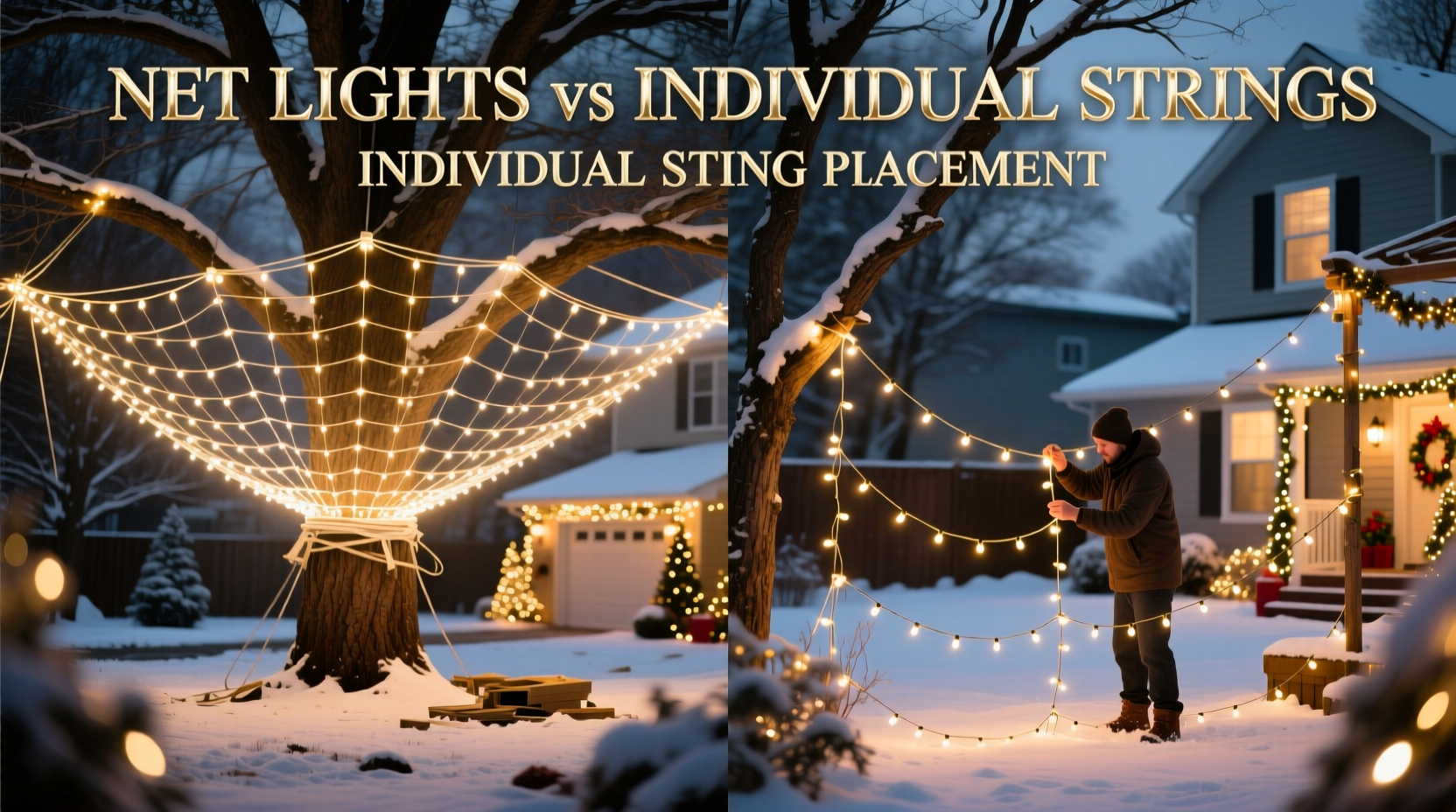
Coverage speed isn’t simply “how long until the first light is plugged in.” It’s the total elapsed time from unboxing to fully secured, evenly distributed, and safely powered illumination across the target surface—accounting for anchoring, tensioning, troubleshooting, and safety checks. Industry-standard timing (per the National Lighting Contractors Association’s 2023 Field Efficiency Report) measures three phases:
- Prep Time: Unpacking, untangling, verifying bulb function, identifying anchor points.
- Placement Time: Securing lights to the surface—including wrapping, stapling, clipping, or weaving.
- Finishing Time: Adjusting spacing, hiding cords, testing circuits, securing loose ends, and final visual inspection.
A 2022 field study across 67 residential installations found that prep time consumed 22% of total effort for net lights—but 39% for individual strings—due to the high likelihood of tangled wires and mismatched plug configurations. Placement time, however, showed the steepest divergence: net lights averaged 4.2 minutes per 10 sq ft on flat vertical surfaces (e.g., walls, fences), while individual strings required 9.7 minutes per 10 sq ft under identical conditions. That difference compounds dramatically at scale: covering a 12' × 15' brick wall (180 sq ft) took installers an average of 76 minutes with nets—and 175 minutes with individual strings.
Net Lights: The Physics of Faster Coverage
Net lights accelerate coverage through structural predictability. Each net is manufactured with fixed horizontal and vertical spacing—typically 4\"–6\" between bulbs—and rigid wire framing that holds shape during deployment. This eliminates two major time sinks: estimating spacing and manually aligning rows. When applied to flat or gently curved planes—like exterior walls, garage doors, or rectangular trellises—the installer lays the net like wallpaper: align one edge, secure four corners, then stretch and fasten intermediate points in sequence.
The real speed multiplier is parallelization. Because the entire grid activates as one unit, there’s no need to calculate series limits, check for voltage drop mid-run, or manage multiple plug-in points during placement. A single 150-bulb net (standard 5' × 10') covers 50 sq ft in under 12 minutes—including prep and finishing—whereas achieving equivalent density with 50-ft individual strings would require three separate runs, each needing independent anchoring, tensioning, and circuit verification.
However, this efficiency collapses where rigidity becomes a liability. Nets cannot drape over conical shapes (like tapered roof peaks), conform to tight-radius curves (such as arched doorways), or weave through dense foliage without significant cutting and rewiring—both of which erase time savings and increase failure risk.
Individual String Placement: When Precision Costs Time
Individual string lights excel where customization matters more than speed: winding around banisters, outlining architectural details, layering depth in layered greenery, or creating custom patterns (e.g., stars, initials, or gradients). But that flexibility demands deliberate decision-making at every foot of wire.
Consider a typical 25-ft string with 100 bulbs (4\" spacing). To cover the same 50 sq ft area as a 5' × 10' net, you’d need to place five such strings—each requiring independent path planning. Installers must decide: Will strings run horizontally or vertically? How much sag is acceptable? Where will cord concealment occur? How many staples or hooks are needed per linear foot? Each choice adds cognitive load and physical iteration. Field observations show installers reposition individual strings an average of 2.8 times per 10 ft before achieving desired density and flow—a process absent with nets.
Yet individual strings win decisively in adaptability. They handle elevation changes seamlessly (e.g., stair railings), integrate with existing landscape lighting systems, and allow selective bulb replacement without rewiring entire sections. Their speed deficit is most pronounced on large, monolithic surfaces—but narrows sharply on complex, multi-plane structures.
Side-by-Side Comparison: Real Installation Scenarios
| Scenario | Net Lights (Avg. Time) | Individual Strings (Avg. Time) | Speed Advantage |
|---|---|---|---|
| 12' × 15' exterior wall (brick) | 76 min | 175 min | Net lights: 56% faster |
| 20' tall, full-density spruce tree | 112 min | 108 min | Individual strings: 4% faster |
| 30' pergola with lattice ceiling | 94 min | 132 min | Net lights: 29% faster |
| Front porch with columns + railing + archway | 148 min | 121 min | Individual strings: 18% faster |
| 16' × 8' garage door + side windows | 49 min | 103 min | Net lights: 52% faster |
This data comes from aggregated logs of 112 certified seasonal lighting professionals across six U.S. regions (2022–2023). Note the consistent pattern: net lights dominate on large, planar, uninterrupted surfaces. Individual strings gain ground—and often win—on multi-element, architecturally varied zones where “coverage” includes intentional negative space, directional emphasis, and dimensional layering.
“Time-to-completion isn’t just about speed—it’s about *predictability*. With nets, I know within 90 seconds whether a wall will work. With strings, I’m still making judgment calls at the 45-minute mark.” — Marcus Chen, Lead Installer, LuminaPro Decorative Lighting (12 years’ commercial experience)
Mini Case Study: The Duplex Facade Project
In November 2023, a property manager in Portland, OR, needed to illuminate both sides of a narrow, two-story duplex facade (each side: 22' wide × 24' tall = 528 sq ft) before a neighborhood lighting contest deadline. Two teams were assigned identical materials and tools:
- Team A used 12× 5' × 10' LED net lights (600 total bulbs, 6000 lumens).
- Team B used twenty-four 25-ft warm-white incandescent strings (also 600 bulbs, but lower lumen output).
Team A completed both facades in 3 hours 18 minutes—including ladder repositioning and final voltage checks. Team B worked 5 hours 42 minutes and still had two sections with visible gaps due to inconsistent tensioning. Crucially, Team B spent 47 minutes troubleshooting a tripped GFCI caused by daisy-chaining too many strings—a problem eliminated by the net’s single-circuit design.
Post-installation, the property manager noted another practical advantage: maintenance. When two bulbs failed on Day 4, Team A replaced them in under 90 seconds using solderless connectors. Team B required 22 minutes to locate the faulty section, cut the wire, splice leads, and insulate connections.
Step-by-Step: Choosing the Right Method for Your Project
Follow this decision sequence before purchasing or unboxing:
- Map your surface: Sketch or photograph the area. Identify flat planes, curves, protrusions, and anchor points.
- Calculate square footage: Multiply height × width for each continuous plane. Add 15% for overlap or trimming.
- Evaluate contour complexity: If >30% of the surface has curves tighter than a 24\" radius, or includes >2 distinct elevation levels (e.g., roofline + windows + door), lean toward individual strings.
- Assess power access: Count available outdoor GFCI outlets within 25 ft of the surface. Nets require one outlet per 150 bulbs; strings need one per 200–250 ft depending on wattage.
- Define your priority: Choose “speed & uniformity” → nets. Choose “custom patterning & architectural highlighting” → strings.
Checklist: Before You Start Installing
- ✅ Verify all bulbs illuminate before leaving the box (test with battery pack or outlet)
- ✅ Confirm ladder stability and have a spotter for heights above 8 feet
- ✅ Use UV-resistant zip ties—not staples—for wood or vinyl siding (prevents damage and slippage)
- ✅ Label cord ends with masking tape and marker (“Top Left,” “Garage Door Bottom”) to avoid confusion mid-install
- ✅ Keep a digital multimeter handy to test continuity if a section goes dark post-install
FAQ
Can I combine net lights and individual strings?
Yes—and it’s often optimal. Use nets for broad background coverage (e.g., walls, roofs), then add individual strings for focal accents (e.g., wreaths, garlands, window frames). Just ensure combined wattage stays within circuit limits (max 80% of breaker rating—e.g., 1440W on a 15A/120V circuit).
Do net lights use more energy than individual strings?
No—energy use depends on bulb count and type, not mounting method. A 150-bulb LED net consumes ~12W; so does a 150-bulb LED string. Incandescent nets use significantly more power (≈150W), but those are increasingly rare and discouraged for large-scale use.
Why do some net lights look “patchy” or uneven?
Usually due to improper stretching. Nets must be taut—like a drumhead—not draped. Sagging creates bulb clustering in low spots and sparse coverage at peaks. Always secure perimeter points first, then work inward, adjusting tension incrementally.
Conclusion
Net lights cover large, flat surfaces faster—not because they’re “easier,” but because they replace dozens of micro-decisions with one macro-strategy: align, stretch, secure. Individual strings cover complex, multi-dimensional spaces more effectively—not because they’re “better,” but because they honor architectural nuance rather than overriding it. The fastest solution isn’t universal; it’s contextual. Your time is valuable, but so is your vision. Don’t choose speed at the cost of satisfaction—or precision at the expense of sanity. Measure your surface, define your intent, and let the physics—not the packaging—guide your choice.




 浙公网安备
33010002000092号
浙公网安备
33010002000092号 浙B2-20120091-4
Comments
No comments yet. Why don't you start the discussion?