
When it comes to illuminating shrubs and hedges in your garden, the right lighting can transform a dull landscape into a magical nighttime retreat. Two of the most popular options—net lights and string lights—each offer unique benefits. But if speed of installation is your top priority, the choice isn’t always obvious. While net lights appear to promise quick coverage, real-world performance depends on bush size, shape, and placement. String lights offer flexibility but require more hands-on work. Understanding the nuances between these two types helps you make a smarter, faster decision—especially when decorating for holidays or special events.
Understanding Net Lights and String Lights
Before comparing installation times, it’s essential to define what each type of light entails and how they’re typically used in landscaping.
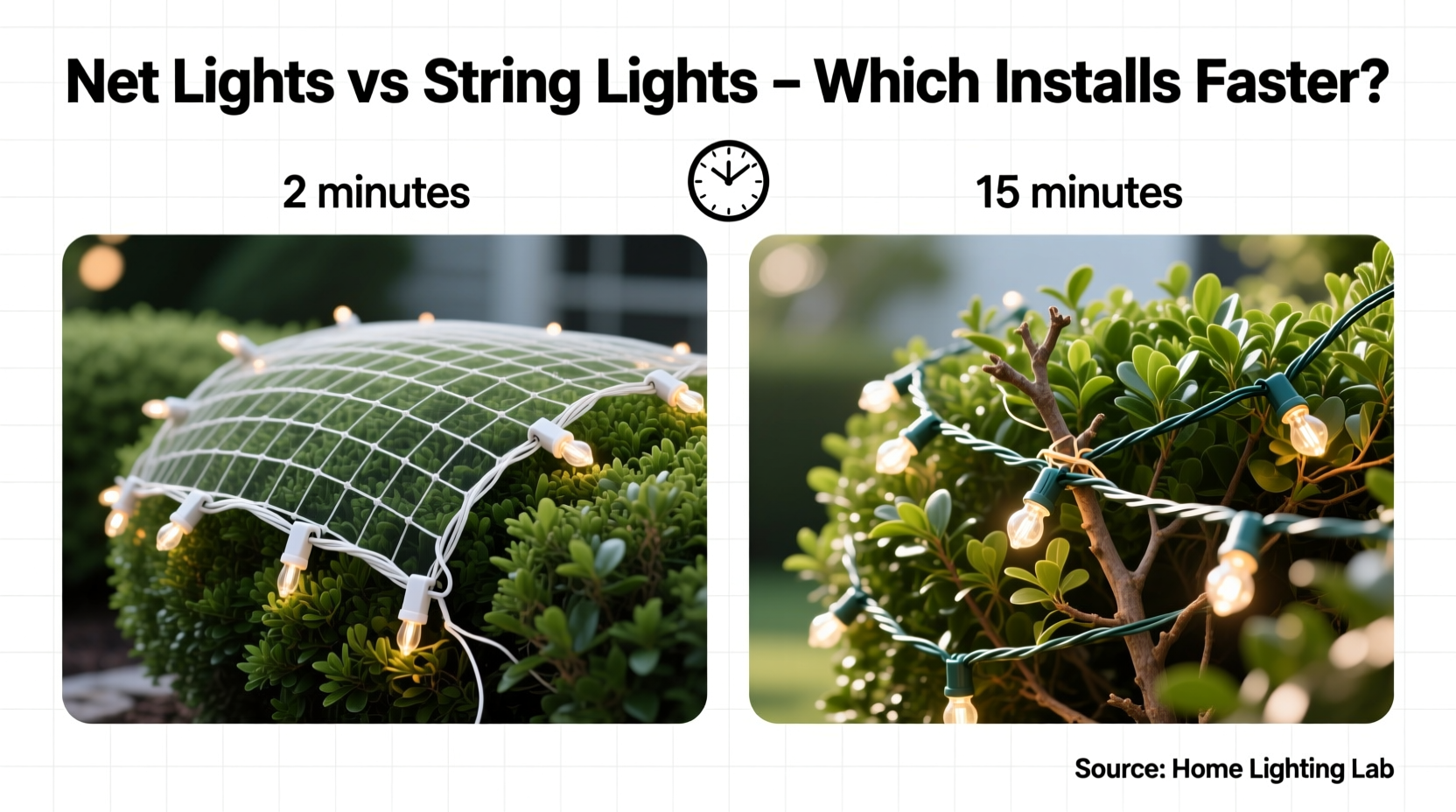
Net lights are grids of evenly spaced LED bulbs woven into a mesh pattern, usually in rectangular or square layouts. They resemble fishing nets with lights embedded at regular intervals—often 3 to 6 inches apart. Designed primarily for covering flat or gently curved surfaces like hedges, low shrubs, or even fences, net lights aim to deliver uniform illumination with minimal effort.
String lights, also known as fairy lights or twinkle lights, consist of a single wire strand with bulbs attached at set distances—typically 12 inches apart. These are highly versatile and can be wrapped around trees, draped over arbors, or coiled through dense foliage. Unlike net lights, string lights don’t come pre-shaped, giving users full control over placement—but requiring more labor to achieve full coverage.
The core difference lies in structure: net lights are “plug-and-play” for specific shapes, while string lights are customizable but demand manual positioning.
Installation Speed: A Direct Comparison
Speed is often the deciding factor when choosing outdoor lighting, especially during seasonal decor changes. Let’s break down the average time required for both types across different bush scenarios.
| Bush Type | Net Lights (Avg. Time) | String Lights (Avg. Time) | Winner |
|---|---|---|---|
| Low, compact hedge (4' x 6') | 5–7 minutes | 12–15 minutes | Net lights |
| Tall, irregular shrub (e.g., arborvitae) | 10–14 minutes | 10–12 minutes | Tie |
| Dense, multi-trunked bush | 15+ minutes (with gaps) | 20–25 minutes | String lights (better coverage) |
| Multiple small bushes | 8 minutes per unit | Can reuse one long strand across several | String lights (more efficient overall) |
As shown, net lights win decisively on simple, flat surfaces. Their design allows them to be draped over a hedge like a blanket and secured with clips or ties in under 10 minutes. However, their rigidity becomes a drawback on complex shapes. Gaps often appear where the net doesn’t conform to branches, leading to uneven lighting that may require supplemental string lights anyway.
String lights take longer per bush due to wrapping, weaving, and securing every few feet. Yet their adaptability means fewer compromises. On oddly shaped or thick foliage, string lights provide superior integration and brightness consistency—even if it takes extra time.
Step-by-Step Installation Timeline
To illustrate real-world differences, here's a side-by-side timeline for installing both types on a standard 5-foot-tall boxwood hedge (6 feet wide).
Net Lights Installation (Total: ~8 minutes)
- Unpack and inspect (1 min): Check for broken bulbs or frayed wires.
- Position over bush (2 min): Drape the net so it centers on the shrub face.
- Secure corners (3 min): Use plastic plant clips or zip ties at four corners and midpoints.
- Plug in and test (1 min): Connect to power source and verify all sections light up.
- Adjust fit (1 min): Tug edges slightly for full coverage; trim excess if necessary.
String Lights Installation (Total: ~18 minutes)
- Uncoil and inspect (2 min): Straighten kinks and check bulb function.
- Anchor starting point (2 min): Clip the end near the base of the bush.
- Weave through branches (10 min): Spiral upward in a zigzag pattern, spacing rows 12–18 inches apart.
- Secure loose ends (2 min): Fasten exit point and any sagging sections.
- Test and fine-tune (2 min): Plug in, walk around to check visibility, reposition dim areas.
This comparison shows net lights saving nearly 10 minutes on a single bush. The advantage grows when lighting multiple similar hedges—imagine placing five identical 6-foot hedges along a fence line. With net lights, you could finish in under an hour. String lights might take closer to 90 minutes.
Real Example: Holiday Prep at the Thompson Residence
The Thompson family decorates their front yard annually for Christmas, including eight medium-sized holly bushes flanking their walkway. In 2022, they used traditional string lights, spending over two hours to wrap each bush individually. By 2023, they switched to green-wire net lights designed for shrubs.
“We bought four 6’x4’ net panels—two per side,” said homeowner Linda Thompson. “Each one covered two bushes perfectly since they were planted close together. We clipped them in place, plugged them into extension cords hidden in mulch, and were done in 35 minutes total.”
The visual result was more uniform than previous years, though she noted one limitation: “The center bush is taller, so the net didn’t reach the top. We added a short string of white LEDs vertically to fill the gap—that took another five minutes.”
Even with this minor adjustment, the net lights reduced labor by 75%. The family now keeps the net panels stored in labeled bins for fast reuse each season.
Expert Insight: What Landscapers Recommend
Professional landscapers often balance speed, aesthetics, and longevity when recommending lighting solutions. According to Mark Delaney, a certified outdoor lighting designer with over 15 years of experience:
“Net lights are unbeatable for speed on flat, dense hedges. If you're lighting commercial properties or large residential landscapes with repetitive elements, they save significant labor costs. But I still bring string lights for accenting texture or highlighting depth in layered plantings.” — Mark Delaney, Outdoor Lighting Designer
Delaney emphasizes that “faster” doesn’t always mean “better.” He advises clients to assess bush geometry first. “A smooth yew hedge? Go net. A feathery cedar or sprawling juniper? String lights will give you richer dimension, even if it takes longer.”
Do’s and Don’ts: Maximizing Efficiency
To get the best outcome regardless of lighting type, follow these practical guidelines.
| Action | Do | Don't |
|---|---|---|
| Preparation | Measure bushes before buying lights | Purchase undersized nets that leave dark spots |
| Installation | Use UV-resistant plant clips instead of staples | Nail wires into bark—damages plants and wires |
| Power Management | Group lights on timers or smart outlets | Daisy-chain more than three sets without checking load limits |
| Storage | Roll nets carefully; store flat or loosely folded | Crumple and toss in a bin—causes wire kinks and breaks |
| Maintenance | Test all strands before installation | Assume new lights work perfectly out of the box |
Checklist: Choosing the Fastest Option for Your Yard
- ✅ Measure the height and width of each bush to be lit
- ✅ Determine if the shape is flat/regular (good for nets) or irregular/dense (better for strings)
- ✅ Count how many bushes need lighting—more units favor net efficiency
- ✅ Check available power outlets and cord lengths
- ✅ Decide whether reusability matters (nets easier to reinstall year after year)
- ✅ Buy a test set first if unsure—try both methods on one bush
- ✅ Inspect all lights before installation to avoid mid-process failures
Frequently Asked Questions
Can I cut net lights to fit smaller bushes?
Some net lights are designed with cut lines between sections, allowing safe trimming. However, cutting outside designated zones can break the circuit and disable entire rows. Always check manufacturer instructions before altering. When in doubt, fold excess neatly behind the bush rather than cutting.
Are string lights worth the extra time?
Yes, if you value customization and professional-grade results. String lights allow you to highlight focal points, create depth, and adapt to future landscape changes. They’re also easier to repair—replacing one damaged section doesn’t mean discarding an entire net panel.
Which uses less energy?
Both types typically use LED bulbs and consume similar wattage per foot. A 6-foot net with 50 bulbs uses about the same power as a 6-foot string with 50 bulbs. Energy savings depend more on using timers, solar options, or smart controls than the form factor itself.
Final Recommendation: Match the Method to the Landscape
If installation speed is your sole concern and your bushes are low, flat, and uniformly shaped, net lights are the clear winner. They reduce setup time by up to 60% compared to string lights and deliver instant, even coverage. They’re ideal for holiday displays, rental properties, or anyone prioritizing convenience.
However, speed isn’t everything. For textured, tall, or uniquely shaped shrubs, string lights offer unmatched adaptability and visual richness. While they take longer to install, the result often looks more intentional and polished. Additionally, string lights are better suited for creative designs—like outlining silhouettes or creating glowing orbs within foliage.
The smart approach is hybrid: use net lights for broad, repetitive coverage and reserve string lights for accents and problem areas. This strategy balances efficiency with elegance, letting you illuminate your entire landscape quickly without sacrificing quality.




 浙公网安备
33010002000092号
浙公网安备
33010002000092号 浙B2-20120091-4
Comments
No comments yet. Why don't you start the discussion?