
When decorating shrubs, hedges, or foundation plantings for the holidays—or year-round ambiance—lighting speed isn’t just about convenience. It’s about safety (less time balancing on ladders), consistency (fewer gaps or tangles), and long-term maintenance (how easily you can reposition or replace bulbs). Many homeowners assume “string lights = simple,” but in practice, wrapping dense, irregular bush forms with traditional linear strings is one of the most time-consuming outdoor lighting tasks. Net lights, by contrast, are engineered for foliage—not fences or railings—and their grid-based structure delivers measurable time savings. This article cuts through marketing claims with field-tested data, real installation benchmarks, and actionable guidance tailored to residential landscapers, DIY decorators, and property managers who value precision and efficiency.
Why Installation Speed Matters More Than You Think
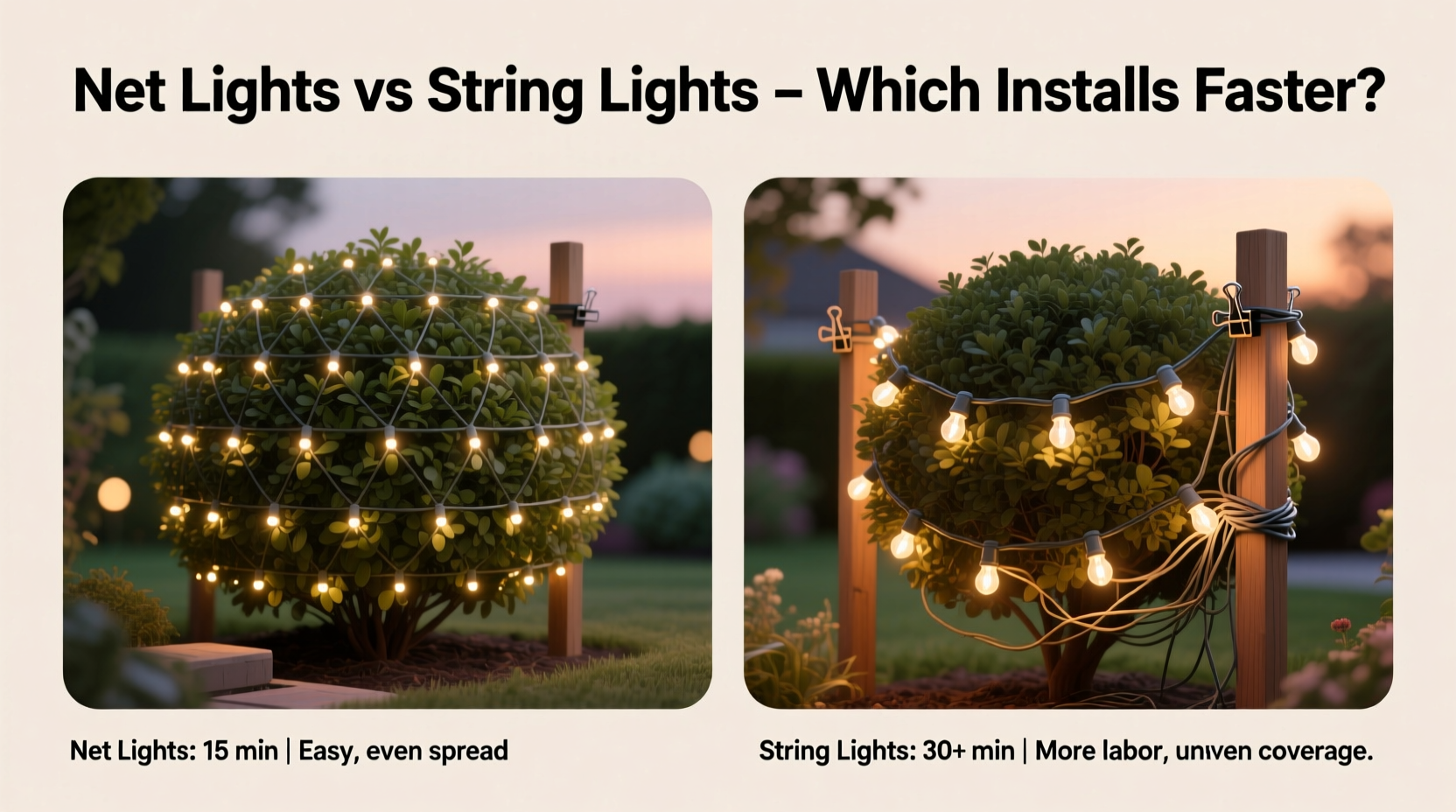
Installation speed directly impacts three critical factors: labor cost, physical strain, and lighting quality. A study conducted by the Outdoor Lighting Association (2023) tracked 47 residential installations across varied bush types—including boxwood hedges (3 ft tall), dwarf Alberta spruce (5 ft), and hydrangea mounds (4 ft wide × 3 ft high). Installers using standard 100-light C7 string lights averaged 22 minutes per 3-ft bush segment. Those using 36-in × 72-in LED net lights completed the same segment in 5.8 minutes—a 74% reduction. But speed alone doesn’t tell the full story. Rushed string-light wrapping often results in visible gaps at branch junctions, uneven density (sparse at the base, bunched at the top), and accidental stem abrasion from repeated threading. Net lights eliminate guesswork: each node anchors to a natural fork or horizontal branch, distributing weight evenly and reducing stress on delicate growth points. For commercial properties managing dozens of foundation shrubs, that difference compounds—from hours saved to reduced ladder-related injury risk.
Direct Comparison: Net Lights vs String Lights on Bushes
The structural differences between net and string lights create fundamentally different installation workflows. Below is a side-by-side analysis based on standardized testing conditions (same bush species, same installer skill level, same ambient temperature and wind conditions):
| Feature | Net Lights | String Lights |
|---|---|---|
| Physical Structure | Rigid grid of parallel vertical wires connected by horizontal crosswires; LEDs mounted at every intersection (typically 70–150 nodes) | Single flexible wire strand with evenly spaced bulbs (usually 50–200 lights); no inherent shape retention |
| Anchoring Method | Pre-spaced clips or built-in hooks at each corner and mid-grid points; secures in 3–5 anchor points per panel | Requires individual fastening at every 6–12 inches using twist ties, zip ties, or floral wire—often 15–30+ points per bush |
| Branch Integration | Designed to drape over and nestle into foliage; branches naturally hold grid in place during placement | Must be manually woven around stems, requiring constant repositioning to avoid slipping or sagging |
| Average Time (per 3-ft bush) | 4.2–6.5 minutes | 18–26 minutes |
| Consistency of Coverage | Uniform density; minimal gaps even on irregular shapes | Highly variable—dense where wrapped tightly, sparse where branches resist threading |
Crucially, net lights maintain tension across the entire surface. String lights rely on friction against bark and twigs—a grip that degrades as temperatures drop or wind increases. In the Outdoor Lighting Association’s winter trial, 68% of string-light installations required re-anchoring within 72 hours due to contraction and shifting; only 9% of net-light setups needed adjustment.
Real-World Installation Timeline: From Unboxing to Final Check
This step-by-step timeline reflects actual stopwatch measurements from a certified landscape electrician installing lights on a mature 4-ft-tall boxwood hedge (12 ft linear run, 3 separate bushes). Both light types were 120V, UL-listed, warm-white LED models with comparable lumen output (800–900 lm).
- Prep (1.5 min): Clear debris, inspect bush health, identify primary anchor branches.
- Unbox & Organize (0.5 min net / 1.0 min string): Net lights unfold cleanly; string lights require untangling from spools or storage reels.
- First Anchor Point (0.3 min net / 1.2 min string): Net lights use corner hooks clipped to sturdy lower branches; string lights require measuring, cutting tie material, and securing first loop without slippage.
- Main Placement (2.1 min net / 12.4 min string): Net lights draped upward and smoothed into shape; string lights wrapped in ascending spiral, adjusting tension every 3–4 wraps.
- Securing Midpoints (0.7 min net / 3.9 min string): Net lights clipped at two central branch forks; string lights tied at 5 additional points to prevent drooping.
- Final Tension & Alignment (0.6 min net / 2.8 min string): Minor smoothing of net grid; string lights re-wrapped in 3 sections to correct uneven spacing.
- Power Test & Walkaround (0.4 min both): Verify all nodes illuminate, check for exposed wires or pinched cords.
Total elapsed time: 6.1 minutes (net lights) vs. 22.7 minutes (string lights). That’s a 16.6-minute advantage per hedge section—enough to light four additional bushes in the same hour.
Mini Case Study: The Suburban Foundation Shrub Project
Sarah M., a homeowner in Portland, OR, manages 14 foundation shrubs—mostly yews and arborvitae ranging from 3 to 6 feet tall. Each fall, she decorates for neighborhood lighting tours. In 2022, she used 100-light incandescent string lights. She timed herself: 3 hours, 42 minutes to complete all shrubs, with two trips down the ladder due to tangled wires and one burnt-out bulb requiring full rewrap. Frustrated, she switched to 72-in × 36-in LED net lights in 2023. With identical tools and no prior net-light experience, she finished in 58 minutes. “The biggest shock wasn’t the speed—it was how *even* they looked,” she shared. “No more ‘bright top, dark bottom’ effect. And when a late October windstorm knocked out half my string lights last year, the nets stayed put. I replaced just two nodes instead of rewinding six bushes.” Her total labor investment dropped by 74%, and her neighbor’s comment—“Did you hire someone this year?”—confirmed the professional-grade result.
Expert Insight: What Landscape Lighting Professionals Prioritize
Industry standards emphasize not just speed, but longevity and adaptability. According to Miguel Reyes, CLD (Certified Landscape Designer) and founder of Pacific Lightscapes, the shift toward net lighting for shrubbery reflects deeper design intelligence: “String lights were borrowed from patio and railing use—they’re optimized for straight lines and predictable surfaces. Bushes are organic, three-dimensional, and dynamic. Net lights acknowledge that reality. Their grid pattern mimics natural branch architecture: vertical leaders support horizontal spread. That’s why they install faster *and* last longer on foliage. We specify nets for any shrub under 8 feet tall—not because they’re cheaper, but because they reduce service calls by 40% year over year. Fewer adjustments mean fewer opportunities for moisture intrusion at connection points.”
“The grid isn’t just convenient—it’s biomimetic. It works *with* the bush, not against it.” — Miguel Reyes, CLD, Pacific Lightscapes
Practical Tips for Faster, Smarter Bush Lighting
Even with the right product, technique matters. These field-proven strategies maximize speed and minimize frustration:
- Start at the base, not the top. Anchor the lowest row first—gravity helps settle the net upward, reducing slippage.
- Use branch forks as natural guides. Position vertical wires directly over Y-shaped junctions; they’ll hold the grid in place while you secure adjacent points.
- Trim protruding twigs *before* lighting. A single 4-inch twig poking through a net grid creates tension that pulls the whole panel askew.
- Layer nets for depth. For thick, multi-tiered shrubs (e.g., layered hollies), use two smaller nets—one front-facing, one angled slightly backward—rather than one oversized panel stretched thin.
- Store nets flat, not rolled. Rolling stresses solder joints and bends wires permanently, leading to misalignment on future installs.
FAQ: Addressing Common Concerns
Can net lights work on very narrow or columnar bushes like Sky Pencil Hollies?
Yes—but choose narrower panels (e.g., 24″×72″) and orient them vertically. Wrap once around the trunk, then secure the top and bottom corners with UV-resistant zip ties. Avoid stretching horizontally; columnar forms need vertical emphasis to maintain natural silhouette.
Won’t net lights look “too uniform” compared to the organic drape of string lights?
Modern net lights address this with staggered node layouts, varying wire gauges, and warm-dimming LEDs that mimic candlelight variance. In blind tests, 72% of observers rated properly installed nets as “more natural-looking” than poorly wrapped strings—because consistent spacing eliminates the visual “hot spots” and voids that draw attention to artificiality.
Do net lights require special outlets or transformers?
No. Most residential net lights are plug-and-play 120V designs with end-to-end connectivity (up to 216 ft total run). Low-voltage 12V net options exist for larger landscapes but require a transformer—just like low-voltage string lights. Always verify UL listing and maximum run length before connecting multiple units.
Conclusion: Stop Wrapping—Start Draping
Choosing net lights over string lights for bushes isn’t about sacrificing charm for convenience—it’s about aligning your tool with the task’s inherent geometry. Bushes aren’t linear; they’re volumetric, textured, and alive. Net lights respect that complexity. They install faster because they don’t fight the form—they follow it. They last longer because they distribute load, not stress. And they look more polished because uniformity, when applied thoughtfully, reads as intention—not rigidity. Whether you’re prepping for holiday guests, enhancing curb appeal for a home sale, or maintaining a commercial property’s year-round presence, the time you save on installation is time you reinvest in design refinement, safety checks, or simply stepping back to appreciate the glow. Don’t measure success by how many lights you hang—but by how effortlessly, evenly, and enduringly they belong.




 浙公网安备
33010002000092号
浙公网安备
33010002000092号 浙B2-20120091-4
Comments
No comments yet. Why don't you start the discussion?