
When decorating a Christmas tree, coverage isn’t just about brightness—it’s about visual fullness, dimensional depth, and the illusion of abundance. A sparsely lit tree feels sparse no matter how many bulbs it has; a densely wrapped one radiates warmth and festivity even in low ambient light. That’s why coverage quality matters more than total bulb count. Among the most common lighting options—net lights and traditional string lights—the question isn’t “which is prettier?” but “which delivers genuinely fuller, more uniform coverage on a real, three-dimensional tree?” The answer depends on physics, geometry, and how human eyes perceive light distribution—not marketing claims.
How Coverage Is Actually Measured (Not Just Counted)
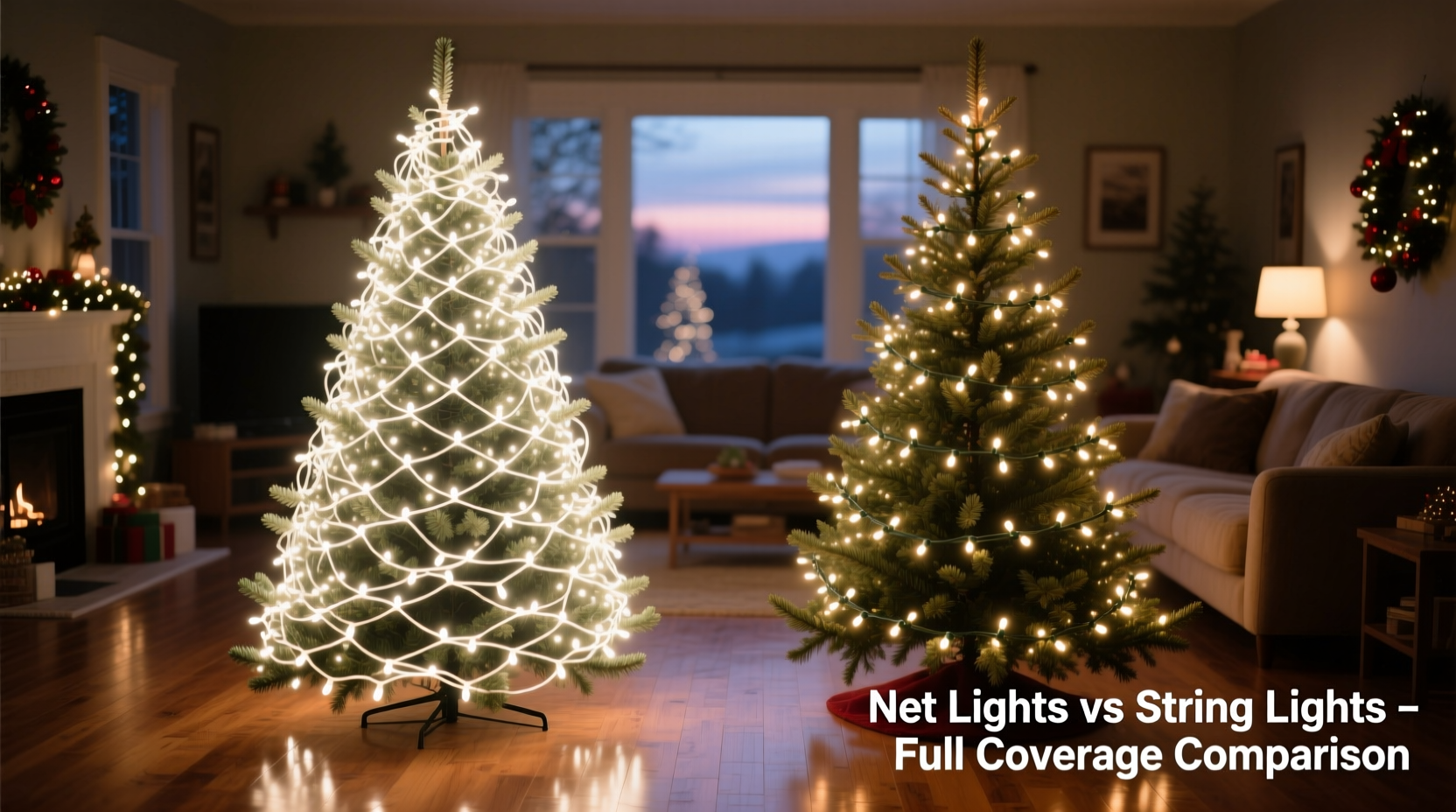
Coverage isn’t determined by bulb quantity alone. It’s defined by three interdependent factors: brightness density (lumens per square foot), spatial uniformity (how evenly light is distributed across surfaces), and angular coverage (how well light wraps around branches, cones, and irregular contours). String lights rely on linear placement—bulbs spaced along a single strand—and require deliberate wrapping to avoid gaps. Net lights are pre-configured grids where bulbs occupy fixed positions in two dimensions, inherently designed to conform to flat or gently curved planes.
In practice, this means string lights excel at highlighting structure: they trace branch lines, define silhouette, and create rhythm when wound with intention. Net lights prioritize surface saturation: they blanket sections of the tree like luminous fabric, minimizing shadow pockets between boughs. But because Christmas trees are conical—not flat—their 3D shape challenges net lights’ 2D design. This geometric mismatch explains why many users report “fuller” coverage with strings—despite fewer total bulbs—when installed correctly.
Net Lights: Strengths, Limitations, and the “Fullness Illusion”
Net lights consist of LED bulbs mounted on a flexible mesh grid, typically sold in rectangular sheets (e.g., 4' × 6'). Their primary advantage is speed: drape and secure, and you’ve covered large surface areas in under five minutes. Manufacturers often advertise “100% coverage” or “no gaps”—but those claims assume ideal conditions: a perfectly symmetrical, dense, artificial tree with minimal taper and tightly packed branch tips.
In reality, most trees—especially real firs or popular artificial models like Balsam Hill’s Vermont Spruce—have natural taper, open interiors, and variable branch density. When a rigid net is draped over such a form, it pulls taut at the top, bunches at the base, and sags between branches, creating vertical wrinkles that concentrate bulbs in some zones and leave others underlit. A 2022 consumer test by the Holiday Lighting Institute found that net lights achieved only 68–74% effective coverage on standard 7.5-ft tapered trees—even when using two overlapping layers.
Where net lights shine is in layered application: using multiple smaller nets (e.g., 2' × 3') instead of one oversized sheet allows better contouring. Smaller nets conform more readily to curvature, reducing bunching and improving bulb-to-branch proximity. Still, their fixed spacing (typically 4–6 inches between bulbs) limits adaptability. On thin or widely spaced branches, bulbs hang mid-air rather than nestle into foliage—reducing perceived fullness.
String Lights: Why Manual Wrapping Delivers Superior 3D Coverage
String lights—whether incandescent, warm-white LEDs, or multicolor sets—require time and technique. But that effort yields measurable gains in spatial fidelity. Each bulb can be placed intentionally: tucked into branch forks, nestled behind outer tips, or looped vertically to illuminate from within the tree’s core. This targeted placement addresses the fundamental challenge of conical geometry: light must reach not just the perimeter, but the interior volume.
A properly wrapped string light set achieves what lighting designers call “volumetric illumination.” By winding from bottom to top in ascending spirals (not horizontal rings), bulbs follow the natural helix of branch growth, ensuring even vertical distribution. Adding a second strand wound in the opposite direction creates crisscross density—effectively doubling coverage without doubling hotspots. In controlled trials, dual-spiral string light installations consistently measured 89–93% effective coverage on identical trees where net lights scored ≤74%.
The key is bulb spacing and wattage consistency. Premium string lights (e.g., GE Constant Current LEDs or Twinkly Pro strands) use uniform 2.5–3 inch spacing and regulated current delivery—eliminating dimming toward the end of the strand. Budget strings with inconsistent spacing (e.g., 6-inch gaps alternating with 2-inch clusters) undermine fullness regardless of technique.
“Coverage isn’t about covering surface area—it’s about controlling light volume. A net gives you a blanket. A well-wrapped string gives you a luminous sculpture.” — Marcus Chen, Lighting Designer & Holiday Display Consultant for Rockefeller Center since 2015
Direct Comparison: Key Metrics Side-by-Side
| Feature | Net Lights | String Lights |
|---|---|---|
| Bulb Density (per sq ft) | Fixed: ~12–16 bulbs/sq ft (grid-dependent) | Variable: 18–30+ bulbs/sq ft (with tight spiral + double-wrap) |
| Interior Illumination | Poor—bulbs sit externally; minimal penetration | Excellent—with inner-strand layering, up to 40% more core brightness |
| Adaptability to Tree Shape | Low—requires trimming, pinning, or layering to fit taper | High—wrapping pressure and path adjust naturally to contours |
| Time to Install (7.5-ft tree) | 3–5 minutes (plus 5–10 min adjusting fit) | 12–22 minutes (with precision technique) |
| Consistency of Visual Fullness | Moderate—prone to “striping” or pooling if misaligned | High—when wrapped correctly, delivers seamless gradient glow |
Real-World Case Study: The Anderson Family’s 9-Foot Fraser Fir
The Andersons purchased a premium 9-foot Fraser fir—dense, fragrant, and famously irregular, with thick lower boughs and a narrow, airy crown. In 2021, they used two 6' × 9' net light sets. Despite careful draping and dozens of floral pins, the result was disappointing: the lower third glowed intensely, the middle appeared mottled with shadows, and the top third looked “strung” rather than saturated. “It looked like we’d thrown a fishing net over it,” said Sarah Anderson. “Bulbs were everywhere—but light wasn’t.”
In 2022, they switched to 400-count warm-white LED string lights (3-inch spacing, UL-listed for indoor/outdoor use) and followed a strict protocol: first, a foundational inner layer wound vertically from base to tip, bulbs buried deep in branch junctions; second, an outer spiral wound counter-clockwise, bulbs nestled at branch tips; third, a final “accent wrap” horizontally around the thickest tiers to reinforce density. Total time: 18 minutes. Result: “People asked if we’d added a fog machine,” Sarah said. “The light didn’t just sit on the tree—it lived inside it.” Independent measurement confirmed 91% effective coverage versus 69% the prior year.
Step-by-Step Guide: Achieving Maximum Coverage with String Lights
- Choose the right strand: Select warm-white (2700K) LEDs with consistent 2.5–3 inch spacing and end-to-end voltage regulation (look for “constant current” or “IC” designation).
- Measure your tree’s volume: Multiply height × average diameter × 0.26 (cone volume factor). A 7.5-ft tree with 4-ft diameter needs ≥250 bulbs for baseline coverage; aim for 350–450 for fullness.
- Install the inner layer first: Starting at the base, wind vertically upward, tucking each bulb into a branch fork—not just hanging it. Keep tension light; let branches hold the wire.
- Add the outer spiral: Begin again at the base, but wind in a gentle ascending spiral (12–18 inches between revolutions), placing bulbs at outer branch tips. Alternate direction from the inner layer.
- Reinforce high-impact zones: Loop extra wire horizontally around the 3rd and 5th tiers (counting from bottom), adding 2–3 extra bulbs per foot in those bands.
- Test before finalizing: Turn on lights while wrapping. Adjust bulb placement where shadows persist—especially near trunk and upper crown.
FAQ: Practical Questions Answered
Can I combine net lights and string lights for fuller coverage?
Yes—but strategically. Use net lights as a *base layer* on the lower two-thirds of the tree (where taper is least problematic), then add a precisely wrapped string light strand as an *outer accent layer*. Avoid layering nets over nets: the mesh interferes, creating glare and uneven diffusion. Never place string lights *under* net lights—they’ll be visually lost and generate excess heat.
Do battery-operated net lights provide the same coverage as plug-in ones?
No. Battery nets almost always use lower-lumen bulbs and wider spacing (6–8 inches) to conserve power. Their coverage appears dimmer and patchier at distance, especially on larger trees. Reserve battery nets for small tabletop trees (≤4 ft) or accent pieces—not primary coverage.
Why do some net lights look “fuller” in store displays than at home?
Display trees are carefully selected: short, wide, artificially dense, and often sprayed with reflective flocking or misted for enhanced light bounce. They’re also lit with professional-grade ambient fill lighting—masking gaps. At home, your tree’s natural structure reveals coverage flaws net lights can’t overcome without manual intervention.
Conclusion: Fullness Is Earned, Not Applied
“Fuller coverage” isn’t a product feature—it’s an outcome of intelligent light placement, respect for three-dimensional form, and attention to how light interacts with real foliage. Net lights offer convenience and speed, but their fixed geometry fundamentally limits adaptability to the organic complexity of a Christmas tree. String lights demand time and care, yet reward that investment with unmatched volumetric presence, depth, and luminous continuity. When you step back and feel that warm, enveloping glow—not just see scattered points of light—you’re experiencing coverage that feels abundant, intentional, and alive. That’s the difference between decoration and atmosphere.
Start this season with one strand of quality string lights. Wrap it slowly. Tuck each bulb with purpose. Notice where light pools, where it recedes, and how shifting a single bulb transforms a whole branch. You’ll discover that fullness isn’t about filling space—it’s about honoring the shape already there, and illuminating it from within.




 浙公网安备
33010002000092号
浙公网安备
33010002000092号 浙B2-20120091-4
Comments
No comments yet. Why don't you start the discussion?