
When it comes to decorating a Christmas tree, few details matter more than lighting. The right lights can transform a simple evergreen into a glowing centerpiece that radiates warmth and holiday spirit. But achieving that ideal, evenly lit look isn’t just about brightness or color—it’s about how the lights are arranged and applied. Two popular options dominate the market: net lights and string lights. While both illuminate, they differ significantly in structure, ease of use, and effectiveness for full tree coverage. Understanding these differences helps you make an informed choice that saves time, reduces frustration, and enhances visual impact.
Understanding Net Lights and String Lights
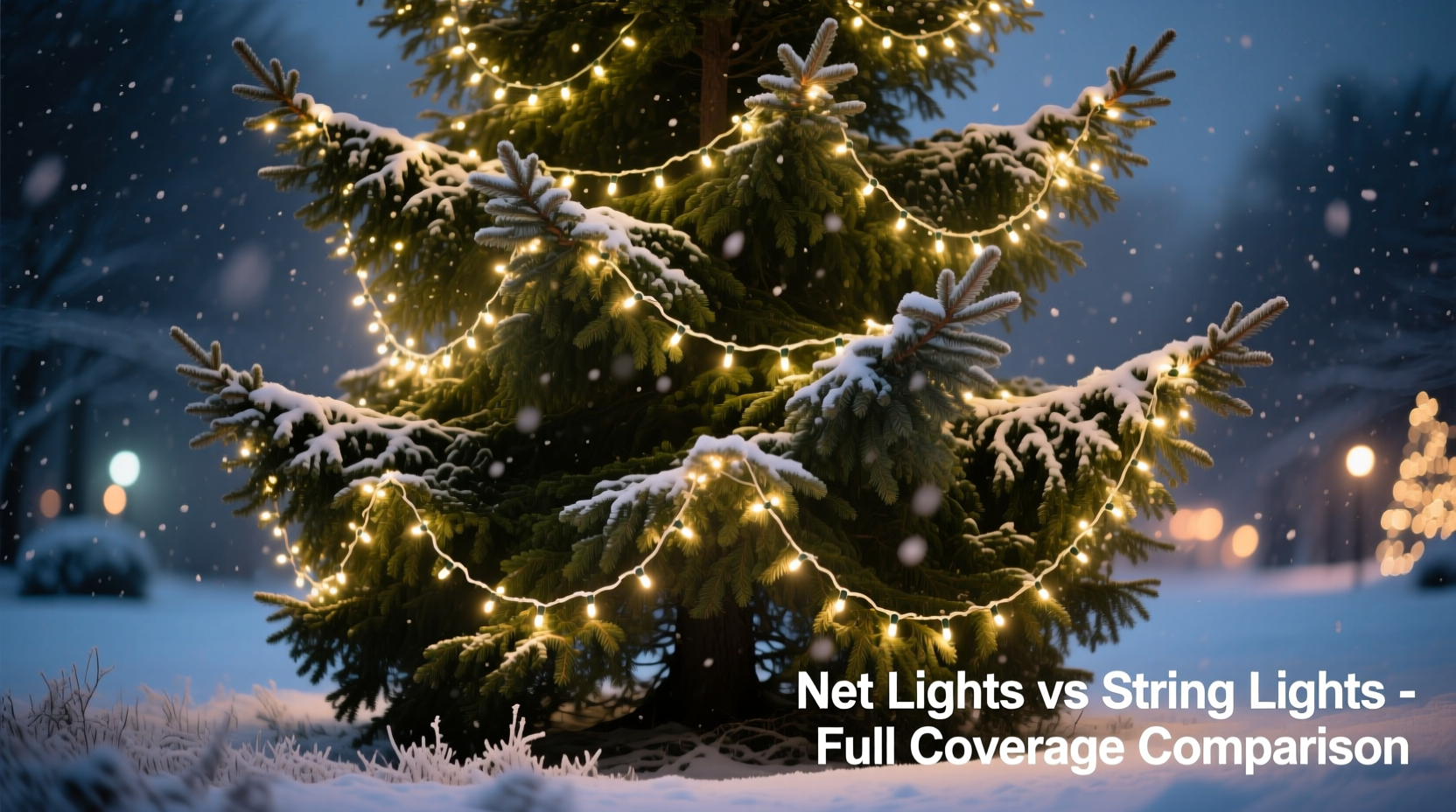
Before comparing performance, it's essential to define what each type is and how it functions.
Net lights consist of strings of mini lights pre-attached to a mesh or net-like framework, typically made of thin, flexible wire or plastic. The bulbs are spaced at regular intervals—commonly 3, 6, or 12 inches apart—forming a grid pattern. This design allows the entire net to be draped over bushes, trees, or other large surfaces quickly, creating a uniform blanket of light.
String lights, by contrast, are linear strands of lights connected end-to-end. They come in various lengths and bulb densities and require manual wrapping around the tree’s branches from base to tip. This method offers greater control over placement but demands more time and precision to avoid dark spots or clumping.
While both types use similar LED or incandescent bulbs, their application methods lead to vastly different outcomes—especially when aiming for complete, seamless coverage on a Christmas tree.
Key Differences in Coverage and Aesthetics
The primary goal for most decorators is full, even illumination without visible gaps or clusters. Achieving this depends heavily on how well the lights integrate with the tree’s shape and density.
Net lights excel in delivering consistent, all-over coverage. Because the bulbs are fixed in a grid, draping a net over a tree naturally distributes light across its surface. When used correctly, especially on fuller artificial trees, net lights create a “glowing from within” effect, minimizing shadowed areas. Their strength lies in speed and uniformity—ideal for those who prioritize efficiency and symmetry.
String lights, however, offer depth and dimension. By weaving them through inner branches and layering spirals outward, decorators can build a three-dimensional lighting effect. This technique highlights texture, adds depth, and allows for accent lighting on specific sections. However, poor wrapping technique often leads to uneven distribution—one side brighter than the other, or a dense cluster at the top tapering off toward the base.
Comparison Table: Net Lights vs String Lights
| Feature | Net Lights | String Lights |
|---|---|---|
| Coverage Uniformity | Excellent – consistent spacing ensures even glow | Variable – depends on skill and attention to detail |
| Installation Time | Fast – minutes per section | Slow – 30+ minutes per tree |
| Tree Compatibility | Better for bushy, rounded trees; less effective on slim or irregular shapes | Adaptable to any tree shape or size |
| Customization | Limited – fixed pattern restricts creative control | High – adjustable density, directional emphasis |
| Storage & Tangle Risk | Low – flat, compact storage; minimal tangling | High – prone to knots if not coiled carefully |
| Cost (per foot) | Moderate to high – higher upfront cost | Low to moderate – widely available at multiple price points |
| Best For | Outdoor shrubs, full artificial trees, quick indoor setups | Detailed displays, real trees, layered lighting effects |
Step-by-Step Guide: Applying Each Type for Full Tree Coverage
Using Net Lights
- Measure your tree: Determine height and widest diameter. Choose a net light size that matches or slightly exceeds these dimensions.
- Lay out the net: Unroll it flat on the floor to check for burnt-out bulbs or damage.
- Start at the top: Drape the first section over the upper third of the tree, aligning the center of the net with the trunk.
- Adjust outward: Gently stretch the net down and around the sides, letting the grid conform to the branches. Avoid pulling too tightly.
- Layer if needed: For thicker trees, overlap a second net vertically or horizontally to eliminate gaps.
- Plug in and test: Connect to power and inspect for dark zones. Shift branches or reposition the net as necessary.
Using String Lights
- Begin at the base: Attach the plug end to the bottom of the trunk using twist ties or hidden clips.
- Work inward first: Route the cord toward the center of the tree, securing lights along interior branches to create internal glow.
- Spiral upward: Move in a continuous clockwise or counterclockwise path, maintaining even spacing (about 4–6 inches between loops).
- Vary depth: Alternate between inner and outer branches to prevent flat appearance and enhance dimension.
- Use the “hand rule”: Insert your hand into the tree every few feet; if you can’t see the bulb when your palm faces outward, add another strand there.
- Finish at the top: Conceal the end near the tree topper or secure it behind a branch.
Real-World Example: A Decorator’s Dilemma
Consider Sarah, a homeowner in Portland who decorates her 7.5-foot pre-lit artificial tree every November. In past years, she used traditional string lights, spending nearly two hours wrapping and adjusting. Despite her efforts, guests often remarked that the left side looked dimmer. Last year, she tried green-wire net lights designed for trees of her size.
The difference was immediate. She draped the net in under ten minutes. The result? A balanced, radiant glow with no noticeable weak spots. Her only adjustment was adding a single vertical strip of warm white string lights down the back to enhance depth—a hybrid solution that gave her the best of both worlds.
Sarah’s experience reflects a growing trend: decorators embracing net lights for speed and consistency, then supplementing with strategic string lighting for dimension. This approach combines efficiency with artistry, particularly effective for families with limited decorating time.
Expert Insight: What Industry Professionals Recommend
“Net lights are fantastic for achieving instant, even coverage—especially on artificial trees with uniform branching. But for a truly professional finish, I always layer in some hand-placed string lights to break up the flatness and add sparkle.” — Daniel Reeves, Professional Holiday Lighting Designer
Reeves, who has designed lighting displays for retail chains and luxury homes, emphasizes balance. He notes that while net lights reduce labor costs and ensure consistency across multiple trees, they lack the dynamic variation that makes high-end displays stand out. His standard practice is to use net lights as a base layer, then apply secondary string lights to highlight focal points like ornaments or garlands.
“For real trees, skip net lights altogether. The irregular shape and soft needles make it hard for nets to stay in place. String lights give you the flexibility to weave through thick branches and anchor securely.” — Maria Lopez, Landscape Lighting Consultant
Checklist: Choosing the Right Option for Your Tree
- ☐ Measure your tree’s height and width before purchasing lights
- ☐ Decide whether speed or customization is more important to you
- ☐ Check bulb spacing—6 inches or less is ideal for full coverage
- ☐ Ensure compatibility with existing tree structure (e.g., pre-lit trees may need supplementary lighting)
- ☐ Test all lights before installation to avoid mid-process failures
- ☐ Consider combining both types: net for base coverage, string for accents
- ☐ Choose warm white for traditional elegance, cool white for modern brightness, or multicolor for festive fun
- ☐ Verify outdoor rating if using near windows, doors, or damp environments
Common Pitfalls and How to Avoid Them
Even experienced decorators make mistakes. With net lights, one common error is forcing the net onto a tree that’s too narrow or tall, resulting in stretched gaps and sagging sections. To prevent this, choose nets specifically labeled for tree use and consider buying multiple smaller panels instead of one oversized sheet.
For string lights, the biggest issue is “lollipop effect”—a dense ring of lights circling the outer edge while the center remains dark. This occurs when lights are wrapped only around the perimeter without penetrating inward. The fix is simple: treat the tree like a cone, moving from inside out and varying depth with each pass.
Another frequent oversight is ignoring bulb burnout. A single dead bulb in an older incandescent strand can darken an entire section. Modern LED sets often isolate failures, so upgrading to LED improves reliability and energy efficiency.
Frequently Asked Questions
Can I use net lights on a real Christmas tree?
It’s possible, but not recommended. Real trees have uneven shapes, soft needles, and shifting branches, making it difficult for net lights to stay in place. They may slip, tear, or leave large uncovered areas. String lights are far more adaptable and secure for natural trees.
How many sets of lights do I need for full coverage?
A general rule is 100 lights per foot of tree height. For a 6-foot tree, that means 600 lights minimum. If using net lights, ensure the total coverage area exceeds the tree’s surface. With string lights, aim for 3–4 wraps around the tree per foot of height.
Are net lights safe for indoor use?
Yes, as long as they are UL-listed for indoor use and you follow manufacturer instructions. Most modern net lights use low-voltage LEDs, which run cooler and consume less energy than traditional bulbs. Always inspect cords for damage and avoid overloading circuits.
Final Recommendation: Match the Light to Your Needs
The choice between net lights and string lights ultimately hinges on your priorities: time, control, and aesthetic goals. If you value speed, simplicity, and uniform brightness—especially on a full artificial tree—net lights are an excellent solution. They reduce setup time dramatically and deliver reliable, photogenic results with minimal effort.
However, if you enjoy the ritual of decorating, want full creative control, or are working with a real or uniquely shaped tree, string lights remain the superior choice. Their flexibility allows for artistic expression, layered effects, and deeper illumination.
Many professionals now advocate a hybrid model: use net lights as a foundational layer to cover broad areas efficiently, then enhance with targeted string lights to add sparkle, depth, and personality. This method balances practicality with polish, giving you a display that looks professionally done without requiring professional-level time investment.
No matter which route you take, proper planning, quality materials, and attention to detail will ensure your tree shines brightly throughout the season.




 浙公网安备
33010002000092号
浙公网安备
33010002000092号 浙B2-20120091-4
Comments
No comments yet. Why don't you start the discussion?