
When it comes to decorating a Christmas tree, few decisions impact both appearance and effort as much as the type of lights used. Net lights and string lights are two popular options, each with distinct advantages. While both can create a magical glow, they differ significantly in how quickly and completely they cover a tree. The right choice depends on your priorities—speed, fullness, control, or customization. Understanding these differences helps ensure your holiday display shines without consuming hours of setup time.
Understanding Net Lights and String Lights
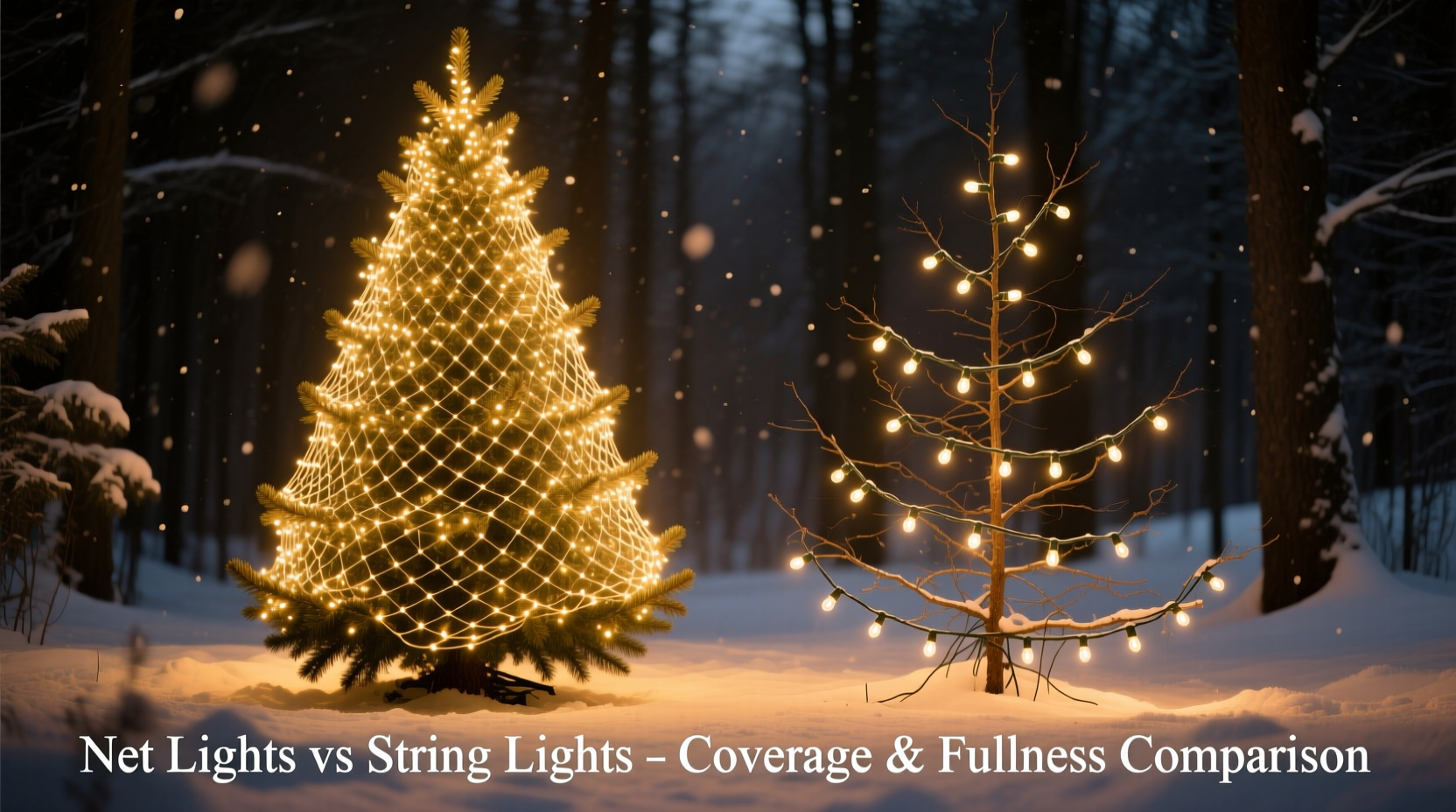
Before comparing performance, it's essential to understand what defines each type.
Net lights consist of strings of bulbs woven into a grid pattern, resembling a fishing net. They are pre-assembled with consistent spacing—typically 6 to 12 inches between bulbs—and come in various colors and bulb types (LED or incandescent). Designed for quick coverage, they’re commonly used on artificial trees and outdoor shrubs.
String lights, by contrast, are linear strands that must be manually wrapped around the tree. Available in multiple lengths—from 25 to over 300 bulbs per strand—they offer flexibility in placement but require more labor to achieve even distribution.
The fundamental difference lies in application: net lights are a \"throw-and-go\" solution, while string lights demand precision and patience. This distinction shapes everything from setup time to final aesthetic.
Coverage Speed: How Quickly Each Type Covers a Tree
Speed is often the deciding factor for busy households or last-minute decorators. When measured by minutes spent, net lights consistently outperform string lights.
A standard 6-foot artificial tree can be fully covered with net lights in under 10 minutes. The process involves draping the net over the outer branches like a blanket and adjusting slightly for alignment. No wrapping, no tucking—just positioning.
String lights, however, take significantly longer. To achieve balanced illumination, decorators typically wrap each strand in a spiral from top to bottom, weaving inward and outward to avoid dark spots. For the same 6-foot tree, this method takes 30 to 45 minutes, depending on experience and desired density.
This efficiency makes net lights ideal for renters, event planners, or anyone managing multiple trees. However, speed doesn’t always equate to superior results—especially when fullness and dimensionality matter.
Visual Fullness: Density and Depth of Light Distribution
While net lights win in speed, string lights often deliver a richer, more immersive glow. The reason lies in three-dimensional coverage.
Net lights only illuminate the outer surface of the tree. Because they lie flat against the tips of the branches, the inner layers remain darker. On sparse or open-framed trees, this can result in a “shell” effect—bright on the outside, hollow within.
String lights, when applied correctly, penetrate deep into the canopy. By weaving strands through multiple branch levels, light is distributed throughout the tree’s volume. This creates a glowing core that enhances depth, especially in low-light rooms.
Fullness also depends on bulb count and spacing. A typical net light panel has 50–100 bulbs. To match that brightness with string lights, you’d need 2–3 strands of 50 lights each. But because those strands can be layered, the cumulative effect appears denser and more dynamic.
“With string lights, you're not just lighting the tree—you're sculpting light within it.” — Daniel Reyes, Professional Holiday Decorator
Comparison Table: Net Lights vs String Lights
| Feature | Net Lights | String Lights |
|---|---|---|
| Setup Time (6-ft tree) | 5–10 minutes | 30–45 minutes |
| Coverage Pattern | Surface-only (flat layer) | 3D penetration (layered) |
| Bulb Spacing | Fixed (e.g., 8” apart) | Adjustable via wrapping technique |
| Customization | Low (pre-assembled) | High (placement control) |
| Best For | Fast decor, outdoor bushes, uniform look | Show trees, depth, custom designs |
| Storage | Bulkier due to rigid shape | Compact when coiled properly |
Real-World Example: Two Homes, Two Approaches
Consider two families preparing their holiday trees on the same weekend.
The Thompsons have three young children and work full-time. Their priority is efficiency. They choose green-net LED lights for their 7-foot pre-lit artificial tree. In under 15 minutes, the net is draped and secured with a few clips. The result is bright, uniform, and festive—perfect for their bustling household. Guests notice the cheerful glow, though one comments that the tree “looks flatter than last year.”
The Garcias, meanwhile, treat tree decorating as a tradition. They spend an evening together carefully wrapping 150 warm-white string lights around their 6.5-foot flocked tree. Starting at the trunk and spiraling outward, they place bulbs closer near the center and space them evenly toward the tips. After 40 minutes, the tree glows from within, casting soft shadows and creating a cozy ambiance. Photos taken at night highlight its dimensional brilliance.
Both trees are beautiful—but reflect different values. The Thompsons prioritized speed and simplicity; the Garcias invested time for depth and warmth.
Step-by-Step Guide: Maximizing Coverage with Either Option
Whichever type you choose, proper technique improves results.
Using Net Lights Effectively
- Measure your tree’s height and width to select the correct net size. Most nets fit trees up to 6 or 7 feet.
- Lay the net flat before placing it to avoid tangles.
- Drape from the top down, aligning the top edge with the tree’s peak.
- Adjust branch tips to ensure bulbs are visible and not buried.
- Add accent lights inside (e.g., a short string) to reduce hollowness.
Using String Lights for Maximum Fullness
- Start with the tree unplugged and place the plug near the outlet.
- Begin at the top-center trunk and work downward in a spiral.
- Weave lights deep into branches, not just along the outer edges.
- Use the hand-over-hand method: alternate hands every few seconds to maintain even tension.
- Layer multiple strands if needed, staggering starting points to avoid clustering.
- Step back frequently to check for dark zones and adjust accordingly.
Hybrid Approach: Best of Both Worlds
Many professionals combine net and string lights to balance speed and quality.
They begin with a set of net lights over the outer layer for instant brightness and uniformity. Then, they weave one or two strands of warm-white string lights through the interior branches to add depth and warmth. This hybrid method cuts setup time in half while preserving the rich, glowing effect of traditional wrapping.
This strategy works especially well on larger trees (7 feet and above), where fullness is harder to achieve with a single method. It’s also useful for commercial displays, where visual impact matters but labor costs are a concern.
Frequently Asked Questions
Can I use net lights on a real Christmas tree?
Yes, but with caution. Real trees have irregular shapes and softer needles, so net lights may not lie flat. Additionally, sap and moisture can damage wiring over time. Use LED net lights (cooler operation) and remove them promptly after the holidays.
Do net lights use less energy than string lights?
Not necessarily. Energy use depends more on bulb type (LED vs. incandescent) and total number of bulbs than on configuration. A net light with 100 LEDs uses roughly the same power as a 100-bulb string of LED lights—about 4–6 watts.
Are string lights more durable than net lights?
String lights tend to be more repairable. If one bulb fails on a strand, you can often replace it. With net lights, a broken wire can disable an entire section, and repairs are difficult due to the fixed grid. However, high-quality net lights with shunt-wired LEDs can remain lit even if a bulb fails.
Checklist: Choosing the Right Lights for Your Tree
- ☐ Measure your tree’s height and diameter
- ☐ Decide whether speed or visual richness is more important
- ☐ Choose LED for cooler operation, longer life, and lower energy use
- ☐ Calculate bulb needs: ~100 lights per foot of tree height
- ☐ Consider a hybrid setup for balance
- ☐ Check for spare bulbs and fuses (especially for incandescent sets)
- ☐ Test all lights before decorating
- ☐ Plan storage: coil string lights neatly; fold nets loosely to avoid wire stress
Final Recommendation: Match the Method to Your Needs
So, which covers a Christmas tree faster and fuller?
Faster? Net lights—without question. Their design eliminates wrapping, reducing setup to minutes. They’re ideal for temporary displays, large surfaces, or anyone short on time.
Fuller? String lights—when properly applied. Their ability to fill the tree’s interior with light creates unmatched depth and warmth. They reward patience with a luminous, professional-grade result.
Ultimately, the best choice isn’t universal—it’s personal. A parent juggling work and kids might value the efficiency of net lights. A hobbyist decorator might relish the ritual of wrapping string lights. And many will find satisfaction in combining both.
“The perfect tree isn’t about perfection—it’s about presence. Whether you spend 10 minutes or an hour, what matters is that the lights reflect your spirit.” — Naomi Bell, Holiday Design Curator
Conclusion
Net lights and string lights each bring unique strengths to Christmas tree decoration. Net lights deliver unmatched speed and ease, making them perfect for fast, consistent coverage. String lights offer superior depth and customization, rewarding effort with radiant, three-dimensional beauty. By understanding your priorities—time, fullness, or a blend of both—you can choose the method that enhances your holiday experience.




 浙公网安备
33010002000092号
浙公网安备
33010002000092号 浙B2-20120091-4
Comments
No comments yet. Why don't you start the discussion?