
When it comes to illuminating shrubs, hedges, and garden bushes during the holiday season or for year-round ambiance, choosing between net lights and string lights can significantly affect both your installation time and final aesthetic. While both options deliver charm and warmth, they differ in structure, coverage efficiency, ease of use, and long-term maintenance. Understanding these differences helps homeowners and landscapers make informed decisions—especially when working with large or densely foliaged bushes.
Net lights are pre-wired grids of bulbs spaced at regular intervals, while string lights consist of a single cord with individual sockets or LEDs attached along its length. The distinction may seem minor, but in practice, it influences how quickly and uniformly you can cover greenery. This article examines real-world performance, setup logistics, durability, and visual outcomes to determine which lighting style is truly faster and easier for bush coverage.
Structure and Design: How They’re Built Matters
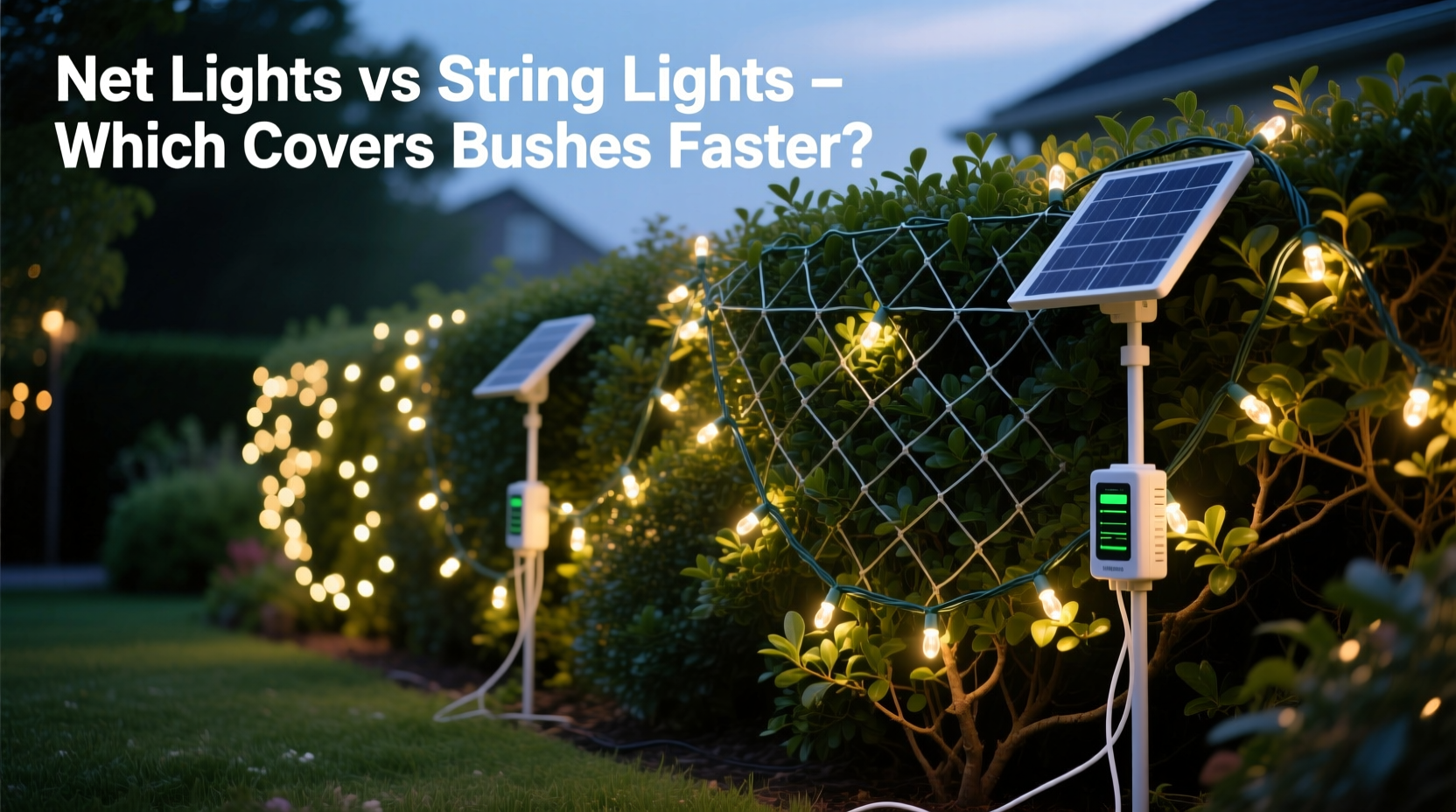
The physical construction of each light type sets the foundation for how they perform on foliage. Net lights are manufactured as a mesh-like sheet, with bulbs sewn or fused into a rectangular or square grid—typically 3x6 feet, 4x6 feet, or similar dimensions. The consistent spacing (often 6 inches apart) creates a uniform blanket of light that drapes easily over surfaces.
String lights, by contrast, are linear. They come in various lengths—commonly 25 to 100 feet—and require manual wrapping, weaving, or looping to achieve full coverage. Some models include clips or stakes for anchoring, but the burden of shaping the layout falls entirely on the installer.
This fundamental difference means net lights are inherently designed for area coverage, while string lights are better suited for outlining shapes or accenting specific features like tree trunks or fence lines.
Coverage Speed: Which Gets the Job Done Faster?
Time is often the deciding factor during seasonal decorating. Net lights win decisively in speed when covering medium to large bushes. Because they function like a luminous tarp, you simply drape them over the bush and secure the corners. A 4x6-foot net can fully cover a standard 3–4 foot tall shrub in under two minutes.
String lights require deliberate placement. To avoid dark spots, you must weave the cord vertically and horizontally through branches, maintaining even spacing. On average, wrapping a comparable bush with string lights takes 15 to 25 minutes, depending on density and experience level.
A mini case study illustrates this clearly: A homeowner in Portland, Oregon, decorated six evergreen bushes around their front yard using both methods. With net lights, the entire job took 20 minutes. When switching to string lights the following year due to availability issues, the same task required 90 minutes—even with prior experience.
“Net lights are the fastest solution for volume coverage. If you have more than three bushes, the time savings compound quickly.” — Daniel Ruiz, Landscape Lighting Specialist, Northwest Outdoor Accents
Installation Ease: Simplicity vs Flexibility
Ease of installation isn’t just about speed—it’s also about accessibility and repeatability. Net lights are beginner-friendly. Most models include corner hooks or built-in ties, allowing users to anchor the net to branches without additional tools. Their flat design naturally conforms to rounded shrubbery, especially when slightly stretched.
String lights offer greater flexibility in custom layouts but demand more effort. Achieving an even glow requires strategic planning. Installers must avoid clustering lights on one side or creating “hotspots” near the base. Without careful attention, string lights can look haphazard on dense bushes.
Moreover, string lights are prone to tangling—a persistent frustration during both setup and storage. Net lights, while not immune to snags, are far less likely to knot due to their structured layout.
However, string lights have one clear advantage: adaptability. They can be used across multiple bushes, wrapped around irregular shapes, or extended with connectors. Net lights are limited by their fixed size. If your bush exceeds the net dimensions, you’ll need to patch gaps with additional strands or combine multiple nets—an approach that can compromise neatness.
Comparison Table: Net Lights vs String Lights for Bush Coverage
| Feature | Net Lights | String Lights |
|---|---|---|
| Setup Time per Bush | 1–3 minutes | 10–25 minutes |
| Coverage Uniformity | High – even grid pattern | Variable – depends on skill |
| Tangling Risk | Low | High |
| Best For | Bushes, hedges, flat surfaces | Trees, railings, custom designs |
| Storage | Roll or fold gently; low tangle | Requires careful coiling |
| Durability (Outdoor Use) | Moderate to high (depends on material) | High (if commercial-grade) |
Durability and Long-Term Use
Durability plays a role in long-term convenience. While net lights are convenient initially, their thin wires and closely packed bulbs can be vulnerable to damage from pruning, wildlife, or harsh weather if not properly secured. Over time, UV exposure may degrade the mesh backing, particularly in cheaper models made with polyethylene.
String lights, especially commercial-grade LED versions with replaceable bulbs or robust waterproofing, tend to last longer. Many are rated for 40,000+ hours and withstand freezing temperatures and heavy rain. Though more labor-intensive upfront, their longevity and repairability make them a cost-effective choice over multiple seasons.
That said, newer premium net lights now feature reinforced wiring and weather-resistant coatings, narrowing the gap. Look for IP44 or higher ratings when purchasing either type for outdoor use.
Step-by-Step Guide: Installing Net Lights on a Bush
For those prioritizing speed and simplicity, follow this efficient process:
- Measure the bush: Determine height and width to select the appropriate net size (e.g., 4x6 ft for a 3–4 ft shrub).
- Lay out the net: Unroll it on the ground nearby to check for damaged bulbs or breaks in the circuit.
- Drape from the top: Start at the highest point of the bush and let the net fall naturally over the sides.
- Secure corners: Use plastic-coated wire ties or landscape staples to anchor the four corners into sturdy branches.
- Adjust spacing: Gently tug edges to eliminate sagging and ensure even bulb distribution.
- Connect to power: Route the lead cord discreetly to the outlet, using ground stakes if needed.
- Test and finalize: Turn on the lights and make micro-adjustments for full coverage.
This entire sequence rarely exceeds five minutes per bush once practiced. In contrast, a comparable step-by-step for string lights would involve estimating length, testing drape patterns, weaving through layers, and troubleshooting dark zones—adding complexity at every turn.
When String Lights Are the Better Choice
Despite the advantages of net lights, there are scenarios where string lights are preferable:
- Irregularly shaped bushes: Topiaries or freeform shrubs benefit from the custom flow of string lights.
- Tall, narrow hedges: Vertical columnar plants like arborvitae may require vertical runs best achieved with strings.
- Mixed landscaping: When combining bushes with trees or architectural elements, string lights provide continuity.
- Reusability across projects: One long strand can serve multiple purposes; nets are more specialized.
If your landscape includes a variety of plant shapes and sizes, a hybrid approach might work best—using net lights for broad, rounded bushes and string lights for accents and transitions.
Frequently Asked Questions
Can I connect multiple net lights together?
Yes, many modern net lights are UL-listed for end-to-end connection, typically up to three or four sets depending on wattage. Always check manufacturer specifications to avoid overloading circuits. Use outdoor-rated extension cords and consider a timer or smart plug for automation.
Are net lights safe for live plants?
Absolutely. LED net lights produce minimal heat and will not harm foliage when installed correctly. Avoid pulling too tightly, which could restrict growth or damage brittle branches. Remove them after the display season to prevent wear from wind or snow load.
Do string lights use more energy than net lights?
Not necessarily. Energy consumption depends on bulb type (LED vs incandescent), number of bulbs, and total length. A 4x6-foot net with 72 LEDs uses roughly the same power as a 25-foot string of 50 LED bulbs—both averaging 4–6 watts per hour. Always opt for LED versions to maximize efficiency and lifespan.
Checklist: Choosing the Right Option for Your Bushes
- ☐ Measure your largest bush to determine required coverage size
- ☐ Decide whether uniform glow (net) or customizable design (string) matters most
- ☐ Count the number of bushes—more than three favors net lights for efficiency
- ☐ Check local weather conditions—opt for weatherproof ratings (IP44 or higher)
- ☐ Consider storage space—nets are bulkier but less prone to tangling
- ☐ Plan for power access—ensure outlets or extension cords can reach all areas
- ☐ Test a single set before buying in bulk to verify brightness and color tone
Final Verdict: Which Covers Bushes Faster and Easier?
For sheer speed and ease of bush coverage, net lights are the superior choice. Their ready-to-deploy design, predictable spacing, and minimal setup requirements make them ideal for homeowners seeking beautiful results without spending hours in the yard. They excel at transforming rows of shrubs into glowing focal points within minutes.
String lights remain valuable for creative expression and complex landscapes but demand more time, patience, and technical skill to achieve professional-looking results on dense foliage.
If your priority is efficiency—especially during busy holiday seasons—net lights deliver unmatched convenience. However, for lasting versatility and multi-season use, investing in high-quality string lights may pay off in the long run.
“The right tool depends on your goals. Want instant impact? Go with nets. Want full control over design? Strings give you that freedom.” — Lena Torres, Outdoor Lighting Designer, Brightline Landscapes
Take Action Today
Whether you're preparing for the holidays or enhancing your garden's nighttime appeal, don't let lighting logistics hold you back. Assess your bush layout, consider your time and aesthetic priorities, and choose the method that aligns with your needs. Try net lights on one section of your yard and compare the result with a traditionally wrapped bush using string lights—you'll see the difference firsthand.




 浙公网安备
33010002000092号
浙公网安备
33010002000092号 浙B2-20120091-4
Comments
No comments yet. Why don't you start the discussion?