
When it comes to decorating a Christmas tree, one of the most impactful decisions you’ll make is how to light it. The right lighting transforms a simple evergreen into a glowing centerpiece. But with two dominant options—net lights and traditional string lights—the choice isn’t always straightforward. Each has strengths in speed, coverage, visual appeal, and adaptability. Understanding the differences helps ensure your tree shines brightly, both in appearance and ease of setup.
Coverage Efficiency: How Fast Can You Light a Tree?
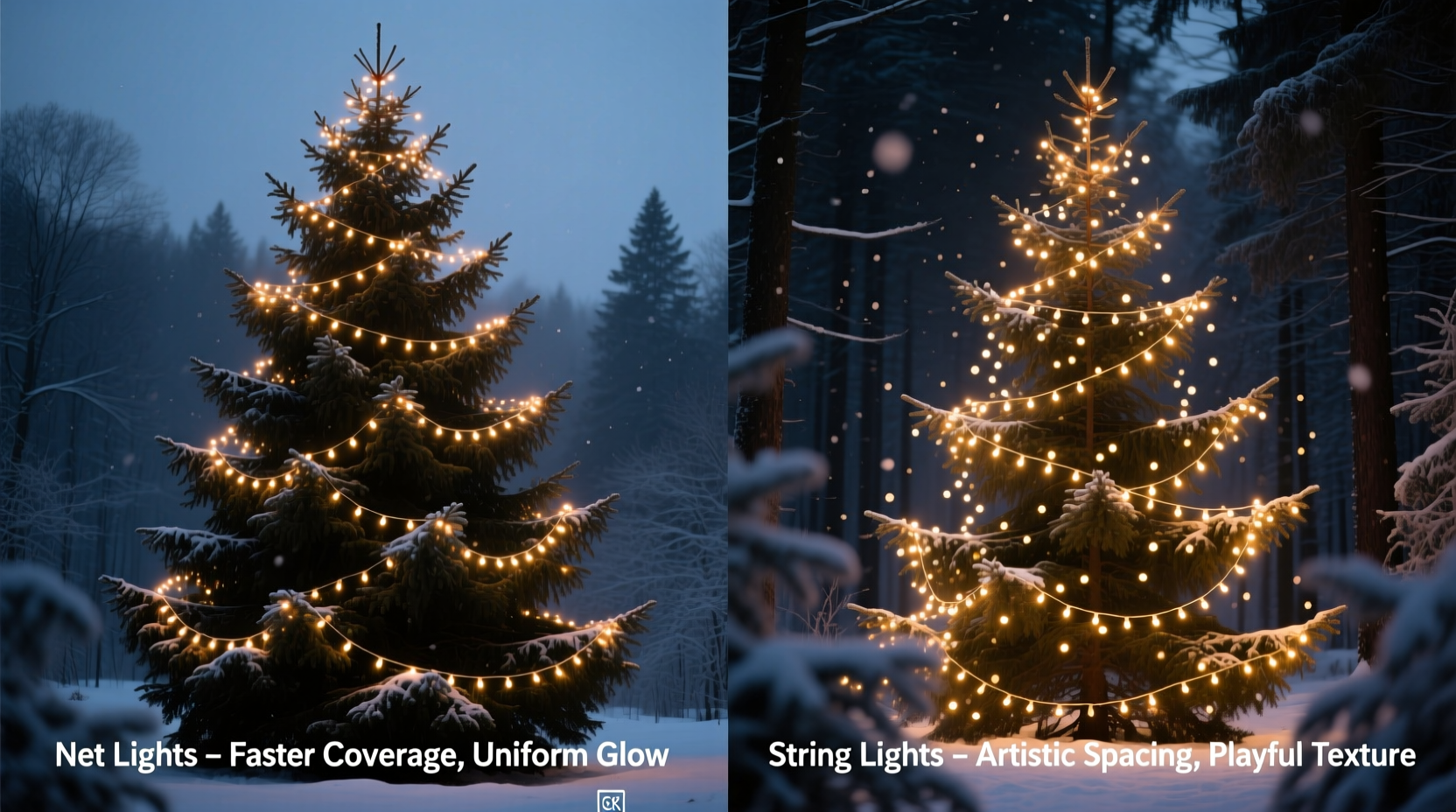
The speed at which lights cover a tree often determines whether decorating feels like a joyful tradition or a frustrating chore. Net lights are designed for rapid deployment. They consist of evenly spaced bulbs woven into a mesh net, typically in rectangular or conical shapes that drape over bushes or trees. Because they’re pre-arranged, you can unfold and position them in under a minute on smaller trees or shrubs.
String lights, by contrast, require manual wrapping. Whether you're using the spiral method, zig-zag pattern, or random placement, each foot of branch must be individually lit. For a standard 6-foot tree, this process can take anywhere from 15 to 40 minutes, depending on experience and bulb density desired.
However, net lights are limited by shape and size. Most come in fixed dimensions—like 4x6 feet or 3x4 feet—which may not conform perfectly to taller or irregularly shaped trees. String lights offer total flexibility. You can wrap higher branches more densely, adjust spacing for symmetry, or even skip sparse areas altogether. This control means slower setup but potentially superior customization.
Visual Appeal: Which Looks Better on a Christmas Tree?
Aesthetics separate adequate lighting from stunning displays. Net lights provide a consistent, grid-like glow. Bulbs are uniformly spaced—usually 3 to 6 inches apart—creating a predictable, even shimmer. This works well for dense foliage, such as boxwood hedges or artificial trees with tight branch structures. The result resembles a blanket of stars, ideal for creating ambient backyard lighting or framing entryways.
On full, bushy Christmas trees, however, the rigid geometry of net lights can become apparent. Gaps may appear where the net doesn’t stretch, especially near the trunk or at varying depths of the canopy. The flat nature of the net also means less three-dimensional depth compared to wrapped string lights, which encircle branches from multiple angles.
String lights, when applied with care, produce a more immersive effect. By weaving them through interior branches and layering outward, you create depth and dimension. The human eye perceives this as natural and dynamic. A professionally wrapped tree with string lights appears fuller, brighter, and more intentional. The ability to vary spacing—tighter near the top, looser at the base—also mimics the way light naturally falls.
“Lighting should enhance the tree’s form, not mask it. String lights give decorators the precision to highlight structure and volume.” — Daniel Reyes, Holiday Lighting Designer, Chicago Botanic Garden
Comparison Table: Net Lights vs String Lights
| Feature | Net Lights | String Lights |
|---|---|---|
| Setup Time (6-ft tree) | 1–3 minutes | 15–40 minutes |
| Coverage Uniformity | High (if size matches tree) | Moderate to high (depends on skill) |
| 3D Depth & Dimension | Low to moderate | High |
| Flexibility in Placement | Low (fixed shape) | Very high |
| Best For | Outdoor shrubs, small trees, quick decor | Indoor Christmas trees, premium displays |
| Storage & Reuse | Easy (lay flat) | Requires careful coiling |
Step-by-Step: Lighting a Tree with String Lights for Maximum Impact
To achieve a professional-quality glow with string lights, follow this proven sequence:
- Start at the base of the power cord. Plug it into an outlet nearby and begin attaching clips or hooks to the trunk near the floor.
- Work from the inside out. Feed the first third of the strand deep into the central branches, spiraling upward toward the top. This creates internal illumination and prevents a hollow look.
- Wrap main branches in a spiral. Move down from the top, circling each major limb every 6–8 inches. Alternate directions slightly between layers to avoid visible patterns.
- Add horizontal runs for density. After completing vertical spirals, weave horizontally across sections to fill dark zones, especially near the front.
- Test frequently. Plug in every few strands to catch dead bulbs or connection issues early.
- Adjust spacing for balance. Step back every few minutes to assess brightness distribution. Add extra lights to dimmer areas.
- Secure loose ends. Use twist ties or hidden clips to fasten dangling wires and prevent sagging.
Real Example: A Suburban Family’s Holiday Upgrade
The Thompson family in Columbus, Ohio, used green net lights on their 7-foot Fraser fir for five years. While quick to install, they noticed guests often commented that the tree “looked flat” or “like it was wearing a net.” Last season, they switched to premium LED string lights and invested 35 minutes wrapping the tree using the inside-out method.
The difference was immediate. Neighbors remarked on the “professional” look, and photos shared online received double the usual engagement. More importantly, the children said the tree “felt more magical.” The family now plans to keep the string lights as a permanent upgrade, reserving net lights only for their outdoor spruce bushes.
Checklist: Choosing the Right Lights for Your Tree
- ☐ Measure your tree height and width before purchasing lights.
- ☐ Decide if speed (net) or quality (string) is the priority.
- ☐ For string lights, calculate needed length: aim for 100 bulbs per foot of tree height.
- ☐ Check bulb spacing—3–6 inches is ideal for full coverage.
- ☐ Choose LEDs for cooler operation, longer life, and lower energy use.
- ☐ Test all strands before decorating to avoid mid-process failures.
- ☐ Plan outlet access and use surge-protected extension cords.
- ☐ Store lights properly after use to prevent tangling and damage.
FAQ: Common Questions About Net and String Lights
Can I use net lights on a tall indoor Christmas tree?
It's possible, but not recommended for trees over 6 feet. Most net lights max out at 6x8 feet and tend to sag or leave gaps on taller, conical trees. They work best on shorter, bushier plants or outdoor landscaping.
Do string lights really look better than net lights?
In most cases, yes—especially on traditional Christmas trees. The three-dimensional wrapping technique produces deeper, richer lighting that enhances volume and texture. Net lights are efficient but lack the layered effect achieved through careful string light application.
Are net lights easier to store than string lights?
Generally, yes. Net lights lay flat and resist tangling. String lights require careful coiling or spooling to avoid knots. However, using a light keeper or cardboard reel can make string light storage just as manageable.
Final Verdict: Speed vs. Beauty
If time is your limiting factor—perhaps you’re decorating late at night or managing multiple outdoor displays—net lights are the clear winner. They deliver instant, even coverage with minimal effort. Their strength lies in efficiency and repeatability, making them ideal for seasonal landscaping or temporary setups.
But when it comes to making a lasting impression—particularly on an indoor Christmas tree—string lights are superior. They allow artistic control, deeper illumination, and a more authentic glow. While they demand more time and attention, the visual payoff is significant. A well-lit tree becomes a focal point, radiating warmth and celebration throughout the home.
The decision ultimately depends on your priorities. Want fast, broad coverage? Reach for the net. Seeking elegance, depth, and timeless charm? Take the time to wrap with string lights. Many experienced decorators use both, applying each where it performs best.
Conclusion
Choosing between net lights and string lights isn’t about finding a single “best” option—it’s about matching the tool to the task. For rapid outdoor decoration, net lights save hours and still create festive ambiance. For the centerpiece of your holiday home, nothing replaces the craftsmanship and brilliance of carefully wrapped string lights.
This season, evaluate your trees, your time, and your aesthetic goals. With the right approach, you can achieve a display that’s both efficient and breathtaking. Whether you’re draping a hedge or perfecting the family tree, let your lights reflect the care and joy of the holidays.




 浙公网安备
33010002000092号
浙公网安备
33010002000092号 浙B2-20120091-4
Comments
No comments yet. Why don't you start the discussion?