
The late '90s were a pivotal era in gaming history, marked by rapid technological evolution and fierce competition among console manufacturers. Two consoles stand out for their bold designs and groundbreaking libraries: the Nintendo 64 and the Sega Dreamcast. Though separated by only a few years—launched in 1996 and 1999 respectively—they represent different philosophies in game design, hardware capability, and market positioning. The Nintendo 64 prioritized cartridge-based media, strong first-party franchises, and local multiplayer experiences. In contrast, the Dreamcast embraced optical discs, online play, and third-party innovation. When comparing these two systems today, one question persists: which has the better game library? The answer depends on what you value most—timeless platforming excellence or forward-thinking experimentation.
Hardware Foundations and Their Impact on Game Design
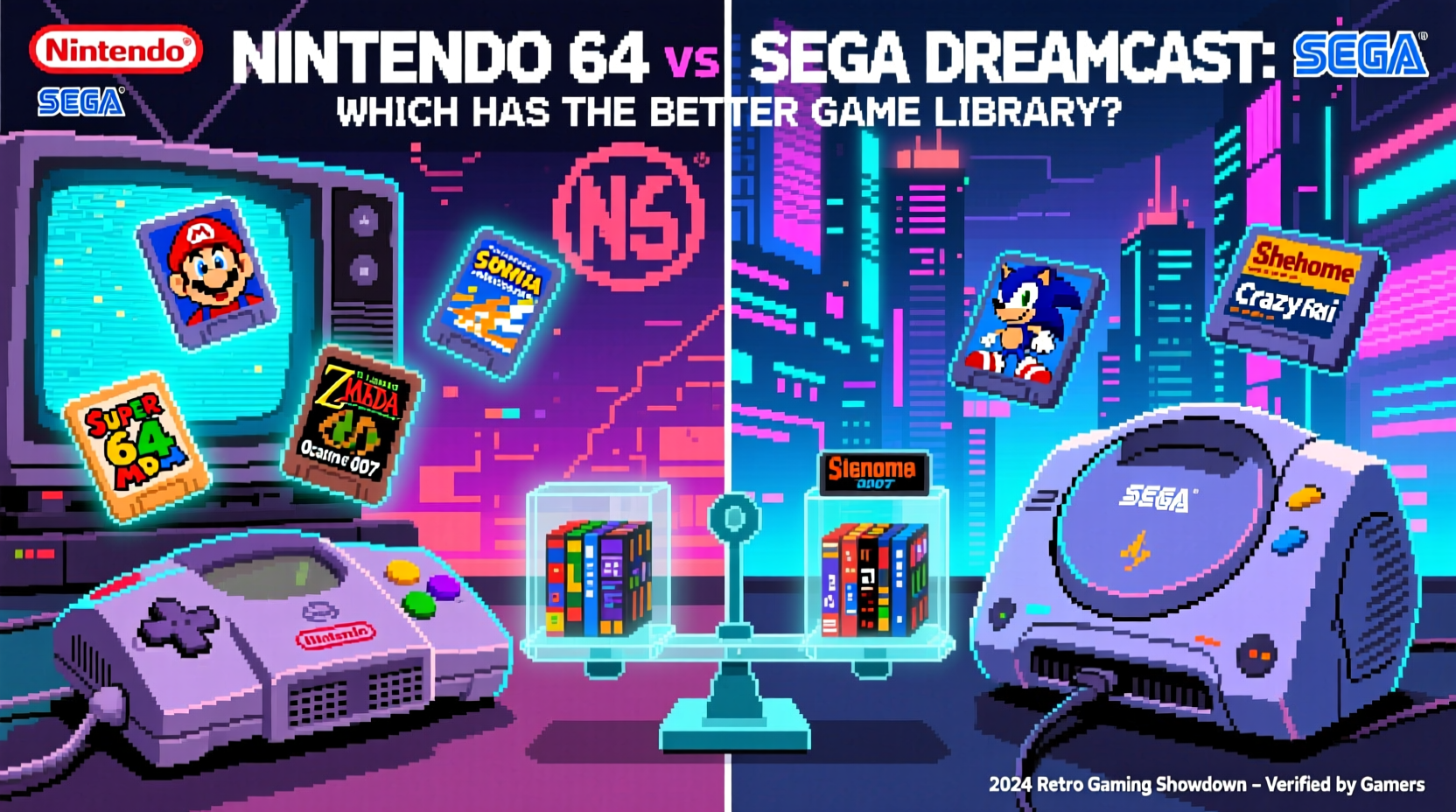
The technical architecture of each console shaped the games they could produce. The Nintendo 64 used cartridges instead of CDs, which limited storage capacity but offered faster load times and resistance to piracy. This decision affected developers significantly—games like Ocarina of Time and GoldenEye 007 were engineered with tight optimization, but expansive cutscenes or high-quality audio were constrained. Cartridges also cost more to manufacture, discouraging smaller studios from publishing on the platform.
In contrast, the Dreamcast used GD-ROMs (Gigabyte Disc Read-Only Memory), allowing for larger storage space, full-motion video, and CD-quality audio. This enabled richer storytelling and cinematic presentation in titles like Shenmue and Soulcalibur. The Dreamcast was also the first console to feature built-in broadband support, making online multiplayer accessible out of the box—a revolutionary step at the time. Games such as Phantasy Star Online demonstrated the potential of persistent online worlds years before Xbox Live or PSN existed.
Nintendo 64: The Golden Age of First-Party Excellence
The N64’s strength lies in its unparalleled lineup of first-party titles developed by Nintendo and close partners. These games defined genres and set benchmarks that still resonate today.
- The Legend of Zelda: Ocarina of Time – Often hailed as one of the greatest games ever made, it introduced a fully 3D world with context-sensitive actions, time manipulation, and an orchestral score. Its influence on adventure games is immeasurable.
- Super Mario 64 – A foundational title for 3D platforming, offering open-ended level design and analog stick control that became standard across the industry.
- GoldenEye 007 – Revolutionized console FPS gameplay with split-screen multiplayer that brought friends together for countless hours of chaos.
- Perfect Dark – Built upon GoldenEye’s foundation with advanced AI, customizable weapons, and deeper mechanics.
- Majora’s Mask – A darker, more psychologically complex follow-up to Ocarina of Time, featuring a real-time three-day cycle and intricate side quests.
- Paper Mario – Introduced RPG elements to the Mario universe with clever turn-based combat and narrative charm.
These titles weren’t just popular; they redefined what games could be. Nintendo leveraged its iconic characters—Mario, Link, Donkey Kong—to create experiences that felt both familiar and revolutionary. The focus remained on polished, single-player adventures with exceptional replayability through collectibles and hidden secrets.
“Super Mario 64 didn’t just transition Mario into 3D—it taught the entire industry how to navigate 3D space.” — Jason Schreier, Video Game Historian
Sega Dreamcast: Innovation Ahead of Its Time
The Dreamcast may have had a short lifespan—discontinued globally by 2001 due to the looming PlayStation 2—but its game library punches far above its weight. It combined Japanese precision with Western appeal, supporting everything from arcade-perfect ports to experimental indie-style titles.
Key highlights include:
- Sonic Adventure – Reimagined Sonic for the 3D era with action sequences, voice acting, and rock music. While divisive among purists, it showcased the Dreamcast’s audiovisual capabilities.
- Soulcalibur – Universally praised for its fluid combat, stunning visuals, and balanced roster. Often cited as one of the best fighting games ever made.
- Jet Set Radio – A stylistic tour de force with cel-shaded graphics, a pulsing soundtrack, and rebellious urban energy. It influenced generations of art-driven games.
- Shenmue – An ambitious open-world RPG with real-time weather, NPC schedules, and interactive environments. Though commercially unsuccessful, it inspired later titles like Yakuza and Red Dead Redemption.
- Phantasy Star Online – The first true MMORPG on a home console, enabling cooperative dungeon crawling with voice chat via the Visual Memory Unit (VMU).
- Rez – A synesthetic rail shooter blending music, light, and rhythm into a hypnotic sensory experience. Now recognized as a masterpiece of interactive art.
What sets the Dreamcast apart is its willingness to take risks. While Nintendo refined proven formulas, Sega pushed boundaries—sometimes awkwardly, but always with vision. The result is a library filled with cult classics that gained acclaim years after release.
Comparative Analysis: Strengths and Weaknesses
| Category | Nintendo 64 | Sega Dreamcast |
|---|---|---|
| Total Game Library | ~388 titles (region-dependent) | ~650+ titles worldwide |
| First-Party Powerhouses | Strong (Zelda, Mario, DK) | Moderate (Sonic, Shenmue) |
| Third-Party Support | Limited (due to cartridges) | Excellent (Capcom, Namco, SNK) |
| Online Functionality | None (no built-in modem) | Full broadband support, online lobbies |
| Audio/Visual Fidelity | Good for era, limited by cartridge | Superior textures, FMV, CD audio |
| Genre Diversity | Platformers, shooters, puzzles | Fighting, racing, RPGs, online MMO |
| Lasting Cultural Impact | Extremely high | Growing posthumous recognition |
The data shows a clear trade-off: the N64 excels in quality over quantity, especially within Nintendo’s core audience. The Dreamcast wins in breadth, technical innovation, and diversity of experience. However, the Dreamcast suffered from poor marketing and premature discontinuation, which limited its reach during its prime.
Mini Case Study: The Evolution of a Collector’s Perspective
Take Mark Rivera, a retro collector from Austin, Texas. He initially bought an N64 in 1997 purely for Super Mario 64. Over time, he collected every major first-party title, drawn by their polish and nostalgia. “I played GoldenEye at birthday parties,” he recalls. “It was magic.” But when he picked up a used Dreamcast in 2015, his perspective shifted. “I tried Jet Set Radio, and I couldn’t believe something so stylish existed in 1999. Then I played Rez and realized how far ahead of its time this machine was.” Today, Mark values both libraries but says, “The N64 gives me comfort. The Dreamcast makes me excited about what could’ve been.”
Tips for Choosing Based on Your Gaming Preferences
- If you love precise platforming, adventure puzzles, and family-friendly fun, the N64 is unmatched.
- If you enjoy experimental gameplay, mature narratives, and early online experiences, the Dreamcast offers unique rewards.
- For multiplayer enthusiasts: N64 supports up to four players locally with iconic party games (Super Smash Bros., Mario Kart 64). Dreamcast supports fewer simultaneous players but offers online connectivity.
- Preservation note: N64 cartridges are prone to battery degradation affecting save files. Dreamcast GD-ROMs are more durable but can suffer from disc rot if improperly stored.
Expert Insight: Why Legacy Matters More Than Sales
“The Dreamcast failed commercially, but its DNA lives on in modern consoles. Always-on internet, digital storefronts, motion controls—it predicted the future. The N64 perfected the past.” — Dr. Lena Torres, Interactive Media Professor at NYU
This duality captures the essence of the debate. The N64 represents the peak of cartridge-era craftsmanship. The Dreamcast symbolizes the dawn of connected, multimedia gaming. Neither \"won\" in sales, but both influenced what came next.
FAQ
Was the Dreamcast more powerful than the N64?
Yes. The Dreamcast featured a 200 MHz Hitachi SH-4 CPU and 12 MB of RAM, compared to the N64’s 93.75 MHz NEC VR4300 and 4 MB RAM. It also had superior graphics rendering, texture filtering, and audio processing thanks to its GD-ROM format and Yamaha sound chip.
Can you play Dreamcast games online today?
Yes. Thanks to community projects like DreamPi and LAN adapters, many Dreamcast online games—including Phantasy Star Online and Quake III Arena—are playable over modern internet connections. Dedicated servers keep the spirit alive.
Which console has better emulation options?
Both emulators—Project64 (N64) and nullDC/Dreamemu (Dreamcast)—are highly accurate. However, Dreamcast emulation requires more system resources due to its complex architecture and reliance on BIOS files. N64 emulation is more accessible on mid-range PCs.
Final Verdict: Which Has the Better Game Library?
There is no definitive winner—only alignment with personal taste. If your ideal gaming experience revolves around beloved characters, tight mechanics, and shared couch multiplayer, the Nintendo 64 delivers an almost flawless lineup. Its top-tier exclusives remain influential decades later, and few libraries match its consistency in quality.
But if you value innovation, artistic expression, and the thrill of discovering hidden gems that were too ambitious for their time, the Sega Dreamcast stands tall. It wasn’t just a console; it was a prototype for the future. Its games dared to ask, “What if?” long before others caught up.
In terms of raw impact and cultural longevity, the N64 edges ahead. But in terms of visionary scope and genre expansion, the Dreamcast earns deep respect. Ultimately, owning both provides the most complete picture of a transformative decade in gaming.
Checklist: Building a Retro Collection
- Determine your primary interest: nostalgia, innovation, or variety.
- Research original hardware availability and condition (check for mod chips or repairs).
- Identify essential titles for each system (e.g., Ocarina of Time, Soulcalibur).
- Consider accessories: N64 Rumble Pak, Expansion Pak; Dreamcast VMU, microphone, broadband adapter.
- Plan for preservation: use cartridge savers, store discs properly, backup saves where possible.
- Explore community forums (like AtariAge or Dreamcast Talk) for tips and trades.
Conclusion
The rivalry between the Nintendo 64 and Sega Dreamcast isn’t just about specs or sales—it’s a reflection of two distinct visions for interactive entertainment. One honors tradition with mastery; the other embraces change with courage. Whether you’re drawn to the castle of Hyrule or the neon streets of Tokyo-to, both consoles offer rich, rewarding libraries worth exploring. Dive in, play the classics, and decide for yourself which legacy speaks louder. And if you’ve experienced both, share your thoughts—gaming history is best remembered together.




 浙公网安备
33010002000092号
浙公网安备
33010002000092号 浙B2-20120091-4
Comments
No comments yet. Why don't you start the discussion?