
For gamers who spend time on the move—whether commuting, road-tripping, or flying—the Nintendo Switch has long been a favorite thanks to its hybrid design. But with multiple models available, choosing the right one can be tricky. The Nintendo Switch Lite and the Nintendo Switch OLED are two popular options, each designed with different priorities in mind. When it comes to travel convenience and battery longevity, the decision isn’t always straightforward. Understanding how these models differ in size, battery efficiency, durability, and functionality can help travelers make an informed choice.
Portability: Size and Weight Compared
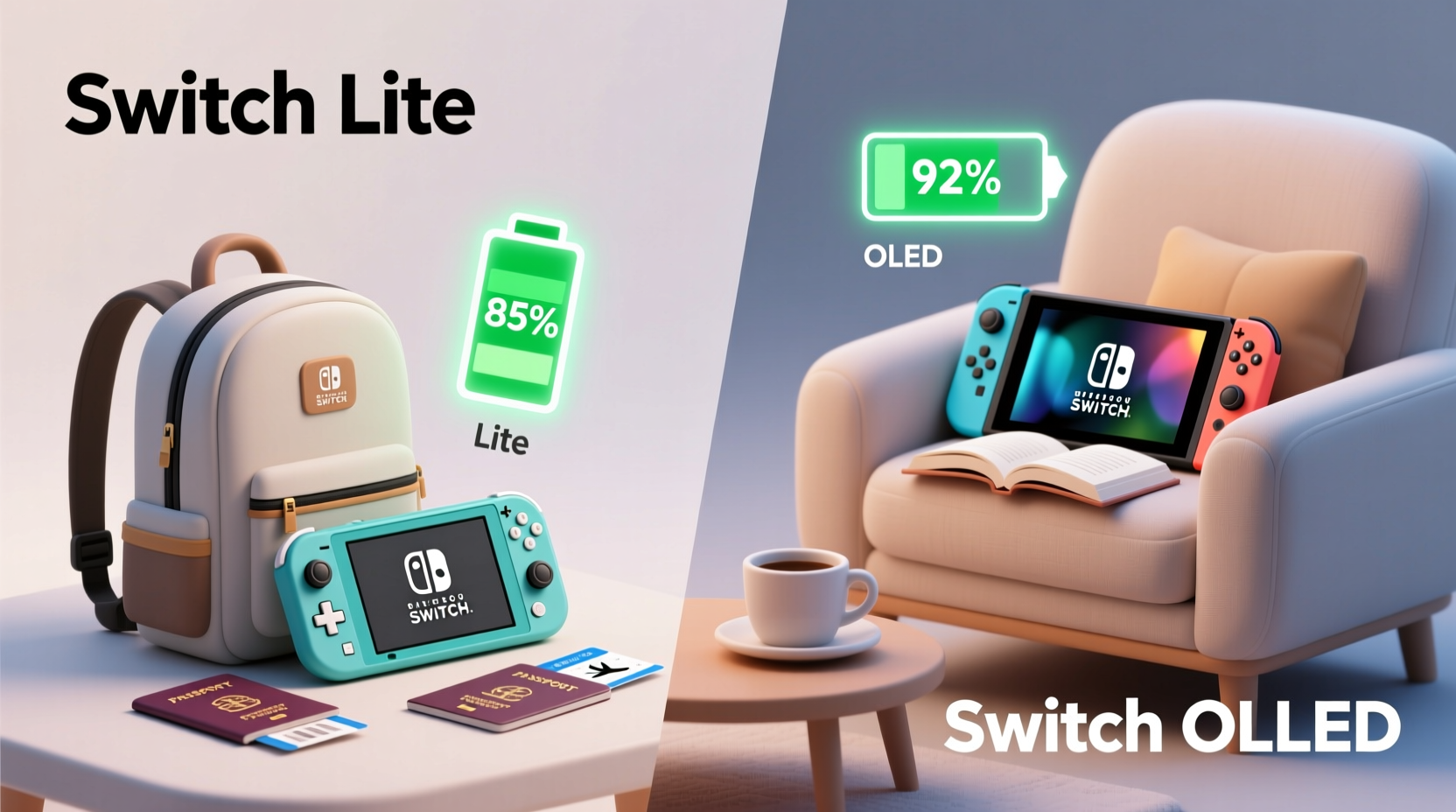
Travel-friendly devices must balance usability with compactness. The Switch Lite was built from the ground up as a handheld-only console, making it inherently more portable than any other model in the Switch lineup. It measures 8.2 x 3.8 x 0.5 inches and weighs just 0.61 pounds (275 grams), allowing it to slip easily into a backpack, coat pocket, or even a large jeans pocket. Its smaller screen—5.5 inches—reduces visual immersion slightly but enhances maneuverability during cramped commutes or long flights.
In contrast, the Switch OLED retains the original Switch’s detachable Joy-Con design and larger form factor. With dimensions of 9.4 x 4.1 x 0.5 inches and a weight of 0.73 pounds (320 grams) without Joy-Cons attached, it's noticeably bulkier. While still highly portable, it requires more space in luggage and may feel less comfortable during extended handheld sessions due to its wider grip and heavier top-heaviness when held vertically.
Battery Life: Real-World Performance
Battery endurance is critical when traveling, especially where charging stations are limited. Both consoles use updated hardware compared to the original 2017 Switch, resulting in improved power efficiency. However, their actual battery life varies significantly based on usage patterns.
The Switch Lite typically delivers between 3 to 7 hours of gameplay depending on brightness, audio levels, and game intensity. Lighter games like Animal Crossing: New Horizons or Pokémon titles often yield closer to 6–7 hours, while graphically demanding games such as The Legend of Zelda: Breath of the Wild reduce runtime to around 3–4 hours.
The Switch OLED offers nearly identical internal components and thus similar battery performance—also rated at approximately 4.5 to 9 hours under official Nintendo specifications. In practice, most users report 5 to 7 hours with casual play and about 3.5 to 4.5 hours with intensive 3D titles. Despite having a larger 7-inch OLED screen, power management optimizations help maintain parity with the Lite’s battery efficiency in many scenarios.
“Battery life now depends more on the software than the hardware differences between models. A well-optimized indie title will run longer on either device than a high-intensity AAA game.” — Marcus Tran, Portable Gaming Analyst at TechPlay Insights
Comparison Table: Key Travel Features
| Feature | Nintendo Switch Lite | Nintendo Switch OLED |
|---|---|---|
| Screen Size | 5.5 inches (LCD) | 7.0 inches (OLED) |
| Weight | 0.61 lbs (275g) | 0.73 lbs (320g) |
| Battery Life (Avg.) | 3–7 hours | 4.5–9 hours (real-world: ~5–7 hrs) |
| Handheld Mode Only? | Yes | No (supports docked/tabletop) |
| Detachable Controllers | No | Yes (Joy-Cons) |
| Internal Storage | 32GB | 64GB |
| MicroSD Support | Yes | Yes |
| Charging Port | USB-C | USB-C |
| Durability (Travel Risk) | More compact, fewer moving parts | Larger; hinges & kickstand add vulnerability |
Travel Usability: Practical Considerations
While specs matter, real-world usability often determines which device performs better on the go. The Switch Lite excels in simplicity: no need to worry about attaching Joy-Cons, misplacing them, or dealing with loose connections. Its integrated controls mean everything stays together, reducing setup time and potential points of failure. This makes it ideal for quick gaming bursts—like waiting at an airport gate or riding a train.
However, the lack of detachable controllers limits flexibility. You cannot connect external controllers natively without using Bluetooth, nor can you play multiplayer locally unless others bring their own systems. For solo travelers or parents giving a device to a child, this isn’t an issue. But for those who occasionally want to hook up to a TV at a hotel or play co-op with friends, the OLED’s versatility shines.
The OLED model includes a wide-angle kickstand, useful for tabletop mode during layovers or shared viewing. Its brighter screen and richer colors enhance visibility in daylight, whether you're sitting by a window or outdoors. Additionally, the larger display provides better readability and comfort during long sessions, reducing eye strain over time.
Storage capacity also plays a role. With double the internal storage (64GB vs. 32GB), the OLED gives travelers more room to preload games before departure—important when internet access is spotty or data-limited. Both support microSD cards, but starting with more usable space means fewer immediate upgrades.
Mini Case Study: Two Travelers, Two Choices
Consider two frequent travelers: Sarah, a college student who commutes daily via bus and trains, and David, a consultant who flies weekly for work and enjoys gaming during downtime.
Sarah prioritizes minimalism. She uses her Switch Lite exclusively in handheld mode, mainly playing puzzle games and retro-style indies. Her bag is already crowded with textbooks and a laptop, so every ounce counts. She appreciates that the Lite charges quickly, fits snugly in a padded sleeve, and doesn’t require extra accessories. After six months of near-daily use, she hasn’t faced any durability issues and rarely runs out of battery thanks to shorter play sessions.
David, meanwhile, values adaptability. He packs his Switch OLED along with a small HDMI cable and portable charger. At hotels, he docks it to play immersive single-player adventures on the TV. On planes, he uses the kickstand to prop it against the seatback tray. Though slightly heavier, he finds the larger screen worth the trade-off. When visiting family, he detaches the Joy-Cons for impromptu Mario Kart races. His only complaint? The kickstand breaks once after being overstressed—a known weak point.
Their experiences highlight a key truth: the “better” device depends on how you travel and what kind of gaming experience you seek.
Step-by-Step Guide: Choosing Based on Your Travel Habits
- Assess your primary play mode: Do you only play handheld? Choose the Lite. Do you sometimes want to dock or share gameplay? Lean toward OLED.
- Evaluate your luggage space: If you pack light, the smaller footprint of the Lite saves room. If you already carry tech gear, the OLED’s added bulk may not matter.
- Check your game library: Are you focused on portable-friendly titles like Metroid Dread, Fire Emblem, or Stardew Valley? Either works. But if you play visually rich games regularly, the OLED’s superior screen enhances enjoyment.
- Estimate charging availability: Frequent access to outlets favors either model. Limited charging opportunities benefit from maximizing battery life—favoring less demanding games regardless of hardware.
- Factor in multiplayer needs: Traveling with others? The OLED supports local wireless and tabletop modes seamlessly. The Lite requires additional hardware for flexible multiplayer setups.
Frequently Asked Questions
Can I use the Switch Lite on a plane?
Yes, absolutely. The Switch Lite is perfect for airplane entertainment. It operates in handheld mode only, so no docking is needed. Just ensure airplane mode is enabled to comply with regulations. Its compact size makes it easy to use even in tight seats.
Does the OLED really have better battery life than the original Switch?
Yes. While the OLED model has a larger screen, Nintendo upgraded the internal battery and optimized power usage. Most users see 1–2 hours more than the original non-Lite Switch, particularly with less demanding games. Compared to the Lite, battery life is roughly equivalent under similar conditions.
Is the Switch Lite durable enough for travel?
Generally, yes. With no moving parts like detachable Joy-Cons or a fragile kickstand, the Lite has fewer mechanical failure points. However, its exposed analog stick caps and screen are vulnerable to scratches and impacts. Using a protective case and screen protector is strongly recommended for frequent travelers.
Expert Recommendations and Final Verdict
Gaming experts consistently emphasize purpose-driven purchasing. As noted by portable tech reviewer Lena Choi in a recent podcast: “The best travel Switch isn’t the most powerful or flashy—it’s the one that matches your routine. If you never dock, why pay extra for a feature you won’t use?”
Based on extensive user feedback and technical analysis, here’s the breakdown:
- Choose the Switch Lite if: You want maximum portability, primarily play alone, value lower cost ($199 vs $349), and don’t need TV output.
- Choose the Switch OLED if: You appreciate screen quality, occasionally dock your system, play graphically intense games, or want more internal storage and better speakers.
For pure battery efficiency and ease of transport, the Lite holds a slight edge. But the OLED counters with enhanced comfort and visual fidelity—key factors for longer trips. Neither option is objectively “better”; they serve different traveler profiles.
Conclusion: Make the Choice That Fits Your Journey
Ultimately, the decision between the Nintendo Switch Lite and the OLED model comes down to personal travel style and gaming preferences. The Lite remains the ultimate minimalist machine—light, efficient, and purpose-built for on-the-go play. Meanwhile, the OLED elevates the handheld experience with a stunning display, robust sound, and unmatched versatility across play modes.
Whether you’re a daily commuter or an international flyer, investing in the right device ensures uninterrupted entertainment and lasting satisfaction. Evaluate your habits honestly, consider your typical environment, and choose accordingly. And remember: whichever model you pick, pairing it with a good case, screen protector, and portable charger will maximize its lifespan and reliability on the road.




 浙公网安备
33010002000092号
浙公网安备
33010002000092号 浙B2-20120091-4
Comments
No comments yet. Why don't you start the discussion?