
For gamers who prioritize playing on the go, handheld performance is a deciding factor when choosing between Nintendo Switch models. While both the original base model and the newer OLED variant run the same games and support docked play, their experience in handheld mode diverges significantly. The differences aren’t just cosmetic — they affect visual clarity, comfort, audio immersion, and overall usability. Understanding these distinctions helps clarify which model truly excels when used off the TV.
Screen Quality: A Clear Step Up
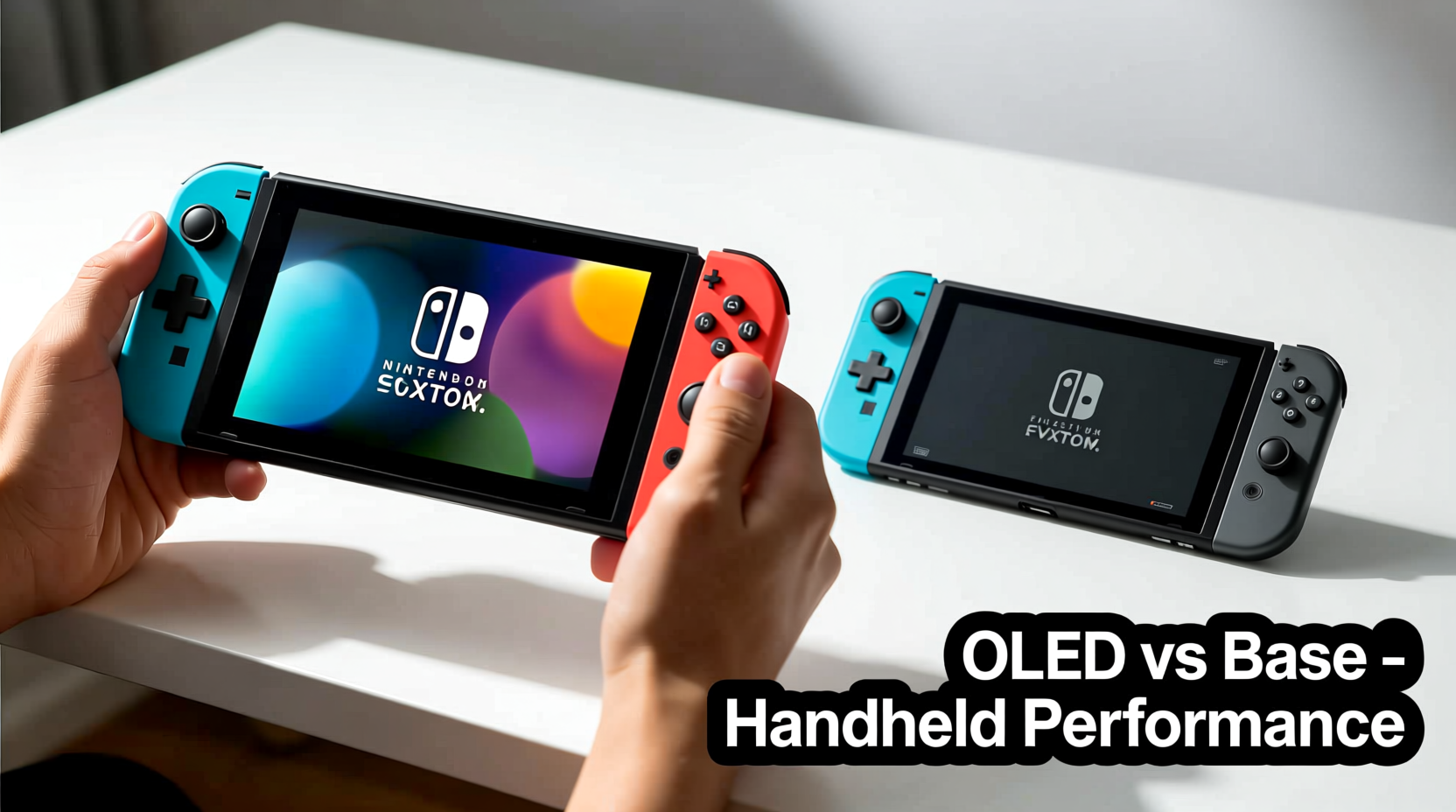
The most immediately noticeable difference between the two models is the display. The base Switch features a 6.2-inch LCD panel with a resolution of 720p. While functional, it often appears washed out, especially in bright environments, and lacks deep contrast or vibrant color reproduction.
In contrast, the Switch OLED model upgrades to a 7-inch OLED screen. This may not seem like a massive increase in size, but the technology behind it transforms the viewing experience. OLED panels deliver true blacks, higher contrast ratios, and richer colors due to individual pixel illumination. For handheld gaming, this means games like *The Legend of Zelda: Breath of the Wild* or *Hades* look more vivid, with greater depth and detail.
Brightness is another key factor. The OLED model’s screen is noticeably brighter, making outdoor or well-lit indoor use much more comfortable. In direct sunlight, the base model can become difficult to see, while the OLED holds up better thanks to improved luminance and anti-reflective coating.
Battery Life and Performance: Closer Than You Think
One common misconception is that the OLED model offers substantially longer battery life. In reality, both systems now share similar endurance thanks to internal improvements made during the base model’s 2019 revision. Most modern Switch games last between 3 to 6 hours depending on brightness and game intensity, regardless of model.
Nintendo officially rates both the revised base model and the OLED version at approximately 4.5 to 9 hours of gameplay, depending on the title. For example, less demanding games like *Animal Crossing: New Horizons* can stretch toward 6–7 hours, while graphically intensive titles such as *The Witcher 3* may drain the battery closer to 3.5 hours.
Despite the larger screen, the OLED model manages comparable efficiency due to the inherent power-saving properties of OLED technology—dark pixels consume less energy. However, if you frequently max out brightness or play in full-screen mode, the advantage diminishes.
“Battery life isn’t the differentiator anymore. What matters is how long you can enjoy a high-quality image without eye strain.” — Marcus Tran, Handheld Gaming Analyst at GamePort Insights
Ergonomics and Build: Comfort Over Time
While both models share the same general design language, the OLED version introduces meaningful ergonomic improvements. Its adjustable kickstand is wider and sturdier, allowing for stable tabletop play—a feature absent on the base model beyond a flimsy slot-based stand.
More importantly, the OLED model features a refined body with slightly rounded edges and a more balanced weight distribution. Although it’s marginally heavier (approx. 420g vs. 398g), users report that the added heft feels more substantial and less plasticky. The screen-to-body ratio has also improved, reducing bezel size and enhancing immersion despite the modest screen size increase.
The placement of the volume rocker, power button, and USB-C port remains consistent, but the OLED model uses a more durable hinge mechanism for the Joy-Con rails. Long-term durability was a concern with early base models, where repeated attachment and detachment could loosen connections. The updated design resists wear better, crucial for frequent handheld users.
Audio Experience: Subtle But Meaningful Upgrade
Sound quality is often overlooked in handheld comparisons, yet it plays a vital role in immersion. The OLED model includes upgraded stereo speakers with enhanced bass response and clearer mid-tones. When playing without headphones, the difference is immediately apparent—explosions feel punchier, music scores are more dynamic, and ambient sounds are better separated.
Consider a scenario where you're commuting and want to enjoy *Metroid Dread* without earbuds. On the base model, audio can sound thin and muffled, especially at lower volumes. The OLED’s speakers project sound more outward and with greater clarity, making short bursts of gameplay more engaging even in noisy environments.
That said, serious audiophiles will still prefer using headphones via the 3.5mm jack. Both models support wired audio output, and neither includes Bluetooth audio support natively (a limitation some find frustrating). So while the OLED improves built-in sound, it doesn’t eliminate the need for external listening solutions during extended sessions.
Storage and Connectivity: Practical Differences
Internally, the OLED model doubles the onboard storage from 32GB to 64GB. This may not seem like a lot by modern standards, but it provides breathing room for large games like *Red Dead Redemption 2* (~18GB) or *Elden Ring* (~15GB), especially if you’re not using a microSD card immediately.
Both models support expandable storage via microSDXC cards (up to 2TB), so this difference isn’t a dealbreaker—but having extra space out of the box reduces setup friction. If you plan to download multiple AAA titles before your first trip, the OLED gives you more flexibility.
Connectivity remains largely unchanged: both have Wi-Fi, Bluetooth, and a single USB-C port. However, the OLED docking station includes a LAN port, enabling wired internet connections when docked—an advantage only relevant in TV mode, not handheld.
| Feature | Base Model | OLED Model |
|---|---|---|
| Screen Size & Type | 6.2\" LCD | 7\" OLED |
| Battery Life | 4.5–9 hours | 4.5–9 hours |
| Internal Storage | 32GB | 64GB |
| Speakers | Basic stereo | Enhanced stereo |
| Kickstand | Limited angle, fragile | Wide-angle, durable |
| Weight | 398g | 420g |
| Price (MSRP) | $299 | $349 |
Real-World Use Case: Traveling Gamer’s Dilemma
Sophie, a college student and avid *Splatoon 3* player, commutes daily via train and relies on her Switch for downtime. She initially bought the base model due to its lower price but found herself frustrated by poor visibility in daylight and weak speaker quality during quick matches. After six months, she upgraded to the OLED model using gift cards and trade-ins.
“The first time I played outside under a tree, I couldn’t believe how much clearer the screen was,” she said. “I don’t have to crank the brightness all the way up anymore. And the speakers? Now I actually hear enemy footsteps without headphones.”
Though the battery life didn’t improve, Sophie values the better screen and sturdier build. “It just feels like a premium device now, not something held together with tape.” Her experience reflects a growing trend among mobile-focused players: small hardware refinements compound into a significantly better user experience over time.
Actionable Checklist: Choosing Your Ideal Handheld Switch
- Evaluate your primary play style: Do you mostly play in handheld or tabletop mode?
- Test screen visibility: If you often play outdoors or near windows, OLED’s brightness and contrast are worth the upgrade.
- Assess storage needs: Do you own many large games? The extra 32GB helps avoid immediate microSD dependency.
- Consider audio preferences: If you rarely use headphones, prioritize the OLED’s improved speakers.
- Budget accordingly: Determine whether the $50 premium aligns with your usage frequency and expectations.
- Check durability concerns: Frequent travelers may appreciate the OLED’s stronger kickstand and Joy-Con rails.
Frequently Asked Questions
Is the OLED screen worth it for casual handheld players?
If you play occasionally and mostly indoors, the base model remains perfectly capable. However, if you value visual fidelity and comfort during longer sessions, the OLED offers tangible benefits that enhance enjoyment.
Can I use the same accessories with both models?
Yes. All cases, screen protectors (with proper fit), charging docks, and Joy-Con controllers are fully compatible across both versions. Only minor form factor differences exist around the edges.
Does the OLED model overheat more in handheld mode?
No. Both systems use the same NVIDIA Tegra processor and thermal management. Under normal conditions, neither runs excessively hot. Poor ventilation (e.g., covering vents with hands) affects both equally.
Final Verdict: Which Is Better for Handheld Mode?
When evaluating pure handheld performance, the Nintendo Switch OLED clearly surpasses the base model. It delivers a superior screen, better speakers, improved build quality, and practical enhancements like the wide-angle kickstand—all tailored to mobile gamers.
The base model remains a viable budget option, especially for younger players or those who split time evenly between docked and portable play. At $299, it offers access to the full Switch library without compromise in functionality. But for anyone who prioritizes handheld immersion, clarity, and comfort, the $349 OLED model justifies its price through meaningful, everyday improvements.
Ultimately, the decision hinges on how you play. If your Switch spends more time in your hands than on your TV, the OLED isn’t just an upgrade—it’s the definitive handheld experience Nintendo currently offers.




 浙公网安备
33010002000092号
浙公网安备
33010002000092号 浙B2-20120091-4
Comments
No comments yet. Why don't you start the discussion?