
When Nintendo released the Switch OLED model in 2021, it wasn’t a full redesign but a refined evolution of the original hybrid console. With a larger, more vibrant screen and a few quality-of-life improvements, the OLED version promised a better handheld experience. But for many gamers, the question remains: does the upgraded display alone justify the higher price tag—typically $50 to $100 more than the standard model?
The answer isn't straightforward. While the visual improvements are undeniable, especially in handheld mode, the core gaming experience across both models is fundamentally identical. To determine whether the upgrade is worth it, we need to examine not just the screen, but also build quality, audio, storage, dock features, and how these factors align with individual usage patterns.
Display Quality: The Core Difference
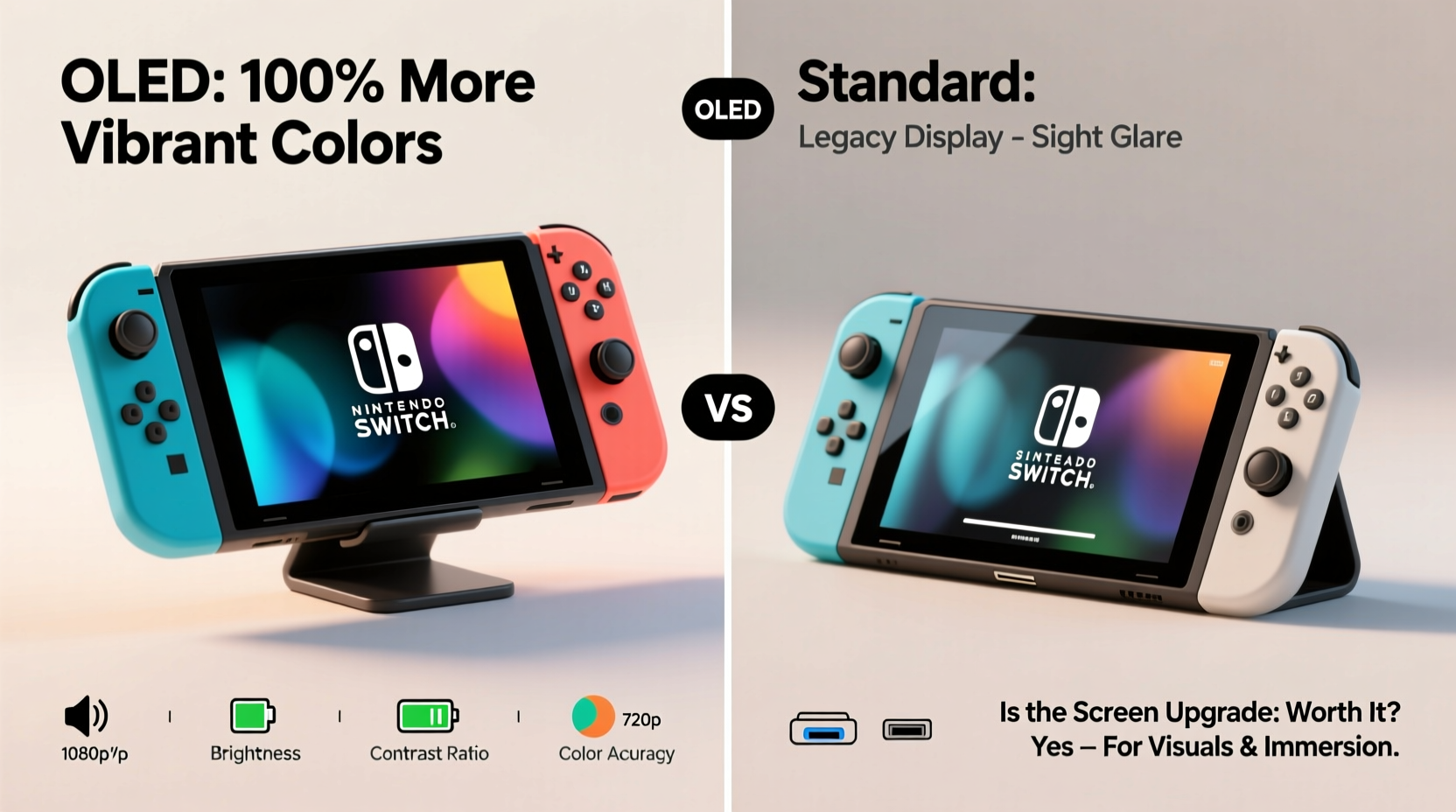
The most significant change between the two models is the screen. The standard Nintendo Switch features a 6.2-inch LCD panel with a resolution of 720p when undocked. The OLED model upgrades this to a 7-inch organic light-emitting diode (OLED) display. While the resolution remains 720p, the difference in image quality is immediately noticeable.
OLED technology offers deeper blacks, higher contrast ratios, and more accurate color reproduction compared to traditional LCDs. This means games like *The Legend of Zelda: Breath of the Wild*, *Hades*, or *Splatoon 3* appear richer and more immersive on the OLED model. Text is sharper, shadows have more depth, and outdoor scenes benefit from enhanced vibrancy without appearing oversaturated.
However, it's important to note that the resolution hasn’t increased. You’re not getting more pixels; you're getting better pixel quality. For users who mostly play docked to a TV, where the output is 1080p regardless of the model, the screen upgrade offers no advantage during those sessions.
Build and Design Improvements Beyond the Screen
The OLED model isn’t just about the display. Nintendo made several subtle but meaningful hardware refinements that enhance the overall user experience.
- Larger kickstand: The original Switch had a flimsy, narrow kickstand that often failed on uneven surfaces. The OLED model features a wide, adjustable kickstand that spans the entire back edge, making tabletop mode significantly more stable and usable.
- Improved speakers: Audio output is slightly louder and clearer on the OLED model. While still not audiophile-grade, the upgrade makes a difference during immersive gameplay or when using the console in handheld mode without headphones.
- More internal storage: The OLED model comes with 64GB of internal storage, doubling the 32GB of the standard model. Given that many modern Switch games exceed 10GB, this additional space reduces the immediate need for a microSD card.
- New dock with LAN port: The OLED bundle includes an updated dock that adds a wired Ethernet port. This is a major win for online multiplayer gamers who want a stable internet connection without relying on USB adapters or Wi-Fi.
“Even small hardware refinements—like a reliable kickstand and better audio—can dramatically improve day-to-day usability.” — David Kim, Console Hardware Analyst at GameTech Weekly
Performance and Battery Life: No Meaningful Difference
Despite the visual and structural upgrades, there are no performance enhancements in the OLED model. Both consoles use the same NVIDIA Tegra X1-based processor and deliver identical frame rates, load times, and graphical fidelity when playing the same games.
Battery life is nearly equivalent. The OLED model maintains the improved battery found in the 2019 revision of the standard Switch (often called the “V2”), which lasts between 4.5 to 9 hours depending on the game. The OLED screen’s efficiency helps offset its larger size, so power consumption remains in the same range. In practical terms, you won’t see longer play sessions simply by upgrading to the OLED.
This parity means that if your priority is raw performance or extended battery, neither model holds a clear advantage. The choice then shifts entirely to comfort, convenience, and display quality.
Price Comparison and Value Assessment
The standard Nintendo Switch typically retails for around $299, while the OLED model is priced at $349. Third-party sellers sometimes list the OLED version even higher due to demand. That $50 premium buys you:
| Feature | Standard Model | OLED Model |
|---|---|---|
| Screen Size & Type | 6.2” LCD | 7” OLED |
| Internal Storage | 32GB | 64GB |
| Kickstand | Narrow, single-piece | Full-width, adjustable |
| Dock Features | No Ethernet port | Includes LAN port |
| Audio Quality | Average | Slightly enhanced |
| Battery Life | 4.5–9 hours | 4.5–9 hours |
| Price (MSRP) | $299 | $349 |
For $50, you gain a superior screen, double the storage, a vastly better kickstand, a more robust dock, and slightly improved sound. When viewed as a package, the upgrade offers tangible benefits—especially for players who value stability in tabletop mode or frequently play online.
Real-World Usage: Who Benefits Most?
To illustrate the impact of these differences, consider Sarah, a college student who uses her Switch primarily during commutes and in her dorm room. She plays a mix of indie titles and AAA games, often in handheld mode. After upgrading from the standard model to the OLED version, she noticed immediate improvements:
- The OLED screen made reading dialogue in *Disco Elysium* easier on her eyes during late-night sessions.
- The wider kickstand allowed her to prop the console on her cluttered desk without constant readjustment.
- The extra storage meant she could download *Elden Ring* and *Stardew Valley* without immediately buying a memory card.
In contrast, Mike, a parent who mainly docks his Switch to the living room TV for family game nights, saw little benefit from the OLED model. He appreciated the new dock’s Ethernet port for smoother Mario Kart races, but the screen upgrade was irrelevant during his typical usage.
This contrast highlights a key insight: the value of the OLED model depends heavily on how you use your console. If handheld or tabletop play dominates your routine, the upgrades are meaningful. If you’re almost always docked, the benefits shrink considerably.
Frequently Asked Questions
Can I use the OLED dock with the standard Switch?
Yes. The updated dock with the Ethernet port is fully compatible with all Switch models, including the original and the standard V2. You can purchase it separately or transfer it between consoles.
Does the OLED screen drain the battery faster?
Not significantly. Despite the larger OLED panel, battery life remains consistent with the revised standard model. OLEDs are energy-efficient, especially when displaying dark content, which helps balance power use.
Is the OLED model more durable?
It’s slightly more robust due to the improved kickstand and sturdier hinge design. However, both models require careful handling. The OLED screen, while beautiful, is still vulnerable to scratches and impacts—using a case or screen protector is recommended.
Step-by-Step Guide: Choosing the Right Model for You
- Assess your primary play style: Do you mostly play handheld, tabletop, or docked? If handheld or tabletop, lean toward OLED.
- Evaluate your storage needs: If you plan to download multiple large games, the OLED’s 64GB gives you breathing room.
- Consider your internet setup: If you rely on Wi-Fi and don’t need Ethernet, the dock upgrade matters less.
- Test the kickstand need: Have you struggled with the standard model’s kickstand? If yes, the OLED’s design solves this pain point.
- Compare prices and bundles: Sometimes retailers offer the standard model with free games or accessories, improving its value proposition.
- Decide on future-proofing: The OLED model represents the current peak of Switch hardware. Unless a full successor arrives soon, it’s the best long-term handheld option.
Final Verdict: Is the Screen Upgrade Worth It?
The screen upgrade alone may not seem like a compelling reason to spend more—after all, resolution and performance remain unchanged. But when combined with the expanded storage, superior kickstand, better audio, and enhanced dock, the OLED model becomes a more complete package.
For players who prioritize portability and daily usability, the $50 premium is justified. The improvements compound over time, reducing friction in common scenarios like propping up the console or switching between games without deleting files. The visual upgrade enhances immersion, particularly in narrative-driven or visually rich titles.
However, for families or casual gamers who mostly play on a TV, the standard model remains an excellent choice. You lose some conveniences, but not the core experience. And if budget is tight, saving $50—or applying it toward games or accessories—can be smarter.
“The OLED model isn’t revolutionary, but it’s the most polished version of the Switch yet. It fixes known flaws and elevates the handheld experience meaningfully.” — Rachel Tran, Senior Editor at Pixel & Play Magazine
Conclusion
The Nintendo Switch OLED isn’t a necessity, but it is a worthwhile upgrade for the right user. If you value a better screen, more storage, and thoughtful design refinements, paying extra makes sense. If your Switch lives mostly in the dock, the standard model delivers the same great games at a lower price.
Ultimately, the decision hinges on how you play. Evaluate your habits, weigh the added features against the cost, and choose the model that aligns with your lifestyle. Whether you go OLED or standard, you’re getting access to one of the most versatile and beloved gaming libraries of the past decade.




 浙公网安备
33010002000092号
浙公网安备
33010002000092号 浙B2-20120091-4
Comments
No comments yet. Why don't you start the discussion?