
When it comes to portable gaming, two devices dominate the conversation: the Nintendo Switch OLED and the Steam Deck. Both offer immersive experiences on the go, but they cater to different types of players with distinct priorities. For travelers who want reliable entertainment during commutes, flights, or weekend getaways, choosing between them isn’t just about specs—it’s about practicality, comfort, and long-term enjoyment.
The Nintendo Switch OLED refines an already proven formula with a brighter screen, improved audio, and increased storage. Meanwhile, the Steam Deck brings full PC gaming power into a handheld form, capable of running modern AAA titles and indie darlings alike. But when you’re packing light and relying on your device for hours at a time, performance alone doesn’t tell the whole story.
Portability and Build Design
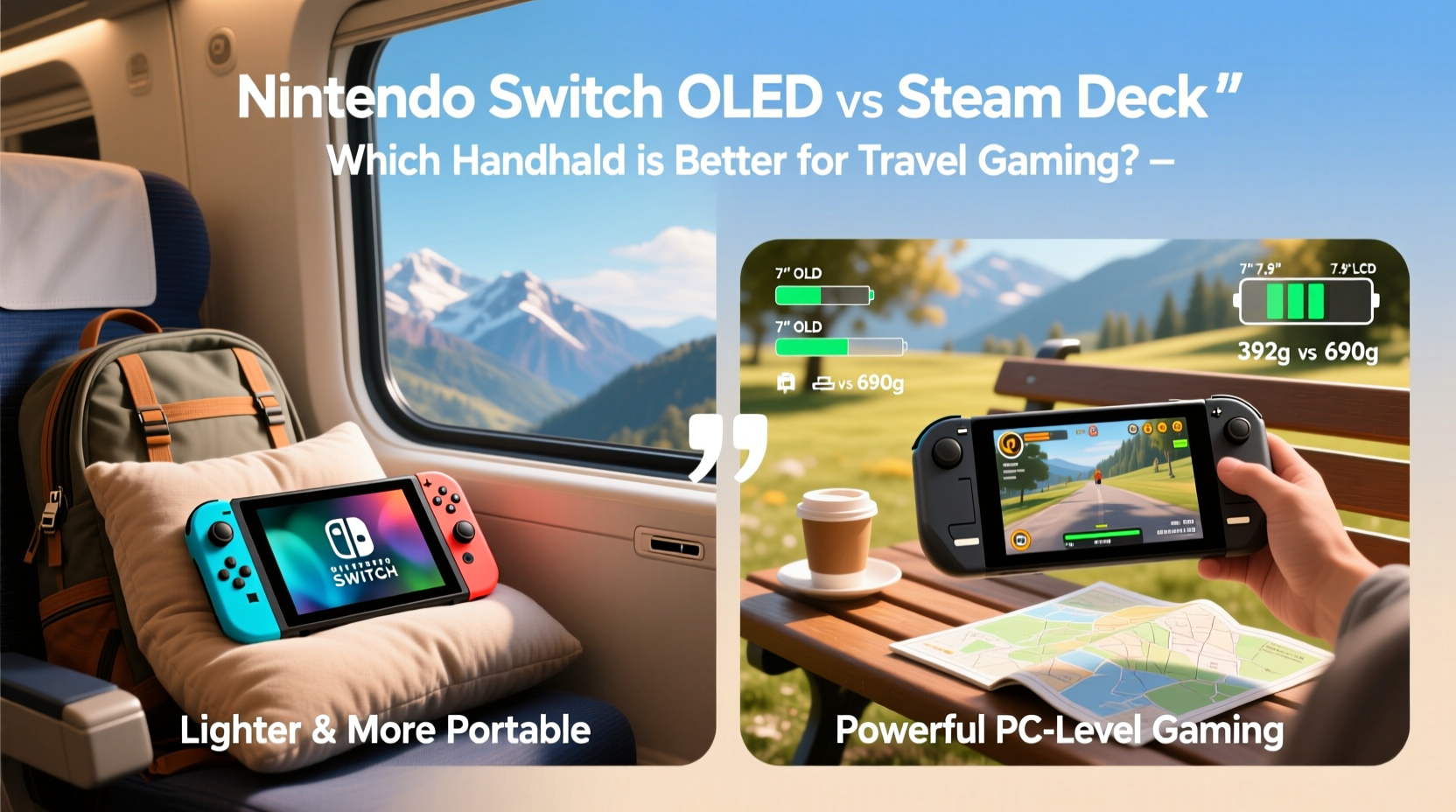
Travel demands compactness, durability, and ease of handling. The Nintendo Switch OLED measures 9.4 x 4.1 x 0.5 inches and weighs approximately 0.88 pounds (398g) in handheld mode. Its sleek, minimalist design makes it easy to slip into a backpack or even a large coat pocket. The integrated kickstand is sturdier than previous models and folds flush against the back, reducing snag risk.
In contrast, the Steam Deck is significantly larger—11.7 x 4.6 x 1.5 inches—and heavier at around 1.47 pounds (669g). While its size accommodates larger controls and more powerful internals, it can feel bulky during extended handheld sessions. Travelers with limited bag space may find it less convenient, especially when paired with accessories like carrying cases or external batteries.
The Switch’s modular approach also gives it an edge: detachable Joy-Con controllers allow flexible setups, including tabletop mode in cramped airplane trays. The Steam Deck, while self-contained and robustly built with textured grip, offers no such versatility. However, its physical buttons, trackpad, and analog sticks provide console-like precision that some gamers prefer for complex titles.
Battery Life and Charging Practicality
For travel, battery endurance is non-negotiable. The Nintendo Switch OLED delivers between 4.5 to 9 hours depending on usage. Lighter games like Animal Crossing: New Horizons or Stardew Valley can stretch close to nine hours, while graphically intensive titles like The Legend of Zelda: Tears of the Kingdom drain the battery faster, often under five hours.
The Steam Deck varies even more dramatically. Valve estimates 2–8 hours of gameplay, heavily dependent on settings and game type. Running a title like Elden Ring at high settings might yield only two hours, whereas lower-intensity games (Hades, Disco Elysium) can last up to seven. This inconsistency means travelers must plan charging stops carefully.
| Device | Avg. Battery Life | Charging Time | Charging Port |
|---|---|---|---|
| Nintendo Switch OLED | 4.5–9 hrs | ~3 hours (to 100%) | USB-C |
| Steam Deck (LCD model) | 2–8 hrs | ~2.5 hours (with 45W charger) | USB-C |
Both support USB-C fast charging, but the Switch benefits from widespread compatibility with portable power banks. Most standard phone chargers can keep it topped up. The Steam Deck, due to higher power draw, performs best with high-wattage PD chargers (30W+), limiting flexibility when outlets are scarce.
“Battery anxiety is real when traveling. I always pack a 20,000mAh power bank if I’m taking the Steam Deck on a long trip.” — Jordan Lee, tech reviewer at PortablePlay.co
Game Library and Play Experience
This is where the fundamental philosophies diverge. The Nintendo Switch OLED runs exclusive first-party franchises—Super Mario Bros. Wonder, Pikmin 4, Metroid Prime 4—alongside select third-party indies and retro titles via Nintendo eShop. Its curated ecosystem ensures consistent optimization, minimal crashes, and intuitive navigation.
The Steam Deck accesses your entire Steam library, including thousands of PC-native games. With features like Proton compatibility, it runs many Windows-based titles without modification. That includes demanding games like Cyberpunk 2077 (at reduced settings) and Doom Eternal. It also supports cloud saves, mods, and community patches—offering depth unmatched by any dedicated handheld.
However, this freedom comes with complexity. Some games require manual configuration; others have control mapping issues. While Valve has streamlined the interface with “Deck Verified” ratings, not every title works flawlessly out of the box. Travelers seeking plug-and-play simplicity may find this frustrating.
Conversely, the Switch’s library, while smaller, guarantees smooth performance. There’s no need to tweak graphics settings or troubleshoot launch errors. Parents traveling with kids appreciate this reliability—turn it on, pick a game, play.
Real-World Example: A Cross-Country Flight
Sarah, a software developer and avid gamer, recently flew from Seattle to Boston. She brought both devices but used them differently. On takeoff, she played Hades on the Steam Deck—enjoying near-console-quality visuals and responsive controls. After two hours, the battery dipped below 30%, so she switched to her Switch OLED and spent the next four hours immersed in Fire Emblem: Engage.
She appreciated having options but noted: “The Steam Deck felt amazing while it lasted, but I couldn’t shake the worry about running out of juice. The Switch was my safety net—I knew it would last until landing.”
Comfort and Long-Term Usability
Ergonomics matter when you’re playing for hours in a car seat or airport lounge. The Switch OLED’s slim profile fits comfortably in most hands, though prolonged use can strain thumbs due to small analog stick placement. Many users opt for aftermarket grips or attach the Joy-Cons to a central holder for better balance.
The Steam Deck, despite its heft, is designed for marathon sessions. The contoured back shell fits naturally in adult hands, and shoulder buttons are positioned for easy reach. Thumbsticks and trackpads are generously sized, making precise input easier for shooters or RPGs. Haptic feedback adds immersion without being distracting.
Screen quality also influences fatigue. The Switch OLED boasts a vibrant 7-inch OLED display with deep blacks and excellent color accuracy—ideal for outdoor viewing. The Steam Deck uses an 8.4-inch LCD with 1280x800 resolution. Brightness peaks lower than the Switch, making it harder to see in direct sunlight unless manually boosted (which drains battery).
- Nintendo Switch OLED: Best for bright environments and casual visual clarity
- Steam Deck: Superior for detailed textures and desktop-style UI navigation
Storage, Connectivity, and Expandability
The base Switch OLED includes 64GB of internal storage, expandable via microSDXC cards (supporting up to 2TB). Most digital games range from 10–20GB, meaning users rarely hit limits unless collecting large titles like Zelda or Xenoblade Chronicles 3.
The Steam Deck starts at 64GB (eMMC) or 256GB/512GB (NVMe SSD), all user-upgradeable. Its M.2 slot allows swapping drives—a rare feature in handhelds. Given that PC games often exceed 50GB (Red Dead Redemption 2 takes ~105GB), storage expansion is almost essential for serious players.
Connectivity-wise, both support Wi-Fi 5 and Bluetooth 4.2. Neither has LTE, so offline access requires pre-downloading content. The Steam Deck supports remote play from a home PC, letting users stream games over internet connections—a boon for travelers with stable Wi-Fi.
Checklist: Preparing Your Handheld for Travel
- Charge fully the night before
- Download desired games and updates
- Install necessary mods or patches (Steam Deck only)
- Pack a compatible USB-C cable and wall adapter
- Bring a high-capacity power bank (30W+ recommended for Steam Deck)
- Use a protective case with padding
- Back up save data (especially Steam Cloud sync)
Which Is Better for Travel Gaming?
The answer depends on what kind of traveler—and gamer—you are.
If you value simplicity, longevity, and family-friendly content, the **Nintendo Switch OLED** is the superior travel companion. It boots instantly, plays reliably, lasts longer per charge, and slips easily into any bag. It’s ideal for short trips, daily commutes, or vacations where downtime entertainment is secondary to other activities.
If you crave deep, customizable gaming experiences and don’t mind managing settings and power, the **Steam Deck** unlocks unparalleled potential. It transforms planes and trains into personal gaming stations, letting you play nearly any PC title in your library. Just be prepared to carry extra gear and monitor battery closely.
Consider hybrid solutions: some travelers own both. Use the Switch for quick sessions and social play; reserve the Steam Deck for evenings or layovers when charging isn’t a concern.
Frequently Asked Questions
Can the Steam Deck run modern AAA games smoothly?
Yes, but usually at reduced resolution (typically 800p–900p) and medium-to-low settings. Games like Baldur’s Gate 3 and Horizon Zero Dawn run well after optimization, though performance varies by title. Emulation and older AAA ports tend to perform best.
Is the Nintendo Switch OLED worth upgrading to for travelers?
If you currently own an original Switch, yes. The improved screen, louder speakers, and double the storage make a tangible difference in mobile comfort. The enhanced kickstand is also far more stable on uneven surfaces like tray tables.
Do I need internet access to play on either device while traveling?
No. Both support full offline gameplay once games are downloaded. The Switch requires occasional online checks for some accounts, but single-player titles work indefinitely offline. The Steam Deck needs initial activation online, but subsequent play does not require connectivity.
Final Verdict and Recommendation
There is no universal “better” device—only the one that aligns with your lifestyle. For stress-free, accessible, and enduring portable fun, the Nintendo Switch OLED excels. It’s refined, predictable, and built for mobility above all else.
The Steam Deck, meanwhile, redefines what handheld gaming can be. It’s a portable PC first and a console second—perfect for enthusiasts who refuse to compromise on game choice or control.
Ultimately, travel gaming should enhance your journey, not complicate it. Choose the device that matches your expectations: effortless joy or limitless possibility.




 浙公网安备
33010002000092号
浙公网安备
33010002000092号 浙B2-20120091-4
Comments
No comments yet. Why don't you start the discussion?