
When it comes to reliving gaming history, few features attract more attention than curated retro libraries offered by subscription services. For fans of classic gaming, the choice between Nintendo Switch Online and PlayStation Plus Extra often hinges on one key question: which service delivers a richer, more satisfying retro experience? Both platforms offer access to vintage titles, but their approaches differ significantly in scope, presentation, and overall appeal.
This isn’t just about nostalgia—it’s about accessibility, curation, and how well these companies honor their legacies. While Nintendo leans heavily into its iconic franchises and family-friendly roots, Sony casts a wider net across multiple generations and genres. Understanding the strengths and limitations of each service can help players decide where their monthly fee is best spent.
Library Size and Generational Coverage
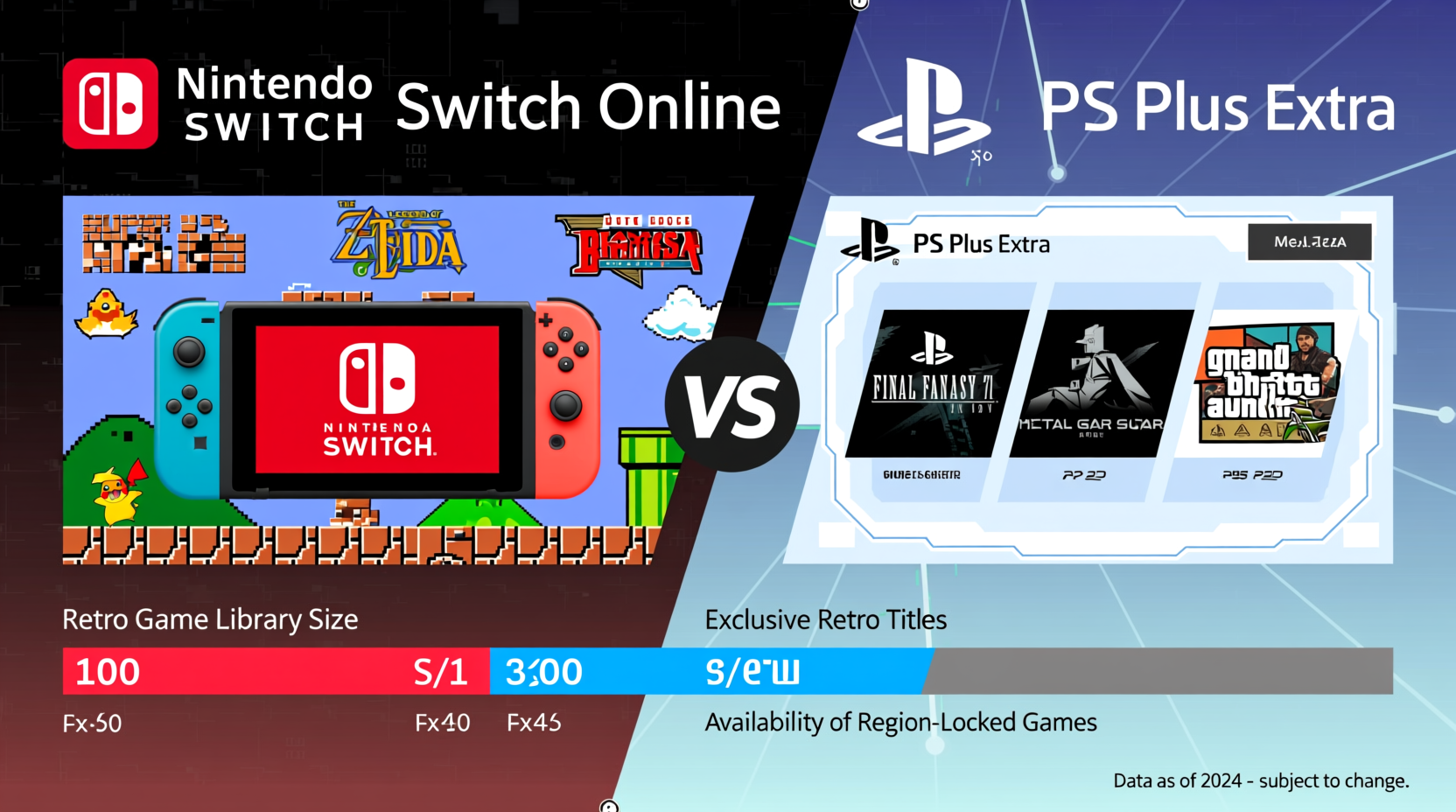
The most immediate difference between Nintendo Switch Online and PS Plus Extra lies in the breadth of retro content available. Sony’s offering is far more expansive, both in terms of volume and historical reach.
PS Plus Extra includes hundreds of backward-compatible PlayStation titles from the original PS1, PS2, and PS3 eras—many of which are accessible via cloud streaming or direct download (depending on region and device). This includes critically acclaimed games like *Final Fantasy VII*, *Shadow of the Colossus*, *Metal Gear Solid 2*, and *God of War II*. The inclusion of emulated PS2 and PS3 classics through streaming gives subscribers access to some of the most influential games of the early 2000s, many of which have never been re-released digitally.
In contrast, Nintendo Switch Online focuses exclusively on titles from the NES, SNES, Game Boy, Game Boy Color, Nintendo 64, and Sega Genesis (via the Expansion Pack tier). While this covers foundational entries in series like *Super Mario*, *The Legend of Zelda*, and *Metroid*, the total number of available games remains modest—around 150–170 depending on the subscription level. There's no access to GameCube, Wii, or later systems, limiting the depth of Nintendo’s retro offerings.
Emulation Quality and User Experience
Beyond quantity, the quality of emulation and user interface plays a major role in how enjoyable retro gaming feels on modern hardware.
Nintendo has invested heavily in polished emulation for its legacy titles. Games run smoothly with accurate frame rates, minimal input lag, and added quality-of-life features such as save states (suspend points), rewind functionality, and customizable display filters (CRT scanlines, borders). Multiplayer classics like *Super Mario Bros. 3* and *Mario Kart 64* support online play with friends, preserving the social spirit of couch co-op in a digital format.
Sony’s emulation varies by platform. PS1 games are generally well-emulated with save states and rewind options. However, PS2 and PS3 titles accessed via cloud streaming depend heavily on internet stability. Input latency, compression artifacts, and occasional server lag can detract from the experience, especially in fast-paced games. Native downloads are limited to select PS4-era remasters included in the catalog, not true retro ports.
Additionally, Nintendo integrates its retro apps directly into the system menu, making navigation intuitive. Sony, meanwhile, houses its classics within the “Game Library” section under PS Plus, requiring more steps to locate specific retro titles.
“Sony’s cloud-based approach allows them to offer technically complex PS2 and PS3 games without local emulation, but it sacrifices responsiveness. Nintendo prioritizes precision and preservation.” — Adrian Lee, Digital Archivist & Retro Gaming Consultant
Genre Diversity and Hidden Gems
A strong retro library should balance mainstream hits with niche or cult-favorite titles across multiple genres. Here, PS Plus Extra clearly outperforms in diversity.
Sony’s catalog spans RPGs (*Persona 4 Golden*), survival horror (*Resident Evil 4*), action-adventure (*Ico*), rhythm games (*Patapon*), and even experimental indie titles released during the PS3’s later years. Many of these games represent artistic milestones in gaming history and remain relevant today. The ability to explore lesser-known Japanese imports or genre-defining experiments adds significant long-term value.
Nintendo’s collection, while meticulously preserved, skews toward platformers, puzzle games, and action-adventures aimed at broader audiences. There are standout RPGs like *EarthBound* and *Chrono Trigger* (the latter only available via the Expansion Pack), but the absence of deeper narrative-driven or mature-themed experiences limits variety. Sega Genesis titles add some edge with games like *Streets of Rage 2* and *Shinobi*, but they’re a small portion of the lineup.
For players seeking variety beyond side-scrolling adventures and kart racers, PS Plus Extra offers a broader spectrum of gameplay styles and emotional tones.
Comparison Table: Key Features at a Glance
| Feature | Nintendo Switch Online + Expansion Pack | PS Plus Extra |
|---|---|---|
| Retro Systems Covered | NES, SNES, GB, GBC, N64, Genesis | PS1, PS2, PS3 (streaming), select PS4 remasters |
| Approximate Game Count | ~170 (across all tiers) | 300+ (including modern remasters) |
| Save States / Rewind | Yes (all systems) | Yes (PS1/PS2 via app); limited on streamed titles |
| Online Multiplayer for Retro Titles | Yes (e.g., Mario Kart 64, Super Smash Bros.) | No native support; depends on original game design |
| Emulation Method | Local, high-fidelity emulation | Mixed: Local (PS1), Cloud Streaming (PS2/PS3) |
| Notable Exclusives | Zelda: Ocarina of Time, Super Metroid, EarthBound | Shadow of the Colossus, God of War trilogy, Persona 5 Royal |
| Price (Annual, U.S.) | $79.99 (Expansion Pack) | $99.99 |
Real Example: Two Gamers, Two Preferences
Consider two hypothetical users: Maya, a longtime Nintendo fan who grew up playing *Super Mario World* and *Donkey Kong Country*, and Jordan, who spent high school immersed in *Silent Hill 2* and *Gran Turismo 3*.
Maya subscribes to Nintendo Switch Online + Expansion Pack. She loves being able to jump into *Yoshi’s Island* during her lunch break, using suspend saves to pause mid-level. She plays *Mario Kart 64* online with her brother every weekend. For her, the service delivers exactly what she wants—faithful recreations of childhood favorites with seamless integration into her current gaming life.
Jordan, on the other hand, values narrative depth and technical ambition. With PS Plus Extra, he revisits *Shadow of the Colossus*, marveling at its minimalist beauty despite occasional streaming hiccups. He discovers *Okami HD* for the first time and dives into *Demon’s Souls*, a game that defined a generation. While he wishes emulation were fully local, the sheer range of available experiences makes the trade-off worthwhile.
This illustrates a core truth: the “better” retro selection depends on personal taste and gaming background.
Actionable Tips for Choosing the Right Service
- Ask yourself: Do you prefer precise, nostalgic recreations of 8-bit and 16-bit classics?
- Or are you drawn to cinematic PS2 epics and groundbreaking third-party exclusives?
- Check whether your favorite retro titles are actually included—don’t assume availability.
- Test internet performance if considering PS Plus Extra’s streamed PS2/PS3 games.
- Factor in multiplayer needs: Nintendo excels at reviving old-school co-op online.
FAQ: Common Questions About Retro Game Subscriptions
Can I play PS2 and PS3 games offline with PS Plus Extra?
No. PS2 and PS3 titles are only available via cloud streaming and require a stable internet connection. They cannot be downloaded for offline use.
Are Nintendo Switch Online retro games modified in any way?
Games are emulated faithfully, but some include minor adjustments such as button remapping for modern controllers. No content changes are made. Optional visual filters (like CRT effects) are cosmetic only.
Is the Expansion Pack worth it for retro gaming alone?
If you value Nintendo 64 and Genesis games, yes. The base tier only includes NES, SNES, and Game Boy titles. The Expansion Pack unlocks critical entries like *Ocarina of Time*, *Star Fox 64*, and *Sonic the Hedgehog 2*, making it essential for serious retro fans.
Final Verdict: Which Has the Better Retro Selection?
Objectively, **PS Plus Extra offers a broader and more diverse retro game selection**. Its inclusion of PS1, PS2, and PS3 classics—many of which are otherwise inaccessible—gives it a massive advantage in historical scope and genre variety. For players interested in story-rich RPGs, atmospheric horror, or ambitious open-world designs from the early 2000s, there’s simply no equivalent on Nintendo’s side.
However, **Nintendo Switch Online delivers a superior retro experience in terms of presentation, reliability, and interactive features**. Its locally emulated games run flawlessly, support online multiplayer, and benefit from thoughtful enhancements like rewind and suspend points. For fans of platformers, puzzle games, and iconic Nintendo IPs, the service feels purpose-built and deeply respectful of its source material.
In essence: If you want **depth, variety, and access to rare or unre-released classics**, go with **PS Plus Extra**. If you prioritize **playability, polish, and beloved Nintendo nostalgia**, **Nintendo Switch Online + Expansion Pack** is unmatched.
Conclusion: Make Your Choice Based on What You Love
Gaming history is vast, and no single subscription can capture it all. Rather than chasing the “best” service on paper, focus on what kind of retro experience resonates with you. Are you replaying *GoldenEye 007* with friends or diving back into *Dark Cloud* for the first time in decades? Your answer will guide the right decision.
Both Nintendo and Sony are doing important work preserving gaming’s legacy—one with meticulous care, the other with bold ambition. Whichever path you choose, you’re not just playing old games; you’re reconnecting with moments that shaped how we play today.




 浙公网安备
33010002000092号
浙公网安备
33010002000092号 浙B2-20120091-4
Comments
No comments yet. Why don't you start the discussion?