
When it comes to handheld gaming, few devices have captured the imagination quite like the Nintendo Switch and the Playdate. One is a global phenomenon from a gaming giant with decades of legacy; the other is an indie darling born from crowdfunding and creative rebellion. While both are technically handhelds, their philosophies diverge sharply—especially in their quirky features. This isn’t just a specs showdown; it’s a cultural contrast between mainstream polish and experimental charm.
The Nintendo Switch, launched in 2017, redefined portable gaming by merging home console power with on-the-go flexibility. The Playdate, released in 2022, took a different route—offering a monochrome screen, a crank-based controller, and seasonal game drops. At first glance, comparing them might seem unfair. But when you examine their quirks—the unexpected, playful, and sometimes baffling design choices—you begin to see two distinct visions of what gaming can be.
Design Philosophy: Mainstream Versatility vs Indie Minimalism
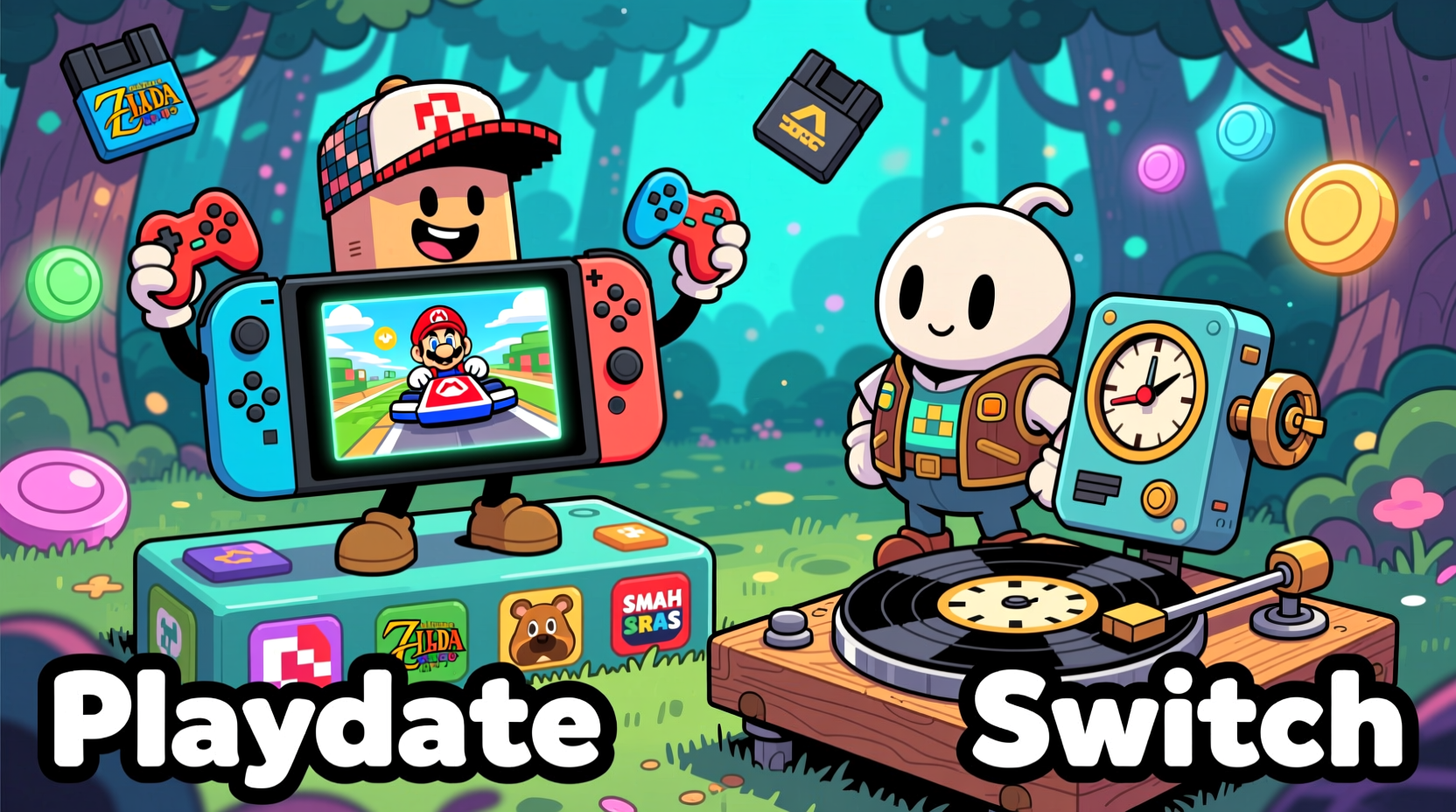
The Nintendo Switch was built for mass appeal. Its hybrid design allows players to dock it for TV play or detach the Joy-Con controllers for multiplayer fun. It supports HD rumble, motion controls, amiibo integration, and even local wireless multiplayer with minimal setup. Every feature serves a clear purpose: accessibility, flexibility, and broad compatibility.
In stark contrast, the Playdate embraces constraints as creativity. Developed by Panic, the software company behind apps like Transmit and Nova, the Playdate was never meant to compete on power. Instead, it offers a 400x240 black-and-yellow e-ink display, no backlight, and a distinctive hand-crank controller that juts out from the side. These aren't limitations—they're invitations to rethink interaction.
“Playdate isn’t trying to be another Switch. It’s asking, ‘What if a game console felt like a sketchbook?’” — Cabel Sasser, Co-founder of Panic
This philosophical split shapes every quirky feature. The Switch enhances existing paradigms; the Playdate invents new ones. For example, while the Switch lets you play The Legend of Zelda: Breath of the Wild on a train, the Playdate delivers short, inventive games like Crankin’s Time Travel Adventure, where you literally turn the crank to control time.
Quirky Feature Breakdown: What Sets Them Apart?
Let’s dissect the standout quirks—those unusual elements that define each console’s personality.
Nintendo Switch: Quirks That Serve Function
- Detachables Everywhere: The Joy-Con controllers snap on and off with magnets, enabling instant multiplayer. They also house motion sensors, IR cameras, and HD rumble—features used creatively in games like 1-2-Switch and Ring Fit Adventure.
- Tabletop Mode: Flip out the kickstand and play anywhere. It’s not perfect (the stand is flimsy), but it enables impromptu gaming sessions without needing a TV.
- Amiibo Integration: Tap an NFC figurine to unlock content. While underused in many titles, it adds collectible depth in games like Super Smash Bros. Ultimate.
- Asymmetrical Analog Sticks: The left stick is slightly larger than the right—a subtle quirk some find ergonomic, others frustrating.
Playdate: Quirks That Are the Experience
- The Crank: A physical rotating handle that doubles as an input method. In Dial Trials, you race by cranking faster. In Recess, you swing a bat using the crank. It’s tactile, absurd, and strangely satisfying.
- Seasonal Game Delivery: Instead of downloading everything at once, Playdate users receive 24 curated games in “seasons”—12 per week for two weeks. It creates anticipation, like a serialized story.
- No Backlight, No Color: The e-ink screen saves battery and reduces eye strain, but demands good lighting. It also forces developers to focus on clever UI and animation within strict visual limits.
- Bluetooth LE for Saves: No internal storage? Your save data syncs via Bluetooth to your phone when docked. Unconventional, but efficient for its scale.
Side-by-Side Comparison: Key Features at a Glance
| Feature | Nintendo Switch | Playdate |
|---|---|---|
| Screen Type | 6.2\" LCD (720p) | 2.7\" Monochrome e-ink (400x240) |
| Battery Life | 4.5–9 hours | Up to 1000 hours (on standby), ~10 hours active |
| Unique Input | Motion controls, HD rumble, IR camera | Side-mounted crank + d-pad/buttons |
| Game Library | Thousands (AAA to indie) | Curated seasons (24 games total at launch) |
| Connectivity | Wi-Fi, Bluetooth, USB-C | USB-C, Bluetooth LE (for syncing) |
| Price (Launch) | $299 | $179 (sold out at preorder) |
| Expandable Storage | MicroSD support | No—games preloaded via cable sync |
Note: The Playdate’s lack of expandable storage and reliance on wired syncing may feel archaic, but it aligns with its ethos—minimalist, intentional, and disconnected from constant updates.
Real Example: A Week With Both Consoles
Consider Sarah, a graphic designer and casual gamer. She owns a Switch for weekend Zelda marathons and co-op Mario with her partner. But during her daily commute, she pulls out her Playdate.
On Monday, she plays Exhausting Speed—a racing game where accelerating requires rapid cranking. Her coworkers laugh as she mimes revving a motorcycle. Tuesday brings Window Pains, a stealth puzzle game where timing crank movements opens blinds to avoid detection. By Friday, she’s received her final seasonal game: Tiny Valley, a minimalist life sim where turning the crank ages crops.
She doesn’t play the Playdate longer than 15 minutes at a stretch. But those moments are memorable—playful, surprising, and deeply tactile. Meanwhile, her Switch remains at home, reserved for immersive sessions. For Sarah, the two don’t compete; they complement. One feeds escapism, the other curiosity.
Step-by-Step: How to Get the Most From Each Console
- Start with Purpose: Define what you want—broad entertainment (Switch) or curated experimentation (Playdate).
- Set Up Your Environment: For the Switch, ensure your docking station is near a TV. For Playdate, install the desktop app and sync via USB before first use.
- Explore Launch Titles: On Switch, try 1-2-Switch to experience all hardware quirks. On Playdate, complete the first season to understand crank mechanics.
- Invite Others: Host a Switch party with local multiplayer. Share your Playdate with friends just to see their reaction to the crank.
- Track Usage Patterns: After two weeks, note which console you reach for most—and why. You might discover preferences you didn’t expect.
Expert Insight: Why Quirks Matter in Gaming
Dr. Lena Tran, a human-computer interaction researcher at MIT, argues that unconventional inputs foster deeper engagement.
“When a device asks you to interact differently—like cranking, tilting, or blowing into a mic—it breaks passive consumption. You’re not just pressing buttons; you’re performing. That physicality creates emotional resonance.” — Dr. Lena Tran, HCI Researcher
This explains why even simple Playdate games feel memorable. The crank turns gameplay into performance art. Similarly, the Switch’s motion-controlled fishing in Snack World or gyro-aiming in The Legend of Zelda: Tears of the Kingdom adds immersion beyond traditional controls.
Checklist: Choosing the Right Handheld for You
- ✅ Do you want access to major franchises like Mario, Zelda, and Pokémon? → Switch
- ✅ Are you intrigued by tactile, experimental gameplay? → Playdate
- ✅ Do you frequently play multiplayer or share with kids? → Switch
- ✅ Do you appreciate design as art and enjoy limited-edition tech? → Playdate
- ✅ Is budget under $200? → Playdate (though resales now exceed $250)
- ✅ Do you need long battery life for travel? → Playdate wins (weeks vs. hours)
- ✅ Do you prefer color screens and high-fidelity graphics? → Switch
This isn’t about superiority—it’s alignment. The Switch excels as a full-featured entertainment system. The Playdate thrives as a conversation piece and creative playground.
Frequently Asked Questions
Can the Playdate replace my Nintendo Switch?
No, and it’s not designed to. The Playdate lacks the processing power, library size, and multimedia functionality of the Switch. It’s a companion device, not a competitor. Think of it as the difference between a novel and a poetry collection—one offers depth, the other distilled brilliance.
Is the crank durable? Does it break easily?
Early units showed minor wear, but Panic reinforced later models. In normal use, the crank withstands thousands of rotations. Users report no widespread failures. Still, treat it gently—it’s a precision mechanism, not a car ignition.
Why does the Playdate release games in seasons?
It’s a deliberate pacing strategy. Like a weekly comic strip or podcast, it builds narrative tension and encourages regular engagement. It also helps smaller developers craft focused experiences without overwhelming players.
Conclusion: Embracing Different Kinds of Fun
The Nintendo Switch and Playdate represent two valid paths in gaming’s evolution. One refines the familiar, delivering polished, expansive worlds. The other dares to be odd, reminding us that joy can come from turning a tiny crank on a yellow rectangle.
If you only own one handheld, the Switch is the practical choice. But if you care about innovation, tactile design, and games that surprise you, the Playdate earns its place on the shelf—even if it’s just for ten minutes a day.
Ultimately, quirks aren’t flaws. They’re signatures. The Switch’s detachable Joy-Cons say, “Gaming should be shared.” The Playdate’s crank whispers, “What if we played differently?” Both messages matter.




 浙公网安备
33010002000092号
浙公网安备
33010002000092号 浙B2-20120091-4
Comments
No comments yet. Why don't you start the discussion?