
Choosing between the Nintendo Switch and the Steam Deck isn’t just about which games you want to play—it’s about how you want to play them. Both devices redefine portable gaming, but they approach the experience from entirely different philosophies. The Switch is a polished, console-grade handheld with seamless integration into Nintendo’s ecosystem. The Steam Deck, by contrast, is a full-fledged PC in your hands, capable of running thousands of Steam titles with near-desktop fidelity. This breakdown examines their portability, performance, real-world usability, and long-term value to help you decide which device fits your lifestyle.
Portability: Design, Size, and On-the-Go Usability
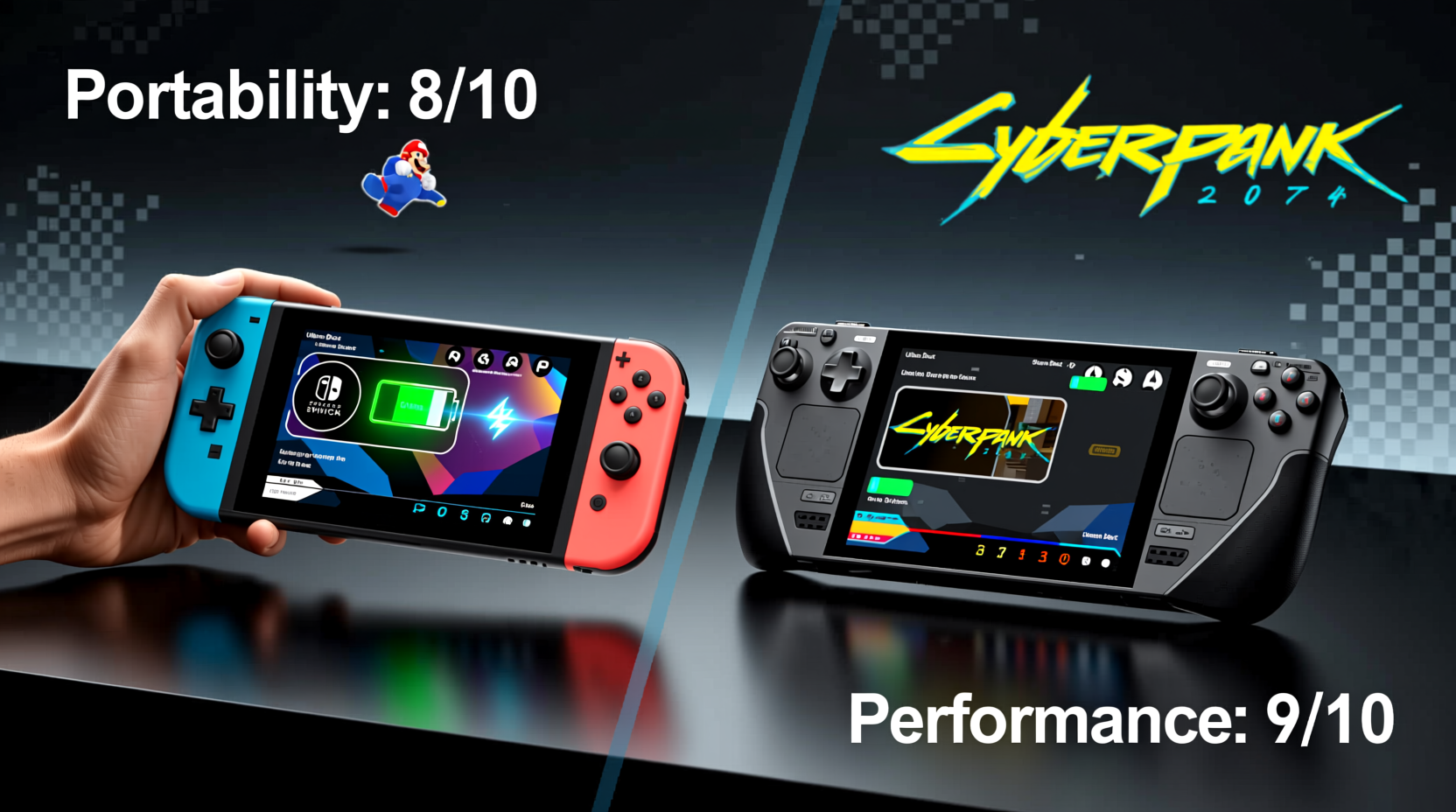
The physical design of a handheld gaming device directly impacts how easily it can be carried, used in transit, or played during downtime. The Nintendo Switch and Steam Deck differ significantly in size, weight, and ergonomics.
The original Nintendo Switch measures 9.4 inches long, 4.1 inches wide, and 0.55 inches thick when undocked, weighing approximately 0.88 pounds (398 grams) with Joy-Con attached. Its compact form makes it ideal for slipping into a backpack or even a large coat pocket. The foldable kickstand allows for quick setup on tables or tray backs, though its durability has been criticized over time.
In contrast, the Steam Deck OLED model measures 11.5 x 4.6 x 1.4 inches and weighs around 1.4 pounds (640 grams). It's noticeably larger and heavier—closer to holding a small tablet than a traditional handheld. While this extra bulk accommodates better cooling and a larger screen, it also reduces one-handed comfort and increases fatigue during extended sessions.
Ergonomics are another key factor. The Switch’s modular design lets users detach Joy-Con controllers for multiplayer or attach them to a grip for a more traditional layout. However, the standard configuration lacks shoulder button reach for larger hands. The Steam Deck features full analog sticks, trackpads, rear triggers, and a D-pad—all laid out like a modern gamepad. Its contoured shape fits naturally in adult hands, making long RPG or strategy sessions more comfortable.
Performance: Hardware, Frame Rates, and Game Fidelity
Under the hood, these systems serve very different purposes. The Switch uses a custom NVIDIA Tegra X1 chip (updated slightly in later models), designed for efficiency rather than raw power. It targets 720p resolution in handheld mode, often rendering games at lower internal resolutions and upscaling. Most AAA titles run at 30 FPS, with dynamic resolution scaling under load.
The Steam Deck, meanwhile, runs on an AMD APU combining Zen 2 CPU cores and RDNA 2 graphics architecture—essentially a stripped-down version of what powers modern desktop PCs. Valve rates its GPU performance at roughly 1.6 TFLOPS, compared to the Switch’s estimated 0.3–0.5 TFLOPS. This means the Steam Deck can handle more demanding titles like Disco Elysium, Hades, and even Baldur’s Gate 3 at medium settings and 30–60 FPS, depending on optimization.
Resolution is where the gap widens further. The base Switch has a 720p LCD screen; the OLED model upgraded to a 7.4-inch 720p OLED panel with richer colors and deeper blacks. The Steam Deck OLED now features a 1280x800 display with higher brightness, faster refresh rate (up to 90Hz), and improved outdoor visibility.
| Feature | Nintendo Switch (OLED) | Steam Deck (OLED) |
|---|---|---|
| Screen Size | 7.0 inches | 7.4 inches |
| Resolution | 1280x720 (720p) | 1280x800 |
| Display Type | OLED | OLED |
| Processor | NVIDIA Tegra X1+ | AMD Zen 2 / RDNA 2 |
| GPU Performance | ~0.5 TFLOPS | ~1.6 TFLOPS |
| RAM | 4GB LPDDR4 | 16GB LPDDR5 |
| Storage Options | 64GB eMMC (expandable via microSD) | 256GB NVMe SSD / 512GB w/ cache |
| Weight | 398g | 640g |
While the Steam Deck clearly wins on specs, real-world performance depends heavily on software optimization. Emulation, for instance, favors the Steam Deck: it can smoothly run PS2, GameCube, and even early PS3 titles through tools like RPCS3. The Switch, limited by its architecture, only officially supports backward compatibility within its own lineage (NES, SNES, N64, etc.) via online subscriptions.
“Handheld gaming is no longer about compromise. The Steam Deck proves that PC-level performance can fit in your palms.” — Mark Serrels, CNET Senior Editor
Battery Life: Real-World Endurance Compared
No amount of power matters if the device dies mid-game. Battery life remains one of the most critical factors for truly portable use.
The Nintendo Switch OLED delivers between 4.5 to 9 hours depending on the title. Lighter games like Animal Crossing: New Horizons or Stardew Valley can stretch close to nine hours, while graphically intense games like The Legend of Zelda: Tears of the Kingdom drain the battery in about five. Charging via USB-C is standard, and fast charging works with compatible adapters.
The Steam Deck tells a different story. Under light loads (indie titles, emulated games), battery life ranges from 4 to 6 hours. Demanding AAA ports may reduce that to just 1.5–2 hours at max settings. The OLED model introduced a larger 50Wh battery and more efficient components, extending average usage by up to 30%. Still, it rarely matches the Switch’s longevity.
However, the Steam Deck offers greater control. Users can cap frame rates, lower resolution using FSR, adjust GPU clock speeds, and dim the screen to extend playtime. These granular options empower technically inclined gamers to fine-tune performance versus battery trade-offs—a level of customization absent on the Switch.
Game Library & Ecosystem: What Can You Actually Play?
Performance and portability mean little without compelling games. Here, both platforms shine—but in divergent ways.
The Switch thrives on exclusives. Titles like Super Mario Odyssey, Metroid Dread, Pikmin 4, and Fire Emblem Engage are only available on Nintendo hardware. Its curated eShop emphasizes polish, family-friendly experiences, and innovative gameplay mechanics. Indie developers also favor the platform due to predictable hardware and strong discoverability.
Meanwhile, the Steam Deck opens access to over 8,000 “Verified” PC games and many more playable through Proton compatibility layers. From Civilization VI to Doom Eternal, the breadth is staggering. Backward compatibility with older Steam purchases adds immense value. However, not all games translate well—complex mouse-and-keyboard titles like MMOs or strategy games may require remapping or external peripherals.
Valve maintains a \"Deck Verified\" status system indicating whether a game runs smoothly in handheld mode. Green means fully playable, yellow indicates minor issues, and red warns of major problems. This transparency helps users make informed choices before downloading.
- Switch Strengths: First-party exclusives, local multiplayer, plug-and-play simplicity
- Steam Deck Strengths: Massive library, mod support, emulation, cloud saves via Steam
- Shared Weaknesses: Online infrastructure less robust than consoles; voice chat limitations
“The Steam Deck isn’t replacing consoles—it’s expanding what portable gaming can be.” — Tom Warren, The Verge
Real-World Use Case: Traveling Gamer’s Dilemma
Consider Sarah, a software developer who commutes two hours daily via train and enjoys weekend trips. She loves indie adventures and retro platformers but also plays deep RPGs like Persona 5 Royal.
Initially, she bought a Switch for its ease of use and enjoyed Tears of the Kingdom and Octopath Traveler II. But she missed playing her Steam backlog—titles like Dead Cells and Disco Elysium weren’t available. After switching to the Steam Deck, she gained access to nearly all her favorite games. However, she found the device too bulky for quick pulls during short breaks and had to charge it midday.
Her solution? Dual ownership. She keeps the Switch for casual outings and family visits, appreciating its instant-on functionality and shared play. The Steam Deck stays in her work bag for longer journeys where high-fidelity gaming justifies the extra weight and charging needs.
Sarah’s experience reflects a growing trend: rather than choosing one over the other, many gamers now treat the Switch and Steam Deck as complementary tools serving different scenarios.
Step-by-Step Guide: Choosing the Right Device for Your Needs
- Assess your primary gaming environment: Do you play mostly at home, on transit, or in mixed settings? Frequent travelers benefit from the Switch’s lighter build.
- List your must-play games: Are they Nintendo exclusives or Steam/PC titles? This single factor may determine your choice.
- Evaluate technical comfort: Are you willing to tweak settings, manage storage, or troubleshoot compatibility? The Steam Deck rewards tinkering; the Switch avoids it.
- Test ergonomics in person: Visit a retailer if possible. Holding both devices reveals which feels more natural for your hand size.
- Consider future-proofing: The Steam Deck receives regular OS updates and driver improvements. The Switch’s hardware is mature, with few expected upgrades beyond software.
- Budget for accessories: Factor in cases, docks, external drives, or controllers. The Steam Deck often requires more add-ons for optimal use.
Frequently Asked Questions
Can the Steam Deck run all Steam games?
No—not all Steam games are optimized for handheld play. While over 8,000 titles are verified or playable, some rely on mouse input, lack controller support, or demand more power than the Deck can provide. Always check the verification tag before downloading.
Is the Nintendo Switch still worth buying in 2024?
Absolutely. With a steady stream of first-party releases, excellent battery life, and unmatched local multiplayer, the Switch remains the best option for families, casual gamers, and fans of Nintendo franchises. Its simplicity appeals to users who prefer hassle-free gaming.
Which has better online multiplayer?
The Switch integrates Nintendo Switch Online for cloud saves and voice chat via smartphone app. The Steam Deck uses Steam’s overlay and Discord integration, offering superior text and voice communication. For competitive or co-op games requiring coordination, the Steam Deck provides a more robust social toolkit.
Final Verdict: Complementary Devices, Not Direct Competitors
The Nintendo Switch and Steam Deck represent two distinct visions of portable gaming. The Switch excels as a cohesive, user-friendly system built around accessibility and exclusive content. It’s the ideal companion for quick sessions, shared play, and gamers who value polish over power.
The Steam Deck, in contrast, is a gateway to the expansive world of PC gaming—portable, customizable, and endlessly expandable. It caters to enthusiasts who want control over their experience, whether that’s modding Skyrim, emulating classic consoles, or playing the latest indie hit.
Ultimately, the “winner” depends on your priorities. If you seek reliability, long battery life, and Nintendo magic, go with the Switch. If you crave flexibility, performance depth, and a vast library, the Steam Deck is unmatched.




 浙公网安备
33010002000092号
浙公网安备
33010002000092号 浙B2-20120091-4
Comments
No comments yet. Why don't you start the discussion?