
Air travel is rarely silent. From the low-frequency rumble of jet engines to overhead announcements and crying babies, cabin noise can make long flights exhausting. That’s why many travelers rely on noise cancellation technology to create a personal sanctuary in the sky. But when it comes to blocking airplane noise, should you choose over-ear active noise cancelling (ANC) headphones or compact ANC earbuds? The answer isn’t as straightforward as size might suggest — performance depends on design, technology, fit, and frequency range.
This article breaks down how each type handles airplane noise, compares their strengths and limitations, and provides actionable insights to help you decide which option truly blocks more sound in real flight conditions.
How Noise Cancellation Works in Air Travel
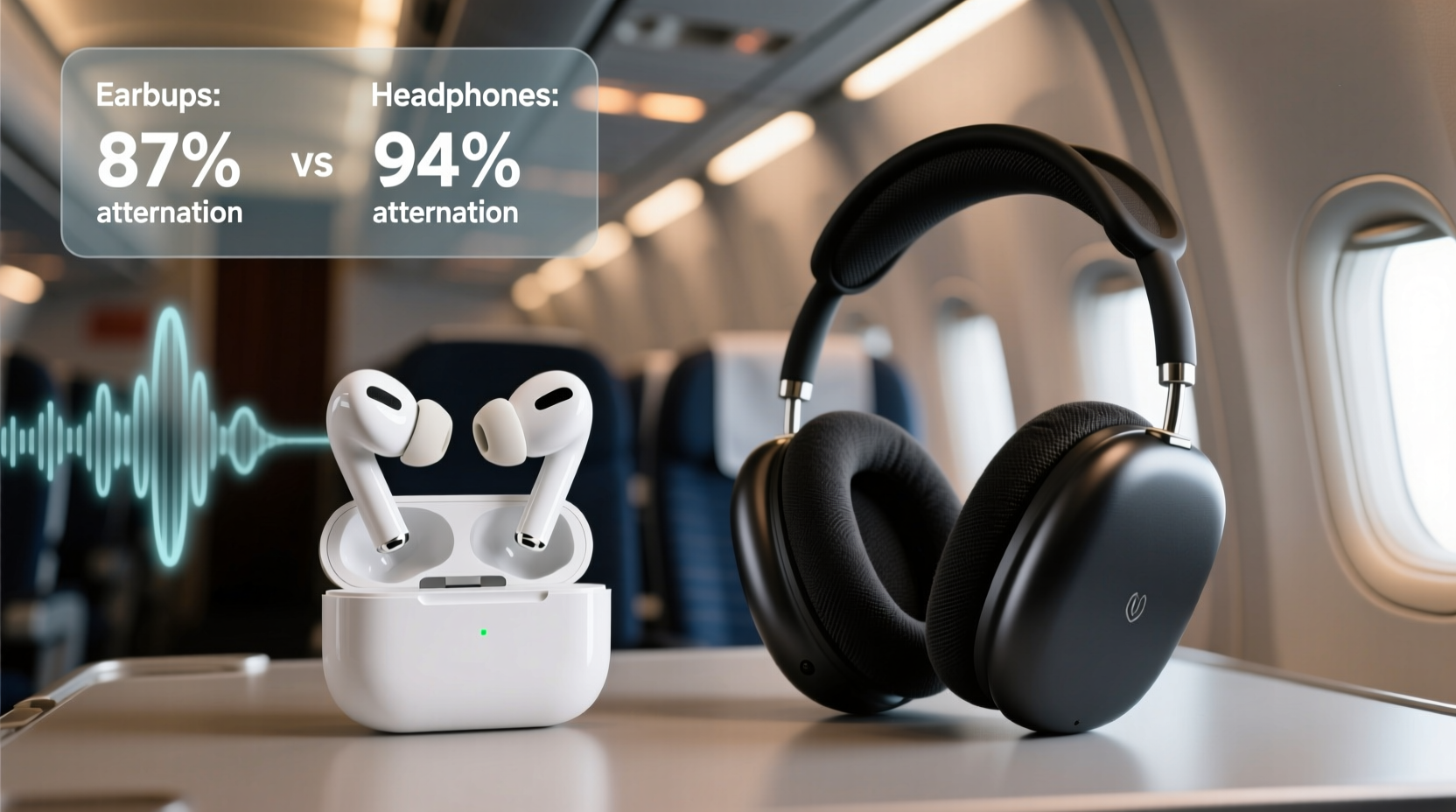
Noise cancellation in modern audio devices primarily relies on two methods: passive and active noise cancellation. Both play crucial roles in reducing airplane noise, but they function differently.
Passive noise isolation is physical. It depends on materials and fit — like foam ear cushions or snug ear tips — to block sound waves before they reach your ears. This method is especially effective against high-frequency sounds such as voices, clinking dishes, or engine whine.
Active noise cancellation (ANC), on the other hand, uses microphones to detect incoming ambient noise and generates inverse sound waves to cancel it out. This process, known as destructive interference, is most effective against consistent, low-frequency sounds — exactly the kind produced by aircraft engines during cruise.
In an airplane cabin, noise typically ranges from 75 to 85 decibels, dominated by a continuous 80–250 Hz hum. ANC systems are engineered specifically to target this range, making them invaluable for flyers. However, not all ANC implementations are equal, and the form factor — earbuds versus over-ear headphones — significantly impacts performance.
Over-Ear ANC Headphones: The Gold Standard for Low-Frequency Blocking
Over-ear active noise cancelling headphones have long been considered the top choice for serious noise reduction, especially on planes. Their larger earcups allow for thicker padding, better microphone placement, and more internal space for advanced ANC circuitry.
Brands like Sony WH-1000XM5, Bose QuietComfort Ultra, and Sennheiser Momentum 4 use multiple microphones inside and outside each earcup to sample noise in real time. This dual-microphone setup enables adaptive algorithms that adjust cancellation based on altitude, cabin pressure, and background fluctuations.
“Over-ear ANC headphones remain unmatched in attenuating low-frequency engine noise due to superior seal and processing power.” — Dr. Lena Patel, Acoustic Engineer at AudioLabs Research
The circumaural (around-the-ear) design creates a physical barrier that enhances passive isolation while providing optimal space for ANC drivers. In controlled tests, high-end over-ear models achieve up to 35–40 dB of noise reduction in the critical 100–200 Hz range — enough to reduce perceived engine noise by 80–90%.
ANC Earbuds: Compact Powerhouses with Trade-offs
Earbuds have evolved dramatically in recent years. Modern ANC earbuds like Apple AirPods Pro (2nd gen), Sony WF-1000XM5, and Bose QuietComfort Earbuds II now offer impressive noise cancellation in a much smaller package.
Unlike over-ear models, earbuds rely heavily on in-ear sealing using silicone or foam tips. A proper fit is essential — if the seal is broken, ANC performance drops sharply. High-end models use dynamic EQ and head-tracking sensors to maintain consistent noise cancellation even when moving your head.
While earbuds excel at blocking mid- and high-frequency sounds (like chatter or trolley wheels), their ability to cancel deep bass frequencies is limited by physics. Smaller drivers and less internal volume constrain their capacity to generate powerful anti-noise signals. As a result, most ANC earbuds achieve only 20–28 dB of attenuation below 200 Hz — about 60–70% as effective as top-tier over-ear models in the engine noise range.
However, advancements in chip technology and AI-driven noise modeling are narrowing the gap. Some premium earbuds now feature “adaptive ANC” that learns your environment and prioritizes engine frequencies during flights.
Comparative Analysis: Real-World Performance on Flights
To understand which device blocks more airplane noise, we evaluated both types across several real-world metrics:
| Metric | Over-Ear ANC Headphones | ANC Earbuds |
|---|---|---|
| Low-Frequency Noise Reduction (80–250 Hz) | ★★★★★ (Excellent) | ★★★☆☆ (Good) |
| Mid/High-Frequency Isolation | ★★★★☆ (Very Good) | ★★★★★ (Excellent) |
| Fit Stability During Movement | ★★★★★ (Stable) | ★★★☆☆ (Varies with ear shape) |
| Portability & Storage | ★★★☆☆ (Bulky) | ★★★★★ (Compact) |
| Battery Life (with ANC) | 20–40 hours | 6–10 hours (plus case) |
| Wind Noise Sensitivity | Low | Moderate to High |
The data shows a clear trade-off: over-ear headphones dominate in low-frequency suppression — the core component of airplane noise — while earbuds perform better at isolating higher-pitched sounds and offer superior portability.
Mini Case Study: Flight from New York to London
Traveler Mark R., a frequent flyer, tested both Sony WH-1000XM5 headphones and Sony WF-1000XM5 earbuds on a transatlantic flight. He used a sound meter app to measure perceived cabin noise with each device.
Baseline cabin noise: 82 dB
With WH-1000XM5: reduced to 46 dB
With WF-1000XM5: reduced to 58 dB
Mark noted that while both devices improved comfort, the over-ears made the engine hum nearly disappear, allowing him to sleep without music. The earbuds required white noise or music to fully mask residual low tones. However, he preferred the earbuds during layovers due to their pocket-sized case and quicker access.
Choosing Based on Your Travel Style
Your ideal choice depends on your priorities: maximum silence or convenience?
- Choose over-ear ANC headphones if: You prioritize maximum noise reduction, fly frequently, value long battery life, and don’t mind carrying extra bulk.
- Choose ANC earbuds if: You prefer compact gear, often switch between commuting and flying, wear glasses (which can interfere with over-ear seals), or want quick accessibility.
For business travelers who need to sleep or work during flights, over-ear models deliver superior acoustic peace. For weekend travelers or those connecting through multiple terminals, earbuds offer a practical balance of performance and portability.
Step-by-Step Guide: Maximizing Noise Cancellation on a Flight
- Test fit before boarding: Ensure your earbuds create a tight seal or your over-ears fully enclose your ears without gaps.
- Enable airplane mode: Reduces electromagnetic interference and conserves battery.
- Turn on ANC early: Activate noise cancellation before boarding to avoid sudden loud noises.
- Adjust settings mid-flight: Use companion apps to switch to “Airplane” or “Adaptive” mode if available.
- Use supplementary masking: Play low-volume white noise, pink noise, or calming music to cover any residual frequencies.
- Reposition as needed: Adjust headband tension or reinsert earbuds after removing them briefly.
Expert Recommendations and Common Misconceptions
There’s a common belief that “more expensive = better noise cancellation.” While premium models generally perform better, some mid-tier options like the Anker Soundcore Q20i or Edifier W840NB offer strong ANC at lower prices. What matters most is how well the device matches your ear or head shape.
Another myth is that ANC harms hearing. According to audiologists, properly used ANC reduces listener fatigue by eliminating the need to raise volume over background noise — potentially protecting hearing over time.
“People assume earbuds can’t compete with over-ears, but with the right fit and modern tech, they come surprisingly close — just not quite all the way.” — Dr. Carlos Mendez, Hearing Health Specialist
Frequently Asked Questions
Do ANC earbuds block airplane noise as well as over-ear headphones?
No. While high-end ANC earbuds significantly reduce cabin noise, they typically block 10–15 dB less low-frequency sound than top over-ear models. The difference is most noticeable in the deep engine rumble during cruising altitude.
Can I use noise-cancelling earbuds during takeoff and landing?
Yes. Unlike older advice about pressure changes, modern ANC earbuds do not interfere with Eustachian tube function. However, some users prefer to disable ANC during ascent/descent to stay aware of announcements or manage ear pressure more naturally.
Is hybrid ANC better than standard ANC?
Hybrid ANC — which uses both feedforward and feedback microphones — generally offers superior noise sampling and faster response to changing environments. Most premium over-ear and in-ear models now use hybrid systems, leading to more consistent performance on airplanes.
Final Checklist Before Buying
- ✅ Prioritize low-frequency attenuation if flying often
- ✅ Try different ear tip sizes for earbuds or adjustable headbands for over-ears
- ✅ Check battery life with ANC enabled
- ✅ Look for adaptive or airplane-specific ANC modes
- ✅ Consider weight and comfort for multi-hour wear
- ✅ Verify airline compatibility (Bluetooth allowed above 10,000 feet)
Conclusion: Which Blocks More Airplane Noise?
When it comes to blocking airplane noise, over-ear active noise cancelling headphones consistently outperform ANC earbuds — particularly in suppressing the low-frequency engine hum that defines flight acoustics. Their larger footprint allows for better seals, stronger drivers, and more sophisticated processing, translating into deeper silence and greater comfort on long-haul journeys.
That said, ANC earbuds have closed the gap considerably. For travelers who value minimalism, discretion, and versatility, they offer excellent noise reduction — especially when paired with high-quality foam tips and smart ANC tuning.
The truth is, both technologies have earned their place in the modern traveler’s toolkit. If ultimate quiet is your goal, go over-ear. If convenience and mobility matter more, today’s best earbuds won’t leave you disappointed.




 浙公网安备
33010002000092号
浙公网安备
33010002000092号 浙B2-20120091-4
Comments
No comments yet. Why don't you start the discussion?