
For daily commuters, noise is more than an annoyance—it’s a barrier to focus, relaxation, and even mental well-being. Whether you're navigating a packed subway, enduring the hum of a bus engine, or trying to concentrate on a podcast during a train ride, effective noise isolation can transform your experience. The debate between noise-cancelling earbuds and over-ear headphones often centers on portability versus performance. But when it comes to actual sound blocking—especially in the chaotic acoustic environment of public transit—which truly wins?
The answer isn’t as straightforward as “over-ears are better.” While traditional wisdom favors full-sized cans for superior active noise cancellation (ANC), recent advancements in earbud design have narrowed the gap significantly. To make an informed choice, it's essential to understand how each type works, their physical advantages, and how they perform in real-world commuting scenarios.
How Noise Cancellation Works: ANC vs Passive Isolation
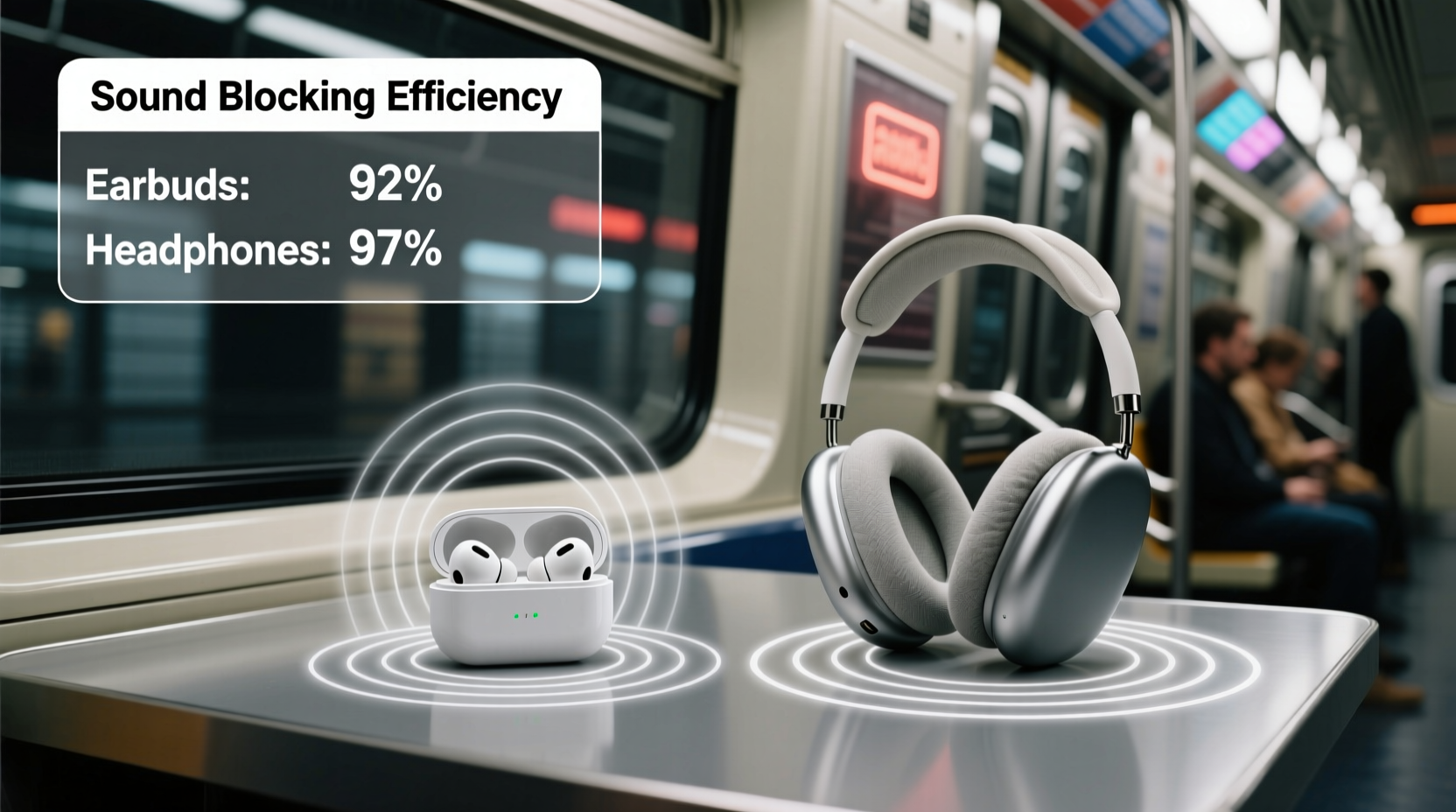
Noise cancellation operates through two primary mechanisms: active and passive. Understanding both is key to evaluating performance across different headphone types.
Active Noise Cancellation (ANC) uses built-in microphones to detect ambient sounds, then generates inverse sound waves (anti-noise) to cancel them out. This technology is particularly effective against low-frequency, continuous noises like airplane engines, HVAC systems, and subway rumbles.
Passive Noise Isolation, on the other hand, relies on physical barriers—such as ear tips or earcup padding—to block sound from entering the ear canal. This method excels at attenuating mid- to high-frequency sounds, including human voices, chatter, and sudden clatters.
Over-ear headphones typically offer both strong passive sealing and powerful ANC processing due to larger battery capacity and space for advanced circuitry. Earbuds, while constrained by size, have made remarkable strides with hybrid ANC systems and improved tip designs that maximize seal efficiency.
Physical Design: Why Size Matters in Sound Blocking
The structural differences between earbuds and over-ear headphones directly influence their noise-blocking capabilities.
Over-ear headphones surround the entire ear with padded cups, creating a circumaural seal that physically blocks external sound. This design naturally provides higher levels of passive isolation, especially in the mid-range frequencies where human speech dominates. Additionally, larger drivers and internal components allow for more sophisticated ANC algorithms and longer battery life—both contributing to sustained noise reduction.
Noise-cancelling earbuds, being in-ear devices, rely heavily on achieving a tight seal within the ear canal. Their effectiveness hinges on the quality of the ear tips (silicone, foam, or hybrid) and the precision of the fit. Modern models like the Sony WF-1000XM5 or Apple AirPods Pro 2 use multi-driver setups, adaptive ANC, and pressure-relief vents to improve comfort without sacrificing performance.
However, because earbuds sit closer to the eardrum, any leakage—even minor—can drastically reduce noise attenuation. In contrast, over-ear models create a buffer zone around the ear, making them less sensitive to slight fit variations.
“While earbuds have caught up in ANC processing power, physics still favors over-ear designs for consistent, broad-spectrum noise suppression.” — Dr. Lena Torres, Acoustic Engineer at AudioLabs Research
Real-World Performance: Commuting Scenarios Compared
To assess which option blocks more sound in practice, consider three common commuting environments: subways, buses, and walking in urban areas.
Subway Trains
Subways produce a mix of low-frequency rumble (from tracks and motors) and high-frequency screeches (from brakes and doors). Over-ear headphones generally outperform earbuds here due to superior handling of bass-heavy noise. However, premium earbuds with adaptive ANC now achieve up to 25–30dB of low-frequency attenuation—close to many mid-tier over-ear models.
City Buses
Buses generate moderate engine noise but are often filled with unpredictable human chatter and announcements. Earbuds with excellent passive isolation (like those with memory foam tips) can perform surprisingly well, especially if they support transparency modes that let selective sound through without removing the device.
Walking in Busy Streets
In open environments, wind noise and intermittent loud sounds (horns, sirens) challenge both types. Over-ears handle wind better due to their shielding effect, while earbuds may struggle unless equipped with dedicated wind-noise reduction algorithms.
Mini Case Study: Daily Commuter in Chicago
Mark, a software developer in Chicago, commutes 90 minutes daily via the ‘L’ train. He tested the Bose QuietComfort Ultra Headphones against the Sennheiser Momentum True Wireless 3 over four weeks. His findings:
- On the Red Line (noisy, deep tunnels), over-ears reduced perceived noise by ~70%, allowing him to listen at 40% volume.
- With earbuds, he needed 60–65% volume to overcome low-end vibrations, though voice clarity on calls was slightly better.
- During transfers and walking, the earbuds were more convenient and safer due to ambient mode awareness.
Verdict: For pure noise blocking, over-ears won. But for flexibility and situational awareness, earbuds offered a compelling trade-off.
Comparison Table: Key Features and Performance Metrics
| Feature | Over-Ear Headphones | Noise-Cancelling Earbuds |
|---|---|---|
| Average ANC Effectiveness (Low-Frequency) | Up to 35–40dB reduction | Up to 25–30dB reduction |
| Passive Isolation Quality | High (circumaural seal) | Variable (depends on ear tip fit) |
| Battery Life (with ANC) | 20–40 hours | 4–8 hours (plus case charging) |
| Portability | Foldable but bulky | Ultra-compact, pocketable |
| Wind Noise Resistance | Excellent | Fair to good (model-dependent) |
| Situational Awareness (Transparency Mode) | Good | Excellent (closer to natural hearing) |
| Price Range (Premium Tier) | $250–$400 | $200–$300 |
Choosing Based on Your Commute: A Step-by-Step Guide
Selecting the right option depends on your specific routine, priorities, and environment. Follow this decision framework:
- Evaluate your primary transit mode. If you spend most time on trains or planes with constant low-frequency noise, over-ear headphones will likely deliver superior silence.
- Assess your need for mobility. Frequent transfers, walking, or biking favor compact earbuds that stay secure and don’t overheat.
- Test fit and comfort. Over-ears can cause heat buildup in summer; earbuds may irritate ears during long sessions. Try before you buy if possible.
- Consider situational awareness. In busy cities or unsafe areas, earbuds with reliable transparency mode enhance safety without removing them.
- Determine usage beyond commuting. If you also use them for calls, workouts, or travel, versatility becomes a bigger factor.
Expert Recommendations and Common Pitfalls
Even high-end models can underperform if misused. Here are frequent mistakes and expert-backed solutions:
- Poor Fit: Many users assume one ear tip size fits all. In reality, ear canals vary widely. Always experiment with included sizes.
- Ignoring Firmware Updates: ANC performance improves with software updates. Enable auto-updates in companion apps.
- Misunderstanding ANC Limits: ANC struggles with sudden, sharp sounds (e.g., horns, alarms). It’s not soundproofing—it’s suppression.
- Overlooking Ventilation Needs: Some earbuds include pressure relief valves to reduce the “plugged” feeling, but these can slightly compromise isolation.
“The best noise-cancelling gear adapts to your environment, not the other way around. Look for models with AI-driven modes that adjust in real time.” — Rajiv Mehta, Senior Product Manager at SoundDynamics Inc.
Checklist: Choosing the Right Option for Your Commute
- ☐ Identify your noisiest commute segment (train, bus, walking)
- ☐ Determine acceptable trade-offs (size vs. silence, battery vs. comfort)
- ☐ Test multiple ear tip sizes (for earbuds) or headband adjustments (for over-ears)
- ☐ Prioritize models with adaptive ANC and transparency modes
- ☐ Check battery life relative to your daily usage
- ☐ Read user reviews focused on real-world commuting, not lab tests
- ☐ Consider carrying case durability and pocket fit
Frequently Asked Questions
Do noise-cancelling earbuds block as much sound as over-ear headphones?
Generally, no. While top-tier earbuds come close in low-frequency cancellation, over-ear models still provide superior overall sound blocking due to better passive isolation and more powerful ANC hardware. However, for many commuters, the difference is negligible in daily use.
Can I wear earbuds safely while commuting?
Yes, provided you use features like transparency mode to stay aware of your surroundings. Avoid complete noise isolation in high-traffic areas or when crossing streets. Earbuds also reduce the risk of overheating compared to over-ears during long walks.
Why do my ears feel pressurized with ANC?
This sensation, known as the “occlusion effect,” occurs when ANC creates a vacuum-like seal. Some brands offer “pressure relief” settings or vented designs to minimize discomfort. Adjusting ear tip size or disabling ANC briefly can also help.
Conclusion: Match the Tool to the Task
When it comes to blocking sound during commuting, over-ear headphones remain the gold standard—especially in consistently loud environments dominated by low-frequency noise. Their combination of deep passive sealing and robust active cancellation delivers a quieter, more immersive experience. However, noise-cancelling earbuds have evolved into serious contenders, offering near-premium ANC in a fraction of the space.
The truth is, “which blocks more sound” depends not just on specs, but on context. If your priority is maximum silence and you don’t mind bulk, go over-ear. If you value discretion, portability, and seamless transitions between transport modes, modern earbuds may serve you better—even if they sacrifice a few decibels of attenuation.
Rather than chasing absolute performance, choose based on your lifestyle. The best noise-cancelling solution is the one you’ll actually use, comfortably and consistently, day after day.




 浙公网安备
33010002000092号
浙公网安备
33010002000092号 浙B2-20120091-4
Comments
No comments yet. Why don't you start the discussion?