
Choosing the right pair of earbuds in today’s crowded audio market can feel overwhelming. With claims like “immersive sound,” “studio-quality clarity,” and “blocks all outside noise,” it’s easy to get lost in marketing jargon. Two terms that often cause confusion are noise cancelling and noise isolating. While they sound similar—and both aim to improve your listening experience—they work in fundamentally different ways. Understanding these differences isn’t just about technical curiosity; it’s about making a smarter investment in your daily comfort, productivity, and audio enjoyment.
Whether you're commuting on a noisy train, working from a bustling café, or trying to focus at home with background distractions, selecting the right type of earbud can dramatically affect how well you hear your music, podcasts, or calls. More importantly, choosing incorrectly could mean paying extra for features you don’t actually need—or worse, ending up with earbuds that fail to deliver the quiet environment you expected.
How Noise Isolation Works: The Physical Barrier Approach
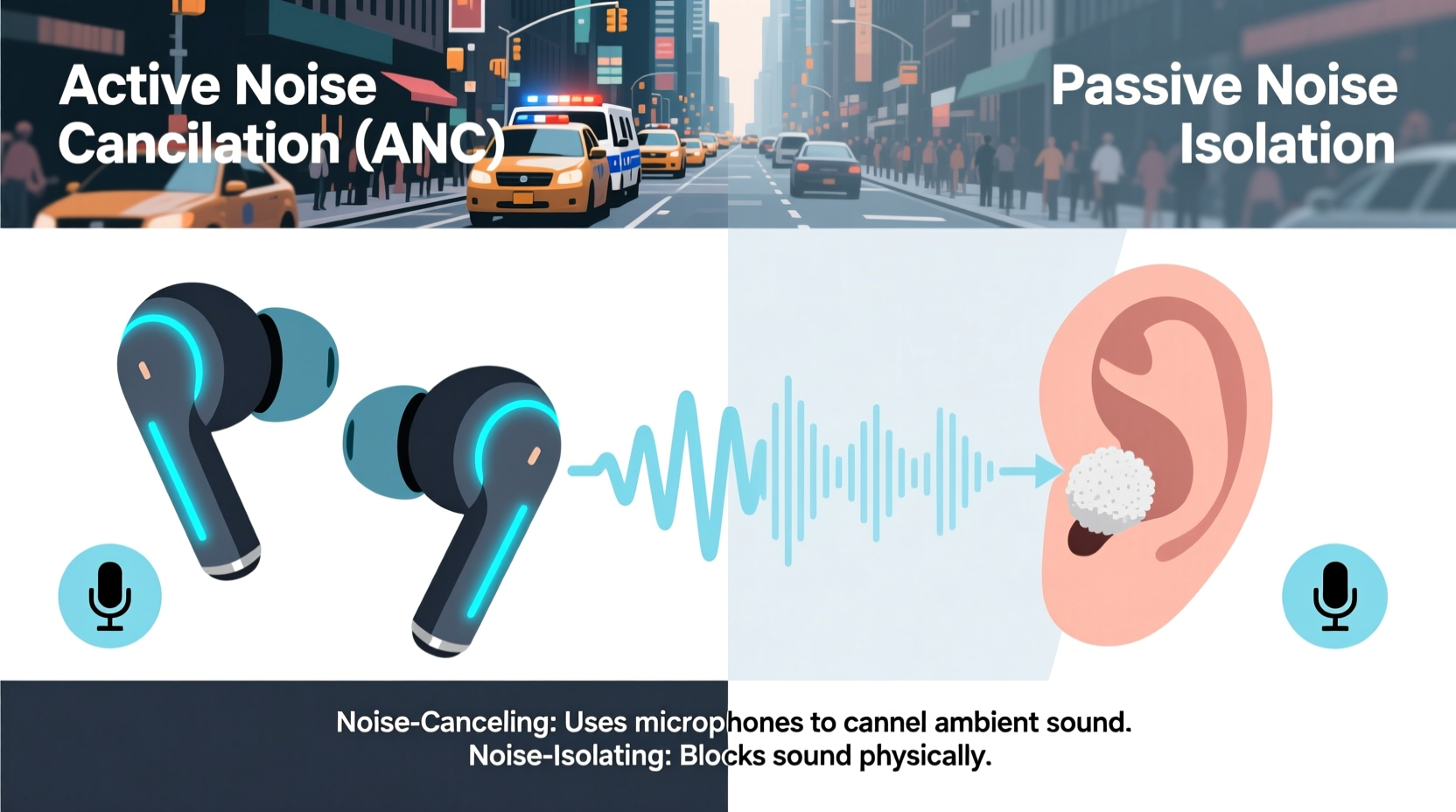
Noise isolation is a passive method of reducing external sound. It relies entirely on physical design—specifically, how well the earbud forms a seal inside your ear canal. When properly fitted, noise-isolating earbuds block out ambient noise by creating a tight barrier that prevents sound waves from entering. This is achieved through materials like silicone, foam, or rubber tips that conform to the shape of your ear.
The effectiveness of noise isolation depends heavily on fit and material quality. For example, memory foam tips expand gently inside the ear canal, offering a snugger seal than standard silicone. Because this method doesn't require power or electronics, it works consistently across all types of earbuds—even basic, budget-friendly models without any advanced tech.
It's worth noting that noise isolation tends to be most effective against high-frequency sounds—like chatter, clinking dishes, or keyboard typing—but less so against low-frequency rumbles such as airplane engines, traffic hum, or air conditioning units. Still, when paired with good-quality drivers, isolated earbuds can provide surprisingly immersive sound in moderately loud environments.
Active Noise Cancellation: Science Meets Sound Waves
Active noise cancellation (ANC), on the other hand, is a technological solution. Instead of relying solely on physical barriers, ANC uses microphones, processors, and inverse sound waves to neutralize incoming noise. Here’s how it works: tiny microphones on the earbuds pick up ambient sounds, then the internal processor generates a “counter-sound” wave that’s identical in frequency but opposite in phase. When these two waves meet, they cancel each other out—a phenomenon known as destructive interference.
This process happens in real time and is particularly effective against consistent, low-frequency noises. That’s why ANC shines in scenarios like long-haul flights, subway rides, or open-plan offices where background drone dominates. Unlike passive isolation, ANC actively adapts to changing environments, especially in higher-end models with adaptive or contextual noise control.
However, ANC comes with trade-offs. It requires battery power, which means it reduces overall playback time. Some users also report a slight pressure sensation in their ears due to the anti-noise signals, often described as feeling like descending in an airplane. Additionally, ANC can slightly degrade audio quality if not implemented well, sometimes dulling treble or adding subtle hiss.
“While ANC technology has improved dramatically over the past five years, no system eliminates 100% of noise. The best results come from combining ANC with proper ear tip fit.” — Dr. Lena Torres, Audio Engineer at Acoustic Insights Lab
Key Differences at a Glance
| Feature | Noise Isolation | Noise Cancelling (ANC) |
|---|---|---|
| Mechanism | Physical seal using ear tips | Electronic signal processing with anti-noise waves |
| Power Required | No | Yes |
| Best Against | High-frequency sounds (voices, birdsong) | Low-frequency droning (engines, AC units) |
| Battery Impact | None | Reduces usage time by 20–50% |
| Cost | Generally lower | Higher due to added tech |
| Suitability | Daily use, gym, casual listening | Travel, commuting, focused work |
Real-World Example: Choosing the Right Earbuds for Your Lifestyle
Consider Sarah, a freelance graphic designer who splits her time between working remotely from home and meeting clients in busy co-working spaces. At home, her biggest distraction is street noise from nearby construction and occasional barking dogs. She initially bought premium ANC earbuds expecting total silence, only to find that while the low rumble of trucks was reduced, sudden voices and bird calls still broke through.
After consulting a product specialist, she switched to a mid-tier model with excellent passive isolation and memory foam tips. Surprisingly, she found these more comfortable and nearly as effective in her environment—especially since she didn’t need constant ANC draining her battery during full-day sessions.
In contrast, her colleague James, a frequent international traveler, needs deep noise suppression on long flights. He finds that even minor cabin hum distracts him, so he values ANC’s ability to reduce engine noise significantly. His $300 earbuds with multi-mode ANC may cost more, but they enhance his rest and concentration mid-flight, making them a justified investment.
Their experiences highlight a crucial point: the best choice depends not on which technology is “better” in absolute terms, but on your specific environment and priorities.
What to Look for Before Buying: A Practical Checklist
- Evaluate your primary use case: Are you mostly traveling, exercising, working, or relaxing at home?
- Check battery life with ANC enabled: Some models lose half their runtime when ANC is active.
- Test ear tip options: Ensure multiple sizes and materials are included for optimal sealing.
- Look for transparency mode: Useful for staying aware of surroundings without removing earbuds.
- Read real-user reviews: Pay attention to comments about fit comfort and actual noise reduction performance.
- Consider hybrid ANC: Advanced models combine feedforward and feedback systems for broader noise coverage.
- Weigh weight and fit: Bulky ANC earbuds may not stay secure during workouts.
Common Misconceptions About Noise Reduction
One widespread myth is that “more expensive = quieter.” In reality, some affordable earbuds with superior ergonomics outperform pricier ANC models in certain conditions. Another misconception is that ANC eliminates all noise. Even top-tier systems only reduce decibels by 20–35 dB, primarily in the 100–1000 Hz range. Sudden, sharp sounds like alarms or door slams remain audible.
Additionally, many assume that in-ear monitors (IEMs) automatically offer better noise isolation. While their design helps, poor fit negates any advantage. A loose-fitting IEM will leak sound just like any other bud. Fit matters more than form factor.
Frequently Asked Questions
Can I use noise isolating earbuds for flying?
Yes, but with limitations. Passive isolation helps reduce cabin chatter and overhead announcements, but it won’t do much against the deep drone of jet engines. For long flights, ANC earbuds are far more effective at minimizing fatigue caused by continuous low-frequency noise.
Do noise cancelling earbuds damage hearing?
No, ANC itself does not harm hearing. In fact, by reducing the need to turn up volume in noisy environments, ANC can help protect your ears. However, listening at high volumes for extended periods—even with noise reduction—can still lead to hearing loss over time.
Is hybrid ANC worth the extra cost?
Hybrid ANC combines inward- and outward-facing microphones to capture noise both outside and inside the earcup, allowing for faster, more accurate corrections. For frequent travelers or those in highly variable environments, the improvement is noticeable and often worth the price premium.
Making the Right Choice: A Step-by-Step Guide
- Identify your main listening environment: Airports? Office? Gym? Each favors different noise-handling strategies.
- Determine your budget: High-end ANC adds cost. Decide whether the benefit justifies the expense.
- Prioritize fit and comfort: Spend time researching models known for secure, comfortable seals.
- Compare specs beyond ANC: Look at driver size, codec support (like LDAC or aptX), and water resistance.
- Try before you buy if possible: Visit a retailer to test fit and perceived noise reduction firsthand.
- Check return policies: Online purchases should allow testing in real-world conditions with easy returns.
“The ideal earbud balances personal physiology with lifestyle demands. Technology is powerful, but anatomy is destiny when it comes to sound isolation.” — Rajiv Mehta, Hearing Health Consultant
Final Thoughts: Match the Tech to Your Life
Noise cancelling and noise isolating earbuds serve overlapping goals but achieve them through distinct methods. One isn’t inherently superior—it all depends on how, where, and why you listen. For urban commuters and frequent flyers, active noise cancellation offers tangible benefits in comfort and concentration. But for fitness enthusiasts, remote workers, or budget-conscious buyers, well-designed noise-isolating earbuds can deliver impressive results without the complexity or cost.
The key is awareness. By understanding the mechanics behind each approach, you move beyond marketing hype and make decisions grounded in real-world utility. Don’t assume that the latest ANC model is right for you just because it’s trending. Instead, assess your environment, prioritize fit, and consider whether electronic intervention truly enhances your experience—or simply drains your battery.




 浙公网安备
33010002000092号
浙公网安备
33010002000092号 浙B2-20120091-4
Comments
No comments yet. Why don't you start the discussion?