
In an increasingly noisy world, finding peace through headphones has become a necessity rather than a luxury. Whether you're commuting, working in a bustling café, or trying to focus at home, sound control matters. Two terms dominate discussions around audio clarity and silence: noise cancelling and noise isolating. While often used interchangeably, they refer to fundamentally different technologies with distinct mechanisms, benefits, and limitations. Understanding the real difference isn't just about marketing jargon—it's about making informed decisions that impact your listening experience, comfort, and even hearing health.
How Noise Isolation Works: The Physics of Passive Silence
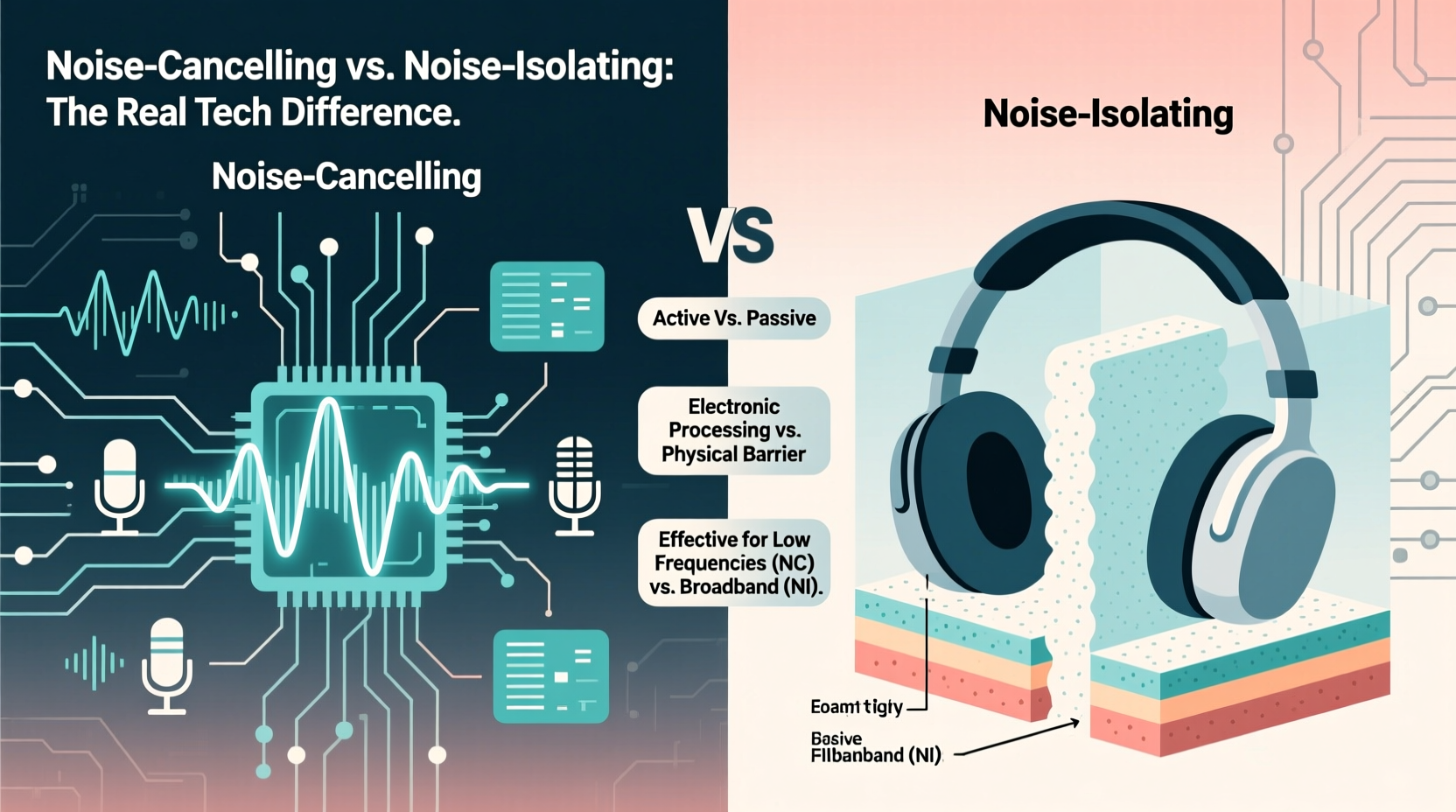
Noise isolation, also known as passive noise reduction, relies entirely on physical barriers to block external sound. It doesn’t involve electronics or microphones. Instead, it depends on materials, design, and fit. When sound waves travel through air, they can be reflected, absorbed, or deflected by solid objects. High-quality ear cups or in-ear tips made from memory foam, silicone, or dense plastics act as acoustic shields, preventing ambient noise from reaching your eardrums.
The effectiveness of noise isolation hinges on three key factors:
- Seal quality: A proper seal between the earpiece and your ear canal (for in-ears) or around the outer ear (for over-ears) is critical. Even a small gap can let in significant noise.
- Material density: Thicker, denser materials block more sound, especially higher frequencies like voices, clinking dishes, or keyboard taps.
- Design: Over-ear headphones generally offer better isolation than on-ear models because they fully enclose the ear. Similarly, in-ear monitors (IEMs) with deep insertion and custom molds provide superior isolation compared to loose-fitting earbuds.
It’s important to note that noise isolation works best against mid-to-high frequency sounds. Low-frequency rumbles—like airplane engines or traffic hum—are much harder to block passively because they vibrate through materials and require mass and depth to attenuate effectively.
Active Noise Cancelling: Engineering Silence with Sound Waves
Active noise cancelling (ANC), in contrast, is an electronic technology that actively fights incoming sound. It uses microphones placed on the exterior of the headphones to detect ambient noise. A built-in processor analyzes the waveform of that noise in real time and generates a \"counter-signal\"—a sound wave with the same amplitude but inverted phase. When this anti-noise meets the original noise, they cancel each other out through destructive interference.
This process happens continuously and rapidly, often thousands of times per second. Modern ANC systems use advanced digital signal processing (DSP) chips to adapt to changing environments, whether you’re on a plane, train, or city street.
ANC excels where passive isolation struggles: low-frequency, continuous noises. Airplane cabin drones, HVAC systems, and highway engine rumbles are prime targets. However, ANC is less effective against sudden, sharp, or irregular sounds—like a door slamming or someone calling your name—because there’s not enough time to generate the precise counter-wave.
“Active noise cancellation doesn’t eliminate sound; it neutralizes predictable patterns using inverse acoustics. It’s like putting up a silent shield against constant background pressure.” — Dr. Lena Park, Audio Engineer at MIT Media Lab
Types of Active Noise Cancellation
There are two primary implementations of ANC:
- Feedforward ANC: Microphones are placed on the outside of the ear cup. They detect noise before it reaches the ear. This system reacts quickly but may struggle with accuracy since it doesn’t account for how sound changes once inside the ear cup.
- Feedback ANC: Microphones are located inside the ear cup, closer to the ear. They measure the noise that has already entered and adjust the anti-noise accordingly. This method is more accurate for ongoing sounds but can lag slightly behind sudden changes.
High-end models now combine both approaches—called hybrid ANC—to leverage the strengths of each. Additionally, some headphones feature adaptive ANC, which uses sensors and machine learning to adjust cancellation levels based on your environment, such as switching from quiet office mode to loud subway mode automatically.
Comparing Performance: Where Each Technology Shines
To understand which solution suits your needs, consider the type of noise you encounter most and your usage context. The table below summarizes key differences:
| Feature | Noise Isolation | Noise Cancelling (ANC) |
|---|---|---|
| Technology Type | Passive (physical barrier) | Active (electronic signal processing) |
| Power Required | No | Yes (battery-dependent) |
| Best Against | Mid-to-high frequency sounds (voices, typing, chatter) | Low-frequency, consistent noise (engines, fans, AC units) |
| Effectiveness Without Power | Full effect retained | Limited to passive isolation only |
| Battery Impact | None | Reduces playback time by 20–50% |
| Situational Flexibility | Consistent across environments | Adaptive models adjust dynamically |
| Cost | Generally lower | Higher due to electronics and R&D |
Neither technology is universally superior. For example, a musician practicing in a moderately noisy apartment might prefer high-isolation in-ear monitors to block vocal distractions without needing batteries. Conversely, a frequent flyer would benefit far more from ANC headphones that reduce the oppressive drone of jet engines during long-haul flights.
Real-World Example: Commuting in a Major City
Consider Sarah, a software developer who commutes daily via subway in New York City. Her ride includes screeching brakes, loud announcements, and crowded platform chatter. She initially bought basic earbuds with poor isolation and found herself cranking the volume to unsafe levels just to hear her podcasts.
After researching, she upgraded to over-ear ANC headphones. The change was immediate: the constant rumble of the train was dramatically reduced, allowing her to listen at safer volumes. But she noticed something interesting—the sudden PA announcements were still audible, which she actually appreciated for safety. Meanwhile, the persistent engine noise was nearly gone.
Later, she tried a pair of custom-molded in-ear monitors for studio work. Though they lacked ANC, their physical seal blocked out 90% of her home office distractions. No battery needed, no latency, just pure acoustic sealing. This experience taught her that both technologies have a place—one isn’t inherently better, but context determines value.
Choosing the Right Option: A Practical Checklist
Still unsure which approach suits your lifestyle? Use this checklist to guide your decision:
- ✅ Do you frequently travel by plane, train, or car? → ANC is likely worth the investment.
- ✅ Are you sensitive to low-frequency hums (e.g., AC, refrigerators)? → ANC provides noticeable relief.
- ✅ Do you prioritize battery life and simplicity? → Noise isolation avoids power dependency.
- ✅ Do you work in environments with sudden, unpredictable sounds? → Isolation + situational awareness may be safer.
- ✅ Are you on a budget? → Well-designed isolated headphones often cost less than ANC models.
- ✅ Do you need maximum silence for concentration or sleep? → Combine both: ANC with high-isolation fit.
Frequently Asked Questions
Can noise cancelling damage my hearing?
No, ANC itself does not harm hearing. In fact, it can protect your ears by reducing the need to increase volume in loud environments. However, prolonged use at high volumes—even with ANC—can still cause hearing damage. Always follow safe listening practices: keep volume below 60% and limit extended exposure.
Do noise isolating headphones need batteries?
No. Since noise isolation is purely physical, it requires no electronics or power. This makes it ideal for users who want reliable sound blocking without charging concerns or electronic failure.
Why does ANC sometimes create a “pressure” feeling?
Some users report a sensation of “ear pressure” or fullness when ANC is active. This is caused by the way the anti-noise waves interact with air pressure inside the ear cup. Not everyone experiences it, and newer models have minimized this effect through improved algorithms and venting designs.
Final Thoughts: Silence Is a Spectrum, Not a Switch
The distinction between noise cancelling and noise isolating isn’t just technical—it shapes how we interact with sound in our daily lives. One builds a wall; the other wages a silent war against noise. The best choice depends on your environment, priorities, and personal tolerance for sound intrusion.
Many modern premium headphones now integrate both technologies: strong passive isolation forms the foundation, while active noise cancellation handles the frequencies that physical barriers can’t stop. This hybrid approach delivers the closest thing to true auditory privacy available today.
Ultimately, understanding the mechanics behind these features empowers you to move beyond marketing claims and select gear that aligns with your real-world needs. Whether you're seeking focus, rest, or immersive audio, the right combination of isolation and cancellation can transform your sonic experience.




 浙公网安备
33010002000092号
浙公网安备
33010002000092号 浙B2-20120091-4
Comments
No comments yet. Why don't you start the discussion?