
In an increasingly noisy world—whether from city traffic, office chatter, or industrial environments—protecting your hearing has never been more important. Two commonly discussed solutions are noise cancelling and noise isolating technologies. While they sound similar and both aim to reduce unwanted sound, they function in fundamentally different ways. Understanding these distinctions is essential not only for comfort but also for long-term auditory health. This article breaks down how each method works, their effectiveness in hearing protection, real-world applications, and how to choose the right one based on your lifestyle and environment.
How Noise Affects Hearing Health
Prolonged exposure to high-decibel sounds can lead to irreversible hearing damage. According to the World Health Organization (WHO), over 1 billion young people are at risk of hearing loss due to unsafe listening practices, including extended use of headphones at high volumes in noisy environments. The danger lies not just in loud sounds themselves, but in how we compensate for background noise—often by turning up volume levels beyond safe thresholds.
Effective hearing protection doesn’t always mean complete silence. Instead, it involves managing sound exposure intelligently. Both noise cancelling and noise isolating technologies contribute to this goal, but through different mechanisms and with varying degrees of success depending on context.
What Is Noise Isolating?
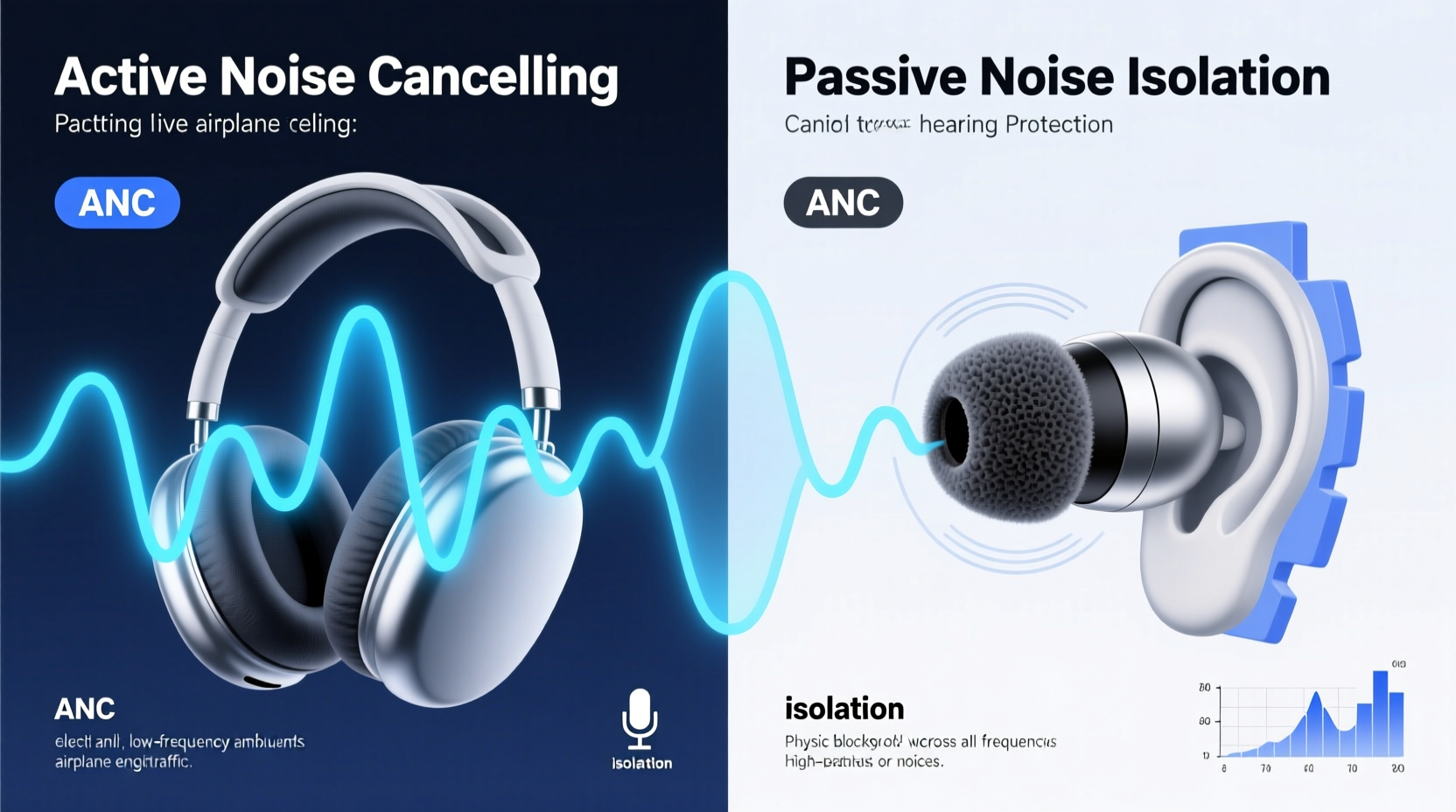
Noise isolation, sometimes referred to as passive noise reduction, relies on physical barriers to block external sound. This method uses materials and design features—such as padded ear cups, snug-fit earbuds, or over-ear seals—to create a seal around or within the ear canal. By forming a tight acoustic barrier, noise isolating devices prevent outside sound waves from reaching the eardrum.
This form of sound reduction is entirely mechanical and requires no power source. It’s effective across a broad range of frequencies but tends to perform best against higher-pitched noises like human voices, keyboard tapping, or birdsong. However, low-frequency sounds such as engine hums, air conditioning units, or subway rumbles are harder to block using isolation alone.
The Role of Fit and Material in Noise Isolation
The effectiveness of noise isolation depends heavily on fit and material density. In-ear monitors (IEMs) used by musicians, for example, are custom-molded to fit individual ear shapes, offering superior isolation compared to generic earbuds. Similarly, over-ear headphones with memory foam padding and thick sealing cushions provide better performance than flimsy plastic models.
Materials matter too. Soft silicone, memory foam, and layered composites absorb and reflect sound energy more efficiently than hard plastics. That’s why professional-grade isolation earplugs often use multi-layered foam or specialized polymers designed specifically to attenuate sound without distorting internal audio.
What Is Noise Cancelling?
Noise cancelling—more precisely called active noise cancellation (ANC)—uses advanced electronics to neutralize incoming sound. Instead of blocking sound physically, ANC systems analyze ambient noise in real time and generate an “anti-noise” signal that destructively interferes with the original sound wave, effectively cancelling it out.
This process happens instantaneously via built-in microphones that detect external noise, digital signal processors (DSPs) that calculate the inverse waveform, and speakers that emit the counter-signal directly into the ear. Because it relies on power and processing, ANC requires batteries or charging, making it more complex—and typically more expensive—than passive isolation.
ANC excels at reducing consistent, low-frequency sounds like airplane engines, HVAC systems, or highway drone. These predictable waveforms are easier for the system to anticipate and cancel. However, sudden or irregular noises—like a dog barking or a door slamming—are much harder to eliminate because the system needs time to react.
“Active noise cancellation isn’t just about comfort—it’s a tool for preventing auditory fatigue and protecting hearing in chronically noisy environments.” — Dr. Lena Patel, Audiologist and Hearing Conservation Specialist
Types of Active Noise Cancellation
- Feedforward ANC: Microphones are placed on the outside of the earcup to capture noise before it reaches the ear. Effective for steady background sounds but less responsive to rapid changes.
- Feedback ANC: Microphones sit inside the earcup, measuring residual noise after it enters. More accurate but can introduce slight audio distortion.
- Hybrid ANC: Combines both feedforward and feedback systems for broader frequency coverage and improved adaptability.
Comparing Noise Cancelling and Noise Isolating: Key Differences
| Feature | Noise Isolating | Noise Cancelling |
|---|---|---|
| Mechanism | Physical barrier blocks sound | Electronic anti-noise signal cancels sound |
| Power Required | No | Yes (battery or charge) |
| Best Against | High-frequency sounds (voices, clatter) | Low-frequency droning (engines, fans) |
| Effectiveness | Up to 15–30 dB reduction | Up to 20–45 dB reduction (depending on frequency) |
| Cost | Generally lower | Higher due to tech components |
| Maintenance | Minimal (cleaning seals/tips) | Requires firmware updates, battery care |
| Hearing Protection Suitability | Good for moderate environments | Better for prolonged exposure to constant noise |
When Each Technology Excels: Real-World Applications
Case Study: Air Travel and Commuting
Sophie, a marketing executive who flies weekly between New York and London, struggled with fatigue and ear pressure during long-haul flights. She initially used standard earbuds but found herself cranking up music to overcome cabin noise, leading to headaches and tinnitus-like symptoms. After switching to over-ear headphones with hybrid ANC, she noticed immediate improvements. The constant 85 dB engine rumble was reduced to a faint whisper, allowing her to listen at safer volumes. Additionally, the padded seal provided passive isolation for higher-pitched cabin announcements and crying babies.
This combination of active and passive technologies made her travel experience not only quieter but also safer for her hearing. Her audiologist confirmed that her reduced daily sound exposure lowered her risk of noise-induced hearing loss (NIHL).
Industrial and Construction Settings
In high-noise workplaces—such as factories, construction sites, or airports—neither ANC nor isolation alone may be sufficient. OSHA recommends hearing protection when noise exceeds 85 dB over an 8-hour shift. While consumer ANC headphones can help, they are not certified as personal protective equipment (PPE). Instead, workers should use purpose-built electronic earmuffs with integrated ANC and high NRR (Noise Reduction Rating) ratings.
These industrial-grade solutions combine robust physical isolation with active cancellation and often include features like speech amplification, so workers can hear warnings or communication while still being protected from hazardous noise.
Choosing the Right Option for Hearing Protection
Selecting between noise cancelling and noise isolating depends on several factors: your environment, duration of exposure, budget, and whether you need situational awareness.
Step-by-Step Guide to Selecting Hearing-Friendly Audio Gear
- Assess your primary noise environment: Is it dominated by low-frequency hums (e.g., planes, traffic) or high-frequency chatter (e.g., offices, cafes)?
- Determine usage duration: Long exposures benefit more from ANC to reduce auditory fatigue.
- Set a budget: High-quality ANC gear typically starts around $150; good isolating earbuds can be found under $50.
- Test fit and comfort: Poorly fitting earbuds compromise isolation, even if technically advanced.
- Check for safety certifications: For occupational use, ensure the product meets ANSI S3.19 or equivalent standards.
- Consider transparency modes: Some ANC headphones allow controlled ambient sound in, improving safety in outdoor settings.
Do’s and Don’ts of Hearing Protection with Headphones
| Do | Don't |
|---|---|
| Use volume-limiting settings (e.g., 85 dB max) | Listen at maximum volume for extended periods |
| Combine ANC with moderate volume levels | Rely solely on ANC to justify loud playback |
| Clean ear tips regularly to maintain seal | Ignore signs of ear discomfort or ringing |
| Take listening breaks every hour | Wear headphones 24/7, even while sleeping |
Frequently Asked Questions
Can noise cancelling headphones prevent hearing damage?
Yes, indirectly. By reducing background noise, ANC allows users to listen at lower volumes, decreasing the risk of noise-induced hearing loss. However, they are not a substitute for certified hearing protection in extremely loud environments (above 85–90 dB).
Is noise isolation better than noise cancelling for gym workouts?
For most gym settings, noise isolation is sufficient and often preferable. It blocks out distracting chatter and music without requiring charging. Plus, many sweat-resistant in-ear models offer excellent passive isolation and secure fit during exercise.
Do I need both noise cancelling and noise isolating?
Ideal hearing protection often combines both. Most high-end ANC headphones incorporate strong passive isolation as a foundation, then add active cancellation on top. This dual approach provides comprehensive sound attenuation across frequencies.
Final Thoughts: Prioritizing Hearing Health
The choice between noise cancelling and noise isolating isn’t just about preference—it’s about protecting one of your most vital senses. Noise isolating offers a simple, reliable, and cost-effective way to reduce sound exposure, especially in dynamic or mobile environments. Noise cancelling adds a technological edge, particularly valuable in settings with persistent low-frequency noise where auditory fatigue accumulates over time.
Ultimately, the best hearing protection strategy is proactive: limit exposure, keep volumes moderate, take regular breaks, and invest in gear that supports healthy listening habits. Whether you're commuting, working, or simply trying to focus, understanding the tools at your disposal empowers you to make smarter, safer choices.




 浙公网安备
33010002000092号
浙公网安备
33010002000092号 浙B2-20120091-4
Comments
No comments yet. Why don't you start the discussion?