
Modern wireless earbuds offer more than just high-quality audio—they come packed with intelligent features designed to adapt to your surroundings. Among the most impactful are active noise cancellation (ANC) and transparency mode. While both manipulate sound, they serve opposite purposes. Understanding when to use one over the other can significantly enhance your listening experience, personal safety, and situational awareness.
Whether you're commuting, working from a café, exercising, or simply trying to relax at home, choosing the right audio mode matters. Misusing these features can lead to missed announcements, unsafe walking conditions, or even listener fatigue. This guide breaks down the technical differences, real-world applications, and best practices so you can make informed decisions every time you pop in your earbuds.
What Is Active Noise Cancellation (ANC)?
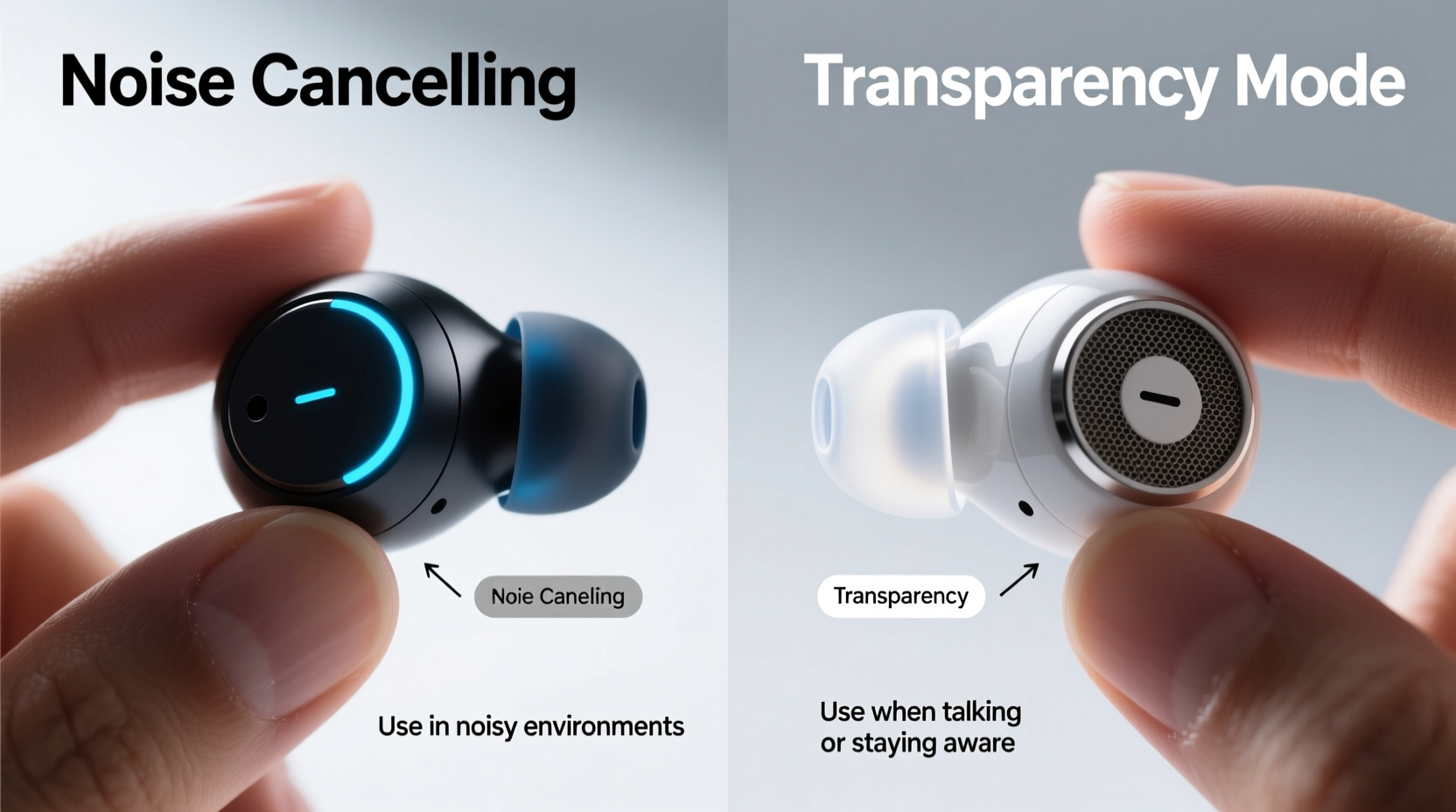
Active noise cancellation uses built-in microphones and advanced digital signal processing to detect ambient sounds and generate opposing sound waves—essentially \"cancelling\" external noise before it reaches your ears. ANC is especially effective against low-frequency, consistent background noises such as airplane engines, air conditioners, subway rumble, and office HVAC systems.
The technology works by continuously sampling environmental sound and reacting in real-time. High-end models use multiple microphones and adaptive algorithms that adjust based on fit, movement, and changing environments. The result is a quieter auditory space, allowing you to listen at lower volumes and maintain focus without distractions.
However, ANC isn’t perfect. It struggles with sudden, sharp sounds like conversations, horns, or children crying. Additionally, prolonged use in silent environments can create a disorienting “void” effect, where the absence of natural ambient sound feels unnatural or fatiguing.
How Transparency Mode Works
Transparency mode—sometimes called ambient mode or hear-through mode—does the opposite of ANC. Instead of blocking outside noise, it allows it to pass through, often amplifying key frequencies so you can hear your surroundings clearly while still enjoying your audio. Microphones on the earbuds capture external sounds and pipe them directly into your ears alongside your music or podcast.
This feature is ideal when situational awareness is crucial. For example, crossing a busy street, having a quick conversation, or monitoring a baby’s cry while listening to music. Some premium earbuds use AI-powered voice isolation to boost human speech during transparency mode, making interactions feel seamless.
Unlike passive listening (simply lowering volume), transparency mode actively enhances specific frequencies associated with speech and environmental cues. This means you don’t have to remove your earbuds entirely to stay connected to the world around you.
“Transparency mode bridges the gap between immersion and awareness—it’s not about cutting off the world, but controlling how much of it you engage with.” — Dr. Lena Torres, Audio Ergonomics Researcher, MIT Media Lab
When to Use Noise Cancelling: Scenarios and Benefits
ANC shines in predictable, noisy environments where uninterrupted focus or relaxation is the goal. Here are common situations where turning on noise cancellation makes the most sense:
- Air travel: Block out engine drone and cabin chatter to sleep or concentrate.
- Open-office workspaces: Reduce keyboard clatter, phone calls, and general office buzz.
- Public transit: Minimize train rumbles and bus engine noise during commutes.
- Noisy neighborhoods: Create a quiet bubble if you live near construction or heavy traffic.
- Focused work or study: Eliminate distractions for deeper concentration.
In these settings, ANC helps reduce cognitive load caused by constant background noise. Studies show that chronic exposure to low-level environmental noise increases stress hormones and impairs concentration. By reducing this input, ANC supports mental clarity and auditory comfort.
Limitations of ANC
Despite its benefits, ANC has drawbacks. It consumes additional battery power—often reducing playback time by 20–30%. It also introduces a subtle hiss or pressure sensation in some users, particularly at higher altitudes or during physical activity. Moreover, relying on ANC in dynamic outdoor environments can be dangerous, as it may mask important auditory cues like sirens, horns, or verbal warnings.
When to Switch to Transparency Mode
Transparency mode should be your go-to setting whenever safety, communication, or environmental engagement takes priority over immersion. Consider using it in the following scenarios:
- Walking or running outdoors: Stay aware of traffic, cyclists, and pedestrians.
- Shopping or navigating crowded areas: Hear store announcements and interact with staff without removing your earbuds.
- Quick conversations: Talk to a colleague or friend without pausing your playlist.
- Waiting for announcements: At airports, train stations, or event venues where missing a call could cause delays.
- Working out indoors: Hear gym staff instructions or spotter cues while staying motivated with music.
One underappreciated benefit of transparency mode is reduced social isolation. Wearing closed earbuds can make you appear unapproachable. Using transparency mode signals openness and accessibility, which can improve interpersonal interactions in shared spaces.
Real Example: The Commuter’s Dilemma
Consider Sarah, a graphic designer who commutes daily via subway and walks 15 minutes through a busy downtown district to reach her office. On the train, she uses ANC to block out screeching tracks and loud passengers, helping her finish a podcast episode and arrive mentally prepared. As she exits the station, she automatically switches to transparency mode using a tap gesture on her earbuds.
During her walk, she hears a cyclist shout “on your left!” just in time to step aside. Later, a coworker greets her, and she responds naturally without fumbling to pause music or remove an earbud. Her smart use of both modes ensures productivity, safety, and smooth social interaction—all within a single morning routine.
Noise Cancelling vs Transparency Mode: Key Differences at a Glance
| Feature | Noise Cancelling (ANC) | Transparency Mode |
|---|---|---|
| Purpose | Block external sounds | Amplify external sounds |
| Best For | Focused work, travel, relaxation | Safety, conversations, dynamic environments |
| Battery Impact | Moderate to high drain | Low to moderate drain |
| Sound Quality | Slightly altered bass response; possible pressure sensation | Natural ambient sound; may amplify wind noise |
| User Interaction | Minimizes interruptions | Facilitates real-time engagement |
| Risk Factors | Reduced situational awareness; potential ear fatigue | Distraction from audio content; wind interference |
Step-by-Step Guide to Optimizing Your Earbud Modes
To get the most out of your earbuds, follow this practical sequence to choose the right mode based on context:
- Assess your environment: Is it loud and predictable (e.g., flight), or dynamic and interactive (e.g., city sidewalk)?
- Determine your primary goal: Focus and immersion favor ANC; safety and communication favor transparency.
- Check fit and seal: Ensure ear tips create a snug fit—especially important for ANC performance.
- Enable the appropriate mode: Use touch controls, voice commands, or app shortcuts to switch quickly.
- Monitor duration: Limit continuous ANC use to 90 minutes; take breaks to reset auditory perception.
- Adjust volume accordingly: Lower volume in ANC mode; increase slightly in transparency to balance external sounds.
- Customize settings (if available): Some apps allow adjustable transparency levels or adaptive ANC based on motion.
Many modern earbuds now include auto-switching features. For example, Apple AirPods Pro and Sony WF-1000XM5 can detect when you start speaking and temporarily enable transparency. Others use motion sensors to switch modes when you begin walking outdoors. Explore your device’s companion app to unlock these intelligent behaviors.
Common Mistakes to Avoid
- Using ANC while jogging on public roads: This can prevent you from hearing approaching vehicles or warnings.
- Leaving transparency mode on in loud offices: Defeats the purpose of noise control and may increase distraction.
- Ignoring fit issues: Gaps in ear tip seal drastically reduce ANC efficiency.
- Over-relying on one mode: Flexibility is key—adapt to changing environments rather than sticking to defaults.
- Using transparency mode in windy conditions: Wind can cause loud, unpleasant feedback. Some models have wind reduction algorithms—enable them if available.
FAQ
Can I use both noise cancelling and transparency mode at the same time?
No—these modes are mutually exclusive. However, some earbuds offer intermediate settings, such as “ambient sound level 3,” which blends partial noise suppression with selective environmental pickup. True simultaneous operation isn't technically feasible because the microphone and speaker functions conflict in real time.
Does transparency mode affect audio quality?
Yes, slightly. Because external sounds are mixed with your media, the overall audio may feel less immersive or balanced. Higher-end models process this blend more smoothly, preserving clarity. In lower-tier earbuds, transparency mode can introduce echo or muffled tones, especially in noisy settings.
Is noise cancelling harmful to my ears?
No, ANC is not harmful. The anti-noise waves it produces are inaudible and do not damage hearing. However, some users report a sensation of pressure or fullness, similar to ascending in an airplane. This is due to the brain interpreting the lack of ambient sound as a pressure change. Most people acclimate over time, but if discomfort persists, limit ANC use or try earbuds with a pressure relief design.
Expert Insight: Balancing Technology and Awareness
“As audio technology becomes more immersive, we must consciously preserve our connection to the physical world. Features like transparency mode aren’t just conveniences—they’re essential tools for maintaining spatial awareness in an increasingly isolating digital landscape.” — Dr. Rajiv Mehta, Cognitive Scientist, University of Toronto
Final Checklist: Choosing the Right Mode
- ✅ Am I in a safe, controlled environment? → ANC may be suitable.
- ✅ Am I moving through traffic or interacting with others? → Choose transparency.
- ✅ Do I need to concentrate deeply for 30+ minutes? → ANC can help.
- ✅ Is the surrounding noise unpredictable (e.g., children, construction)? → Transparency offers better control.
- ✅ Have I checked my ear tip fit? → Poor fit undermines both modes.
- ✅ Am I using the latest firmware? → Updates often improve mode switching and sound processing.
Conclusion
Understanding when to use noise cancelling versus transparency mode transforms your earbuds from simple audio devices into intelligent companions tailored to your lifestyle. ANC empowers focus and peace in chaotic environments, while transparency mode keeps you safe and socially engaged when the world demands attention. The key is not choosing one over the other permanently, but mastering the art of switching based on context, intention, and environment.
Take a moment today to explore your earbuds’ settings, test both modes in different locations, and establish habits that align with your daily routines. Whether you're deep in a work session or navigating a bustling street, the right audio mode can make all the difference.




 浙公网安备
33010002000092号
浙公网安备
33010002000092号 浙B2-20120091-4
Comments
No comments yet. Why don't you start the discussion?