
Sleep is foundational to health, yet millions struggle with falling or staying asleep. In response, digital solutions have surged in popularity—especially noise-generating apps and curated sleep music playlists. But which approach actually supports deeper, more restorative sleep? While both aim to mask environmental sounds and calm the mind, their mechanisms differ significantly. Understanding how each works—and for whom—can help you make a smarter choice for your nighttime routine.
How Sound Influences Sleep Quality
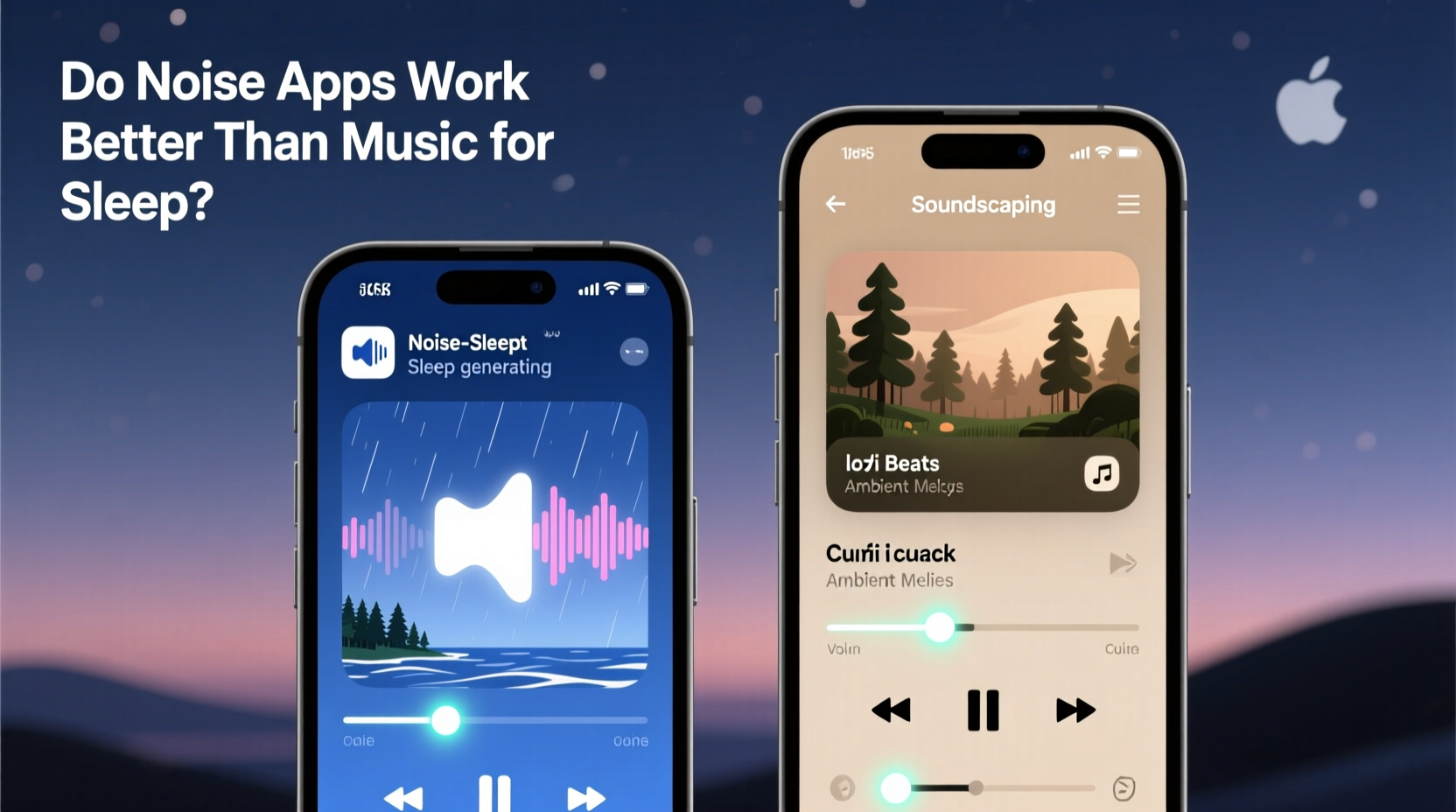
The brain remains responsive to auditory stimuli even during sleep. Sudden noises—a dog barking, a door slamming, or a phone notification—can trigger micro-arousals that fragment sleep architecture, reducing time spent in deep and REM stages. This is where sound masking tools come into play. By introducing consistent auditory input, these tools reduce the contrast between sudden disturbances and silence, minimizing disruptions.
Two primary types of audio aids dominate the market: music and noise-based soundscapes. Music typically follows melodic, rhythmic patterns designed to be emotionally engaging. Noise generators, on the other hand, produce steady, non-musical frequencies such as white, pink, or brown noise. These are engineered not to entertain but to create a predictable sonic backdrop.
“Sound isn’t just background—it’s a neurological tool. The right type can stabilize brainwave activity and support the transition into sleep.” — Dr. Lena Patel, Neurologist & Sleep Specialist
Understanding Noise-Generating Apps: Types and Mechanisms
Noise-generating apps simulate various forms of ambient sound, each with distinct frequency profiles. The most common include:
- White Noise: Equal energy across all frequencies; sounds like static or a fan. Effective at masking sharp, high-pitched sounds.
- Pink Noise: More balanced, with greater power in lower frequencies. Often described as “even” or “natural,” resembling rustling leaves or steady rain.
- Brown (or Brownian) Noise: Heavier in bass tones, similar to thunder or a distant waterfall. Favored for its deep, grounding effect.
- Nature Sounds: Not pure noise, but often grouped with them—examples include ocean waves, forest ambiance, or crickets.
These apps use algorithmically generated or high-fidelity recordings to deliver uninterrupted audio. Many allow customization—volume layering, timers, fade-outs, and looping—making them adaptable to individual preferences.
Music for Sleep: Emotional Resonance vs. Neural Interference
Music has long been used to relax the mind before bed. Slow-tempo tracks (typically 60–80 BPM), minimal instrumentation, and absence of lyrics are hallmarks of “sleep music.” Classical, ambient, and certain minimalist genres are frequently recommended.
However, music carries emotional and cognitive weight. A familiar melody might evoke memories, stir emotions, or engage the brain’s reward system—counterproductive when trying to disengage from mental activity. Research published in the *Journal of Advanced Nursing* found that while soothing music improved subjective sleep quality, it didn’t consistently enhance objective measures like total sleep time or reduced awakenings.
Moreover, music often features dynamic shifts in volume, tempo, or harmony. These variations can subtly alert the brain, interrupting the descent into deeper sleep stages. Unlike steady-state noise, music is inherently unpredictable.
Comparative Effectiveness: Noise vs. Music
To assess which option performs better, we must consider multiple dimensions: sleep onset latency, sleep continuity, user adherence, and personal sensitivity.
| Factor | Noise-Generating Apps | Sleep Music |
|---|---|---|
| Sleep Onset (Time to Fall Asleep) | Generally faster due to consistent masking effect | Moderate improvement; depends on track familiarity |
| Sleep Continuity | Better protection against nighttime disruptions | May cause subtle arousals due to musical changes |
| Cognitive Load | Low—non-representational sound requires no interpretation | Higher—melody and memory engagement may keep mind active |
| Adaptability to Environment | High—effective in noisy urban settings or shared rooms | Limited—less effective at masking external sounds |
| User Preference | Varies—some find noise monotonous or artificial | Often preferred initially due to emotional comfort |
A 2023 meta-analysis in *Sleep Medicine Reviews* concluded that continuous noise—particularly pink and brown varieties—outperformed music in improving sleep efficiency and reducing awakenings, especially in individuals exposed to intermittent nighttime noise.
Real-World Example: Sarah’s Shift from Music to Noise
Sarah, a 34-year-old graphic designer living in downtown Chicago, struggled with light sleep exacerbated by street noise. She initially used Spotify playlists labeled “Deep Sleep” with piano and ambient textures. While she found them calming at first, she often woke up mid-sleep, unsure why.
After reading about sound masking, she downloaded a reputable noise app and began using brown noise at a low volume through a bedside speaker. Within a week, she reported fewer awakenings and a stronger sense of morning refreshment. “It’s not that I love the sound,” she said, “but I don’t notice it—which means my brain isn’t reacting to it. That’s what matters.”
Her experience reflects a key insight: the best sleep sound isn’t necessarily the most pleasant—it’s the one your brain learns to ignore.
When Music Might Be the Better Choice
While noise generally wins on objective metrics, music holds value in specific scenarios:
- Anxiety-driven insomnia: For those whose minds race with worry, emotionally soothing music can reduce pre-sleep arousal.
- Routine and ritual: A consistent playlist can signal bedtime, reinforcing circadian cues.
- Children and teens: Familiar lullabies or gentle tunes provide psychological comfort that abstract noise cannot replicate.
The critical factor is predictability. Instrumental tracks without lyrics, steady tempos, and minimal dynamic range work best. Avoid anything with sudden crescendos or emotional peaks.
Step-by-Step Guide to Choosing the Right Sleep Sound
Selecting the optimal audio aid doesn’t have to be trial-and-error. Follow this structured approach:
- Assess Your Environment: Is external noise (traffic, neighbors, snoring) your main issue? If yes, prioritize noise apps. If silence is already present, music may suffice.
- Evaluate Your Sensitivity: Do melodies distract you or evoke strong feelings? If so, lean toward neutral noise. If you crave comfort, start with soft instrumental music.
- Test One Option at a Time: Use only white, then pink, then brown noise—or one music genre—for at least three nights each. Track sleep quality via journal or wearable device.
- Adjust Volume and Placement: Keep volume low—just enough to mask disturbances. Place speakers or devices at a distance to avoid auditory dominance.
- Monitor Long-Term Use: Reassess monthly. Some people adapt to noise over time, requiring adjustments.
Expert Recommendations and Common Pitfalls
Dr. Alan Zhou, a clinical sleep researcher, emphasizes consistency and simplicity: “The goal is neural habituation. The brain should stop noticing the sound. Overly complex or emotionally charged audio defeats that purpose.”
Common mistakes users make include:
- Using earbuds or headphones overnight (risk of discomfort and ear canal irritation)
- Setting volume too high, which can elevate cortisol levels
- Switching sounds nightly, preventing the brain from adapting
- Ignoring room acoustics—hard surfaces reflect sound, increasing perceived loudness
“The most effective sleep sound is the one you forget exists five minutes after lying down.” — Dr. Alan Zhou, Sleep Research Institute at Johns Hopkins
Checklist: Optimizing Your Sleep Sound Strategy
Use this checklist to ensure you’re getting the most out of your chosen method:
- ✅ Identified primary sleep disruptor (e.g., noise, racing thoughts)
- ✅ Selected appropriate sound type based on environment and preference
- ✅ Tested options systematically over multiple nights
- ✅ Set volume to barely perceptible level
- ✅ Placed speaker away from the bed (3+ feet)
- ✅ Used a timer or auto-off function (30–60 minutes)
- ✅ Avoided lyrical or emotionally intense content
- ✅ Monitored sleep quality changes over time
Frequently Asked Questions
Can noise-generating apps cause hearing damage?
When used at moderate volumes (below 50 dB) and through external speakers, noise apps pose minimal risk. However, prolonged exposure to high-volume sound—even if unobtrusive—can contribute to noise-induced hearing loss over time. Always keep volume low and avoid using in-ear devices overnight.
Is there a best type of noise for sleep?
There’s no universal answer, but research suggests pink and brown noise are more effective than white noise for most adults. Pink noise aligns closely with natural environmental rhythms and has been linked to increased slow-wave sleep in studies. Try all three to determine personal preference.
Should I use noise every night?
Consistency supports habituation, so using the same sound nightly can improve long-term results. However, occasional breaks prevent dependency. Some users alternate between noise and silence to maintain flexibility.
Final Thoughts: Matching the Tool to the Need
Noise-generating apps and sleep music both have roles in promoting rest, but they serve different purposes. For blocking disruptive sounds and creating a stable auditory environment, noise-based solutions are generally more effective. Their uniform, non-intrusive nature allows the brain to disengage more fully, supporting uninterrupted sleep cycles.
Music, while comforting, introduces variables that can interfere with deep sleep. It shines in contexts where emotional regulation is the primary barrier to rest—not environmental noise.
The best approach is personalized. Consider your sleep challenges, test options methodically, and prioritize consistency. Whether you choose the hum of brown noise or the gentle flow of a nocturne, the goal remains the same: to create conditions where sleep can occur naturally and deeply.




 浙公网安备
33010002000092号
浙公网安备
33010002000092号 浙B2-20120091-4
Comments
No comments yet. Why don't you start the discussion?