
Commuting often means navigating a noisy world—subway rumbles, bus engines, chatter in train stations, and overhead announcements. To reclaim peace and focus during transit, many turn to earbuds. But not all noise-reducing technologies are created equal. The choice between noise isolating earbuds and active noise cancellation (ANC) can significantly impact your daily experience. Understanding how each works, their strengths, and limitations helps you make an informed decision based on your commute type, budget, and listening preferences.
How Noise Isolation Works
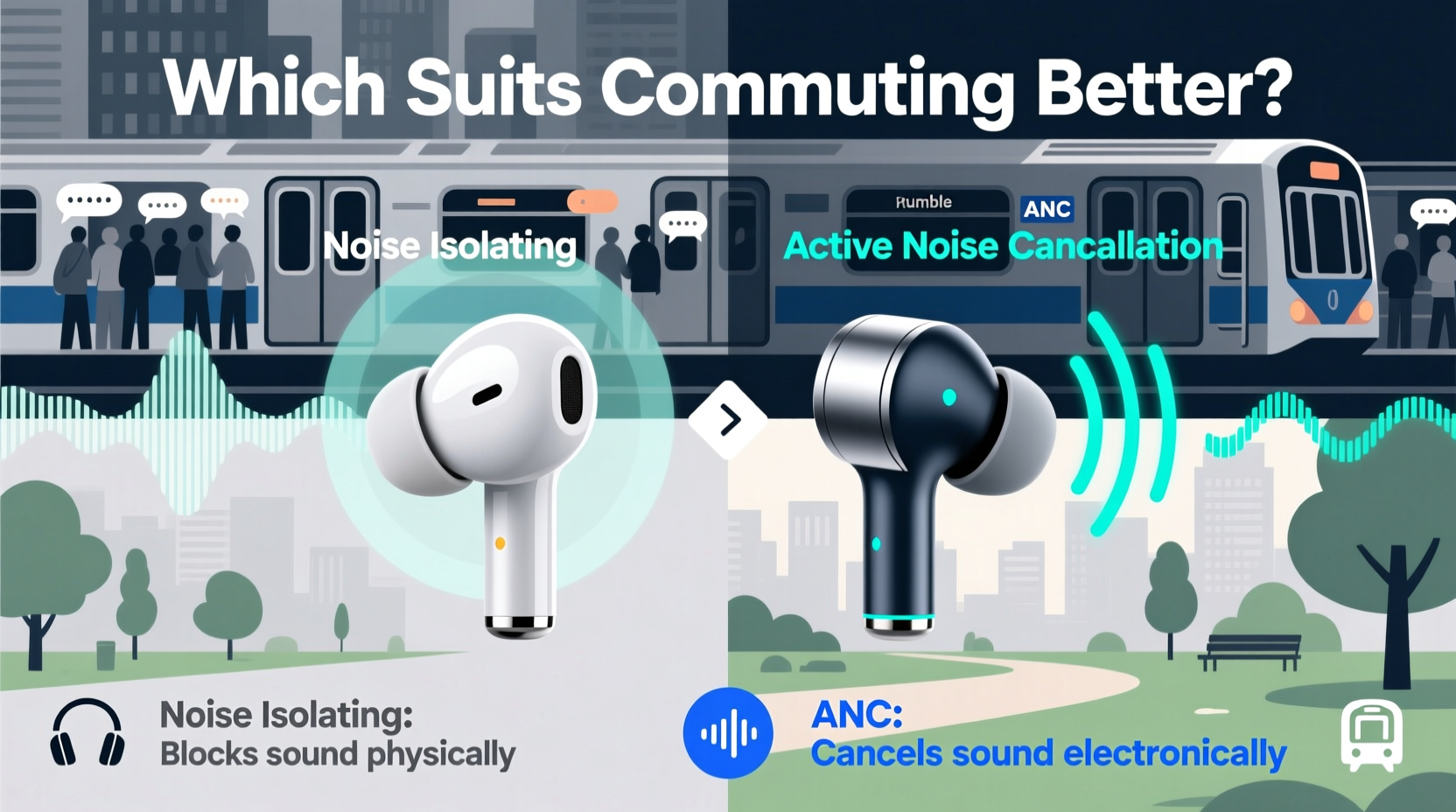
Noise isolation, also known as passive noise reduction, relies entirely on physical barriers to block external sound. This is achieved through the design of the earbud and the seal it forms within the ear canal. Materials like silicone, foam, or rubber tips create a tight fit that prevents ambient noise from entering. Unlike electronic solutions, noise isolation requires no power, processing, or additional circuitry—it’s purely mechanical.
The effectiveness of noise isolation depends heavily on fit. A well-seated earbud with properly sized tips can block up to 20–30 decibels of high-frequency sounds, such as voices, clattering dishes, or nearby conversations. However, lower-frequency noises—like engine hums or subway vibrations—are harder to stop using this method alone.
The Science Behind Active Noise Cancellation
Active noise cancellation takes a technological approach. ANC earbuds use built-in microphones to detect incoming ambient sounds. A digital signal processor then generates “anti-noise”—sound waves that are the exact inverse of the detected noise. When these opposing waves meet, they cancel each other out through destructive interference, effectively reducing perceived volume.
This process is especially effective against consistent low-frequency sounds—the kind common in transportation environments. Airplane cabins, trains, buses, and even city traffic produce steady droning noises that ANC systems are designed to neutralize. Modern implementations use adaptive algorithms that adjust in real time to changing environments, improving overall performance.
However, ANC has trade-offs. It consumes battery life, adds weight and complexity to earbuds, and may introduce subtle audio artifacts or a slight “pressure” sensation in the ears for some users. Additionally, it performs less effectively on sudden, irregular sounds like horns, sirens, or human speech.
“Active noise cancellation excels at removing predictable, low-frequency background noise—exactly what commuters face daily.” — Dr. Lena Park, Audio Engineer at Acoustic Insights Lab
Comparative Performance in Commuting Scenarios
To determine which technology serves commuters best, consider different transit environments and the types of noise encountered.
| Commute Type | Common Noises | Noise Isolation Effectiveness | ANC Effectiveness |
|---|---|---|---|
| Subway / Metro | Train rumble, screeching rails, PA announcements | Moderate – blocks higher frequencies but struggles with deep bass | High – excellent at reducing low-frequency rumble |
| Bus | Engine drone, road noise, passenger chatter | Fair – good for voices, limited on engine hum | Very High – handles both engine and mid-range noise well |
| Walking / Cycling | Traffic, wind, pedestrian interactions | Good – blocks nearby voices and urban chatter | Variable – wind can disrupt ANC microphones |
| Air Travel | Cabin pressure hum, engine noise, flight attendants | Poor – insufficient against constant low-end frequencies | Excellent – industry standard for long-haul flights |
| Train (Regional/Intercity) | Track vibration, AC units, conversation | Moderate – effective only when combined with snug fit | High – reduces continuous mechanical noise effectively |
From this comparison, it's clear that ANC holds a distinct advantage in enclosed, mechanically noisy environments—precisely where most commuters spend their time. However, noise-isolating earbuds still offer value, particularly for those who prioritize minimalism, longer battery life, or situational awareness.
Real-World Example: Maria’s Morning Commute
Maria lives in Chicago and commutes 45 minutes each way via the 'L' train. Her ride includes underground tunnels, elevated tracks, and frequent stops with loud public address systems. Initially, she used basic silicone-tip earbuds with moderate noise isolation. While music was audible, she found herself constantly raising the volume to drown out the screech of metal wheels on rails—an unhealthy habit risking hearing damage over time.
She upgraded to a pair of ANC-enabled earbuds with adaptive mode. The difference was immediate. The persistent low-frequency rumble dropped by nearly 70%, allowing her to enjoy podcasts at safe volume levels. Even more valuable was the mental relief—fewer auditory distractions meant less fatigue by the time she reached work.
On weekends, when walking through quieter neighborhoods, she switches back to her noise-isolating buds. They’re lighter, don’t require charging, and allow her to stay aware of her surroundings while still enjoying music without full immersion.
Maria’s experience illustrates a growing trend: many commuters benefit most from having both options available, using each strategically depending on context.
Key Factors to Consider When Choosing
Selecting the right solution isn't just about technology—it’s about lifestyle, safety, and practicality. Here are the critical factors to evaluate:
- Noise Profile: If your commute involves constant engine noise, HVAC systems, or rail travel, ANC will deliver noticeable benefits. For urban walking or cycling, physical isolation might suffice.
- Battery Life: ANC drains power faster. Earbuds with ANC typically offer 4–6 hours of playback with cancellation enabled, versus 6–10+ hours without. Long commuters should look for models with fast charging or carrying cases.
- Situational Awareness: Some cities advise against using isolated audio devices while crossing streets. Many ANC earbuds now include transparency modes that amplify ambient sound, offering a safer middle ground.
- Fit and Comfort: Noise isolation depends on a secure fit. If you have smaller ear canals or discomfort with in-ear designs, even the best ANC may underperform due to poor sealing.
- Cost: ANC earbuds generally cost more due to added components. Entry-level isolating earbuds can be found under $50, while quality ANC models start around $100 and go beyond $250.
Actionable Checklist: Choosing Your Commute Earbuds
Before purchasing, ask yourself the following:
- What type of transport do I use most? (e.g., subway, bus, bike, car)
- Do I frequently hear low-pitched droning (engines, HVAC)? → Lean toward ANC
- Am I concerned about battery life or forgetting to charge? → Consider isolation-only
- Do I need to hear announcements or interact with people during transit? → Look for strong transparency mode
- Can I try the earbuds in-store or through a return policy? → Fit is critical; don’t buy blind
- Is hearing protection a priority? → Lower volume with ANC reduces long-term risk
- Do I wear glasses or helmets? → Check for pressure points caused by bulkier ANC models
Hybrid Solutions: The Best of Both Worlds?
Modern premium earbuds increasingly combine both technologies. These hybrid models feature anatomically designed seals for passive isolation plus advanced ANC circuitry. The result is cumulative noise reduction—often exceeding 35dB across a broad frequency range.
For example, brands like Sony, Bose, and Apple integrate multi-microphone arrays with pressure-sensing drivers and ergonomic tips to maximize both physical and electronic suppression. In real-world testing, these hybrids reduce everything from baby cries to jet engines with remarkable efficiency.
Yet, they come with caveats: higher price tags, increased earbud size, and dependency on regular charging. For occasional commuters, this level of performance may be overkill. But for daily travelers spending hours in noisy environments, the investment often pays off in comfort, concentration, and auditory health.
Frequently Asked Questions
Can noise isolating earbuds protect my hearing?
Yes, indirectly. By blocking external noise, they allow you to listen at lower volumes, reducing the risk of noise-induced hearing loss. However, unlike ANC, they don’t actively suppress sound—they rely solely on fit and material.
Does active noise cancellation work on voices?
Only partially. ANC is optimized for steady, low-frequency sounds. Human speech contains dynamic, mid-to-high frequencies that are difficult to cancel. While some newer models reduce voice volume slightly, most people can still hear conversations clearly even with ANC enabled.
Are there health risks associated with ANC?
No direct evidence suggests ANC harms hearing. However, some users report a feeling of “ear pressure” or mild dizziness, similar to what’s felt during airplane descent. This usually subsides after acclimatization. If discomfort persists, switching to transparency mode or taking breaks is advised.
Final Recommendation: What Suits Commuting Better?
While both technologies have merit, **active noise cancellation is generally better suited for most commuting scenarios**. Its ability to neutralize the dominant low-frequency noise of vehicles gives it a functional edge over passive isolation alone. Daily exposure to loud transit environments makes ANC not just a luxury, but a tool for auditory wellness and mental focus.
That said, noise isolating earbuds remain ideal for shorter trips, outdoor movement, or budget-conscious buyers. They’re simpler, more reliable, and free from battery concerns. The smartest approach may be owning both: a lightweight pair for casual use and a capable ANC model for heavy-duty commutes.
Ultimately, the best choice aligns with your routine, environment, and personal comfort. Prioritize fit, test features like transparency mode, and consider long-term usage patterns. With the right earbuds, your commute can transform from a stressful grind into a productive or relaxing part of your day.




 浙公网安备
33010002000092号
浙公网安备
33010002000092号 浙B2-20120091-4
Comments
No comments yet. Why don't you start the discussion?