
In an open office, ambient chatter, keyboard clatter, HVAC hums, and impromptu meetings create a constant sonic backdrop that can fracture focus and drain mental energy. For professionals striving to maintain concentration, choosing the right audio solution is not just about sound quality—it’s about cognitive preservation. Two technologies dominate this space: noise isolating and noise cancelling earbuds. While often used interchangeably, they function differently and serve distinct needs. Understanding their mechanics, strengths, and limitations is essential for making an informed decision tailored to the acoustic reality of modern workspaces.
How Noise Isolation Works
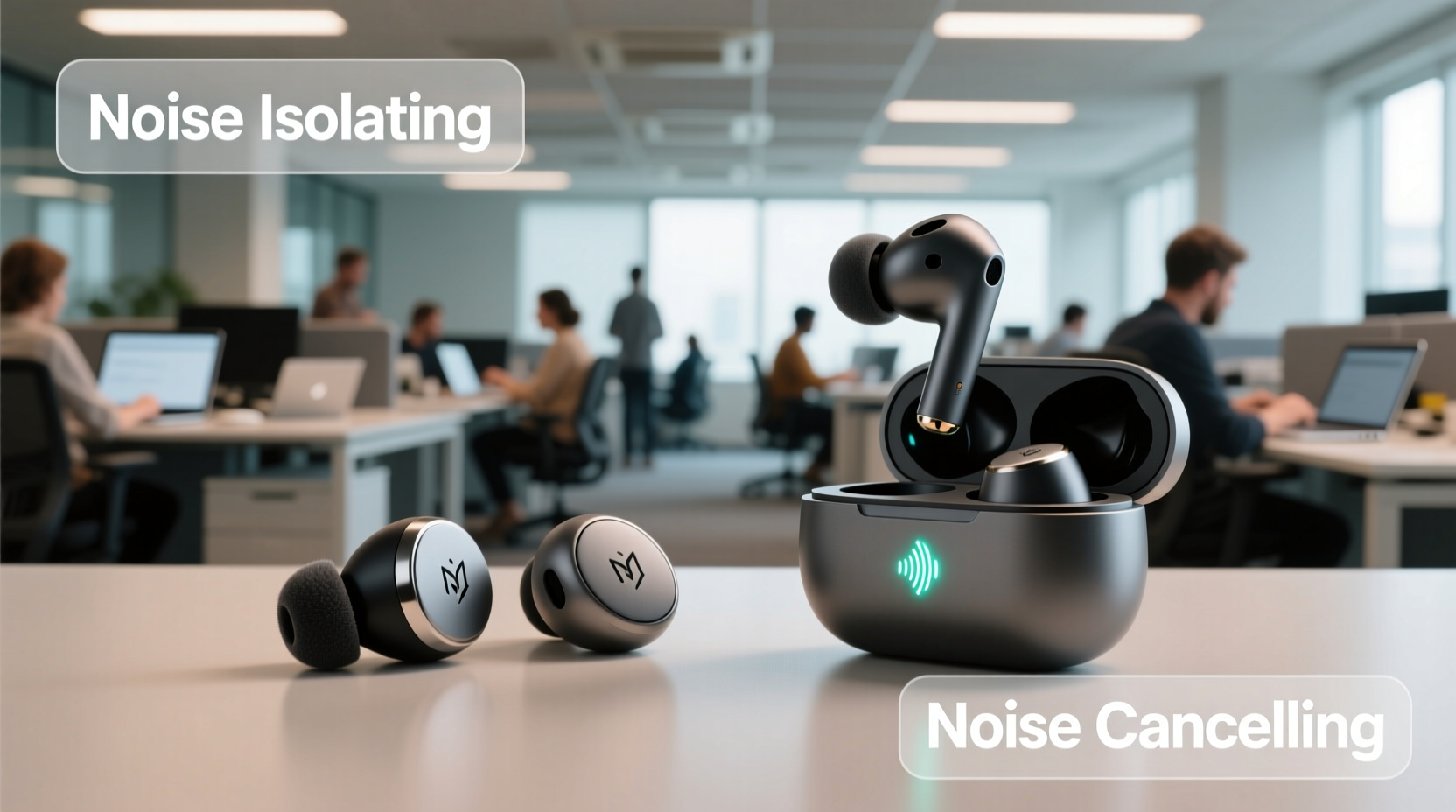
Noise isolation is a passive method of reducing external sound. It relies on physical barriers—earbud design, tip material, and fit—to block out unwanted noise before it reaches the ear canal. Unlike active systems, it doesn’t require power or electronics. Instead, effectiveness hinges on creating a tight seal between the earbud and the ear.
The most critical factor in noise isolation is the ear tip. Silicone, foam, and hybrid tips each offer different levels of comfort and sound attenuation. Memory foam tips, such as those used by brands like Comply, expand gently inside the ear canal, conforming to its shape and forming a superior seal. This can reduce ambient noise by 15–30 decibels, particularly in the mid-to-high frequency range—exactly where human speech sits.
Because noise isolation depends on physical fit, individual anatomy plays a significant role. Some people naturally have ear canals that accept earbuds more securely, while others may struggle with dislodging or discomfort during extended wear. Active users who move frequently or adjust their head position often find that even slight shifts can break the seal, allowing outside noise to leak in.
How Active Noise Cancellation (ANC) Works
Active Noise Cancellation is an electronic process. ANC earbuds use built-in microphones to detect incoming ambient sounds, then generate inverse sound waves—anti-noise—that cancel out the original frequencies in real time. This technology excels at neutralizing low-frequency, consistent noises such as air conditioning, traffic rumble, or the drone of fluorescent lighting.
Modern ANC systems employ adaptive algorithms that adjust based on your environment. For example, if you're in a quiet zone but someone begins speaking nearby, the system may reduce cancellation intensity to avoid over-processing. High-end models use multiple microphones and feedback loops to refine accuracy and minimize latency.
However, ANC has limitations. It struggles with sudden, high-pitched, or irregular sounds—like laughter, phone rings, or abrupt conversations—because these are harder to predict and counteract. Additionally, ANC requires battery power, which reduces overall usage time. The processing itself can sometimes introduce a faint hiss or pressure-like sensation in the ears, commonly described as \"eardrum suck,\" especially in quieter settings.
“Passive isolation handles high frequencies well, but ANC dominates in sub-500Hz ranges—where office machinery lives. For open offices, combining both gives the best defense.” — Dr. Lena Torres, Acoustic Engineer at AudioSensory Labs
Comparative Performance in Open Office Settings
Open offices present a complex soundscape: a mix of steady background noise (HVAC, fans) and unpredictable human-generated sound (conversations, phone calls, movement). To evaluate which earbud type performs better, consider how each handles specific office noise profiles.
| Noise Type | Noise Isolating Effectiveness | Noise Cancelling Effectiveness |
|---|---|---|
| HVAC Hum (Low-Frequency) | Moderate – limited by physical barrier only | High – ANC excels at continuous low tones |
| Keyboard Typing (Mid-Frequency) | High – silicone/foam tips block sharp clicks effectively | Moderate – inconsistent timing reduces cancellation efficacy |
| Human Speech (Mid-to-High Frequency) | High – especially with deep-insertion fit | Low-to-Moderate – ANC struggles with variable pitch and tone |
| Footsteps & Movement | Moderate – depends on proximity and flooring | Low – transient sounds bypass prediction algorithms |
| Phone Ringing / Alarms | High – sudden high-frequency sounds partially blocked by seal | Low – too abrupt for effective phase inversion |
The data shows a clear pattern: noise isolating earbuds perform consistently across speech-heavy environments, while ANC shines in suppressing mechanical droning. In practice, many professionals benefit from hybrid models that combine both technologies—offering the best of both worlds.
Comfort and Practicality for All-Day Wear
Even the most technically advanced earbuds fail if they’re uncomfortable after two hours. In open offices, workers often wear earbuds for 4–8 hours daily, making ergonomics a top priority.
Noise isolating earbuds tend to be lighter and simpler in design since they lack ANC circuitry. However, deep-fitting models required for maximum isolation can cause ear fatigue or fullness over time. Foam tips, while effective, absorb body heat and may feel warm during prolonged use.
ANC earbuds, though slightly heavier due to internal components, often feature ergonomic shaping and customizable fit wings. Many include transparency modes—allowing users to hear announcements or colleagues without removing the earbuds. This functionality is invaluable in collaborative environments where complete auditory disconnection isn’t safe or appropriate.
Battery life is another key differentiator. Pure noise isolating models don’t consume extra power for sound blocking, so playback duration remains unaffected. ANC earbuds typically lose 1–3 hours of battery when cancellation is active. For all-day users, this may necessitate midday charging or carrying a case.
Real-World Scenario: Sarah’s Open Office Challenge
Sarah is a UX designer working in a bustling downtown co-working space. Her desk neighbors frequently take client calls, and the shared kitchen area generates intermittent noise throughout the day. Initially, she purchased basic earbuds with no noise control and found herself constantly distracted.
She first tried high-isolation silicone-tipped earbuds. They reduced typing and conversation noise significantly, but the persistent AC hum made it hard to relax during deep work sessions. After upgrading to ANC-enabled earbuds, the low-frequency drone disappeared—but sudden voices still broke her focus.
Her breakthrough came with a hybrid model featuring both memory foam tips and adaptive ANC. By sealing the ear canal physically and electronically damping background noise, she achieved a stable auditory environment. She enabled transparency mode during stand-ups and disabled ANC during breaks to preserve battery. The result: a 40% increase in uninterrupted focus time, measured via her time-tracking app.
Sarah’s experience underscores a broader truth: optimal performance comes not from choosing one technology over the other, but from leveraging both strategically.
Choosing the Right Option: A Step-by-Step Guide
Selecting between noise isolating and noise cancelling earbuds shouldn’t be arbitrary. Follow this structured approach to match your needs with the right product.
- Assess Your Noise Environment: Spend a day noting dominant sounds. Is it constant HVAC (favor ANC), or frequent talking (favor isolation)?
- Determine Usage Duration: If wearing earbuds for more than four hours daily, prioritize comfort and battery life.
- Test Fit and Seal: Try different ear tips. A good seal is non-negotiable for isolation. Tug test: gently pull the earbud; if sound changes, the seal is weak.
- Evaluate ANC Quality: Read professional reviews focusing on mid-frequency suppression. Avoid models with noticeable hiss or pressure effects.
- Check for Transparency Mode: Essential for staying aware in shared spaces without removing earbuds.
- Consider Hybrid Models: Devices like the Sony WF-1000XM5 or Bose QuietComfort Earbuds II combine premium foam tips with industry-leading ANC.
- Budget Accordingly: True hybrid performance starts around $180. Entry-level ANC models often underperform in real-world conditions.
Expert-Recommended Checklist Before Buying
- ✅ Compatible with your device’s Bluetooth codec (AAC, SBC, LDAC, or aptX)
- ✅ Includes multiple ear tip sizes (at least three)
- ✅ Offers app-based customization (ANC strength, EQ, transparency)
- ✅ Has at least 6 hours of battery with ANC on
- ✅ Supports quick charge (5 minutes = 1+ hour of playback)
- ✅ Features secure fit for active movement
- ✅ Provides firmware updates for long-term performance tuning
Frequently Asked Questions
Can I use noise isolating earbuds with music off?
Yes. Since noise isolation is passive, it works even without audio playback. In fact, some users prefer listening to nothing at all—just the quiet provided by a good seal—to avoid sensory overload.
Do noise cancelling earbuds block out voices completely?
No technology fully blocks human speech. ANC is less effective on mid-to-high frequencies where voices reside. However, combining ANC with isolating tips can reduce vocal clarity enough to prevent distraction, even if sounds are still faintly audible.
Are there health risks associated with long-term ANC use?
No evidence suggests ANC causes hearing damage. However, some users report mild discomfort from the pressure effect, especially in quiet rooms. Taking regular breaks and using transparency mode can mitigate this.
Final Recommendation: Hybrid Approach Wins
For most open office professionals, the ideal solution lies in hybrid earbuds that integrate strong passive isolation with capable active noise cancellation. Relying solely on isolation leaves you exposed to low-frequency droning, while depending only on ANC fails against the unpredictable spikes of human interaction.
Look for models that pair deep-insertion foam tips with multi-microphone ANC systems and adaptive environmental sensing. Prioritize fit and comfort as much as technical specs—because no amount of decibel reduction matters if you can’t wear them past lunchtime.
The goal isn’t total silence. It’s creating a controlled auditory buffer that protects focus while allowing intentional engagement when needed. In the dynamic ecosystem of an open office, that balance is everything.




 浙公网安备
33010002000092号
浙公网安备
33010002000092号 浙B2-20120091-4
Comments
No comments yet. Why don't you start the discussion?