
For millions of people struggling with sleep, white noise has become a nightly ritual. Whether it's to drown out traffic, quiet a restless mind, or create a consistent auditory environment, many rely on either a fan or a dedicated noise machine. But when comparing these two common tools, a critical question arises: Is the mechanical hum of a fan more effective—and more natural—than the digital loops produced by modern noise machines?
The answer isn’t straightforward. It depends on personal sensitivity to sound patterns, the type of noise needed, and how the brain processes repetitive versus organic audio. While both options serve the same basic function—masking disruptive sounds—their mechanisms, sound profiles, and long-term usability differ significantly.
The Science Behind Sound and Sleep
Sleep is highly sensitive to environmental stimuli, especially sound. Sudden noises—a dog barking, a door slamming, or even a partner shifting in bed—can trigger micro-arousals that fragment sleep without fully waking you. These disruptions reduce sleep efficiency and can leave you feeling unrested despite spending eight hours in bed.
White noise, pink noise, and brown noise work by filling the auditory spectrum with consistent frequencies, effectively raising the \"noise floor.\" This makes sudden external sounds less noticeable because they don’t stand out as sharply against the background. The result is a buffer zone for your brain, allowing deeper, uninterrupted sleep cycles.
But not all background noise is created equal. The source—mechanical (like a fan) or digital (like a noise machine)—impacts the texture, predictability, and psychological comfort of the sound.
Mechanical vs Digital: How Fans and Noise Machines Produce Sound
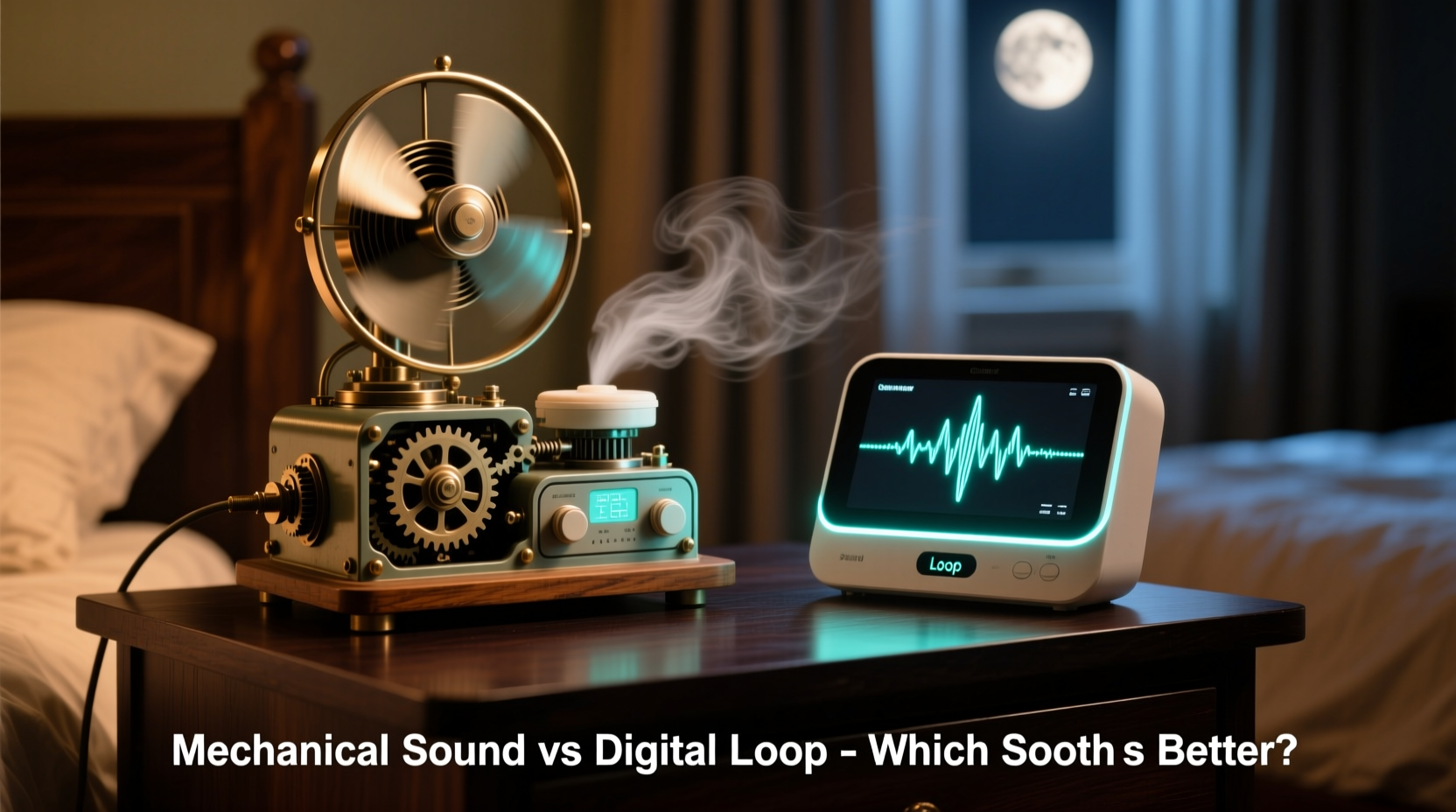
A traditional fan generates sound through physical motion: spinning blades disrupt air molecules, creating turbulence and pressure waves. This produces a broadband noise that closely resembles pink or brown noise—richer in lower frequencies and naturally dynamic. Because the airflow is affected by dust, blade angle, motor vibration, and room conditions, the sound has subtle variations. These micro-fluctuations make the output feel organic and less predictable, which some brains interpret as more soothing.
In contrast, most digital noise machines use pre-recorded or algorithmically generated audio loops. Even high-end models cycle through short segments—often 30 seconds to a few minutes—that repeat continuously. While this ensures consistency, the repetition can become perceptible over time, especially in quiet environments. Some listeners report a faint \"seam\" between loop points, which the subconscious may detect as unnatural, potentially disrupting relaxation.
Comparative Analysis: Fan vs Noise Machine
| Feature | Fan | Noise Machine |
|---|---|---|
| Sound Type | Mechanical, dynamic, broadband | Digital, static or looped |
| Natural Variation | High – due to air resistance, motor fluctuations | Low to moderate – depends on model |
| Loop Artifacts | None | Potential at low bitrates or short cycles |
| Portability | Limited – bulky, requires outlet, no battery | High – compact, often battery-powered |
| Versatility | Only fan noise; limited speed settings | Multiple sounds: rain, ocean, white/pink/brown noise |
| Cooling Effect | Yes – improves thermal comfort | No – unless combined with fan |
| Maintenance | Dusting required; motor wear over time | Minimal – software updates possible |
| Cost | $20–$80 | $30–$200+ |
This comparison reveals trade-offs. Fans offer a free, cooling, naturally variable sound but lack customization. Noise machines provide tailored audio experiences and portability but risk sounding artificial if poorly designed.
Real-World Example: A Light Sleeper’s Dilemma
Consider Sarah, a 34-year-old graphic designer living near a busy intersection. She’s tried multiple solutions for her insomnia. Initially, she used a basic box fan. The constant airflow helped mask traffic noise, and she appreciated the cool breeze during summer. However, in winter, running a fan felt wasteful and overly loud on high settings.
She switched to a digital noise machine offering “ocean waves” and “forest rain.” At first, it worked well. But after a few weeks, she began noticing a faint rhythmic pulsing beneath the waves. Upon closer listening, she realized the wave file repeated every 45 seconds. Her brain had started detecting the loop, undermining its masking effect.
Eventually, Sarah found a hybrid solution: a smart noise machine with real-time sound generation (not looping) and a built-in fan. By combining mechanical airflow with non-repeating digital filtering, she achieved both natural sound variation and climate control. Her sleep efficiency improved by 22% over six weeks, as tracked by her sleep monitor.
Sarah’s experience illustrates a key insight: the best solution often lies in blending the strengths of both technologies rather than choosing one exclusively.
“Humans evolved listening to natural, non-repetitive sounds—wind, water, fire. Our brains are wired to relax in their presence. Digital loops, even when well-designed, can trigger subconscious alertness if they feel too perfect.” — Dr. Lena Torres, Sleep Neurologist, Stanford Center for Sleep Sciences
How to Choose the Right Option for Your Sleep Environment
Selecting between a fan and a noise machine shouldn’t be arbitrary. Consider the following factors to make an informed decision:
1. Room Temperature and Climate
If you tend to sleep hot, a fan offers dual benefits: noise masking and cooling. Overheating is a common cause of nighttime awakenings, so the temperature regulation from a fan may outweigh the sonic advantages of a digital device.
2. Sensitivity to Repetition
Some individuals are hyper-aware of rhythmic patterns. If you find yourself focusing on beats, pulses, or recurring tones in music or ambient sound, you may be more likely to notice digital loop seams. In such cases, a fan’s irregular mechanical rhythm may be more effective.
3. Need for Customization
Fans produce one type of sound: airflow. If you prefer variety—switching between rain, thunder, or brown noise depending on mood or season—a noise machine provides flexibility. Some advanced models even adjust sound dynamically based on detected room noise.
4. Portability and Lifestyle
Travelers or shift workers benefit from compact, battery-powered noise machines. A desktop fan isn’t practical in a hotel room or shared apartment. Additionally, noise machines with apps allow remote control via smartphone, enabling adjustments without getting out of bed.
5. Long-Term Maintenance
Fans require regular cleaning to maintain efficiency and prevent dust buildup, which can alter sound quality and pose respiratory risks. Noise machines, especially solid-state devices with no moving parts, require little upkeep beyond occasional software updates.
Actionable Checklist: Optimizing Your Sleep Sound Setup
- ✅ Assess your primary sleep disruptor (e.g., traffic, snoring, mental chatter)
- ✅ Determine whether you need cooling or just sound masking
- ✅ Test both a fan and a noise machine for at least three nights each
- ✅ If using a digital machine, verify it uses non-looping or long-cycle audio
- ✅ Position the device to avoid direct airflow or volume imbalance
- ✅ Clean fans monthly to maintain consistent sound and air quality
- ✅ Use a timer or smart plug to turn off devices after falling asleep (if desired)
When to Combine Both Solutions
For optimal results, many sleep specialists recommend combining mechanical and digital elements. For example:
- A fan paired with a noise machine playing low-frequency brown noise to enhance bass response.
- Using a fan on low while supplementing with a directional speaker playing nature sounds only during initial sleep onset.
- Smart systems like the LectroFan or Dohm by Marpac, which blend actual fan mechanics with digital modulation to create customizable, non-repeating sounds.
This hybrid approach leverages the organic variability of mechanical sound while retaining the flexibility of digital control. It also reduces reliance on any single point of failure—if the fan breaks, the noise machine can compensate, and vice versa.
Frequently Asked Questions
Can a fan be too loud for healthy sleep?
Yes. While fans typically operate between 40–60 decibels (similar to a quiet conversation), placing one too close to the bed can exceed recommended nighttime noise levels (under 30 dB). Prolonged exposure to higher volumes may lead to elevated cortisol levels and reduced REM sleep. Always position the fan at a distance and use the lowest effective speed.
Do noise machines affect hearing over time?
At typical bedroom volumes (50–60 dB), noise machines pose minimal risk to hearing. However, devices placed inside cribs or within inches of the head—especially for infants—can reach unsafe levels. Experts advise keeping speakers at least 3–6 feet away and using the minimum volume necessary for masking.
Is there a “best” type of noise for sleep?
Research suggests brown noise—deeper and more rumbling than white or pink—may be most effective for deep sleep due to its emphasis on low frequencies. However, individual preference plays a major role. Some find the hiss of white noise irritating, while others find rain sounds distracting. Experimentation is key.
Final Thoughts: Prioritize Natural Consistency Over Artificial Perfection
The debate between noise machines and fans ultimately comes down to authenticity versus control. A fan offers a raw, unfiltered, ever-changing soundscape shaped by physics and environment. A noise machine delivers precision, variety, and programmability. Neither is universally superior.
What matters most is how your brain responds to the sound. If you find yourself focusing on a repeating pattern, even subconsciously, the digital option may be working against you. Conversely, if you crave different sounds for different moods, a fan alone won’t suffice.
The future of sleep technology lies not in choosing one over the other, but in integrating both. Devices that simulate natural variability—either through real airflow, randomized algorithms, or adaptive soundscapes—are setting a new standard. Until then, test both options honestly, listen to your body, and prioritize sustained, undisturbed sleep above all.




 浙公网安备
33010002000092号
浙公网安备
33010002000092号 浙B2-20120091-4
Comments
No comments yet. Why don't you start the discussion?