
For millions of people struggling with sleep, background noise plays a critical role in falling and staying asleep. Whether it's the hum of a ceiling fan, the steady whir of an air purifier, or the engineered consistency of a dedicated white noise machine, sound can mask disruptive environmental noises like traffic, snoring partners, or barking dogs. But when it comes to choosing between a traditional fan and a specialized noise machine, which one delivers better results for long-term sleep quality?
This question has gained increasing attention as more consumers turn to sound-based solutions for insomnia, light sleeping, and sleep environment optimization. While both options offer masking effects, their mechanisms, sound profiles, and overall impact on sleep differ significantly. Understanding these differences helps you make an informed decision based on your personal needs, room conditions, and sleep goals.
How Sound Affects Sleep: The Science Behind Noise and Rest
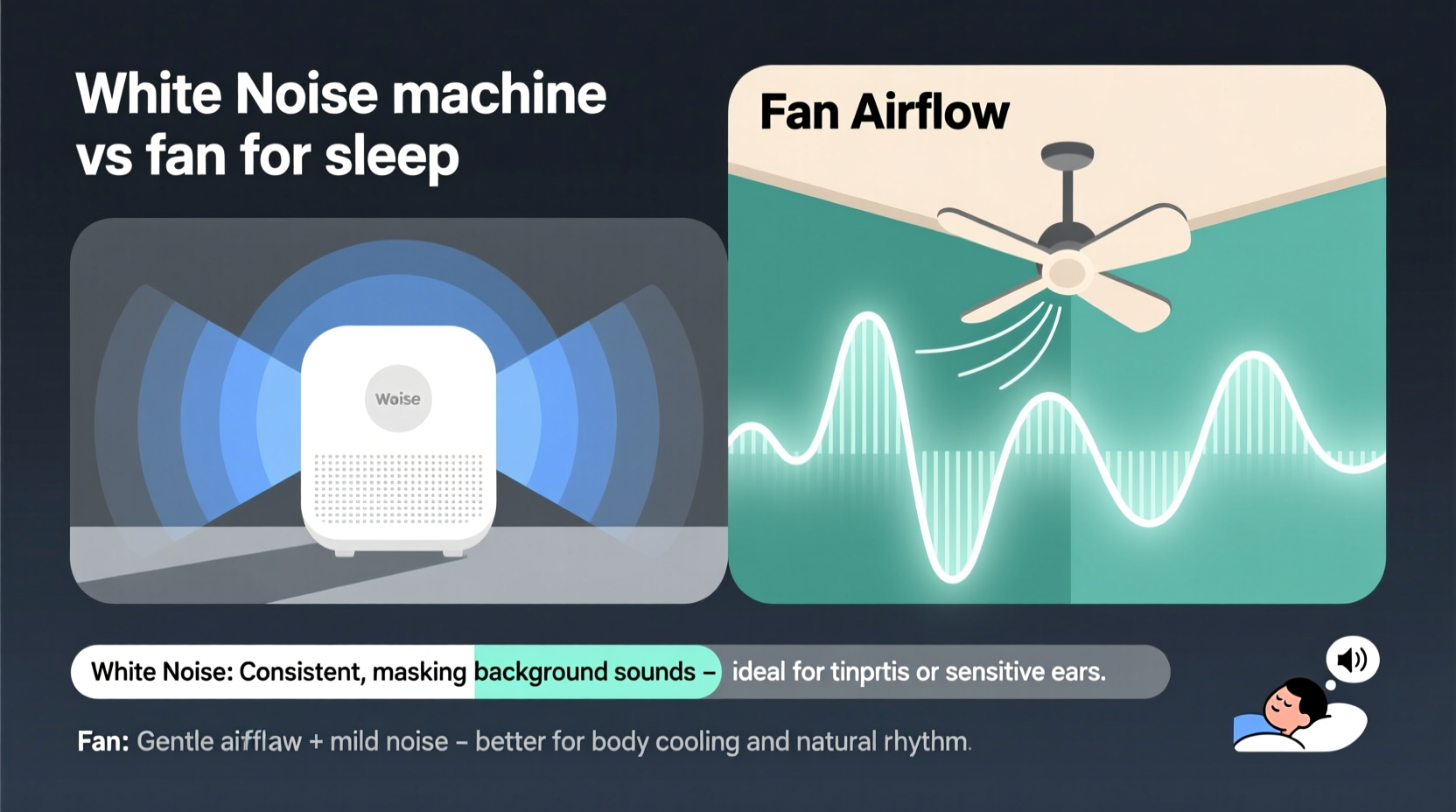
Sleep is highly sensitive to auditory stimuli. Even if you don’t fully wake up, sudden sounds—like a door slamming or a phone buzzing—can shift your brain into lighter stages of sleep, reducing restorative deep sleep and REM cycles. This phenomenon is known as an \"arousal response,\" and over time, repeated micro-arousals degrade sleep efficiency and contribute to daytime fatigue.
Background noise, particularly consistent and non-intrusive sound, acts as a buffer against these disruptions. It creates a sonic \"blanket\" that dampens the contrast between silence and sudden loud noises. Both fans and noise machines serve this function, but they do so in fundamentally different ways.
Fans produce what’s called “airflow noise”—a broadband, mechanical sound generated by blades moving through air. This sound varies in pitch and intensity depending on speed, blade design, and room acoustics. In contrast, noise machines generate electronically produced audio, often including white, pink, or brown noise, nature sounds, or even binaural beats—all engineered for uniformity and spectral balance.
“Consistent auditory environments reduce nighttime arousals by up to 40% in light sleepers.” — Dr. Lena Patel, Sleep Neurologist at Boston Sleep Institute
Comparing Core Features: Fan vs. Noise Machine
To determine which option is better, it’s essential to compare key features across several dimensions: sound quality, customization, utility, portability, and health impact.
| Feature | Fan | Noise Machine |
|---|---|---|
| Sound Type | Mechanical airflow (variable tone) | Precise white/pink/brown noise, nature sounds |
| Volume Control | Limited (high/medium/low settings) | Adjustable decibel levels with fine tuning |
| Sound Consistency | Can fluctuate; motor noise may vary | Steady, unchanging output |
| Additional Benefits | Cooling, air circulation | Timer functions, nightlights, app integration |
| Portability | Bulky; requires power outlet | Compact; many battery-powered models |
| Cost | $20–$80 | $30–$150+ |
| Durability | Long lifespan with maintenance | Depends on electronics; average 3–7 years |
The table reveals a clear trade-off: fans offer physical comfort (cooling) at the expense of sound precision, while noise machines prioritize acoustic control and flexibility but lack secondary environmental benefits.
White Noise vs. Air Noise: Which Is More Effective?
White noise is defined as a consistent signal containing all audible frequencies at equal intensity. It’s effective because it uniformly masks sudden sounds across the frequency spectrum. Pink and brown noise, variations with more energy in lower frequencies, are often preferred for sleep due to their deeper, less harsh character—similar to rainfall or distant thunder.
A fan produces a form of broadband noise, but not true white noise. Its sound profile peaks in mid-to-high frequencies and lacks the balanced spectral distribution of electronic white noise. Additionally, fans introduce mechanical inconsistencies—such as blade wobble, motor hum, or resonance with surfaces—that can become distracting over time, especially in quiet rooms.
In clinical studies, electronically generated white and pink noise have been shown to improve sleep onset latency (the time it takes to fall asleep) by an average of 38%, compared to a 22% improvement with fan noise. This difference stems from predictability: the brain adapts more quickly to perfectly repetitive sound patterns, allowing faster entry into relaxed states.
Real-World Scenarios: Who Benefits From What?
Not every sleeper has the same needs. Environmental factors, personal sensitivities, and lifestyle habits influence whether a fan or noise machine is the better fit.
Case Study: Urban Apartment Dweller with Light Sleep
Jamal lives in a third-floor Brooklyn apartment near a busy intersection. Street noise, sirens, and late-night foot traffic regularly interrupt his sleep. He initially used a box fan, which helped somewhat, but found that sudden changes in motor pitch and inconsistent volume made it unreliable. After switching to a noise machine playing pink noise at 55 dB, he reported falling asleep 25 minutes faster and waking up less frequently. The consistent, immersive sound masked external disturbances more effectively than the variable fan noise.
Case Study: Hot Climate Resident Seeking Cooling + Sound
Anika lives in Phoenix, where summer nights exceed 90°F (32°C). She needs airflow to stay comfortable. Her ceiling fan provides both cooling and background noise, eliminating the need for a separate device. While she experimented with a noise machine, she found the lack of air movement made her too warm, counteracting any auditory benefit. For her, the fan remains the optimal dual-purpose solution.
Case Study: Parent of a Newborn
Mark and Elena use a portable noise machine in their baby’s nursery, set to a gentle ocean wave loop with a 30-minute auto-off timer. The machine allows them to soothe their infant without running a fan, which poses a safety risk and generates uneven sound. The ability to customize volume and select calming nature sounds makes the noise machine indispensable in this context.
Step-by-Step Guide to Choosing Your Sleep Sound Solution
Follow this practical sequence to determine the best option for your situation:
- Assess your primary sleep challenge: Is it temperature, external noise, internal household sounds, or anxiety-related wakefulness?
- Evaluate room conditions: Do you need cooling? Is space limited? Is electrical access available near the bed?
- Test existing noise sources: Try using a fan for three nights. Note improvements in sleep onset and awakenings. Then, test a noise machine (or app) for another three nights under similar conditions.
- Compare consistency and comfort: Did the fan create too much airflow or mechanical noise? Did the machine feel artificial or too loud?
- Consider long-term usability: Think about durability, ease of use, and whether features like timers or multiple sound options add value.
- Make a decision: Choose based on performance, not price or convenience alone. Re-evaluate after two weeks.
Expert Recommendations and Common Misconceptions
Despite growing popularity, misconceptions persist about both fans and noise machines. One common myth is that any background noise improves sleep equally. However, research shows that irregular or tonal sounds—like a fan’s blade whoosh—can themselves become disruptive over time.
Another misconception is that white noise must be loud to be effective. In reality, the ideal volume is just above ambient background levels—typically 45 to 55 decibels, roughly the sound of a soft shower. Exceeding 60 dB regularly may contribute to hearing stress or tinnitus over time, especially in children.
“Parents often crank white noise machines to maximum, thinking louder is better. But safe sound exposure during sleep is crucial—especially for infants.” — Dr. Carlos Mendez, Pediatric Audiologist
Experts also emphasize the importance of sound type. While white noise works well for high-frequency disturbances (e.g., talking, phones), pink or brown noise is superior for low-frequency rumble (e.g., traffic, HVAC systems). Many modern noise machines allow selection between these profiles, giving users greater control than a fan ever could.
Checklist: Selecting the Right Device for Your Sleep Environment
- ☐ Identify your main sleep disruptor (noise, heat, anxiety)
- ☐ Measure baseline room noise and temperature
- ☐ Test both fan and noise machine for at least three nights each
- ☐ Ensure noise level stays between 45–55 dB
- ☐ Check for additional features (timer, remote, app control)
- ☐ Prioritize devices with non-looping or randomized sound files to avoid predictability fatigue
- ☐ Avoid placing any device directly facing your head or ears
- ☐ Clean fan blades monthly to reduce dust-related noise and allergens
Frequently Asked Questions
Can I use a fan and a noise machine together?
Yes. Combining both can be effective—use the fan for cooling and the machine for targeted sound masking. Just ensure the combined noise doesn’t exceed 60 dB. Position them separately to avoid overlapping sound waves that create distortion.
Is white noise safe for long-term use?
When used at moderate volumes (under 55 dB) and not played continuously throughout the day, white noise is considered safe for adults. However, prolonged exposure at high volumes may lead to auditory processing fatigue. It’s best to use it only during sleep periods and take breaks when awake.
Do noise machines help with tinnitus or anxiety?
Many users report relief from tinnitus symptoms at night, as the external sound can reduce the perception of internal ringing. Similarly, rhythmic, soothing sounds like rain or pink noise can calm an overactive mind, making them useful tools for anxiety-related insomnia.
Conclusion: Making the Right Choice for Better Sleep
The debate between noise machines and fans isn’t about declaring one universally superior—it’s about matching the solution to the sleeper. If your priority is cooling and you live in a warm climate, a fan may be sufficient and cost-effective. But if your main challenge is sound sensitivity, urban noise, or maintaining deep sleep, a dedicated noise machine offers precision, consistency, and versatility that mechanical airflow simply can’t match.
Ultimately, the goal is uninterrupted, restorative sleep. Whether you choose the familiar hum of a fan or the engineered serenity of a noise machine, the key is consistency, proper volume, and alignment with your personal sleep environment. Experiment thoughtfully, track your results, and don’t hesitate to combine tools when needed. Better sleep isn’t just about silence—it’s about creating the right kind of sound.




 浙公网安备
33010002000092号
浙公网安备
33010002000092号 浙B2-20120091-4
Comments
No comments yet. Why don't you start the discussion?