
The smartphone market has evolved into a landscape where differentiation isn’t just about specs—it’s about identity. The Nothing Phone 2 enters this arena not with whispers but with a flicker: its signature Glyph Interface, a grid of LED lights across the back that pulse, flash, and animate with notifications, calls, and music. Meanwhile, the Google Pixel 8 represents a different philosophy—minimalist design, pure Android, and AI-powered software refinement. When placed side by side, one question echoes louder than others: Is the Glyph Light just a gimmick?
This isn’t merely a battle of aesthetics. It’s a clash of ideologies—one rooted in bold self-expression, the other in seamless utility. To answer whether the Glyph is meaningful or merely flashy, we need to examine both phones across key dimensions: design and build, display quality, performance, camera capabilities, software experience, and real-world usability.
Design Philosophy: Expression vs. Efficiency
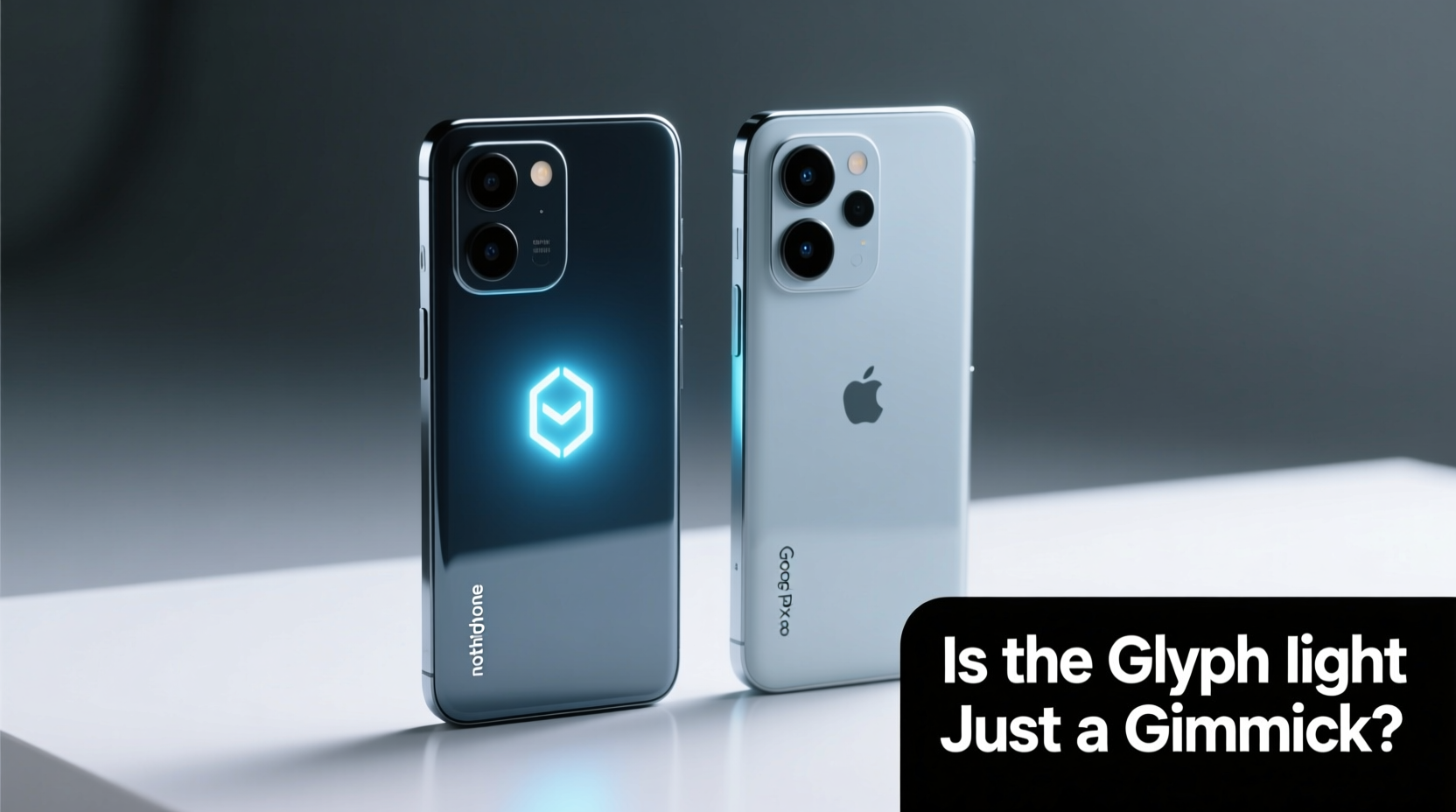
The Nothing Phone 2 wears its personality on its back—literally. The transparent rear panel reveals a minimalist internal layout, while the Glyph Interface pulses with rhythmic animations during calls, charging, or music playback. It’s undeniably eye-catching. In social settings, it turns heads. But does it serve a purpose beyond visual flair?
In contrast, the Pixel 8 embraces subtlety. Its matte aluminum frame, soft-touch back, and clean lines reflect Google’s long-standing commitment to functional minimalism. There are no blinking lights, no moving parts—just a device designed to disappear into your routine.
The Glyph system isn't entirely decorative. It provides silent notification cues (e.g., pulsing for messages), charging status (animated waves when plugged in), and even customizable ringtones through light patterns. For users who rely on visual alerts—especially in noisy environments or those with hearing sensitivities—these features offer tangible benefits.
Performance and Hardware: Under the Hood
Beneath their contrasting exteriors, both phones pack capable internals. The Nothing Phone 2 runs on the Qualcomm Snapdragon 8+ Gen 1, a chip still more than sufficient for everyday tasks, gaming, and multitasking. Paired with up to 12GB of RAM and 512GB of storage, it delivers smooth performance across apps and heavy workloads.
The Pixel 8, meanwhile, features Google’s custom Tensor G3 chipset. While benchmarks may favor the Snapdragon in raw power, the Tensor excels in AI-driven tasks such as voice transcription, photo enhancement, and on-device language processing. Real-world responsiveness is excellent, particularly within the Google ecosystem.
One area where the Pixel holds an edge is longevity. Google promises seven years of OS updates—a first in the Android world—ensuring security patches and feature upgrades through 2030. Nothing commits to three Android version updates and four years of security patches, which is standard but less ambitious.
“Software support is becoming a critical factor in smartphone value. Seven years of updates transforms how we think about device lifespan.” — David Liu, Mobile Analyst at TechPulse Insights
Camera Comparison: Computational Photography vs. Balanced Imaging
The Pixel 8 continues Google’s legacy of class-leading computational photography. Its 50MP main sensor, combined with advanced HDR+, Night Sight, and Magic Eraser, consistently produces vibrant, well-balanced photos—even in low light. The ultrawide and telephoto lenses (on the Pixel 8 Pro; the base model lacks optical zoom) further extend its versatility.
The Nothing Phone 2 uses a dual 50MP setup (main + ultrawide) co-developed with Zeiss. While improved over its predecessor, it struggles to match Pixel-level consistency. Dynamic range can be limited in high-contrast scenes, and skin tones occasionally appear oversaturated. However, manual controls via the Pro mode give photographers more creative freedom—an advantage for enthusiasts.
Where the Pixel shines in automation, the Nothing Phone 2 offers transparency. You’re not locked into black-box algorithms. If you want to tweak shutter speed or white balance, you can. This openness appeals to users wary of over-processed images.
Photo Quality Summary
| Feature | Nothing Phone 2 | Pixel 8 |
|---|---|---|
| Main Sensor | 50MP (f/1.88) | 50MP (f/1.7) |
| Ultrawide | 50MP (f/2.2) | 12MP (f/2.2) |
| Night Mode Performance | Good, slightly noisy | Excellent, clean output |
| Portrait Mode Accuracy | Decent, occasional edge errors | Precise, natural blur |
| Manual Controls | Yes (Pro Mode) | Limited |
Software Experience: Pure Android vs. Personalized Layer
The Pixel 8 runs stock Android with subtle enhancements—Now Playing, Call Screen, and Assistant Voice Typing are standout features powered by on-device AI. The interface is clean, intuitive, and fast. Updates arrive instantly, often weeks before other manufacturers.
Nothing OS, based on Android 13 (upgradable to 14), overlays a unique aesthetic: monochrome app icons, translucent menus, and Glyph-integrated alerts. Some find it refreshing; others see it as unnecessary theming. However, bloatware is minimal, and gesture navigation feels responsive.
The real divergence lies in integration. On the Pixel, services like Google Photos, Gmail, and Maps work seamlessly. On the Nothing Phone 2, you get useful additions like Glyph-triggered music visuals or double-tap-to-wake, but ecosystem cohesion isn’t as tight unless you manually configure third-party apps.
Real-World Usability: A Day in the Life
Consider Maya, a freelance designer who juggles client calls, music playlists, and frequent travel. She owns a Nothing Phone 2 and previously used a Pixel 6.
At a busy café, her phone buzzes with a new email. Instead of checking the screen, she glances at the back—two quick pulses from the Glyph indicate a non-urgent message. Later, during a Zoom call, the Glyph blinks red, reminding her the microphone is active. When she plugs in to charge between meetings, the animated wave pattern gives instant feedback without waking the screen.
These micro-interactions reduce cognitive load. She doesn’t need to unlock the phone constantly. Yet, when she edits photos for clients, she misses the Pixel’s superior noise reduction and faster AI processing. Exporting large files takes longer, and Night Mode shots require extra retouching.
For Maya, the Glyph isn’t a gimmick—it’s a functional layer of ambient feedback. But she acknowledges that the Pixel 8 would streamline her creative workflow more effectively.
When the Glyph Adds Value
- Silent environments where vibration might be missed
- Accessibility use cases (e.g., hearing-impaired users)
- Personalization and mood-based lighting (custom colors for contacts)
- Charging confirmation without screen wake
Is the Glyph Light Just a Gimmick? A Balanced Verdict
Calls it a “gimmick” undersells its potential. While many will dismiss the Glyph Interface as flashy nonsense, dismissing it entirely ignores its utility in specific contexts. It’s not essential—but neither is it meaningless.
Think of it like ambient lighting in a car: not necessary for driving, yet it enhances the experience. The Glyph works best when customized. Out of the box, default animations can feel excessive. But once tailored—dimmed brightness, selective triggers, personalized patterns—it becomes a subtle companion rather than a distraction.
Moreover, the Glyph contributes to brand identity. In a sea of glass slabs, Nothing dares to look different. That courage fosters loyalty among users who value individuality. As one Reddit user put it: *“I bought the Phone 2 because it made me smile. No other phone does that.”*
Yet, practicality cannot be ignored. The Pixel 8 wins in long-term software support, camera reliability, and AI integration. If your priority is a phone that works flawlessly for years with minimal fuss, the Pixel is the safer choice.
Checklist: Choosing Between Nothing Phone 2 and Pixel 8
- ✅ Do you value unique design and visual feedback? → Lean toward Nothing Phone 2
- ✅ Are you deeply embedded in Google’s ecosystem? → Pixel 8 is ideal
- ✅ Do you edit photos or rely on AI tools? → Pixel 8 offers better optimization
- ✅ Do you want maximum customization and transparency in controls? → Nothing Phone 2 wins
- ✅ Is long-term update support critical? → Pixel 8’s 7-year promise is unmatched
- ✅ Do you prioritize accessibility features or silent alerts? → Glyph offers innovative options
Frequently Asked Questions
Does the Glyph Interface drain the battery significantly?
Under normal use, the impact is minimal—around 3–5% per day if enabled for notifications and charging. However, using music visualizers or bright animations continuously can increase drain. Disabling non-essential effects preserves battery life.
Can I disable the Glyph lights completely?
Yes. You can turn off all Glyph functions in Settings > Display > Glyph Interface. Individual triggers (calls, charging, notifications) can also be toggled independently.
Is the Nothing Phone 2 waterproof?
No, it lacks an official IP rating for water resistance. The Pixel 8 has an IP68 rating, meaning it can survive submersion in up to 1.5 meters of water for 30 minutes. This is a notable advantage for outdoor or travel use.
Final Thoughts: Beyond the Blink
The debate over whether the Glyph Light is a gimmick ultimately depends on your definition of usefulness. If utility means raw performance, photographic excellence, and ecosystem synergy, then yes—the Glyph may seem superfluous. But if you define value more broadly—encompassing joy, personalization, and alternative forms of interaction—then the Glyph earns its place.
The Nothing Phone 2 isn’t trying to beat the Pixel 8 at its own game. It’s playing a different one. Where the Pixel optimizes efficiency, the Nothing Phone 2 celebrates expression. Neither approach is wrong. They simply serve different needs.
In a world where smartphones have become indistinguishable commodities, having a device that sparks conversation—or even a smile—has merit. The Glyph may not revolutionize mobile computing, but it reminds us that technology doesn’t always have to be invisible to be valuable.




 浙公网安备
33010002000092号
浙公网安备
33010002000092号 浙B2-20120091-4
Comments
No comments yet. Why don't you start the discussion?