
The smartphone market in 2024 is more polarized than ever. On one side, you have Apple—predictable, polished, and deeply integrated into a billion lives. On the other, newcomers like Nothing are challenging the status quo with bold designs, transparent backs, and a philosophy that prioritizes user experience over ecosystem lock-in. With the rumored launch of the Nothing Phone (3) and Apple’s anticipated iPhone 16 series, consumers face a real dilemma: Is it time to break free from Apple, or does the iPhone still deliver unmatched value?
This isn’t just about specs on paper. It’s about how these devices fit into your life—your workflow, your aesthetic, your long-term investment. Let’s cut through the marketing noise and compare the two based on what actually matters.
Design & Build: Transparency vs Timelessness
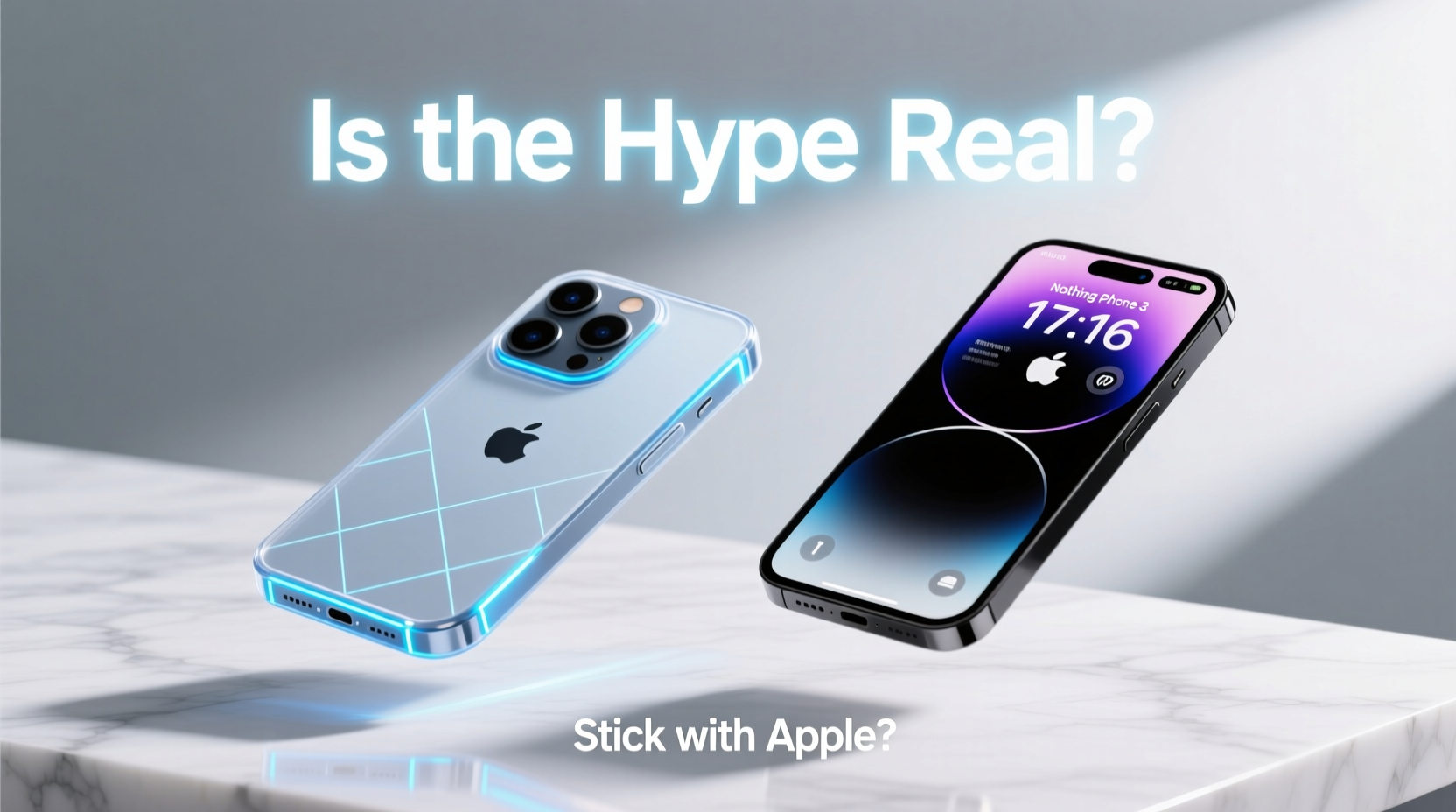
The Nothing Phone (3) continues the brand’s signature look: a semi-transparent back, glowing Glyph Interface LEDs, and a minimalist industrial design. It’s a statement piece. You’re not just buying a phone; you’re buying into a movement that values visibility—both literal and philosophical. The hardware layout is exposed, celebrating engineering rather than hiding it under glass.
In contrast, the iPhone 16 series will likely follow Apple’s tradition of understated elegance. Expect aerospace-grade aluminum or titanium frames, Ceramic Shield glass, and a clean, monolithic silhouette. Apple doesn’t shout for attention—it commands it through precision and consistency.
Where Nothing embraces theatricality, Apple leans into reliability. The question isn’t which looks better, but which aligns with your personal ethos. Do you want a device that turns heads, or one that blends seamlessly into every environment?
Performance & Hardware: Raw Power vs Optimized Efficiency
Rumors suggest the Nothing Phone (3) will be powered by the latest Qualcomm Snapdragon 8 Gen 3 or even Gen 4, paired with up to 16GB of RAM and UFS 4.0 storage. That’s flagship-tier hardware capable of handling heavy multitasking, 4K video editing, and high-frame-rate gaming.
Meanwhile, the iPhone 16 Pro models are expected to debut Apple’s A18 Pro chip—likely built on a 3nm+ process with enhanced neural engine performance. While Apple doesn’t lead in raw GHz or core count, its silicon consistently outperforms Android counterparts in real-world tasks due to tight hardware-software integration.
Benchmarks may favor Android on paper, but iOS smoothness at 60Hz often feels faster than 120Hz Android phones. Why? Because Apple controls both the OS and the chip. Animations are buttery, app launches are instant, and background processes are ruthlessly optimized.
“Apple’s vertical integration gives it an edge in sustained performance and efficiency. No Android OEM matches that level of control.” — Mark Chen, Senior Analyst at TechInsight Group
Software Experience: Freedom vs Frictionless
Nothing OS, based on Android Open Source Project (AOSP), promises a near-stock Android experience with light customization. No bloatware. No aggressive ad integrations. Just clean, fast, and open. The Glyph Interface adds contextual notifications and ambient lighting, making it more than just a gimmick—it’s functional expression.
iOS, on the other hand, is the gold standard for polish and security. Regular updates for five years, seamless integration with Macs, iPads, and AirPods, and a curated App Store that minimizes malware risk. But it comes at a cost: less customization, stricter file system access, and limited support for third-party accessories unless they’re MFi-certified.
If you value control—like sideloading apps, theming your home screen, or using automation tools—Nothing has the clear advantage. But if you prioritize stability, privacy, and long-term support without tinkering, iOS remains unmatched.
Camera Comparison: Computational Mastery vs Emerging Potential
The iPhone 16 series is expected to refine Apple’s already excellent camera system. Rumored upgrades include a periscope zoom lens on the Pro models, improved low-light fusion, and AI-powered computational photography. Apple doesn’t always win megapixel wars, but it consistently delivers reliable, natural-looking photos across conditions.
Nothing, while improving rapidly, still plays catch-up in imaging. The Phone (2) received praise for color accuracy and dynamic range, but struggled in low light and video stabilization. The Phone (3) could close the gap with larger sensors and better software tuning, but it won’t surpass Apple overnight.
For professionals and content creators who need consistent results, the iPhone remains the safer bet. For enthusiasts who enjoy experimenting with manual modes and open-source camera apps, Nothing offers more flexibility.
| Feature | Nothing Phone (3) (Expected) | iPhone 16 (Expected) |
|---|---|---|
| Processor | Qualcomm Snapdragon 8 Gen 4 | Apple A18 Pro (3nm+) |
| RAM | Up to 16GB | 6GB (Pro), 8GB (Max) |
| Storage | 256GB–1TB (UFS 4.0) | 128GB–2TB (NVMe) |
| Display | 6.7” LTPO OLED, 120Hz | 6.1”/6.7” ProMotion OLED, 120Hz |
| Battery | 5,000mAh, 45W wired, 50W wireless | ~4,000mAh, 27W wired, MagSafe |
| Software Updates | 3 OS upgrades, 4 years security | 5+ years full OS support |
| Price (Est.) | $699–$899 | $999–$1,199 |
Real-World Example: Sarah’s Switch
Sarah, a freelance designer in Berlin, used iPhones exclusively for a decade. She loved the ecosystem—her iPad synced perfectly, her MacBook auto-filled passwords, and her AirPods connected instantly. But she grew frustrated with slow charging, lack of customization, and Apple’s refusal to adopt USB-C until 2023.
In early 2024, she switched to the Nothing Phone (2). The first week was rocky—she missed iMessage, had to relearn gestures, and found some apps didn’t optimize well for the Glyph UI. But within a month, she was hooked. The 45W charging meant she spent less time tethered. The open file system let her manage projects directly on the phone. And the transparency? It reminded her why she fell in love with tech in the first place—curiosity.
She hasn’t looked back. “It’s not perfect,” she says, “but it feels like my phone, not a corporate product I rent for $1,200.”
Checklist: Should You Switch from iPhone to Nothing Phone (3)?
- ✅ Want faster charging and longer battery life?
- ✅ Value customization, sideloading, and open software?
- ✅ Tired of paying premium prices for incremental upgrades?
- ✅ Willing to sacrifice iMessage and some ecosystem perks?
- ✅ Interested in a unique design that stands out?
- ❌ Need seamless integration with Mac, iPad, or Apple Watch?
- ❌ Rely heavily on FaceTime, iCloud, or Continuity features?
If most of your answers are “yes” to the first five and “no” to the last two, Nothing could be a compelling upgrade. If you depend on Apple’s ecosystem, switching costs may outweigh the benefits.
FAQ
Will the Nothing Phone (3) get 5G and global band support?
Yes, all Nothing phones since the (1) have included full 5G compatibility and broad LTE band support, including North America. The (3) will almost certainly maintain this standard.
Can I use AirPods with the Nothing Phone (3)?
You can pair AirPods via Bluetooth, but you’ll lose key features like automatic switching, spatial audio with head tracking, and seamless setup. For full functionality, consider open Bluetooth earbuds like Nothing Ear (a) or Sony models.
Is iOS more secure than Nothing OS?
iOS has a stronger track record due to sandboxing, strict app review, and rapid patch deployment. However, Nothing OS is based on AOSP with added privacy features like app permissions dashboard and tracker blocking. Both are secure for average users, but iOS leads in enterprise-level protection.
Conclusion: Hype or Worth It?
The hype around the Nothing Phone (3) isn’t empty. It represents a growing appetite for alternatives to the big tech duopoly. It’s faster to charge, more customizable, and refreshingly honest in design. But it’s not a replacement for the iPhone for everyone.
The iPhone 16 will remain the best choice for those embedded in Apple’s ecosystem, professionals needing reliable cameras, and users who prioritize long-term software support over novelty. It’s not flashy—but it works, year after year.
Nothing, however, is for those ready to question the default. It’s for people who want their phone to reflect their personality, not just their purchasing power. The hype is real—not because it beats the iPhone at everything, but because it dares to be different.




 浙公网安备
33010002000092号
浙公网安备
33010002000092号 浙B2-20120091-4
Comments
No comments yet. Why don't you start the discussion?