
Virtual reality has evolved from a niche technology into a mainstream platform for gaming, fitness, productivity, and social interaction. As standalone headsets become more powerful and accessible, two devices dominate the conversation: the Meta Quest 3 and the Pico 4. Both promise high-fidelity immersive experiences without requiring a PC, but they take different approaches in design, ecosystem, and long-term usability. For users seeking the most engaging and seamless VR experience, understanding the nuances between these two headsets is essential.
This comprehensive analysis examines how the Oculus Quest 3 (marketed as Meta Quest 3) and the Pico 4 deliver on immersion—covering display quality, processing power, tracking accuracy, audio, comfort, software availability, and future-proofing. Whether you're investing in VR for entertainment, training, or creative work, this comparison will clarify which device aligns best with your goals.
Display & Visual Fidelity: Clarity Meets Immersion
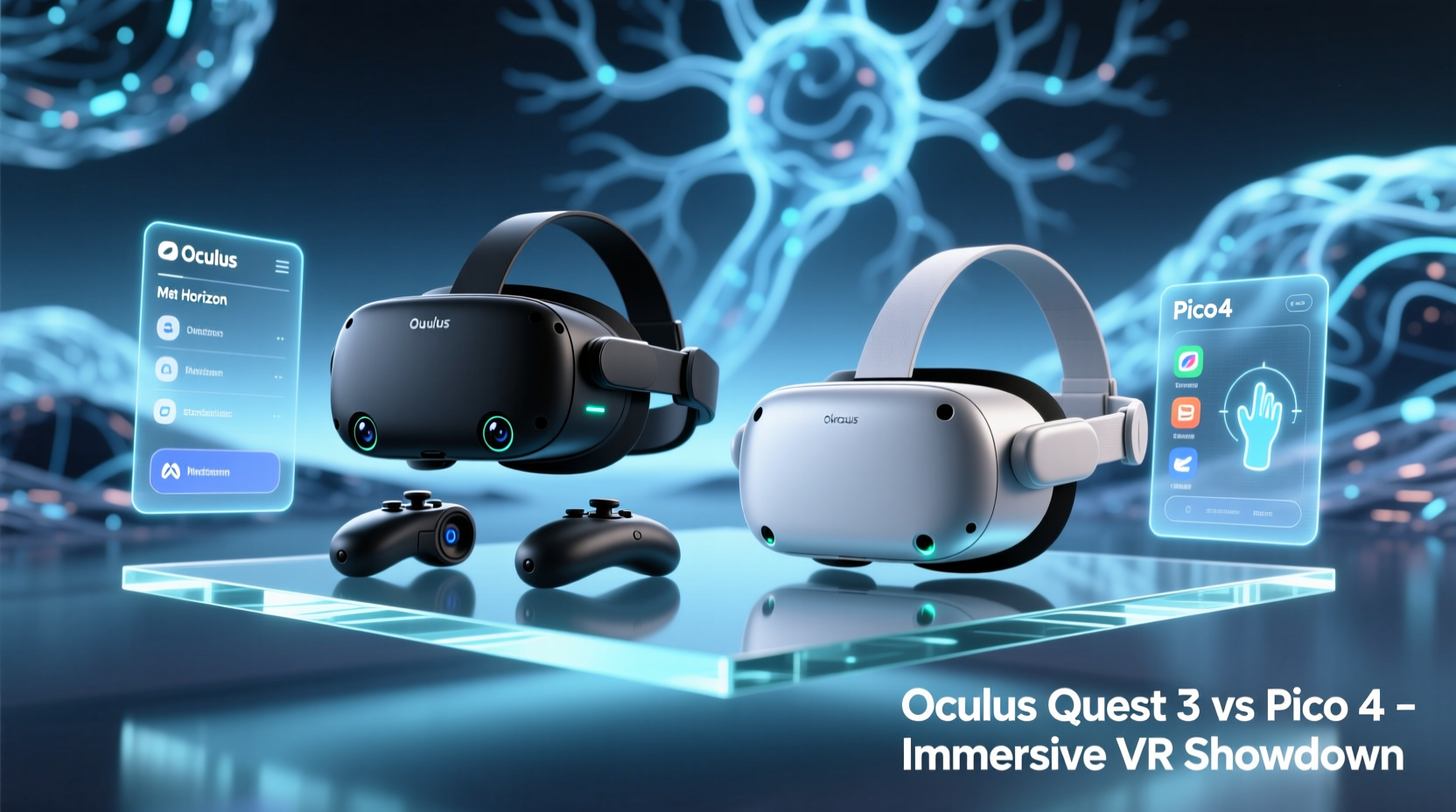
The visual experience is central to immersion in virtual reality. A higher resolution, wider field of view, and better optics can dramatically reduce screen-door effect and motion sickness while deepening presence—the feeling of \"being there.\"
The Meta Quest 3 features dual LCD panels with a resolution of 2064 x 2208 per eye, an improvement over its predecessor and a significant leap in pixel density. It supports a 90Hz to 120Hz refresh rate, enabling smoother gameplay in compatible titles. Its pancake lenses are smaller and allow for a slimmer profile, improving balance and reducing glare. Most importantly, the Quest 3 introduces mixed reality (MR) capabilities through its full-color passthrough cameras, letting users blend digital content with their physical environment in real time.
In contrast, the Pico 4 uses dual RGB subpixel LCDs at 2160 x 2160 per eye—slightly sharper than the Quest 3—and also supports up to 90Hz refresh rates (with select apps pushing to 120Hz). Its Fresnel lenses offer good clarity but are more prone to glare and god rays under bright lighting conditions. While Pico 4 includes monochrome passthrough, it lacks full-color MR functionality, limiting its ability to interact meaningfully with the real world.
| Feature | Meta Quest 3 | Pico 4 |
|---|---|---|
| Resolution per Eye | 2064 x 2208 | 2160 x 2160 |
| Refresh Rate | 72Hz, 90Hz, 120Hz | 72Hz, 90Hz (120Hz limited) |
| Lens Type | Pancake | Fresnel |
| Passthrough Quality | Full-color, high-res | Monochrome, lower res |
| Field of View | Approx. 110° | Approx. 105° |
While the Pico 4 wins slightly on paper with marginally higher resolution, the Quest 3 delivers a more refined visual package thanks to superior lens technology, broader refresh rate support, and advanced MR integration. For immersive storytelling, architectural walkthroughs, or any application where blending real and virtual environments enhances engagement, the Quest 3 sets a new standard.
Hardware & Performance: Powering the Experience
Under the hood, both headsets rely on Qualcomm’s Snapdragon XR2 Gen 1 chipset. However, the Quest 3 upgrades to the **Gen 2** version—a meaningful difference in CPU and GPU performance, AI processing, and thermal efficiency. This enables faster app loading, better multitasking, and more complex simulations without throttling.
The Pico 4 runs smoothly for most games and media but may struggle with graphically intensive titles over extended sessions due to passive cooling and less optimized thermal design. The Quest 3, by comparison, manages heat more effectively and sustains peak performance longer, making it better suited for demanding applications such as photorealistic VR tours or multiplayer battle arenas.
Storage options differ as well: the base Quest 3 starts at 128GB (with a 512GB model available), while Pico 4 offers 128GB and 512GB variants. Neither supports expandable storage, so choosing the right configuration upfront is critical.
“Processing headroom isn’t just about graphics—it determines how richly the virtual world can respond to your actions.” — Dr. Lena Torres, Human-Computer Interaction Researcher, MIT Media Lab
Audio is another area where immersion hinges on execution. Both devices integrate spatial audio via built-in speakers positioned near the ears. The Quest 3 provides slightly warmer sound with better directional cues, enhancing environmental awareness in games. Pico 4’s audio is crisp but can feel more detached, especially during cinematic experiences. For audiophiles or those using VR for language learning or meditation, pairing either headset with high-quality Bluetooth headphones improves fidelity significantly.
User Interface, Ecosystem & Content Library
A headset is only as good as the content it can access. Here, the divide between Meta and ByteDance (Pico’s parent company) becomes stark.
The Meta Quest ecosystem benefits from years of developer investment, a vast library of polished titles, and strong first-party support. Apps like *Lone Echo*, *Resident Evil 4 VR*, *Beat Saber*, and *Gorilla Tag* showcase the depth and variety available. Meta also prioritizes cross-platform compatibility, allowing streaming from PCs via Air Link and integration with Horizon Worlds for social experiences.
Pico 4, primarily marketed outside North America, faces limitations in global content reach. While it hosts many popular titles (*Zenith: The Last City*, *Moss*, *After the Fall*), several major releases are delayed or unavailable. Additionally, Pico’s store interface feels less intuitive, with inconsistent localization and fewer curated recommendations. That said, sideloading via SideQuest is easier on Pico 4 due to looser restrictions, appealing to tech-savvy users who want greater control.
Software Update Roadmap
Meta has committed to annual hardware updates and multi-year software support across its Quest line. With plans for AI-driven avatars, enhanced hand tracking, and deeper workplace integrations, the Quest 3 is positioned as a gateway to the metaverse vision. Pico’s update frequency varies by region; European and Asian users receive timely patches, but U.S.-based buyers often face delays or reduced service.
Comfort, Fit & Long-Term Wearability
No amount of technical prowess matters if a headset causes discomfort after 30 minutes. Both the Quest 3 and Pico 4 weigh approximately 500 grams, but their weight distribution differs significantly.
The Quest 3 uses a balanced strap design with an optional Elite Strap upgrade that shifts weight to the back of the head. Its facial interface is softer and seals better around glasses, reducing light leakage. The overall fit feels secure during active play, whether boxing in *FitXR* or exploring alien planets in *No Man’s Sky VR*.
Pico 4 employs a halo-style headband that distributes pressure evenly but can press uncomfortably against certain hairlines. The default strap is sleek but less adjustable. Users report mild forehead fatigue during hour-long sessions. However, the Pico 4’s IPD (interpupillary distance) adjustment is motorized—users can fine-tune focus with a button press—while the Quest 3 requires manual slider changes.
“The ideal VR headset disappears after five minutes. If you’re constantly adjusting it, immersion breaks.” — Marcus Lee, UX Designer at Valve Software
Ergonomic Checklist Before Purchase
- Try the headset with your glasses (if applicable)
- Check temple and nose bridge pressure points
- Assess ease of IPD adjustment
- Test ventilation during movement (does it fog?)
- Evaluate cable management for charging mid-session
Real-World Example: Training Surgeons in VR
Consider a medical simulation lab adopting VR for surgical training. Instructors need realistic tissue rendering, precise hand tracking, and low-latency interaction. They also require durable hardware that students can use for hours daily.
In a pilot program at a Berlin teaching hospital, both Quest 3 and Pico 4 were tested for laparoscopic procedure simulations. The Quest 3’s higher processing power allowed for dynamic organ deformation and blood flow physics in real time, while its color passthrough enabled instructors to overlay anatomical guides onto mannequins. Hand tracking accuracy was consistently above 95%, crucial for mimicking delicate movements.
The Pico 4 performed adequately but exhibited frame drops during complex animations, and the lack of color passthrough made hybrid training setups impractical. While cost-effective, it was ultimately deemed less suitable for high-stakes educational environments.
This case illustrates that immersion isn’t just about visuals—it’s about reliability, responsiveness, and contextual adaptability. For professional or enterprise use, the Quest 3’s ecosystem maturity and hardware refinement make it the preferred choice.
FAQ: Common Questions Answered
Can I use Pico 4 apps on Quest 3 or vice versa?
No, apps are not natively cross-compatible. While sideloading tools like SideQuest allow installation of APKs from one platform to another, performance and controller mapping issues are common. Official stores remain separate ecosystems.
Which headset has better battery life?
Both last about 2–3 hours under heavy use. The Pico 4 edges ahead slightly with up to 3 hours of continuous gameplay versus 2.5 on the Quest 3. External power banks extend usage for both models.
Is the Quest 3 worth the price premium over Pico 4?
If you prioritize future-proofing, mixed reality, and access to top-tier VR content, yes. For budget-conscious users focused on core gaming and fitness, the Pico 4 offers excellent value—especially in regions where pricing is competitive.
Final Verdict: Choosing Your Path to Immersion
The Meta Quest 3 and Pico 4 represent two philosophies in standalone VR. The Quest 3 is a forward-looking platform built around innovation, ecosystem strength, and seamless user experience. It excels in mixed reality, maintains robust developer support, and continues to push boundaries in AI and spatial computing.
The Pico 4, meanwhile, delivers impressive specs at a competitive price. It appeals to users in Asia, Europe, and emerging markets who want capable hardware without brand lock-in. Its openness to sideloading and cleaner UI in localized versions make it a compelling alternative—for now.
Ultimately, immersion depends not just on pixels and processors, but on how naturally the technology fades into the background. When the visuals, sound, controls, and content work in harmony, the brain accepts the virtual as real. On this measure, the Quest 3 achieves a more consistent state of presence across diverse applications.




 浙公网安备
33010002000092号
浙公网安备
33010002000092号 浙B2-20120091-4
Comments
No comments yet. Why don't you start the discussion?