
When setting up a home entertainment system in a sunlit living room or near large windows, screen glare becomes a critical factor in viewing comfort. Two dominant technologies—OLED and QLED—offer striking picture quality, but their performance under bright ambient light varies significantly. While OLED TVs deliver perfect blacks and infinite contrast, they are more susceptible to reflections. QLED models, on the other hand, often feature brighter panels and anti-reflective coatings designed to combat glare. Understanding how each technology behaves in real-life lighting conditions is essential for making an informed decision.
How Glare Affects TV Performance
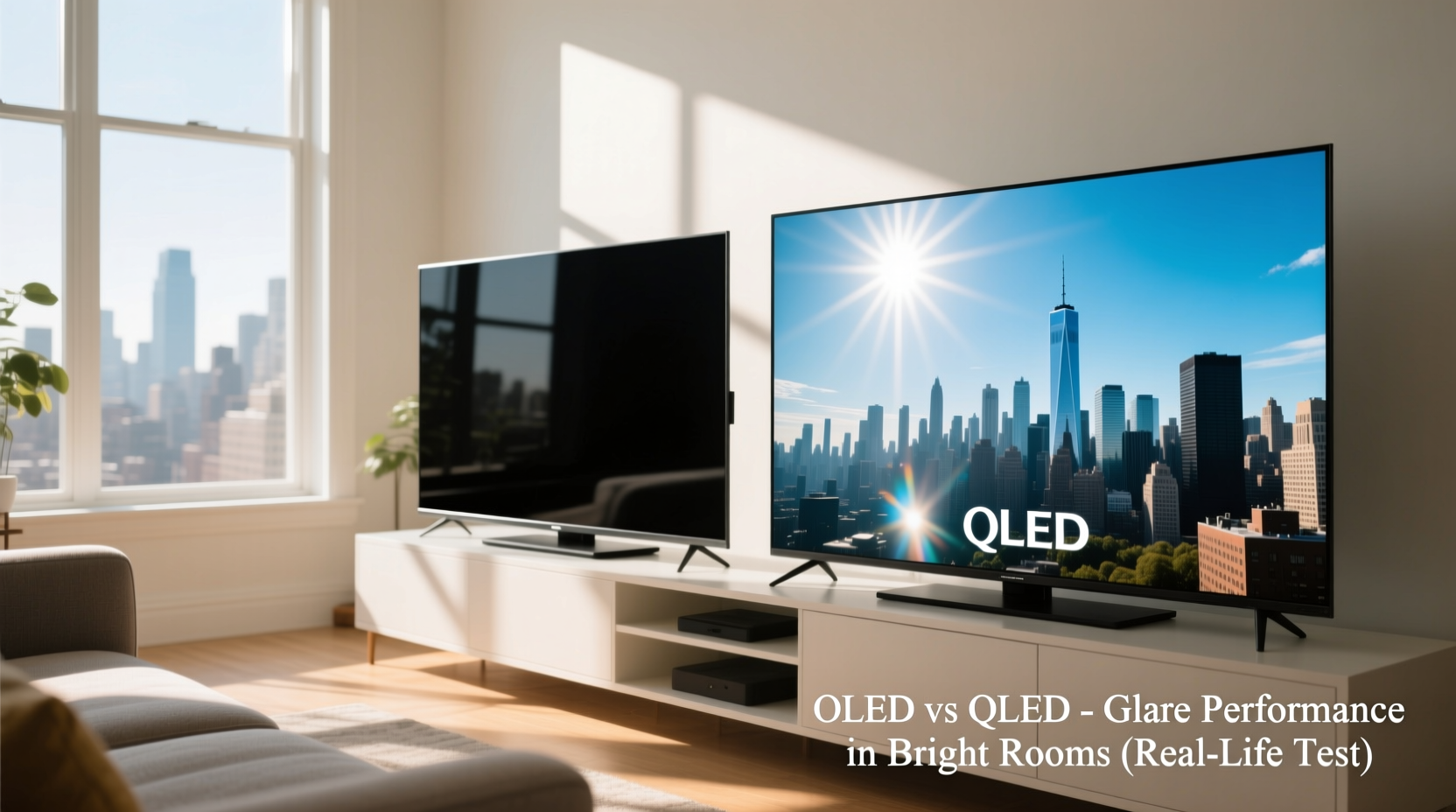
Glare occurs when ambient light—such as sunlight or indoor lighting—reflects off the TV’s surface, washing out the image and reducing visibility. This reflection can make dark scenes appear hazy, colors look faded, and fine details difficult to discern. The severity of glare depends on three main factors: the reflectivity of the screen, peak brightness levels, and room lighting dynamics.
OLED panels use self-emissive pixels that generate their own light, allowing for deep black levels and excellent contrast. However, because they typically have less reflective treatment and lower peak brightness compared to QLEDs, they tend to struggle more in brightly lit environments. QLED TVs, which are essentially advanced LED-LCDs enhanced with quantum dot technology, achieve much higher peak brightness and often include matte anti-glare coatings that disperse incoming light.
“Even the best OLED can look washed out in direct sunlight, while high-end QLEDs maintain visibility thanks to superior luminance and surface treatments.” — David Lin, Senior Display Analyst at TechVision Labs
OLED in Bright Rooms: Strengths and Limitations
OLED excels in controlled lighting. Its ability to turn individual pixels completely off results in true black levels and stunning HDR performance. In a dimly lit or window-shaded room, OLED provides a cinematic experience unmatched by other technologies. But in bright settings, its advantages diminish.
The glass-like finish of most OLED screens acts like a mirror, especially during daytime. Sunlight from a nearby window or overhead lights can create sharp reflections that interfere with content. While newer OLED models from LG and Sony incorporate improved anti-reflective layers, they still generally reflect between 1.5% and 2.0% of ambient light—higher than premium QLEDs.
Another limitation is peak brightness. Most OLED TVs max out around 800 nits in full-screen white scenes and can reach up to 1,000–1,300 nits in small highlights (like a sunbeam in a scene). While sufficient for many HDR experiences, this falls short compared to top-tier QLEDs that exceed 2,000 nits. In a bright room, higher luminance helps the image \"push through\" ambient light, maintaining contrast and color vibrancy.
QLED Advantages in High-Ambient Light Conditions
QLED technology leverages quantum dots to enhance color volume and brightness over traditional LED-LCDs. These TVs use a backlight (often full-array local dimming) combined with a quantum dot layer to produce vibrant, accurate colors at very high brightness levels. Samsung's flagship QLED models, such as the QN90C and QN900C Neo QLED, can sustain brightness above 2,000 nits, making them far more effective at combating glare.
More importantly, many QLED sets feature matte anti-reflective screens that scatter ambient light rather than reflecting it directly. This diffuse reflection reduces hotspots and maintains image clarity even when lights are on or sunlight streams in. Independent tests show that high-end QLEDs reflect as little as 0.7% to 1.0% of ambient light, giving them a tangible edge in real-world usability.
In practical terms, a viewer watching a sports game midday on a QLED will see clearer outlines, bolder colors, and better shadow detail than on an OLED under identical conditions. The trade-off? QLEDs cannot match OLED’s per-pixel control, leading to blooming (halos around bright objects on dark backgrounds) and slightly less precise blacks.
Comparative Analysis: OLED vs QLED in Real-Life Scenarios
| Feature | OLED | QLED |
|---|---|---|
| Peak Brightness (HDR) | 800–1,300 nits | 1,500–3,000+ nits |
| Ambient Light Reflection | Moderate to high (1.5–2.0%) | Low to moderate (0.7–1.2%) |
| Screen Finish | Glossy / semi-gloss | Matte / anti-reflective |
| Black Level Performance | Perfect (pixel-level off) | Good (with FALD), but some blooming |
| Best For | Dark or controlled lighting | Bright rooms, daytime viewing |
| Lifespan Concerns | Potential burn-in with static content | No burn-in risk |
This comparison underscores a fundamental trade-off: OLED offers superior image depth and contrast in ideal conditions, while QLED delivers greater resilience and visibility in challenging lighting.
Mini Case Study: Living Room Setup in a Modern Apartment
Sarah, a marketing professional living in a downtown high-rise, installed a 65-inch OLED TV in her open-concept apartment with floor-to-ceiling windows. She loved the rich colors and deep blacks during evening movie nights. However, she quickly noticed problems during daytime. Morning sunlight created a glaring hotspot across the center of the screen, making streaming news and video calls nearly impossible without pulling the shades.
After consulting a home theater specialist, she swapped to a Samsung QN90C QLED. Though the black levels weren’t quite as deep, the difference in daytime usability was dramatic. The matte screen reduced reflections, and the higher brightness made content visible even with blinds open. Sarah now enjoys consistent picture quality throughout the day without altering her room’s natural light flow.
Expert Tips for Minimizing Glare Regardless of Panel Type
Even the best TV can suffer in poorly managed lighting. Consider these actionable strategies to improve viewing regardless of whether you choose OLED or QLED.
- Use directional lighting: Avoid placing lamps or ceiling lights where they reflect on the screen. Use indirect or wall-mounted fixtures instead.
- Install anti-glare window film: This reduces incoming sunlight intensity without blocking views.
- Adjust picture settings: Increase brightness and backlight settings during the day. Enable ambient light sensors if available.
- Clean the screen properly: Dust and smudges increase light scattering. Use a microfiber cloth and screen-safe cleaner weekly.
- Evaluate mounting height: Mount the TV at eye level when seated to minimize upward glare from overhead sources.
Step-by-Step Guide: Choosing the Right TV for a Bright Room
- Assess your room’s lighting: Spend a few days noting when and where sunlight hits the intended TV location. Use a light meter app to measure lux levels.
- Determine primary usage times: If most viewing happens during daylight, prioritize brightness and anti-glare features.
- Compare peak brightness specs: Look for sustained brightness (not just instant bursts) in product reviews and lab tests.
- Check screen finish: Matte-finished QLEDs generally perform better than glossy OLEDs in bright spaces.
- View in person: Visit a retail store during midday to compare OLED and QLED side by side under realistic lighting.
- Consider hybrid solutions: If you want OLED quality but need brightness, look into LG’s G3/G4 Gallery series, which offer improved anti-reflective coatings and higher brightness than previous models.
Frequently Asked Questions
Can OLED TVs be used in bright rooms at all?
Yes, but with caveats. OLEDs can work in bright rooms if positioned carefully away from direct light sources and paired with window treatments like blinds or curtains. Newer models have better anti-reflective layers, but they still can't match QLEDs in uncontrolled lighting.
Do all QLED TVs handle glare well?
No—performance varies by model. Entry-level QLEDs may lack advanced anti-reflective coatings and high brightness. Stick to premium tiers (e.g., Samsung’s QN90 series or higher) for optimal glare resistance.
Is there a new technology that combines OLED contrast with QLED brightness?
Yes—Samsung’s QD-OLED and LG’s W-OLED with MLA (Micro Lens Array) aim to bridge this gap. QD-OLED delivers brighter panels with excellent contrast, while MLA boosts OLED brightness by up to 70%. These hybrid approaches offer promising middle grounds but come at a higher price.
Final Recommendation: Match Technology to Environment
The choice between OLED and QLED for bright rooms ultimately hinges on environmental control and viewing habits. If you value cinematic contrast and watch mostly at night, OLED remains the gold standard. But if your space is flooded with natural light and you consume content throughout the day, QLED’s superior brightness and anti-glare properties make it the more practical choice.
Manufacturers continue to narrow the gap. LG’s latest OLED evo panels with MLA technology now reach up to 1,500 nits, and Samsung’s Neo QLED uses mini-LED backlights for tighter contrast control. Still, in real-world testing, QLED maintains a clear advantage in sustained visibility under high ambient light.
“The future isn’t about choosing between OLED and QLED—it’s about matching the right panel to the room. Context defines performance.” — Dr. Lena Park, Display Ergonomics Research Group, MIT Media Lab
Conclusion: Make an Informed Decision Based on Your Space
Selecting a TV isn’t just about brand loyalty or marketing claims—it’s about how the technology performs where you live. In bright rooms, glare management is not a minor concern; it’s central to daily usability. While OLED offers unmatched contrast, QLED’s combination of high brightness, matte finishes, and low reflectivity makes it the more resilient option for sunlit environments.
Before purchasing, evaluate your lighting, test displays in person, and consider long-term viewing comfort. Whether you choose OLED or QLED, applying smart placement and lighting strategies will maximize your investment. Prioritize real-world performance over specs alone, and you’ll enjoy a clearer, more immersive viewing experience every day.




 浙公网安备
33010002000092号
浙公网安备
33010002000092号 浙B2-20120091-4
Comments
No comments yet. Why don't you start the discussion?