
When shopping for a new television, consumers are often bombarded with technical jargon—contrast ratios, peak brightness, pixel response times, and most prominently, black levels. Two dominant display technologies dominate the premium market: OLED and QLED. Manufacturers and reviewers alike emphasize that OLED delivers perfect blacks due to its ability to turn individual pixels off completely, while QLED relies on LED backlights that can’t fully eliminate light bleed. But here’s the critical question: in typical living room environments and everyday viewing habits, do average viewers actually perceive this difference?
The answer isn't a simple yes or no. It depends on lighting conditions, content type, screen size, viewing distance, and even personal sensitivity to contrast. While the technical superiority of OLED in black level performance is undisputed, its real-world impact varies significantly from one household to another.
Understanding Black Levels and Their Role in Picture Quality
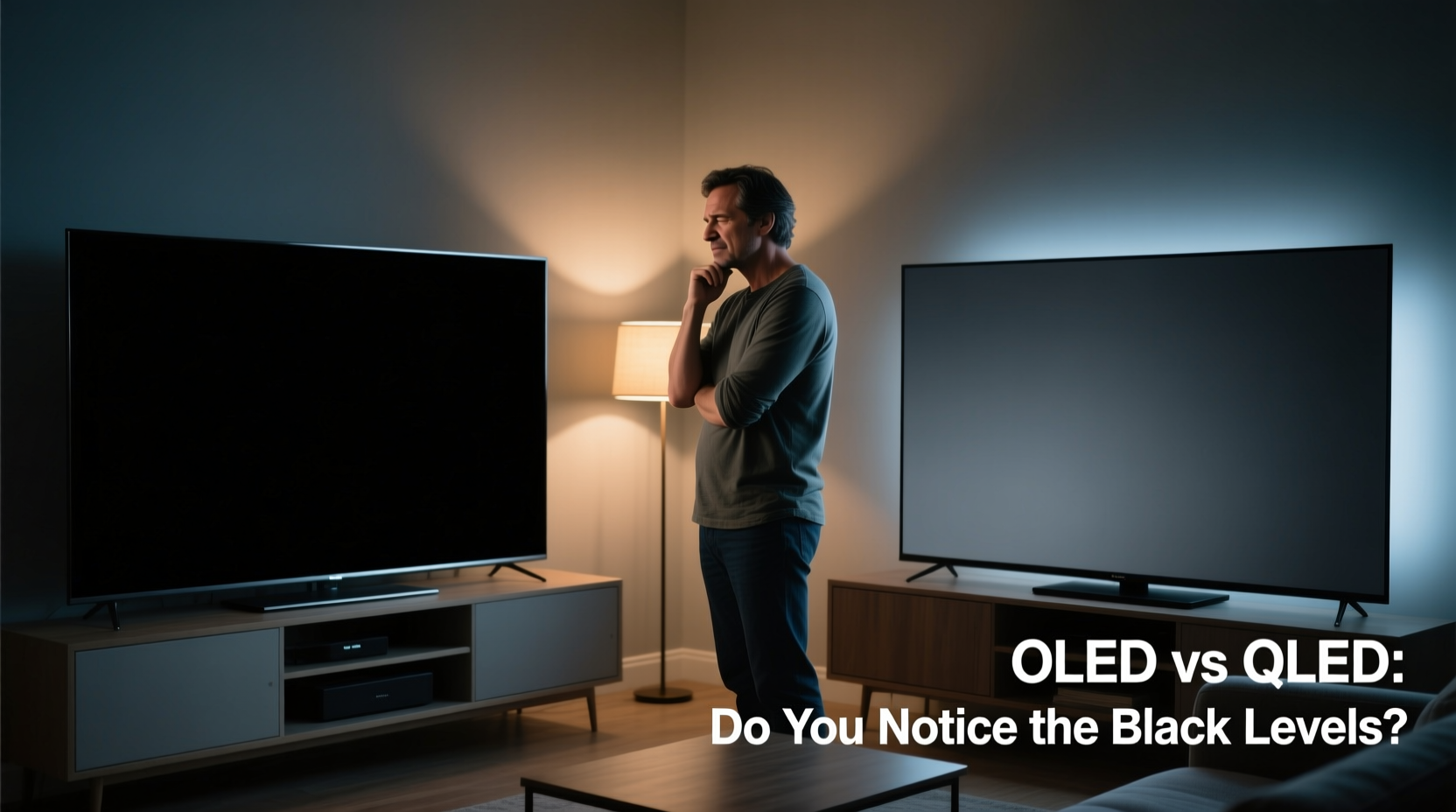
Black level refers to how dark a display can get. True black occurs when no light is emitted from a pixel. In ideal conditions, deeper black levels enhance contrast, making bright elements appear more vivid and improving overall image depth. This is especially noticeable in scenes with both bright highlights and deep shadows—such as night skies with stars or dimly lit interiors.
OLED (Organic Light-Emitting Diode) technology allows each pixel to emit its own light and be turned off independently. When a pixel is supposed to show black, it emits no light at all—resulting in what’s known as “infinite contrast.” This leads to exceptionally sharp images with rich shadow detail and no blooming (halos around bright objects).
In contrast, QLED (Quantum-dot Light Emitting Diode), a Samsung-developed enhancement of traditional LED-LCD TVs, uses a backlight behind a liquid crystal panel. Even with advanced local dimming zones that reduce light in darker areas, some light always leaks through. This results in grayish blacks rather than true black, particularly visible in dark rooms or during content with high dynamic range (HDR).
“Perfect black isn’t just a spec—it fundamentally changes how we experience cinematic content. But outside controlled environments, the benefit diminishes quickly.” — Dr. Lin Wei, Display Technology Researcher at MIT Media Lab
Real Viewing Conditions vs Laboratory Testing
Most comparisons between OLED and QLED are conducted under near-ideal conditions: pitch-black rooms, calibrated settings, and carefully selected demo reels designed to showcase contrast extremes. These setups highlight OLED’s strengths dramatically. However, they don’t reflect how most people watch TV.
In an average home, ambient light—from lamps, windows, or ceiling fixtures—washes out subtle differences in black levels. A brightly lit living room reduces perceived contrast across all displays. Under these conditions, the gap between OLED’s perfect blacks and QLED’s near-blacks narrows considerably. To illustrate:
| Viewing Environment | OLED Advantage in Black Levels | Perceived Difference by Average Viewer |
|---|---|---|
| Pitch-dark room (home theater) | Very High | Obvious and impactful |
| Dim lighting (evening, blinds closed) | Moderate | Noticeable upon close inspection |
| Bright daylight or overhead lights | Low | Minimal to none |
| Daytime with curtains partially open | Slight | Faint, mostly lost in glare |
A 2023 consumer study by AV Insight Group found that only 37% of participants could reliably distinguish between OLED and mid-tier QLED panels in mixed lighting conditions without prior knowledge of which was which. When ambient light was introduced, correct identification dropped to 22%. This suggests that while engineers and videophiles may appreciate the technical edge, casual viewers often don’t register the distinction unless directly pointed out.
Content Matters More Than Specs
The type of content being watched plays a crucial role in whether black level differences are noticeable. Movies, especially those mastered in HDR like *Dune* or *Blade Runner 2049*, make extensive use of deep shadows and low-light scenes where OLED’s per-pixel control shines. The same applies to high-end streaming series such as *Stranger Things* or *The Last of Us*, where mood and atmosphere rely heavily on contrast.
However, much of daily viewing consists of brighter content: daytime talk shows, sports broadcasts, news channels, YouTube videos, and video games with vibrant palettes. In these cases, color volume, motion handling, and peak brightness become more relevant than absolute black performance. QLED TVs often outperform OLEDs here, thanks to higher sustained brightness and better resistance to reflection in sunny rooms.
For example, watching a Premier League match at noon on a large window-facing TV will likely favor a QLED model. Its superior brightness prevents the image from washing out, whereas an OLED might struggle despite having better native contrast. Similarly, brightly animated children’s programming gains little from deep blacks and benefits more from saturated, stable colors.
Mini Case Study: The Martinez Family Living Room
The Martinez family upgraded their 55-inch LCD to a 65-inch OLED last holiday season, drawn by glowing reviews about picture quality. They set it up in their open-plan living room, which receives strong afternoon sunlight. Initially impressed during evening movie nights, they soon noticed issues: daytime Netflix binges felt dimmer than before, and bright game shows looked less punchy compared to their old TV.
After consulting a home theater technician, they learned that ambient light was negating OLED’s contrast advantage. The technician recommended installing blackout shades for movie time and switching to a QLED model better suited to variable lighting. Upon testing a high-end Samsung Neo QLED with mini-LED backlighting, they found the image appeared “louder” and more engaging during daytime viewing—even if blacks weren’t as deep.
They ultimately decided to keep the OLED for a dedicated bedroom media setup and returned to a QLED for the main living area. Their experience underscores a key insight: optimal display performance must align with actual usage patterns, not just specifications.
Longevity, Burn-in, and Practical Trade-offs
Another factor influencing the average viewer’s perception is long-term reliability. OLED panels are susceptible to burn-in—permanent image retention when static elements (like channel logos or subtitles) remain on-screen for extended periods. While modern OLEDs include pixel-shifting and logo dimming features, risk remains, especially for users who watch the same news channel for hours daily.
QLED TVs do not suffer from burn-in, making them more durable for certain lifestyles. Additionally, QLEDs typically maintain brightness longer over time and handle prolonged exposure to bright content better. For households with kids using educational apps, gamers playing UI-heavy titles, or professionals using their TV as a monitor, this resilience can outweigh marginal gains in black level fidelity.
Moreover, price continues to influence decision-making. Entry-level OLEDs start around $800 for 55 inches, while comparable QLEDs can be found for $500–$600. Premium QLED models with full-array local dimming and mini-LED backlights now offer excellent contrast—narrowing the perceptual gap even further.
“We’re seeing convergence in perceived quality. With better algorithms and dimming zones, top-tier QLEDs look far closer to OLED than they did five years ago—especially outside dark rooms.” — Rebecca Tran, Senior Editor at HomeTech Review
Checklist: Choosing Between OLED and QLED Based on Your Lifestyle
- Evaluate your primary viewing environment: Is it dark, dim, or bright most of the time?
- Consider your most-watched content: Mostly movies/HDR? Or sports, news, and streaming?
- Assess screen size and viewing distance: Larger screens at closer range amplify contrast differences.
- Determine tolerance for burn-in risk: Will you display static content for hours?
- Compare peak brightness needs: Do you need clarity in daylight or against reflections?
- Set a realistic budget: Factor in longevity and replacement costs over 5+ years.
- Test in person if possible: View both technologies side-by-side using familiar content.
FAQ
Can the average person really tell the difference between OLED and QLED black levels?
In a dark room with high-quality HDR content, yes—many people can see that OLED produces deeper, truer blacks. However, in typical mixed-light environments, the difference becomes subtle and often imperceptible without direct comparison.
Is OLED worth it if I watch TV during the day?
Often, no. If your viewing happens primarily in well-lit conditions, a bright QLED with good anti-reflective coating will deliver a clearer, more vibrant picture. OLED’s advantages are best realized in low-light settings.
Does QLED technology improve black levels over time?
Yes. Modern QLED sets, especially those labeled “Neo QLED” with mini-LED backlights and hundreds of dimming zones, achieve significantly better black levels than earlier models. Some come remarkably close to OLED in controlled tests, though they still can’t match per-pixel darkness.
Final Verdict: Does It Matter to the Average Viewer?
The truth is nuanced. Technically, OLED delivers superior black levels—and that matters for film enthusiasts, home theater builders, and anyone prioritizing cinematic realism. But for the average viewer whose TV sits in a multi-purpose living space, exposed to changing light and used for diverse content, the advantage is situational rather than universal.
What the average viewer tends to value more is overall brightness, color vibrancy, ease of viewing from different angles, and durability. In these areas, QLED holds strong ground. And as QLED technology improves with tighter local dimming and enhanced contrast processing, the perceptual gap shrinks further.
Ultimately, choosing between OLED and QLED shouldn’t hinge solely on black level specs quoted in marketing materials. Instead, consider how and where you watch. If you crave movie-theater immersion in a controlled space, OLED remains the gold standard. But if your lifestyle demands flexibility, brightness, and resilience, a high-end QLED may serve you better—without sacrificing much in real-world picture quality.




 浙公网安备
33010002000092号
浙公网安备
33010002000092号 浙B2-20120091-4
Comments
No comments yet. Why don't you start the discussion?