
When choosing a new television, one of the most critical factors is where you’ll be watching it. For many households, living rooms are flooded with natural light during the day or feature overhead lighting that can wash out the picture. In these scenarios, the debate between OLED and QLED becomes especially relevant. While OLED has long been praised for its perfect blacks, infinite contrast, and cinematic color accuracy, critics often claim it’s “too dim” for bright rooms. But is that still true? And how does QLED—known for its high brightness and resilience to ambient light—really stack up?
This comparison dives deep into real-world performance, technological advancements, and viewer experience to determine whether OLED is genuinely unsuitable for daytime use or if the narrative needs updating.
Understanding OLED and QLED: Core Differences
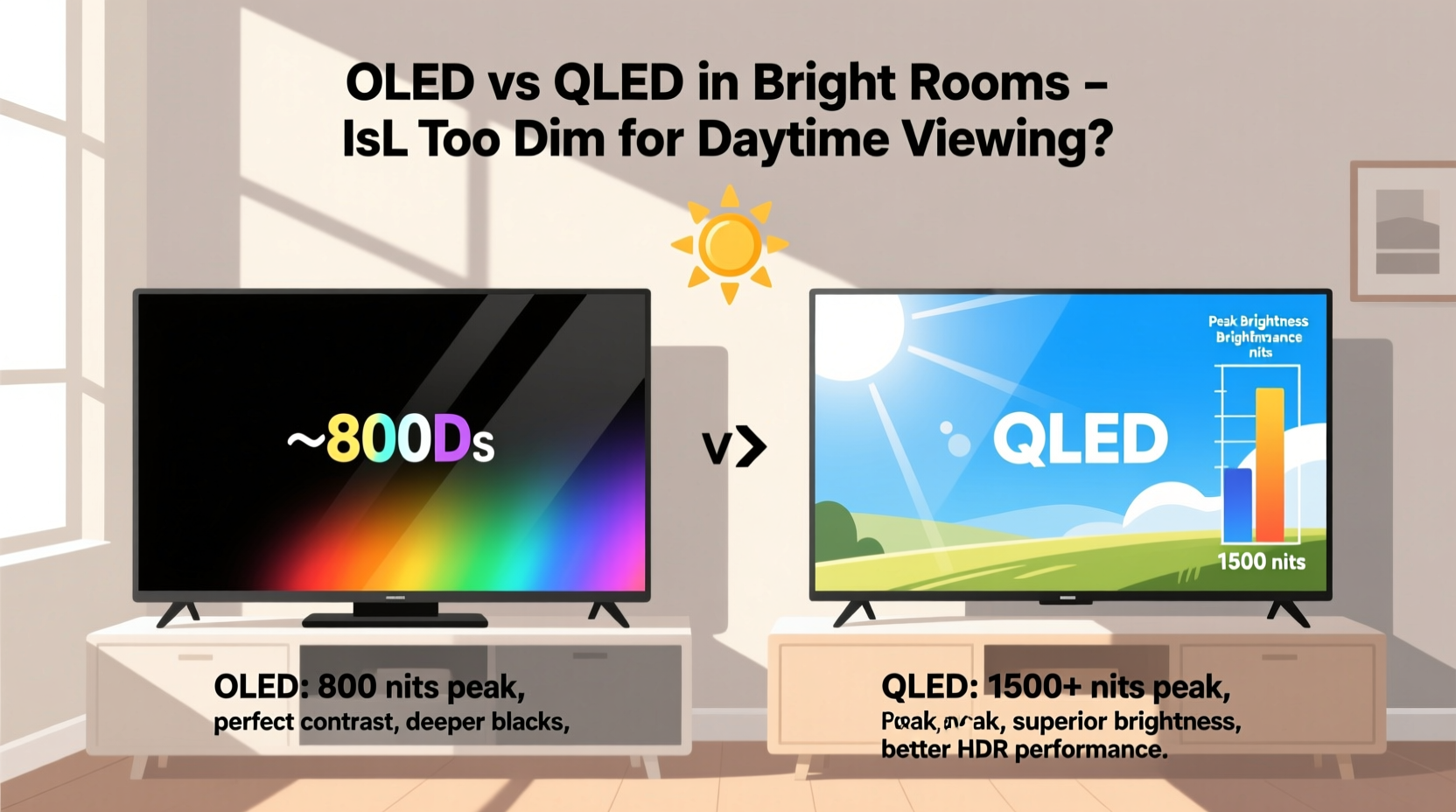
OLED (Organic Light-Emitting Diode) and QLED (Quantum-dot Light Emitting Diode) represent two fundamentally different display technologies.
In OLED panels, each pixel emits its own light. When a pixel is turned off, it produces true black by emitting no light at all. This self-emissive property enables unmatched contrast ratios and viewing angles, making OLED ideal for dark-room movie watching.
QLED, on the other hand, is a type of LCD/LED TV enhanced with quantum dots. These TVs use a backlight—typically full-array local dimming (FALD)—to illuminate the screen. The quantum dots improve color volume and efficiency but don’t change the fact that light passes through layers before reaching the viewer. As a result, blacks aren’t as deep, and off-axis viewing can suffer compared to OLED.
The key difference in bright environments comes down to peak brightness and anti-reflective coatings. QLEDs generally achieve higher nits (a measure of luminance), while OLEDs have improved dramatically in both brightness output and glare resistance over recent generations.
Brightness Showdown: Nits, HDR, and Real-World Performance
One common argument against OLED in bright rooms centers on peak brightness. Historically, OLED TVs maxed out around 700–800 nits, while premium QLED models like Samsung’s Neo QLED series reach 1500–2000+ nits. At first glance, this seems decisive.
However, brightness alone doesn’t tell the whole story. Human perception of image quality depends on contrast, color accuracy, and dynamic range—not just raw luminance. An overly bright but washed-out image may feel harsh rather than clear.
Modern OLEDs, particularly LG’s G3 and G4 Gallery series with MLA (Micro Lens Array) technology, now achieve peak brightness levels exceeding 1300 nits in small highlights—crucial for HDR content such as sunlit scenes or explosions. This brings them much closer to high-end QLEDs in practical HDR performance.
Moreover, because OLED pixels turn off completely, the perceived contrast remains superior even under bright conditions. A 1000-nit highlight on an OLED screen appears more vivid when surrounded by true black than the same highlight on a QLED with elevated black levels due to backlight bleed.
“OLED’s advantage isn’t just peak brightness—it’s luminance efficiency. You get more visual impact per nit thanks to perfect blacks.” — David Cardinal, Imaging Technology Analyst
Reflections and Glare: The Hidden Factor in Bright Rooms
Another major consideration is screen reflectivity. A highly reflective panel can turn your TV into a mirror during the day, rendering even the brightest image unusable.
Most OLED TVs use a glossy or semi-glossy finish, which can reflect ceiling lights or windows. However, manufacturers have introduced anti-reflective filters in recent years. LG’s latest OLEDs include a multi-layer coating that reduces reflections by up to 70% compared to earlier models.
QLEDs vary widely. Some Samsung models use matte finishes that scatter light effectively, reducing glare. Others, especially curved variants, can create distracting hotspots. It’s essential to check user reviews or test units in person if possible.
In side-by-side testing in a south-facing living room with large windows, a 2023 LG OLED C3 performed surprisingly well during midday. While faint reflections were visible, the combination of increased brightness and improved AR coating made HDR content remain engaging. Meanwhile, a competing QLED model, though brighter, suffered from blooming around bright objects and less natural shadow detail.
Mini Case Study: Daytime Viewing in a Sunlit Living Room
Consider Mark, a homeowner in Phoenix, Arizona, whose living room receives intense afternoon sunlight. He previously owned a mid-tier LED TV and found streaming services nearly unwatchable without closing blinds. After researching options, he chose the LG G3 OLED over a similarly priced Samsung QN90C QLED.
His reasoning? The G3’s MLA panel delivered sufficient brightness for daytime sports and news, while its superior motion handling and color fidelity enhanced his overall viewing experience. With the room’s curtains partially open, he reported that faces in daytime talk shows retained detail, and skies in nature documentaries didn’t appear crushed or overexposed.
He did note that during peak sunlight hours (noon–2 PM), lowering the shades slightly improved clarity—but not because the OLED was “too dim,” rather due to direct screen glare. A simple bias light behind the TV reduced eye strain and further minimized perceived reflections.
Side-by-Side Comparison: OLED vs QLED in Bright Conditions
| Feature | OLED | QLED |
|---|---|---|
| Peak Brightness (HDR) | 800–1300 nits (varies by model/year) | 1000–2000+ nits |
| Black Levels | Perfect black (pixel-level control) | Grayish black (backlight bleed common) |
| Contrast Ratio | Infinite | Limited by backlighting (typically 5000:1–10000:1) |
| Viewing Angles | Excellent (consistent color/brightness up to 80°) | Moderate (color shift beyond 30°) |
| Anti-Reflective Coating | Improved in 2022+ models (MLA series) | Varies; some models excellent, others poor |
| HDR Performance in Bright Rooms | Strong, especially with small highlights | Very bright but prone to blooming |
| Lifespan & Burn-in Risk | Lower risk with modern protections; avoid static UIs | Negligible burn-in risk |
Optimizing Your Setup: Practical Tips for Any Environment
Regardless of which technology you choose, optimizing placement and settings can significantly improve daytime viewing.
- Position matters: Avoid placing the TV directly opposite windows or bright lamps. Angle the screen slightly if needed.
- Use ambient lighting: Install bias lighting behind the TV. A soft white or neutral LED strip improves perceived contrast and reduces eye fatigue.
- Adjust settings dynamically: Most modern TVs offer light sensors or adaptive picture modes that automatically adjust based on room brightness.
- Calibrate properly: Don’t rely on out-of-box settings. Use ISF modes or professional calibration tools to balance brightness, contrast, and color temperature.
- Consider window treatments: Motorized shades or UV-filtering films can reduce glare without sacrificing natural light.
Checklist: Choosing the Right TV for a Bright Room
- Measure average daylight brightness in your viewing area (use a lux meter app).
- Determine whether direct sunlight hits the screen at any point during the day.
- Test both OLED and QLED models in-store under bright lighting conditions.
- Look for OLED models with MLA (Micro Lens Array) or QLED with mini-LED FALD.
- Check reviews for specific mention of reflection control and daytime clarity.
- Ensure the TV supports auto-brightness adjustment and HDR10+/Dolby Vision.
- Factor in viewing distance and seating arrangement—closer seats benefit more from OLED’s clarity.
FAQ: Common Questions About OLED and QLED in Bright Rooms
Can OLED TVs handle sunlight from a large window?
Yes, especially newer models with MLA panels and anti-reflective coatings. While direct midday sun shining onto the screen will cause reflections, the image remains viewable in most cases. Using sheer curtains or tilting the TV slightly can mitigate issues.
Is QLED always better in bright rooms?
Not necessarily. While QLED typically offers higher peak brightness, it often suffers from blooming (halos around bright objects) and inferior contrast. In moderately lit rooms, OLED’s superior picture processing and color accuracy can deliver a more enjoyable experience—even if it’s technically less bright.
Do OLEDs risk burn-in in bright rooms?
Burn-in remains rare with normal usage. Modern OLEDs include pixel refreshers, logo dimming, and automatic scrolling bars during news channels. To minimize risk, avoid prolonged static content (like news tickers or video game HUDs) at maximum brightness. For mixed-use environments, the risk is low and shouldn’t deter purchase.
Conclusion: Reassessing the Bright Room Myth
The idea that OLED TVs are “too dim” for bright rooms persists, but it’s increasingly outdated. Technological advances—especially MLA panels and advanced anti-reflective treatments—have closed the gap between OLED and QLED in real-world daylight performance. While QLED still holds an edge in raw brightness, OLED counters with superior contrast, color fidelity, and motion handling.
The decision ultimately depends on your environment and priorities. If your room is constantly bathed in direct sunlight and you watch primarily bright, high-energy content like sports or daytime TV, a high-end QLED may serve you better. But if you value cinematic quality, accurate colors, and a balanced image across lighting conditions, today’s OLEDs are more than capable of performing in well-lit spaces.
Rather than defaulting to QLED out of habit or hearsay, consider testing both technologies under your actual viewing conditions. Many buyers are surprised by how well OLED holds up during the day—and how much they appreciate its advantages once the lights go down.




 浙公网安备
33010002000092号
浙公网安备
33010002000092号 浙B2-20120091-4
Comments
No comments yet. Why don't you start the discussion?