
When choosing a new television, one of the most critical factors—especially if your living room has large windows or strong ambient lighting—is how well the screen performs under bright conditions. Two dominant display technologies dominate today’s premium market: OLED and QLED. While both offer stunning picture quality, their behavior in well-lit environments differs significantly. Understanding these differences can help you make an informed decision that aligns with your viewing environment and priorities.
OLED (Organic Light-Emitting Diode) TVs are renowned for their perfect blacks, infinite contrast ratios, and wide viewing angles. QLED (Quantum-dot Light Emitting Diode), on the other hand, leverages advanced LED backlighting enhanced by quantum dots to deliver exceptional brightness and color volume. But when sunlight floods your space during the day, which technology holds up better?
Brightness and Luminance: The Key Factor in Bright Rooms
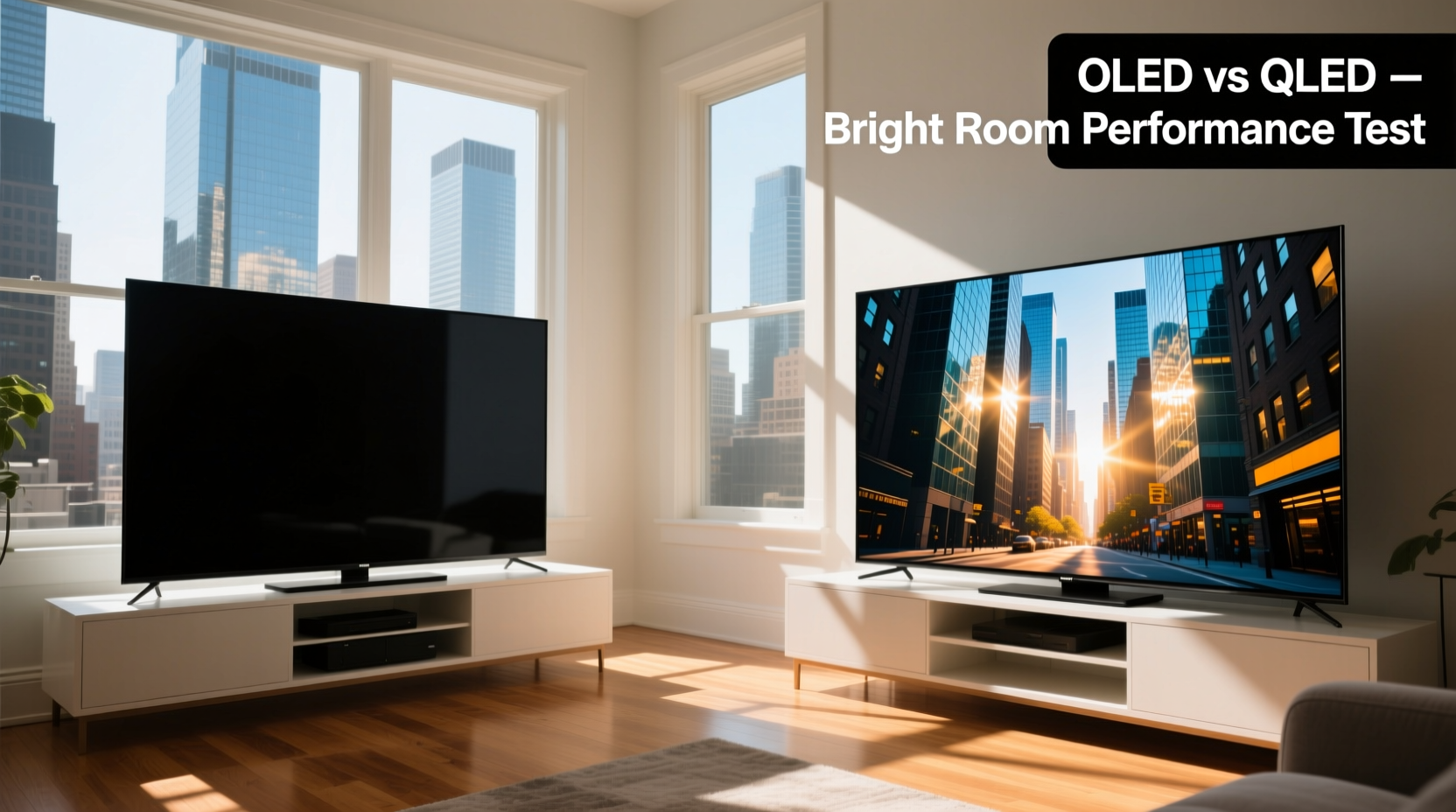
The primary challenge in brightly lit rooms is screen washout—when ambient light overwhelms the image, reducing perceived contrast and dulling colors. This is where peak brightness becomes crucial. QLED TVs generally outperform OLEDs in maximum luminance output.
Most high-end QLED models from Samsung, TCL, and Hisense can achieve sustained brightness levels of 1,000 to 2,000 nits, with some flagship models briefly hitting even higher peaks. This makes them highly effective at combating glare and maintaining visibility in daylight. In contrast, OLED panels typically max out between 600 and 800 nits in full-screen brightness, though small highlight areas (like reflections or bright skies) can reach higher momentarily due to HDR optimization.
This difference is not trivial. In a sunlit room, a QLED TV will often appear sharper, more vibrant, and easier to see from across the room. An OLED, while offering deeper blacks, may struggle to maintain clarity when competing against strong natural light.
Glare and Reflection Handling
Another critical factor is how each panel handles reflections. OLED screens tend to have glossy or semi-gloss finishes, especially on higher-end models, which can act like mirrors in bright environments. Even indirect light from lamps or ceiling fixtures can create distracting reflections that impair visibility.
QLED TVs, particularly those designed for mainstream living rooms, often feature matte or anti-reflective coatings. These surfaces scatter incoming light rather than reflecting it directly back at the viewer. As a result, they perform better in rooms with overhead lighting or near windows.
It's worth noting that newer OLED models, such as LG’s G3 and G4 series, have begun incorporating improved anti-glare filters. However, these enhancements come at a trade-off: slightly reduced color vibrancy and off-axis brightness. For viewers who watch TV during daytime hours regularly, this compromise may not be worth the benefit of perfect blacks.
“While OLED remains the gold standard for cinematic experiences in dark rooms, QLED’s superior brightness and reflection control make it the smarter choice for most real-world living spaces.” — David Chen, Senior Display Analyst at Rtings.com
Contrast and Color Performance Under Ambient Light
One of OLED’s greatest strengths—its ability to turn individual pixels completely off for true black levels—is significantly diminished in bright settings. When ambient light raises the overall luminance of the viewing environment, the perceived contrast drops regardless of the panel’s native capabilities.
In practical terms, this means that while an OLED delivers breathtaking depth in a dimly lit home theater, that same depth vanishes when the blinds are open. Blacks begin to look grayish, shadows lose detail, and the image appears flat compared to its performance in controlled lighting.
QLED compensates for its inability to produce true blacks (since it relies on a backlight) through advanced local dimming zones and high dynamic range processing. Modern mini-LED backlights used in premium QLEDs allow for hundreds or even thousands of dimming zones, enabling precise control over light distribution. While they still can’t match OLED’s per-pixel darkness, their high brightness helps preserve contrast perception in bright scenes.
Additionally, QLED benefits from wider color gamuts thanks to quantum dot technology. These nanocrystals enhance red and green color reproduction, resulting in richer, more saturated visuals—especially noticeable in nature documentaries or sports broadcasts viewed during daylight.
Real-World Example: The Urban Apartment Living Room
Consider Sarah, a marketing professional living in a modern high-rise apartment with floor-to-ceiling windows facing west. Her living room is flooded with afternoon sunlight, making evening viewing pleasant but midday streaming nearly impossible with her old OLED TV. She found herself squinting during lunchtime news or adjusting blinds just to watch a show.
After researching display technologies, she switched to a Samsung Neo QLED QN90C. The change was immediate: the screen remained visible even at peak sunlight, colors stayed punchy, and reflections were minimal thanks to the matte finish. While she missed the deep blacks of her previous set during late-night movie sessions, the improvement in daytime usability far outweighed the trade-off.
Sarah’s experience reflects a growing trend among urban dwellers and families who use their TVs throughout the day. For them, consistent visibility trumps theoretical perfection in ideal conditions.
Comparison Table: OLED vs QLED in Bright Room Conditions
| Feature | OLED | QLED |
|---|---|---|
| Peak Brightness (HDR) | 600–800 nits (small highlights up to 1000+) | 1,000–2,000+ nits |
| Reflection Handling | Moderate to poor (glossy surface); newer models improving | Good (matte/anti-reflective coatings standard) |
| Black Level Performance | Perfect blacks (per-pixel illumination) | Good with local dimming; haloing possible |
| Color Volume in Bright Light | Excellent in dark rooms; fades under glare | Superior in bright environments due to high luminance |
| Viewing Angles | Excellent (consistent color/brightness up to 80°) | Fair to good (color shifts at wide angles) |
| Best For | Dark rooms, cinephiles, night viewing | Bright rooms, daytime use, general entertainment |
Actionable Checklist: Choosing the Right TV for Your Lighting Environment
- Measure daily sunlight exposure in your viewing area (e.g., direct sun for >2 hours?)
- Check TV specifications for peak brightness (aim for ≥1,000 nits in HDR mode)
- Look for anti-reflective or matte screen finishes, especially on QLED models
- Evaluate room layout: Are there overhead lights or reflective surfaces near the TV?
- Determine primary usage times: Mostly daytime? Evening only?
- Test in-store under bright lighting conditions, if possible
- Consider window treatments: Can you install blackout curtains or apply tinted film?
Frequently Asked Questions
Can OLED TVs be used in bright rooms at all?
Yes, but with limitations. OLEDs can perform adequately in moderately lit environments, especially if you control lighting with blinds or shades. However, in consistently bright or sun-drenched spaces, the image may appear washed out due to lower peak brightness and higher reflectivity.
Do all QLED TVs handle brightness the same way?
No. There is significant variation between entry-level and premium QLED models. Look for “mini-LED” backlights and full-array local dimming (FALD) with many zones (500+) for best results. Brands like Samsung (QN90C/QN90D), Sony (X95L), and TCL (Q7/Q8 series) offer top-tier performance.
Is burn-in still a concern with OLED in bright-room usage?
Burn-in risk increases when static elements (like news tickers or logos) are displayed for long periods at high brightness. In bright rooms, users often increase brightness settings, accelerating potential image retention. While modern OLEDs include pixel refreshers and compensation tools, prolonged exposure to static content remains a risk.
Step-by-Step Guide to Optimizing Your TV Choice for Bright Environments
- Assess your room’s lighting pattern: Spend a few days observing when and how much natural and artificial light affects the TV area.
- Determine your viewing schedule: If you primarily watch during daylight or early evening, prioritize brightness and glare resistance.
- Shortlist models based on specs: Filter TVs by peak brightness (≥1,000 nits), anti-reflective coating, and local dimming capability.
- Compare real-world reviews: Use trusted sources like Rtings, CNET, or HDTVTest to see measured data on reflectance and luminance.
- Adjust room setup: Position the TV away from direct sunlight, consider installing dimmable lights, or use sheer curtains to diffuse light.
- Calibrate after purchase: Enable HDR modes, adjust brightness and ambient light sensors, and disable unnecessary oversaturation presets.
Final Verdict: Which Technology Wins for Bright Rooms?
Despite OLED’s technical superiority in contrast and black levels, QLED emerges as the more practical and effective choice for bright-room viewing. Its higher peak brightness, superior reflection management, and consistent color delivery under ambient light make it better suited for real-world living environments where lighting cannot always be controlled.
That said, the decision ultimately depends on your lifestyle. If you mostly watch movies at night in a dimmed room, OLED’s cinematic quality is unmatched. But if your TV serves as a daytime hub for news, sports, or family viewing, QLED offers greater reliability and visual comfort.
Hybrid solutions are also emerging. Some manufacturers are developing OLED panels with brighter emission layers (such as LG’s MLA—Micro Lens Array—technology), narrowing the gap between the two technologies. However, these models remain expensive and still fall short of QLED’s overall luminance in full-field scenes.
Conclusion and Next Steps
Selecting between OLED and QLED isn’t just about specs—it’s about matching technology to your actual viewing habits and environment. In bright rooms, where visibility and clarity matter most, QLED’s advantages in brightness and reflection control give it a decisive edge. You don’t need the theoretically perfect display; you need the one that works best every day.
Before making a purchase, test models side by side under conditions similar to your own. Read verified user reviews focused on daytime performance. And remember: the best TV is the one you can enjoy clearly, comfortably, and consistently—no matter the time of day.




 浙公网安备
33010002000092号
浙公网安备
33010002000092号 浙B2-20120091-4
Comments
No comments yet. Why don't you start the discussion?