
Choosing the right TV for a bright living room is more than just about screen size or smart features—it’s about visibility, contrast, and comfort during daytime viewing. With natural light pouring in from windows and artificial lighting adding to ambient brightness, many high-end televisions struggle to maintain clarity and color accuracy. Two leading display technologies—OLED and QLED—are often pitted against each other, but when it comes to well-lit environments, one tends to pull ahead. Understanding the core differences in how these panels handle light, reflection, and brightness is key to making an informed decision.
How OLED and QLED Work: A Fundamental Difference
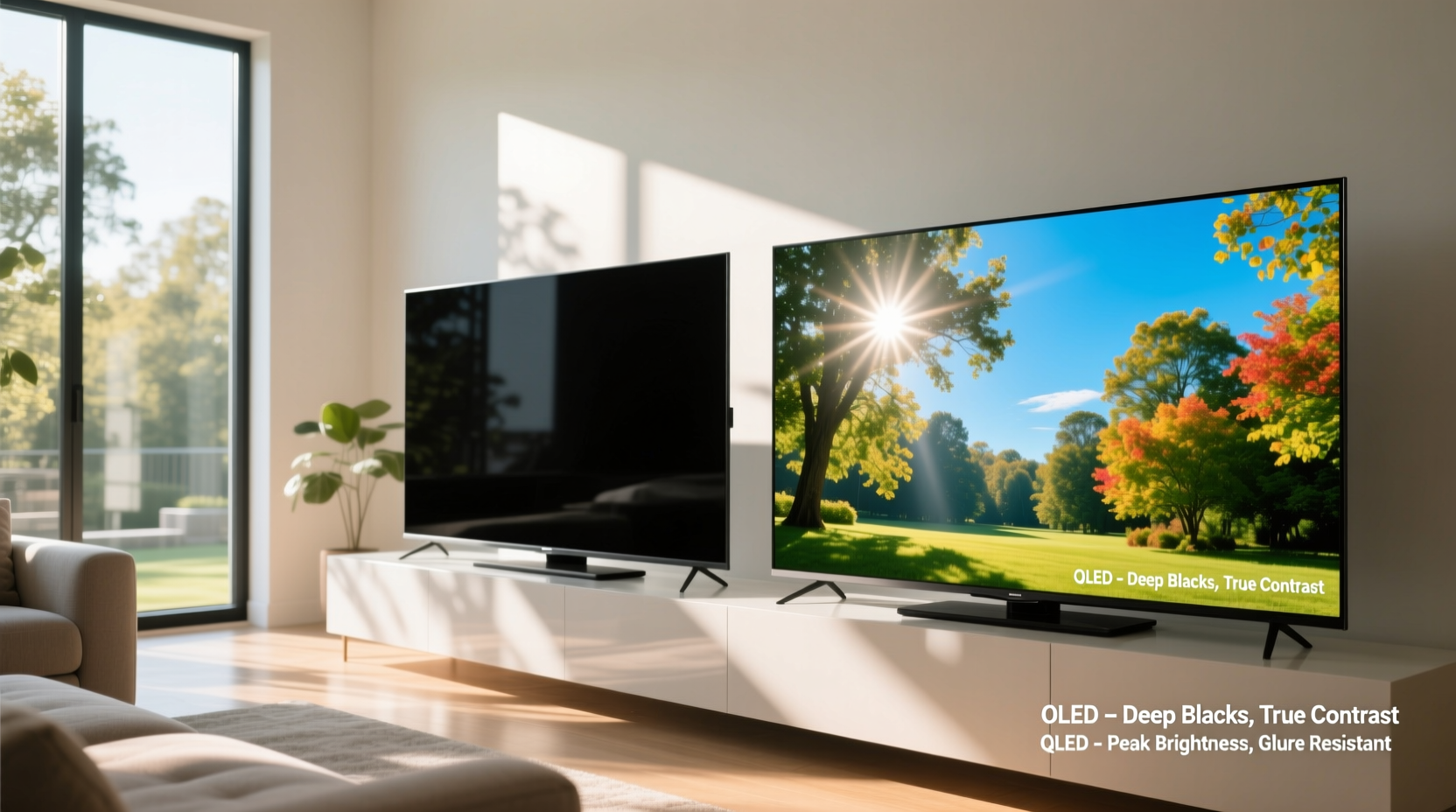
OLED (Organic Light-Emitting Diode) and QLED (Quantum-dot Light Emitting Diode) represent fundamentally different approaches to image creation. In OLED TVs, each pixel produces its own light. When a pixel needs to display black, it turns off completely, resulting in perfect blacks and infinite contrast. This self-emissive nature allows for stunning depth and cinematic quality in dark rooms.
QLED, on the other hand, is a type of LCD/LED TV that uses a quantum dot layer to enhance color and brightness. Unlike OLED, QLED relies on a backlight—typically full-array local dimming (FALD) or edge-lit—to illuminate the screen. The quantum dots improve color volume and efficiency, but they don’t emit light independently. Instead, they filter and refine the light from the backlight to produce vibrant hues.
This foundational distinction has direct implications for performance in bright environments. While OLED excels in contrast and viewing angles, QLED generally achieves higher peak brightness levels—often exceeding 1,500 nits on premium models—making it better equipped to combat glare and washout in sunlit spaces.
Brightness and Reflection: The Daytime Viewing Challenge
In a bright room, two factors dominate picture quality: screen brightness and reflectivity. Even the most color-accurate TV will look washed out if it can't compete with ambient light. Brightness is measured in nits, and for comfortable daytime viewing, experts recommend at least 500–700 nits for moderate lighting and over 1,000 nits for very bright conditions.
Premium QLED models, such as Samsung’s Neo QLED series, regularly achieve peak brightness levels between 1,500 and 2,000 nits thanks to powerful backlights and advanced anti-reflection coatings. These sets are engineered specifically for environments where HDR content must remain vivid even under harsh lighting.
OLED TVs, while improving with newer panels like LG’s MLA (Micro Lens Array) and G3/G4 series, typically max out around 800–1,000 nits in small highlight areas. While this is sufficient for some scenes, sustained full-screen brightness remains lower than top-tier QLEDs. Additionally, OLED panels tend to have slightly more reflective surfaces, which can make them prone to mirror-like reflections of windows or lamps—especially problematic in daytime use.
“While OLED offers unmatched contrast, its lower peak brightness makes QLED the more practical choice for brightly lit living rooms.” — David Chen, Senior Display Analyst at Rtings.com
Contrast and Color: Where OLED Shines (Even in Sunlight)
Despite its limitations in brightness, OLED still holds advantages in image quality. Its ability to turn individual pixels off results in true blacks and infinite contrast ratios. This means that even in a bright room, dark scenes in movies or shadow details in games remain clearly defined without blooming or grayish blacks—a common issue with LCD-based QLEDs.
Color accuracy on high-end OLEDs is also exceptional, with wide color gamut coverage and smooth gradients. Because there's no backlight to unevenly illuminate the screen, colors appear consistent across the entire panel, even at extreme viewing angles. This is particularly beneficial in open-concept homes where seating may not be directly centered.
However, in very bright conditions, these strengths can be overshadowed. A sunlit room floods the screen with ambient light, reducing perceived contrast regardless of the panel’s native capabilities. No matter how deep the black, if the room adds 300+ nits of reflected light, the image loses punch. This is where QLED’s brute-force brightness becomes a decisive advantage.
Real-World Example: Living Room Setup Comparison
Consider Sarah, who recently upgraded her entertainment system in a south-facing apartment with large floor-to-ceiling windows. She watched a demo of both an LG C3 OLED and a Samsung QN90C QLED side by side during midday.
On the OLED, she noticed rich colors and excellent detail in dark scenes from a thriller series. However, when switching to a nature documentary with bright skies and snowy landscapes, the image appeared slightly dimmer and less impactful. Reflections from the window were clearly visible on the screen, creating a distracting mirror effect.
The QLED, by contrast, made the snowscapes pop with intense luminance. Even with direct sunlight hitting the screen, the image remained sharp and vibrant. Blacks weren’t as deep, and some backlight blooming was visible around bright objects on dark backgrounds, but overall, the picture felt more dynamic and easier to enjoy without closing the blinds.
Sarah ultimately chose the QLED for her setup, prioritizing usability throughout the day over absolute perfection in darkness. Her experience reflects a common trade-off faced by consumers in similar environments.
Anti-Reflection Technologies: What to Look For
Manufacturers have responded to the challenge of bright rooms with advanced anti-reflective coatings. LG’s latest OLED models feature improved filters that reduce reflections by up to 60% compared to older versions. Samsung’s QLEDs often include matte anti-glare layers that scatter incoming light rather than reflecting it sharply.
When shopping, check reviews for measurements of reflectivity (expressed as a percentage). A lower number means less mirror-like behavior. Premium QLEDs typically score between 1.5%–2.5%, while standard OLEDs used to hover around 4%–5%. Newer OLEDs with MLA and anti-reflective treatments now reach ~2.8%, narrowing the gap—but still not matching the best QLEDs.
Additionally, consider your room layout. A TV placed opposite a window will face more reflection issues than one positioned beside or adjacent to light sources. Tilting mounts or adjustable stands can help minimize glare, regardless of panel type.
Key Features Compared: OLED vs QLED for Bright Rooms
| Feature | OLED | QLED |
|---|---|---|
| Peak Brightness (Full Screen) | ~500–700 nits | ~800–1,500+ nits |
| Peak Brightness (Small Highlights) | ~800–1,000 nits (MLA models higher) | ~1,500–2,000 nits |
| Native Contrast Ratio | Infinite (perfect blacks) | Limited by backlight (~5,000:1 typical) |
| Reflectivity | Moderate to High (improving with new models) | Low to Moderate (better anti-glare coatings) |
| Viewing Angles | Excellent (color/brightness consistent off-axis) | Fair to Good (color shift at angles) |
| HDR Performance in Bright Rooms | Good, but limited by brightness ceiling | Excellent (high brightness sustains impact) |
| Best For | Dark or controlled lighting environments | Bright rooms, daytime viewing, sunny spaces |
Actionable Checklist: Choosing the Right TV for Your Bright Room
- Evaluate your lighting: Note when and how much natural light enters the room. Use a light meter app or observe screen reflections at different times of day.
- Test in real conditions: If possible, view demo units during daylight hours in a showroom with similar lighting.
- Look for high peak brightness: Aim for 1,000 nits or more, especially if you watch HDR content.
- Check anti-reflective coating specs: Search for terms like “anti-glare,” “low-reflection,” or “matte finish” in product descriptions.
- Consider room layout: Position the TV to avoid direct reflections from windows or overhead lights.
- Review professional lab tests: Consult sites like Rtings.com or HDTVTest for objective measurements of brightness and reflectivity.
- Balance priorities: If you value cinematic quality over daytime usability, OLED may still suit you—even with compromises.
FAQ: Common Questions About OLED and QLED in Bright Rooms
Can OLED TVs work in bright rooms at all?
Yes, especially newer models with MLA (Micro Lens Array) technology that boost brightness and reduce reflections. However, they still fall short of top QLEDs in sustained luminance and glare resistance. If you can control lighting with blinds or shades, OLED remains viable.
Do QLEDs suffer from burn-in like OLEDs?
No. QLEDs are based on LCD technology and do not experience permanent burn-in. They can exhibit temporary image retention under rare conditions, but this fades quickly. This makes QLED a safer choice for users who frequently display static content like news tickers or video game HUDs.
Is there a hybrid option that combines the best of both?
Mini-LED QLEDs come close. By using thousands of tiny LEDs in the backlight, they achieve better local dimming and contrast than traditional LED-LCDs, narrowing the gap with OLED. Some models, like Samsung’s Neo QLED or TCL’s QM8, offer near-OLED contrast with far superior brightness—ideal for mixed lighting conditions.
Step-by-Step Guide: Optimizing Your TV Settings for Daytime Viewing
- Select the correct picture mode: Choose \"Bright Room,\" \"Vivid,\" or \"Dynamic\" mode as a starting point. These prioritize brightness and clarity over cinematic accuracy.
- Increase backlight or brightness setting: On QLED, raise the backlight slider to maximum or near-maximum. On OLED, increase the \"Brightness\" or \"OLED Light\" control based on content.
- Adjust ambient light sensors: Enable auto-brightness if available. Many modern TVs adjust output based on room lighting.
- Reduce motion smoothing (optional): While \"Soap Opera Effect\" settings boost clarity, they alter the intended look of content. Turn off unless preferred.
- Use HDR modes wisely: Ensure HDR tone mapping is set to \"Bright Room\" or \"High Brightness\" to preserve detail in highlights.
- Calibrate color temperature: Slightly cooler tones (6500K–7500K) can improve perceived sharpness in daylight.
- Re-evaluate after sunset: Switch back to \"Cinema\" or \"Standard\" mode at night to restore natural contrast and avoid eye strain.
Final Verdict: Which Technology Wins for Daytime Viewing?
For bright rooms, QLED technology currently holds the upper hand. Its superior peak brightness, lower reflectivity, and resistance to ambient light interference make it the more reliable performer during daytime hours. While OLED continues to innovate with brighter panels and better coatings, it remains fundamentally constrained by its self-emissive design, which limits total luminance output.
That said, the choice isn’t purely technical—it’s also personal. If you spend more evenings watching films in dimmed lighting, OLED’s perfect blacks and cinematic realism may justify its limitations. But if your TV is on throughout the day, used for streaming, sports, or family viewing in a sunlit space, QLED delivers a consistently clearer, more vibrant picture without requiring environmental adjustments.
Ultimately, the best TV is the one that fits your lifestyle. Don’t let marketing narratives dictate your decision. Test, compare, and prioritize real-world performance over spec-sheet ideals.




 浙公网安备
33010002000092号
浙公网安备
33010002000092号 浙B2-20120091-4
Comments
No comments yet. Why don't you start the discussion?