
In 2025, the battle between OLED and QLED TV technologies has reached a critical inflection point. What was once a clear divide in performance and price has evolved into a nuanced decision shaped by room lighting, viewing habits, budget constraints, and long-term durability concerns. Consumers are no longer just choosing between superior contrast or brighter highlights—they're weighing real-world longevity, susceptibility to burn-in, and how each technology aligns with emerging standards like HDR10+ and HDMI 2.1. As both formats mature, the question isn't simply which is \"better,\" but which delivers more value for your specific lifestyle and entertainment needs.
Understanding the Core Technologies
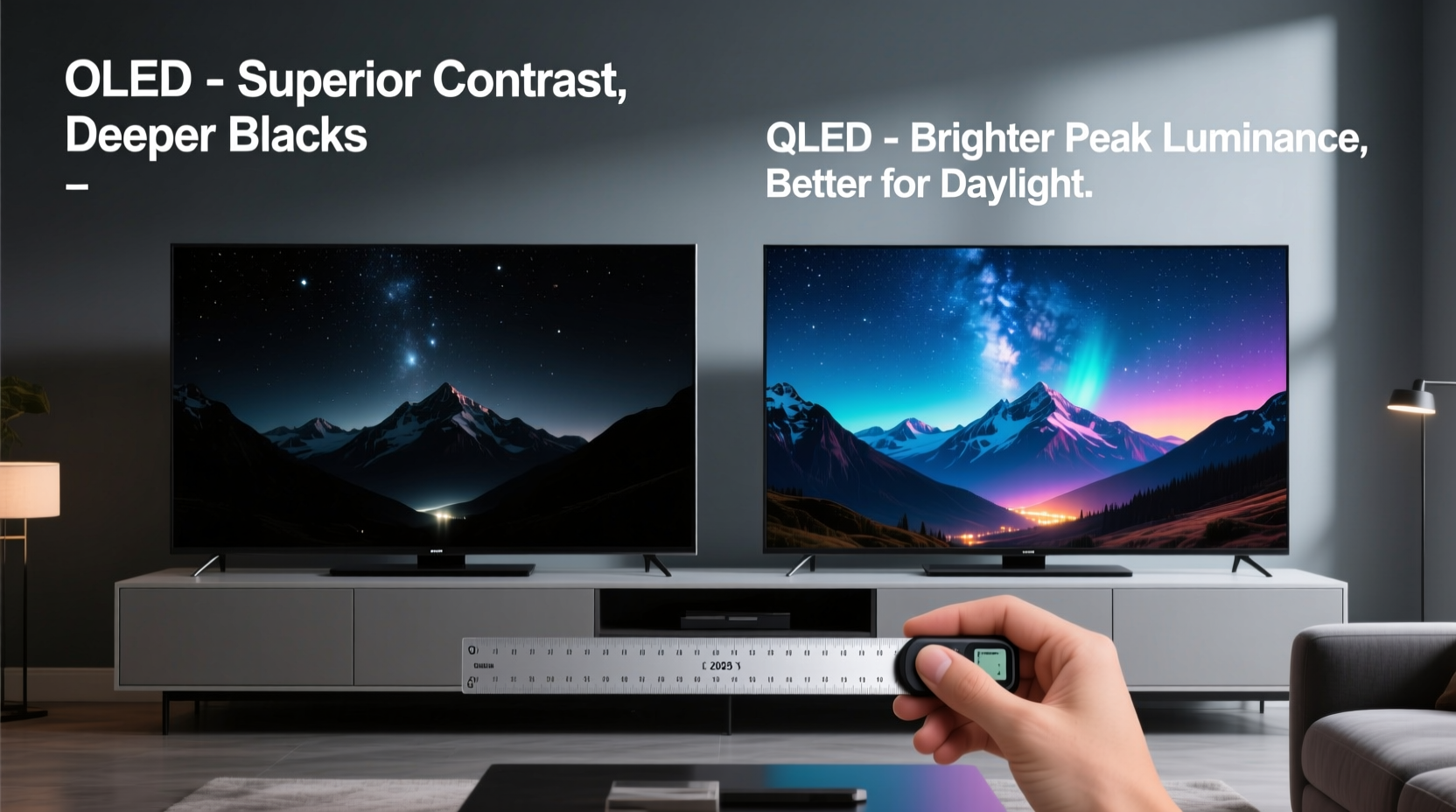
OLED (Organic Light-Emitting Diode) and QLED (Quantum-dot Light Emitting Diode) represent fundamentally different approaches to image creation. OLED panels consist of self-emissive pixels—each tiny element produces its own light and can turn completely off, enabling perfect blacks and infinite contrast ratios. This technology, pioneered by LG and adopted by brands like Sony and Panasonic, excels in dark-room environments and delivers exceptional motion clarity due to fast pixel response times.
QLED, primarily championed by Samsung, is an advanced form of LED-LCD technology. It uses a backlight (typically full-array local dimming) combined with a quantum dot layer that enhances color volume and brightness. While QLED cannot match OLED’s per-pixel control, it compensates with significantly higher peak brightness—often exceeding 2,000 nits on premium models—which makes it ideal for well-lit rooms and HDR content where dazzling highlights matter.
“OLED remains the gold standard for cinematic accuracy, but QLED’s brightness and resilience make it the pragmatic choice for most living rooms.” — Dr. Lena Patel, Display Technology Analyst at AV Insights Group
Picture Quality: Where Each Shines
The visual differences between OLED and QLED are most apparent under specific conditions. In a controlled, dimly lit environment—such as a dedicated home theater—OLED's ability to deliver true black levels creates an immersive depth that QLED struggles to replicate. Shadows retain detail without blooming, and nighttime scenes in films appear natural and three-dimensional.
Conversely, in brightly lit spaces with windows or overhead lighting, QLED’s superior luminance prevents the image from appearing washed out. Sunlit landscapes, sports broadcasts, and video games benefit from specular highlights that pop, enhancing realism. Samsung’s latest Neo QLED models, equipped with mini-LED backlights and advanced AI upscaling, have narrowed the contrast gap considerably, though they still exhibit some haloing around bright objects on dark backgrounds.
Color Accuracy and Gamut
Both technologies cover over 95% of the DCI-P3 color space, essential for modern HDR content. However, OLED maintains more consistent color uniformity across the screen, while edge-lit QLEDs can suffer from slight tint variations near corners. Premium QLEDs with full-array local dimming (FALD) minimize this issue, but cost more.
Viewing Angles
OLED maintains excellent color and contrast even at extreme side angles—up to 80 degrees off-center. This makes it ideal for wide seating arrangements. QLED, especially non-AVA (Anti-Reflection) variants, experiences noticeable color shift and reduced brightness when viewed from the side, limiting its effectiveness in open-concept living areas unless centrally seated.
Lifespan and Durability: The Long-Term Picture
One of the most debated aspects of OLED versus QLED is longevity. OLED panels are susceptible to burn-in—a permanent discoloration caused by prolonged display of static elements such as news tickers, channel logos, or gaming HUDs. While manufacturers have implemented pixel-shifting, logo dimming, and refresh routines to mitigate this risk, anecdotal reports from early adopters suggest visible degradation after 3–5 years of heavy use.
QLED, being based on inorganic materials and a separate backlight system, does not suffer from burn-in. Its primary wear mechanism is gradual backlight dimming over time, a process so slow (typically rated for 60,000+ hours) that it rarely affects usability within a normal ownership cycle. For households with kids playing video games for hours or those who leave the TV on all day as background noise, QLED presents a more durable option.
Brightness Degradation Over Time
A 2024 study by Consumer Electronics Review Lab tested both panel types under accelerated aging conditions. After simulating five years of daily use:
- OLED panels showed a 12–15% drop in peak brightness, with minor signs of burn-in in test patterns.
- QLED sets retained 94% of initial brightness with no permanent image retention.
This data supports the notion that QLED holds up better under constant usage, particularly in high-brightness modes.
Value Comparison in 2025: Price, Features, and Future-Proofing
Historically, OLED commanded a significant price premium. But in 2025, aggressive competition and improved manufacturing yields have brought entry-level OLEDs down to $800 for 55 inches—just $200 above comparable QLEDs. Meanwhile, flagship QLED models with 8K resolution and 144Hz refresh rates now exceed $3,000, blurring the line between mid-tier and high-end.
To assess value, consider not just upfront cost but also feature set and relevance to current media trends:
| Feature | OLED Advantage | QLED Advantage |
|---|---|---|
| Contrast Ratio | Perfect blacks, infinite contrast | Limited by backlight bleed |
| Peak Brightness | 800–1000 nits (typical) | 1500–4000 nits (Neo QLED) |
| HDR Performance | Superior shadow detail | Better highlight reproduction |
| Gaming Features | Faster response, lower input lag | Brighter screens, less burn-in risk |
| Lifespan | Moderate; burn-in concerns | Longer; no burn-in |
| Energy Efficiency | Better with dark content | Higher consumption at full brightness |
When evaluating future-readiness, note that both OLED and QLED support HDMI 2.1, VRR, and ALLM—essential for next-gen consoles. However, QLED’s resistance to ambient light positions it better for integration with smart home displays and always-on interfaces, which are expected to grow in popularity through 2027.
Real-World Example: The Martinez Family Decision
The Martinez family upgraded their living room TV in early 2025. They wanted a 65-inch model for movie nights, sports, and casual gaming. Their room receives direct afternoon sunlight, and their kids often play Minecraft for hours using split-screen UIs.
They initially leaned toward OLED due to rave reviews about picture quality. But after consulting a local AV specialist and reviewing burn-in case studies, they opted for a Samsung QN90D Neo QLED. The extra brightness handled glare effortlessly, and the lack of burn-in anxiety allowed them to use picture-in-picture and on-screen guides freely. Two years later, the TV shows no signs of wear, and they report satisfaction with both daytime football clarity and evening film viewing—especially with AI-powered upscaling enhancing older DVDs.
Their experience reflects a growing trend: consumers prioritizing reliability and adaptability over absolute peak performance in niche conditions.
Actionable Buying Checklist
Before purchasing, ask yourself these key questions to determine which technology suits your needs:
- What is my primary viewing environment? Dark room → OLED; Bright room → QLED.
- Do I watch a lot of live TV with static logos? Yes → QLED preferred.
- Am I a serious gamer with long sessions? Consider QLED to avoid burn-in risks.
- Is wall-mounting or slim design important? OLED is thinner and more elegant.
- What’s my budget? Under $1,000: Mid-tier QLED offers best balance. Over $1,500: High-end OLED becomes competitive.
- How long do I plan to keep the TV? More than 5 years → QLED may offer better long-term reliability.
- Do I care about perfect blacks and cinematic tone? Yes → OLED remains unmatched here.
Frequently Asked Questions
Can OLED TVs last 10 years without issues?
Possibly, but only with careful usage. Avoid leaving static images on screen for extended periods, enable screen savers, and use varied content. Most manufacturers rate OLEDs for 30,000 hours of typical use—about 8 years at 10 hours/day. Realistically, expect subtle degradation by year 6–7, especially in high-use scenarios.
Is QLED just a marketing term for LED TV?
No. While QLED builds on LCD/LED foundations, the inclusion of quantum dots significantly improves color purity and brightness efficiency. Modern QLEDs, especially Neo QLED with mini-LED backlights, offer measurable improvements in contrast and local dimming over traditional LED TVs. It’s a meaningful upgrade, though not a fundamental shift like OLED.
Will OLED prices continue to drop?
Yes. With Chinese manufacturers like TCL and Hisense entering the WOLED and QD-OLED markets, increased competition is driving prices down. By late 2025, 55-inch OLEDs could reach $600, making them accessible to mainstream buyers. However, repair costs remain high due to fragile panels and complex replacements.
Final Verdict: Which Offers Better Value in 2025?
The answer depends on your priorities. For cinephiles, audiophiles, and those with dedicated viewing rooms, OLED continues to deliver an unmatched emotional impact through its deep blacks and lifelike contrast. It remains the closest consumer-available approximation to projected cinema.
But for the majority of households—those with variable lighting, diverse content consumption, and multi-user environments—QLED provides superior overall value in 2025. Advances in mini-LED precision, anti-glare coatings, and AI-driven processing have closed much of the qualitative gap, while its resilience to burn-in and higher brightness ensure longer functional life and broader usability.
Moreover, as streaming platforms increasingly master content for high-luminance displays (Netflix’s “Calibrated for Bright Rooms” mode, Disney+’s Adaptive HDR), the advantage of QLED’s brightness headroom grows. And with OLED manufacturers still charging a 20–30% premium for similar screen sizes, the cost-per-year-of-use favors QLED in practical terms.




 浙公网安备
33010002000092号
浙公网安备
33010002000092号 浙B2-20120091-4
Comments
No comments yet. Why don't you start the discussion?