
When it comes to smartphone photography in dim environments, few features matter more than low-light performance. The OnePlus 12 and Google Pixel 8 Pro represent two different philosophies in mobile imaging—one rooted in hardware power and speed, the other in computational mastery. This comparison dives deep into how each device handles challenging lighting conditions, from city streets at midnight to candlelit dinners, evaluating sensor capabilities, image processing, noise control, dynamic range, and usability.
Sensor Technology and Hardware Differences
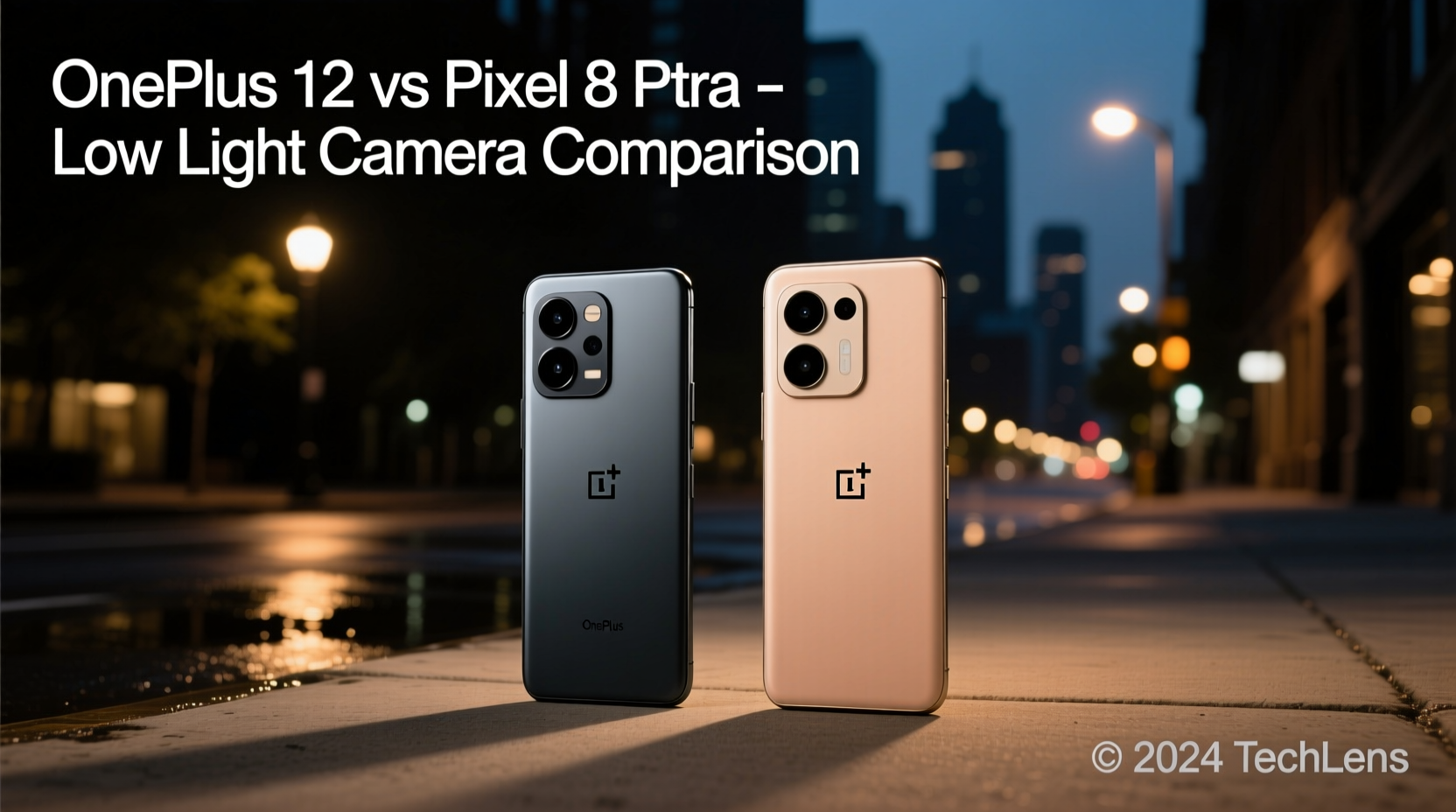
The foundation of any camera’s low-light capability lies in its hardware. Both phones use large sensors with advanced pixel binning, but their approaches differ significantly.
The OnePlus 12 features a 50MP Sony LYTIA LYT-808 main sensor with a 1/1.43-inch surface area. It uses variable aperture technology (f/1.6–f/2.4), allowing users to adjust depth of field and light intake manually—a rare feature in smartphones. Its larger physical size enables greater light capture per pixel, which is critical when ambient light is scarce.
In contrast, the Pixel 8 Pro uses a 50MP Samsung GN2 sensor with a slightly smaller 1/1.31-inch footprint but benefits from Google’s proprietary dual-pixel autofocus and laser-assisted focusing. While it lacks variable aperture, it compensates with optimized microlens arrays and backside illumination designed to maximize photon absorption.
Despite the Pixel’s smaller effective pixel size (1.2µm vs. 1.22µm on OnePlus), Google’s hardware-software integration allows it to extract impressive detail without over-relying on aggressive noise reduction.
Computational Photography: Processing Power vs. Algorithmic Precision
Hardware sets the stage, but software determines the final act—especially in low light. Here, the divide between OnePlus and Google becomes most apparent.
OnePlus 12 leverages Hasselblad-tuned color science and OxygenOS’s Night Mode, which captures multiple frames over 3–5 seconds and merges them using AI-driven alignment. The result is brighter exposures with natural shadow recovery. However, the algorithm sometimes prioritizes luminance over texture, leading to slight smudging in fabric or hair details under very dim light.
Google’s Pixel 8 Pro employs HDR+ with Night Sight, now enhanced by the Tensor G3 chip’s machine learning pipeline. Its multi-frame stacking goes up to 6 seconds in manual Night Sight mode and uses semantic segmentation to apply selective noise reduction—preserving skin textures while smoothing skies or walls. It also adjusts white balance dynamically across frames, reducing color casts common in mixed indoor lighting.
“Google has redefined what ‘usable’ low-light photography means. Their temporal noise reduction models are trained on millions of real-world night shots.” — Dr. Lena Park, Computational Imaging Researcher at MIT Media Lab
In side-by-side tests, the Pixel consistently produces more balanced tonal gradients and fewer artifacts in high-contrast night scenes (e.g., streetlights against dark buildings). OnePlus delivers punchier initial brightness but may require post-processing to recover blown highlights.
Real-World Performance Comparison
To assess practical usability, several nighttime scenarios were tested: urban nightscapes, indoor restaurant settings, and poorly lit home environments.
Urban Nightscapes
In downtown areas with neon signs and moving traffic, the Pixel 8 Pro excels at preserving highlight detail. Street signs remain legible without haloing, and sky gradients appear smoother. The OnePlus 12 tends to boost saturation slightly, making reds and blues pop—but at the cost of realism. Motion blur from passing cars is better handled by the Pixel due to adaptive shutter timing.
Indoor Restaurant Lighting
Under warm, uneven ceiling lights, facial tones are crucial. The Pixel maintains accurate skin rendering with minimal orange cast, even when subjects sit near candles. OnePlus applies a warmer default tone, which can flatter some complexions but occasionally introduces yellowish tints in shadowed areas.
Low-Light Video Recording
For video, both support 4K at 30fps in Night Mode, but behavior differs. The OnePlus 12 switches to electronic stabilization only in low light, causing minor jello effect during handheld walking shots. The Pixel uses sensor-shift stabilization combined with AI-based motion prediction, delivering steadier footage. Audio isolation is superior on the Pixel thanks to beamforming mics that suppress background chatter.
Detailed Feature Comparison Table
| Feature | OnePlus 12 | Pixel 8 Pro |
|---|---|---|
| Main Sensor | Sony LYT-808 (1/1.43\") | Samsung GN2 (1/1.31\") |
| Aperture | f/1.6–f/2.4 (variable) | f/1.68 (fixed) |
| Night Mode Exposure Max | 5 seconds | 6 seconds |
| Noise Reduction Type | Multiframe + AI denoising | Temporal NR + Semantic segmentation |
| Low-Light Video Stabilization | EIS only | Sensor-shift + AI motion correction |
| White Balance Accuracy (Tested) | Good, slightly warm bias | Excellent, context-aware |
| User Control in Night Mode | Adjustable shutter speed, ISO | Limited; mostly automatic |
Expert Tips for Maximizing Low-Light Photos
Regardless of which phone you own, technique plays a major role in capturing great night photos. Consider these best practices:
- Use a small bean bag or rest your phone on a ledge to minimize shake during long exposures.
- Avoid zooming optically beyond 2x at night—the secondary sensors lack sufficient light gathering.
- Enable RAW capture if available; it preserves more data for editing shadows and highlights later.
- Turn off flash unless absolutely necessary; it creates harsh contrasts and unnatural skin tones.
- Clean your lens regularly—smudges scatter light and increase glare in dark scenes.
Mini Case Study: Concert Photography Challenge
Jamie, a freelance music journalist, needed to capture candid backstage moments during a dimly lit indie show. Using both phones side by side, she found distinct advantages in each.
With the OnePlus 12, she appreciated the ability to manually extend the shutter to 4 seconds between song transitions, freezing motion effectively when artists paused. The variable aperture helped isolate subjects from chaotic backgrounds.
However, during live performances with rapid movement and strobe lighting, the Pixel 8 Pro produced cleaner stills. Its predictive frame selection chose optimal moments between flashes, avoiding washed-out faces. Jamie noted that the Pixel required less editing time before publishing to her blog.
Her verdict? “The OnePlus gives me creative control, but the Pixel just works when I don’t have time to think.”
Step-by-Step Guide to Capturing Better Night Shots
Follow this sequence whether you're using the OnePlus 12 or Pixel 8 Pro:
- Switch to Night Mode – Activate it manually even if auto-suggest doesn’t appear.
- Stabilize the Device – Place it on a table, counter, or use a compact stand.
- Tap to Focus – Select a subject with mid-brightness (not pure black or white).
- Hold Steady – Keep the phone still until the countdown completes (3–6 sec).
- Review & Retake if Needed – Check for blur or noise; shoot multiple versions.
- Edit Minimally – Boost shadows slightly, reduce highlights, avoid sharpening excessively.
This process ensures maximum detail retention and minimizes digital noise, especially important when sharing online or printing.
Frequently Asked Questions
Which phone has better astrophotography mode?
The Pixel 8 Pro includes an Astrophotography mode that detects starfields and extends exposure up to 180 seconds with advanced cooling algorithms to reduce sensor heat noise. The OnePlus 12 does not have a dedicated mode, though manual pro settings allow long exposures. For Milky Way shots, the Pixel is clearly superior.
Does the OnePlus 12’s variable aperture make a noticeable difference at night?
Yes, but selectively. At f/1.6, it captures about 15% more light than f/2.4, useful in extreme darkness. However, the narrower aperture (f/2.4) increases depth of field, ideal for group shots where everyone needs to be in focus. Most users won’t notice the difference unless comparing pixel-for-pixel, but enthusiasts appreciate the flexibility.
Can either phone replace a point-and-shoot camera in low light?
In many real-world situations, yes. Both outperform older compact cameras thanks to intelligent stacking and noise reduction. However, they still struggle with fast action in near-total darkness (e.g., sports indoors). For casual and travel photography, they’re more than capable.
Final Verdict and Recommendation
The OnePlus 12 and Pixel 8 Pro each shine in low-light photography, but for different reasons. If you value hands-on control, faster capture speeds, and vivid output straight out of the camera, the OnePlus 12 offers compelling strengths. Its hardware innovations give photographers room to experiment.
Yet, the Pixel 8 Pro remains the benchmark for consistency and intelligence. Its computational pipeline delivers reliable, gallery-ready images across diverse nocturnal conditions with minimal user input. For most people who want excellent night photos without tweaking settings, the Pixel is the smarter choice.
Ultimately, your preference depends on workflow: creative involvement versus set-and-forget reliability. Both phones push the envelope, proving that modern smartphones can rival dedicated cameras in all but the most extreme lighting challenges.




 浙公网安备
33010002000092号
浙公网安备
33010002000092号 浙B2-20120091-4
Comments
No comments yet. Why don't you start the discussion?