
When flagship smartphones from two major brands go head-to-head—especially in the $1,000+ range—the decision becomes less about raw specs and more about real-world value. The OnePlus 8 Pro and Samsung Galaxy S20 Ultra were both released in early 2020 as top-tier Android devices, but they represent different philosophies. OnePlus emphasizes speed, simplicity, and value; Samsung leans into innovation, versatility, and ecosystem integration. So, is spending nearly $300 more on the S20 Ultra truly justified? Let’s break it down across key categories to help you decide where your money goes further.
Design and Build Quality
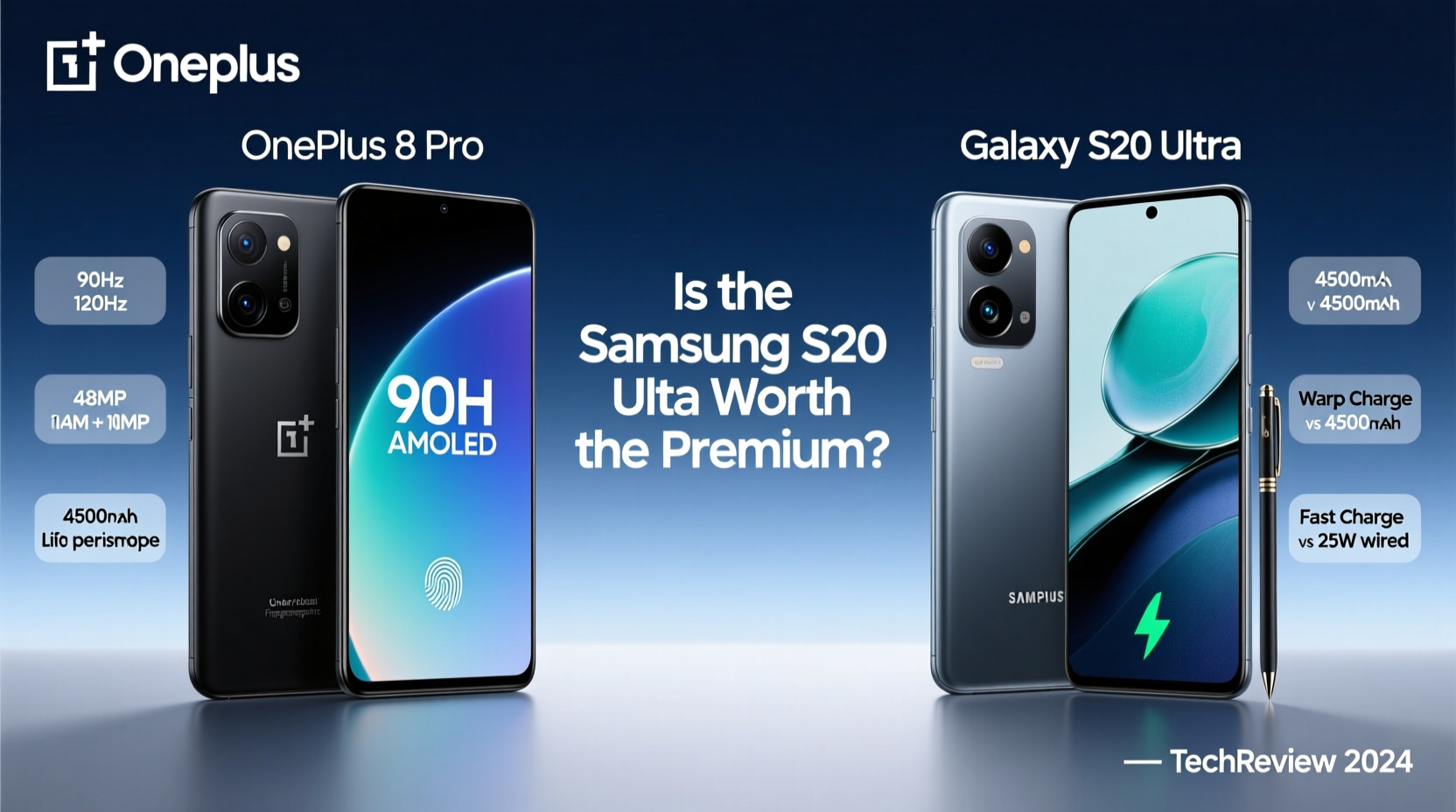
Both phones feature premium builds with glass backs and aluminum frames, but their design languages diverge. The OnePlus 8 Pro has a sleek, minimalist aesthetic with smooth curves and subtle branding. It feels refined without being flashy. In contrast, the S20 Ultra makes a statement—its large camera island dominates the back, and the device is noticeably heavier and taller.
The S20 Ultra’s 6.9-inch display dwarfs the 8 Pro’s 6.75-inch screen, which can be a pro or con depending on hand size and pocket space. While Samsung uses Gorilla Glass Victus (on later models) and offers IP68 water resistance, so does the OnePlus 8 Pro—meaning both survive splashes and drops equally well under normal conditions.
Display and Visual Experience
On paper, both devices boast excellent displays, but the S20 Ultra edges ahead with its 3200 x 1440 resolution and adaptive 120Hz refresh rate that scales between 120Hz and 10Hz based on content. The OnePlus 8 Pro also features a 120Hz QHD+ AMOLED panel, but its resolution is slightly lower at 3168 x 1440.
In daily use, the difference is negligible. Colors are vibrant, blacks are deep, and brightness peaks around 1300 nits on both—ideal for outdoor visibility. However, the S20 Ultra’s higher resolution does deliver crisper text and finer detail when viewing high-resolution media or doing creative work.
That said, OnePlus includes a unique feature: Color Vision calibration powered by DisplayMate. This allows users to fine-tune color accuracy based on visual perception tests—a rare inclusion even among flagships.
Performance and Software Experience
Under the hood, both phones run on Qualcomm’s Snapdragon 865 chipset with 12GB of RAM (S20 Ultra offers up to 16GB), making them effectively equal in raw processing power. Benchmarks show near-identical results in gaming, multitasking, and app launches.
Where they differ significantly is software. OxygenOS on the OnePlus 8 Pro remains one of the cleanest, fastest Android experiences available—close to stock Android with thoughtful additions like Zen Mode and Shelf. Updates arrive quickly, and bloatware is minimal.
Samsung’s One UI 2.5 (upgradable), while powerful, adds layers of customization and pre-installed apps. Some users appreciate the depth—themes, DeX support, enhanced privacy controls—but others find it overwhelming. Samsung also commits to three generations of OS updates, matching Google and exceeding OnePlus at the time.
“Software longevity often outweighs initial smoothness. Samsung’s update policy gives the S20 Ultra longer relevance.” — David Kim, Mobile Analyst at TechPulse Insights
Camera Comparison: Innovation vs Consistency
This is where the price gap starts to make sense—if photography is your priority.
The S20 Ultra introduced a groundbreaking 108MP main sensor (Samsung’s HMX) with nona-binning technology for superior low-light performance. Combined with a 48MP periscope telephoto lens offering up to 100x Space Zoom, it delivers unmatched reach. While 100x is more novelty than practical, the 10x hybrid zoom produces usable results—a rarity in 2020.
The OnePlus 8 Pro, meanwhile, uses a 48MP main sensor (Sony IMX689) with larger pixels (1.12µm) and strong dynamic range. Its ultra-wide and color filter cameras perform well, but lack the telephoto flexibility of the S20 Ultra. No optical zoom means digital cropping degrades quality faster.
In daylight, both capture richly detailed photos with accurate colors. In low light, the S20 Ultra pulls ahead thanks to pixel binning and AI processing. Video capabilities are strong on both, supporting 4K at 60fps and stabilization, though Samsung offers more manual control options.
| Feature | OnePlus 8 Pro | Samsung S20 Ultra |
|---|---|---|
| Main Camera | 48MP (f/1.79) | 108MP (f/1.8) |
| Ultra-Wide | 48MP (f/2.2) | 12MP (f/2.2) |
| Telephoto | None | 48MP periscope (f/3.5, 4x optical) |
| Zoom Capability | Digital only (~2x max useful) | 10x hybrid, 100x digital |
| Front Camera | 16MP (f/2.1) | 40MP (f/2.0) |
Battery Life and Charging Speeds
The OnePlus 8 Pro packs a 4510mAh battery with Warp Charge 30T+, capable of going from 0% to 100% in about 55 minutes. It also supports 30W wireless charging and reverse wireless charging—an advantage over Samsung.
The S20 Ultra has a larger 5000mAh cell, translating to slightly longer endurance during heavy usage. It supports 45W wired charging (charger sold separately), 15W wireless, and reverse wireless. Despite the bigger battery, efficiency losses from the higher-resolution display and aggressive background services sometimes negate the gain.
In real-world testing, both last a full day with moderate to heavy use. But OnePlus wins on convenience: faster charging out-of-the-box and no need to buy an expensive charger separately.
Value Proposition: Is the Premium Justified?
The OnePlus 8 Pro launched at $899. The S20 Ultra started at $1,399—a $500 difference in some configurations. For that premium, you get:
- A higher-resolution display
- Superior zoom and main camera hardware
- Longer software support commitment
- DeX functionality for desktop-like productivity
- More storage/RAM options
But you also sacrifice:
- Out-of-the-box charging speed (no 45W charger included)
- Ease of handling due to size and weight
- Stock-like software fluidity
If you're a mobile photographer, a power user who leverages DeX, or someone planning to keep the phone for four years, the S20 Ultra’s strengths justify the cost. But for most users seeking a fast, reliable, beautifully designed flagship without unnecessary frills, the OnePlus 8 Pro delivers 90% of the experience at 70% of the price.
Mini Case Study: Travel Photographer’s Dilemma
Lena, a freelance travel photographer, needed a smartphone that could double as a backup camera and editing station. She chose the S20 Ultra primarily for its 100x zoom and 8K video recording. On a trip through Morocco, she captured distant architecture details using 10x zoom that would have required a DSLR lens otherwise. Back at her riad, she connected the phone to a monitor via DeX to edit RAW files directly. While the phone was bulky in her bag, the workflow integration made the trade-off worthwhile. For her use case, the extra $500 paid for tangible creative freedom.
Frequently Asked Questions
Is the OnePlus 8 Pro still worth buying in 2024?
Yes, especially at discounted prices. It receives security updates and runs modern apps smoothly. For casual users, it remains a capable daily driver with excellent battery and charging.
Does the S20 Ultra’s 100x zoom produce usable photos?
Rarely. At maximum zoom, images are soft and grainy. However, the 10x hybrid zoom (4x optical + AI enhancement) delivers surprisingly clear results in good lighting—making it useful for concerts, wildlife, or sports.
Which phone has better long-term software support?
The S20 Ultra has a clear edge, receiving updates up to Android 13 and ongoing security patches. The OnePlus 8 Pro was limited to Android 12 officially, reducing its lifespan for users who prioritize current software.
Final Verdict: Who Should Pay More?
The answer depends on what you value. The Samsung Galaxy S20 Ultra isn't just a phone—it's a technological showcase. Its camera system, display fidelity, and ecosystem integration cater to professionals and enthusiasts willing to pay for cutting-edge tools.
The OnePlus 8 Pro, however, represents intelligent engineering focused on user experience: blazing speed, intuitive software, and fast charging—all wrapped in understated elegance. It proves you don’t need every bell and whistle to feel like you own a premium device.
If budget matters and you prefer simplicity over spectacle, the OnePlus 8 Pro is the smarter buy. But if you demand the absolute best camera reach, longest update cycle, and aren’t afraid of complexity, then yes—paying extra for the Samsung is worth it.




 浙公网安备
33010002000092号
浙公网安备
33010002000092号 浙B2-20120091-4
Comments
No comments yet. Why don't you start the discussion?