
Choosing between smartphones in the mid-range segment can be tricky—especially when comparing devices from different generations and brands. The OnePlus Nord N20 5G and Samsung Galaxy A71 represent two distinct approaches to affordable Android excellence. While the Galaxy A71 was once a flagship killer in its category, the newer Nord N20 5G brings updated specs and modern features. But does that automatically make it the better choice? Let’s break down every critical aspect to determine whether upgrading from the A71 to the Nord N20 5G is truly worthwhile.
Design and Build Quality
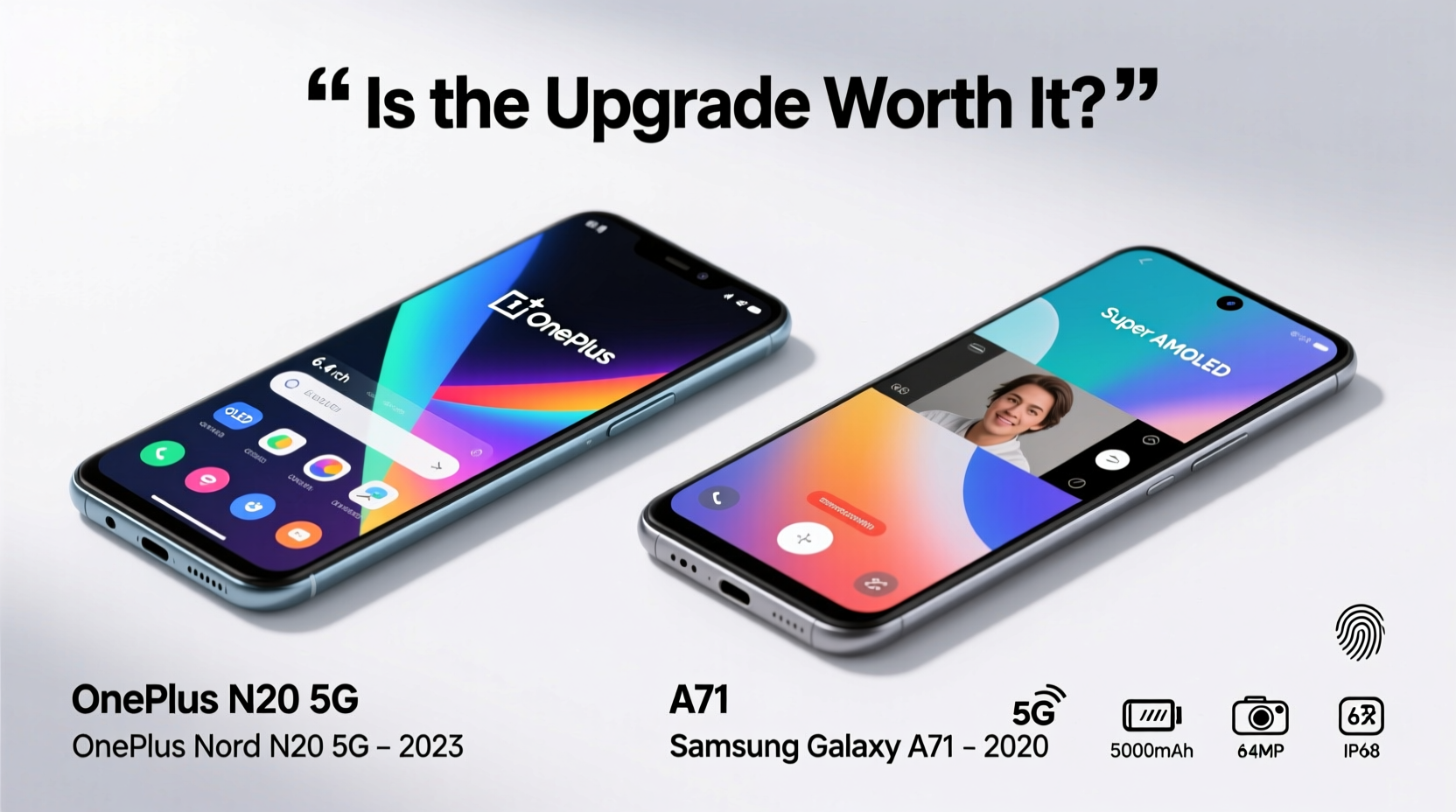
The Galaxy A71 launched in early 2020 with a sleek glass-like back and slim bezels, setting a high bar for design in its price range. It features a plastic frame and glass front with a glossy finish that attracts fingerprints but feels premium in hand. Measuring 162.5 x 75.4 x 7.7 mm and weighing 179g, it remains comfortable for one-handed use despite its 6.7-inch display.
In contrast, the OnePlus Nord N20 5G, released in 2022, opts for a more utilitarian design. It uses a matte polycarbonate back that resists smudges and offers improved grip. At 159.2 x 73.3 x 7.6 mm and 173g, it's slightly more compact and lighter than the A71. OnePlus also included an IP53 rating for dust and splash resistance—a small but meaningful upgrade over the non-rated A71.
Display Comparison: AMOLED vs AMOLED — But Not Equal
Both phones feature Super AMOLED displays, which is excellent news for color accuracy and contrast. However, differences in resolution, refresh rate, and brightness create a noticeable gap in real-world usage.
The Galaxy A71 sports a 6.7-inch FHD+ (1080 x 2400) display with a standard 60Hz refresh rate. While vibrant and sharp, the lower refresh rate makes scrolling feel less fluid compared to modern standards. Peak brightness reaches around 500 nits, adequate for indoor use but struggles under direct sunlight.
The Nord N20 5G improves on this with a 6.43-inch FHD+ AMOLED panel that supports a 90Hz refresh rate. This translates to smoother animations, faster response times, and a more responsive touch experience—especially beneficial for gaming or browsing. Brightness peaks near 600 nits, offering better outdoor visibility.
“Even within the same display technology, refresh rate and brightness significantly impact perceived smoothness and usability.” — David Lin, Mobile UX Analyst at TechPulse Insights
Performance and Software Experience
Under the hood, these phones diverge sharply. The Galaxy A71 runs on the Qualcomm Snapdragon 730G, paired with either 6GB or 8GB of RAM. For its time, this chipset delivered solid mid-tier performance, handling multitasking and moderate gaming well. However, by 2024 standards, it shows signs of aging—app launches are slower, and background app retention suffers.
The Nord N20 5G upgrades to the Snapdragon 695 5G, a newer chip built on a 6nm process. Though not dramatically more powerful in raw CPU benchmarks, it offers better power efficiency, native 5G support, and improved GPU performance via the Adreno 619. Coupled with 6GB of RAM and OxygenOS (based on Android 12), the N20 delivers snappier navigation and longer-term software viability.
OxygenOS is known for its clean interface and minimal bloatware, whereas the A71 runs Samsung’s One UI, which offers deeper customization but includes several pre-installed apps. Over time, users report that OxygenOS maintains speed better, while One UI may slow down due to heavier skin overhead.
Camera Showdown: Which Takes Better Photos?
The Galaxy A71 boasts a quad-camera setup: 64MP main, 12MP ultra-wide, 5MP macro, and 5MP depth sensor. In daylight, the main sensor captures rich detail and accurate colors. Low-light performance is decent thanks to Night Mode, though noise creeps in quickly in darker scenes. The ultra-wide lens performs adequately but lacks clarity at the edges.
The Nord N20 5G simplifies to a triple rear system: 64MP main, 8MP ultra-wide, and 2MP macro. There’s no dedicated depth sensor, but computational photography handles portrait mode reasonably well. The main camera benefits from larger pixel binning (1.4µm effective) and improved processing, resulting in cleaner HDR and better dynamic range. Video recording maxes out at 1080p@30fps on both devices, with stabilization being average on the A71 and slightly better on the N20.
For selfies, the A71’s 32MP front camera still holds up, delivering crisp, natural-looking portraits. The Nord N20 5G counters with a 16MP punch-hole camera—lower resolution but optimized for quick facial recognition and smoother video calls.
Real-World Example: Travel Photography Test
Sophia, a digital nomad using her Galaxy A71 since 2020, recently borrowed a Nord N20 5G during a trip to Morocco. She noticed immediate improvements: faster autofocus in markets, reduced shutter lag when capturing street moments, and more consistent exposure in mixed lighting. “The 90Hz screen made reviewing photos feel more fluid,” she said. “And I didn’t miss the extra lenses—the main camera did most of the heavy lifting.”
Battery Life and Charging Speeds
The Galaxy A71 packs a 4500mAh battery with 25W fast charging support—though Samsung ships only a 15W charger in the box. In typical use, it lasts about a day and a half with moderate screen-on time. Full recharge takes roughly 70 minutes.
The Nord N20 5G has a smaller 4500mAh battery but compensates with 33W SUPER VOOC charging. With the included charger, it goes from 0% to 100% in just 67 minutes. OnePlus also includes AI-based battery optimization, extending standby life. However, the higher refresh rate display can drain power faster during extended streaming or gaming sessions.
| Feature | Galaxy A71 | Nord N20 5G |
|---|---|---|
| Display Size & Type | 6.7” Super AMOLED | 6.43” Super AMOLED |
| Refresh Rate | 60Hz | 90Hz |
| Processor | Snapdragon 730G | Snapdragon 695 5G |
| Rear Cameras | 64MP + 12MP + 5MP + 5MP | 64MP + 8MP + 2MP |
| Front Camera | 32MP | 16MP |
| Battery Capacity | 4500mAh | 4500mAh |
| Charging Speed | 25W (15W in box) | 33W (included) |
| Water Resistance | None | IP53 |
| Software Update Support | Likely ended | Android 13 expected |
Is the Upgrade Worth It? A Practical Checklist
If you're currently using a Galaxy A71 and considering a switch, ask yourself the following:
- Do you want faster charging and a more efficient processor?
- Have you noticed slowdowns or app crashes on your current device?
- Do you value a smoother, 90Hz display for scrolling and media?
- Are you still receiving security updates on your A71? (Likely no after 2023)
- Do you need 5G connectivity for future-proofing?
Frequently Asked Questions
Can the Nord N20 5G last as long as the Galaxy A71?
Yes, and potentially longer. With a newer chipset, ongoing software support, and faster charging, the Nord N20 5G is built to remain functional and secure into 2025 and beyond, unlike the aging A71.
Does the Galaxy A71 have better cameras overall?
Not necessarily. While the A71 has more lenses, the Nord N20 5G’s image processing, low-light tuning, and consistency make it more reliable in real-world conditions. The lack of a 12MP ultra-wide is a trade-off, but most users find the 8MP version sufficient.
Is 5G necessary in the Nord N20 5G?
It depends on your carrier and location. If you’re on a 5G network and notice latency or speed issues on LTE, then yes. Otherwise, 5G is a bonus rather than a necessity for most everyday tasks.
Final Verdict: Should You Upgrade?
The OnePlus Nord N20 5G isn't a revolutionary leap over the Galaxy A71, but it represents meaningful generational progress. It improves where it counts: software longevity, charging speed, display smoothness, and build resilience. For users experiencing slowdowns or seeking a more responsive daily driver, the upgrade is justified.
However, if your Galaxy A71 still performs reliably and you don’t need 5G or faster charging, the change may not feel transformative. In such cases, investing in a protective case or battery-saving habits might extend your current phone’s life more cost-effectively.




 浙公网安备
33010002000092号
浙公网安备
33010002000092号 浙B2-20120091-4
Comments
No comments yet. Why don't you start the discussion?